
Free 45V calculator using 2026 IRS rates. Estimate your clean hydrogen credit by emissions tier, annual and 10-year value, and what it's worth in cash if sold.
Author -
Paulestini Francois
Published -
READ TIME
How much is a clean hydrogen project's 45V credit actually worth? The answer swings by a factor of five on labor compliance and roughly three on a single emissions threshold, so a back-of-envelope number can be badly wrong. This calculator uses the IRS's 2026 inflation-adjusted amounts to estimate the per-kilogram rate, the annual and 10-year credit, and what the credits would bring in cash if sold, followed by worked examples and the inputs that matter most.
How is the 45V tax credit calculated?
The 45V credit equals the kilograms of qualified clean hydrogen produced in a year, multiplied by the per-kilogram rate for the facility’s emissions tier, claimed each year for up to 10 years after the facility is placed in service. The rate depends on two things: the hydrogen’s lifecycle emissions, which set the tier, and whether the project meets prevailing wage and apprenticeship requirements, which multiply the base rate by five. The IRS adjusts the dollar amounts for inflation every year, so the same facility earns slightly more per kilogram over time.
Use the calculator below to estimate a project’s credit. It uses the 2026 amounts the IRS published in Notice 2026-41 and holds them flat, which keeps longer-range estimates conservative.
What is your clean hydrogen worth under 45V?
Illustrative only. Uses 2026 amounts from IRS Notice 2026-41 held flat; the IRS adjusts them for inflation each year. Emissions must be determined with the 45VH2-GREET model (or a provisional emissions rate) and verified annually. Facilities must begin construction before January 1, 2028.
Price your 45V credits →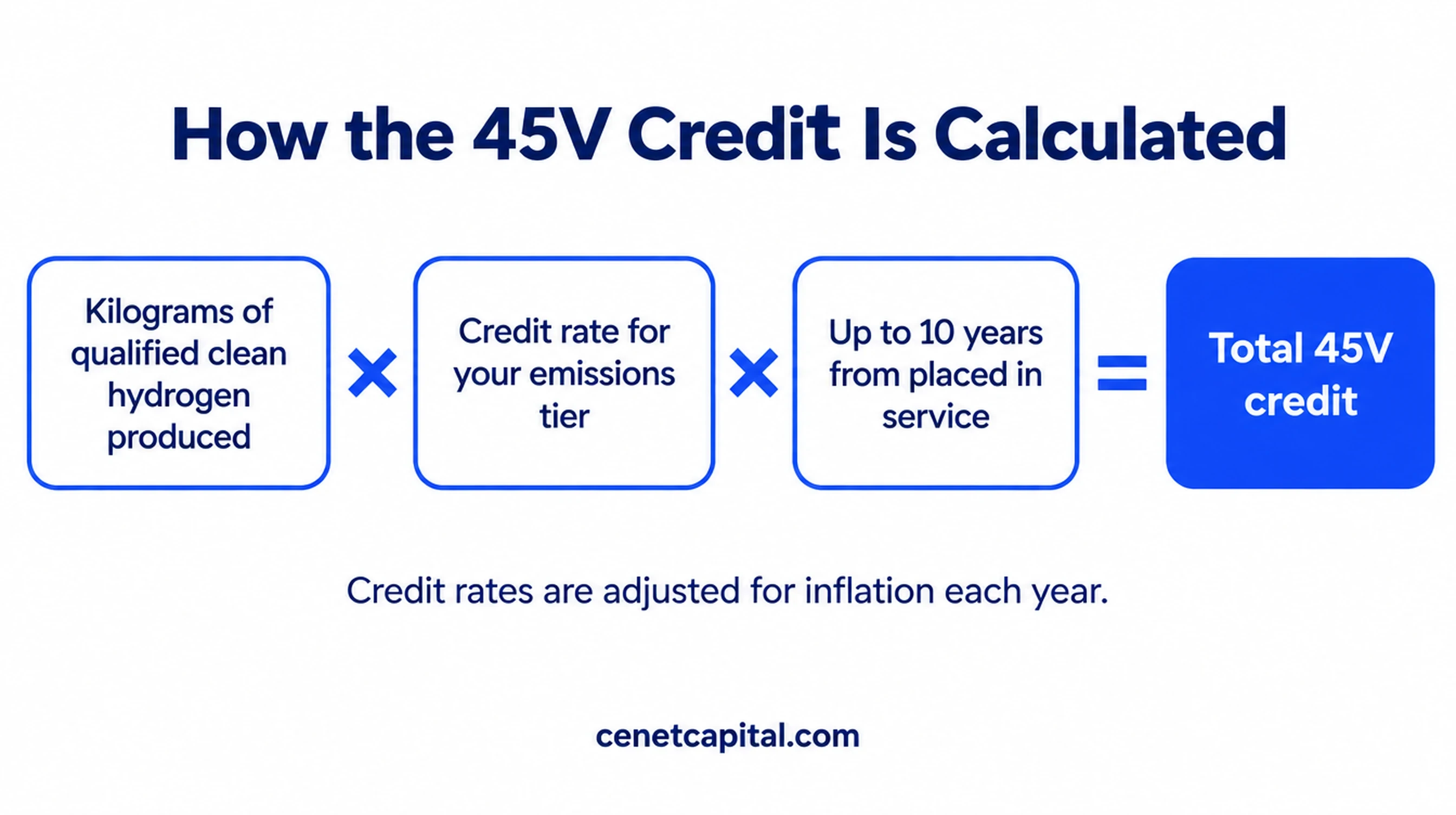
What are the 2026 45V credit amounts by tier?
In 2026, the credit is $3.28, $1.095, $0.82 or $0.655 per kilogram depending on the emissions tier, for projects meeting prevailing wage and apprenticeship rules. Projects that don’t meet them earn one-fifth of those amounts. The tier boundaries come straight from the statute. The 2026 dollar values come from Notice 2026-41, which applied an inflation adjustment factor of 1.0929 to the original 2022 amounts.
Emissions tier (kg CO2e per kg H2) | 2026 rate with PWA | 2026 rate without PWA | Credit per metric ton of H2 (with PWA) |
|---|---|---|---|
Less than 0.45 | $3.28 | $0.656 | $3,280 |
0.45 to less than 1.5 | $1.095 | $0.219 | $1,095 |
1.5 to less than 2.5 | $0.82 | $0.164 | $820 |
2.5 to 4.0 | $0.655 | $0.131 | $655 |
Above 4.0 | $0 | $0 | $0 |
The tier is set by the hydrogen’s well-to-gate emissions, calculated with the Department of Energy’s 45VH2-GREET model, or a provisional emissions rate where the model doesn’t cover the process. The full set of eligibility rules, including the three pillars for grid-powered electrolyzers, is in our guide to 45V tax credit rules.
How much does prevailing wage and apprenticeship change the credit?
By a factor of five. A project producing 1,000 metric tons of top-tier hydrogen earns about $3.28 million a year with prevailing wage and apprenticeship compliance, and about $656,000 without it. No other input to the calculation moves the number that much. That’s why buyers ask for payroll records before they ask almost anything else.
The requirements cover laborers and mechanics working on construction, alteration or repair of the facility. They have to be paid at least locally prevailing wages, and a minimum share of labor hours has to be performed by qualified apprentices. A project that misses the requirements can sometimes cure the failure with back pay and penalties. Doing it right from the start is far cheaper.
What is a 45V credit worth over 10 years?
A facility producing 10,000 metric tons a year in the second tier (0.45 to 1.5 kg) earns about $10.95 million a year at 2026 rates, or roughly $109.5 million over the 10-year credit period, before inflation adjustments. The examples below use 2026 rates held flat and assume prevailing wage and apprenticeship compliance unless noted.
Example project | Annual production | Tier | Annual credit | 10-year credit |
|---|---|---|---|---|
Small electrolyzer on new solar + wind | 1,000 t | < 0.45 | $3.28M | $32.8M |
Same project, no PWA | 1,000 t | < 0.45 | $656K | $6.56M |
Mid-size grid-connected electrolyzer | 10,000 t | 0.45–1.5 | $10.95M | $109.5M |
Large reformer with high carbon capture (claiming 45V, not 45Q) | 50,000 t | 0.45–1.5 | $54.75M | $547.5M |
For scale, 1,000 metric tons a year is about 2.7 tons a day, a small industrial electrolyzer. The real 10-year figure will be somewhat higher than these flat estimates, because each year’s amount is adjusted for inflation, and somewhat lower if the facility runs below its nameplate output or slips a tier in a bad year.
How do you calculate 45V by hand, step by step?
Convert daily output to annual kilograms, multiply by the tier rate, then multiply by the years of credit remaining. Here’s the full calculation for a facility rated at 20 metric tons per day that runs 90% of the time, with emissions of 1.2 kg CO2e per kilogram and prevailing wage and apprenticeship met:
Annual output: 20 t/day × 365 days × 90% = 6,570 metric tons = 6,570,000 kg.
Tier: 1.2 kg CO2e/kg falls in the 0.45-to-1.5 tier, so the 2026 rate is $1.095/kg.
Annual credit: 6,570,000 × $1.095 = about $7.19 million.
10-year credit (flat 2026 rates): about $71.9 million.
Cash at 90 cents: about $6.47 million a year, or $64.7 million over 10 years.
If the same facility could get its emissions below 0.45 kg, the rate would jump to $3.28/kg and the annual credit to about $21.5 million, roughly three times as much from the same hydrogen. That gap is why so much 45V engineering effort goes into electricity sourcing.
How do inflation adjustments change the 10-year total?
They push it up a little every year, because the IRS re-indexes the per-kilogram amounts annually and each year’s hydrogen is credited at that year’s rate. The top rate rose from about $3.19 per kilogram for 2025 production to $3.28 for 2026. If inflation runs around 2.5% a year, a facility’s credit in year 10 would be about a quarter higher per kilogram than in year one.
That’s why the calculator holds 2026 rates flat: it gives a floor, not a forecast. When a buyer prices a multi-year forward purchase of 45V credits, it will usually do the same, because it can’t know future inflation adjustments and doesn’t want to pay for upside that may not arrive.
Does the 45V calculator work for blue hydrogen?
Yes, as long as the facility claims 45V instead of 45Q. The law doesn’t allow both on the same facility, so blue-hydrogen developers have to compare the two before choosing. A reformer with carbon capture can reach a 45V tier if it captures enough carbon and controls upstream methane emissions, which count in the well-to-gate calculation. Plug its expected emissions rate into the calculator to get the 45V side of the comparison. Then compare that with what 45Q would pay per ton of carbon oxide captured and stored or used. Whichever you pick effectively applies for the life of the facility, so it’s worth modeling both under conservative and optimistic emissions assumptions.
What is a 45V credit worth in cash if you sell it?
Transferable credits typically sell for 80 to 95 cents per dollar of credit. At 90 cents, the 10,000-ton example above would turn about $10.95 million of annual credit into roughly $9.86 million of cash each year. That 80-to-95-cent range is what Cenet Capital sees across its deals. Production credits like 45V have historically priced toward the top of it, because buyers don’t take on the recapture and cost-basis risk that comes with investment credits. Crux reported PTCs averaging 95 cents in 2024, against 92.5 cents for ITCs.
Where a specific 45V credit lands depends on the project’s verification history, the producer’s financial strength, whether the credit is insured, and how much emissions risk sits in the tier calculation. A project that sits close to a tier boundary carries more risk for a buyer than one with comfortable headroom. For the first five years, a producer can also take 45V as a direct payment from the IRS instead of selling it. We compare both routes in how to monetize a 45V credit, and break down pricing in transferable tax credit pricing.
Which inputs move the 45V number the most?
In order of impact: prevailing wage and apprenticeship compliance (5×), the emissions tier (up to 3× between the top two tiers alone), and production volume. Sale price and inflation adjustments are second-order. That ordering tells developers where to spend diligence money.
Labor compliance. Missing it costs 80% of the credit. Set up payroll tracking before construction starts.
The 0.45 kg boundary. Moving from just above to just below it roughly triples the credit. For grid-powered projects, the electricity sourcing strategy, and especially how it holds up under hourly matching from 2030, usually decides which side of the line a project lands on.
Capacity factor. The credit pays on hydrogen actually produced and verified, not on nameplate capacity. An electrolyzer that only runs when clean power is available produces fewer kilograms.
Construction timing. None of this matters unless construction begins before January 1, 2028. See what the One Big Beautiful Bill did to 45V for what counts as beginning construction.
How accurate is a 45V calculator?
A calculator gives you a sound order-of-magnitude figure. It can’t replace a facility-specific 45VH2-GREET run and a tax advisor’s review. The final number depends on details a simple model can’t capture: hourly production data, the exact energy attribute certificates retired, upstream methane leakage assumptions for gas-based processes, and how the IRS treats any provisional emissions rate. Use the calculator to size the opportunity and compare scenarios. Then get the emissions analysis done properly before you commit capital or sign a transfer agreement.
When you have a credible tier estimate, Cenet Capital can price your 45V credits. We buy and insure them, and we can tell you where in the 80-to-95-cent range your project is likely to land.
Turn your calculator estimate into a real price.
Cenet Capital buys and insures 45V credits. Share your production volume and emissions tier, and we'll tell you what your credits would sell for.

More Insights