
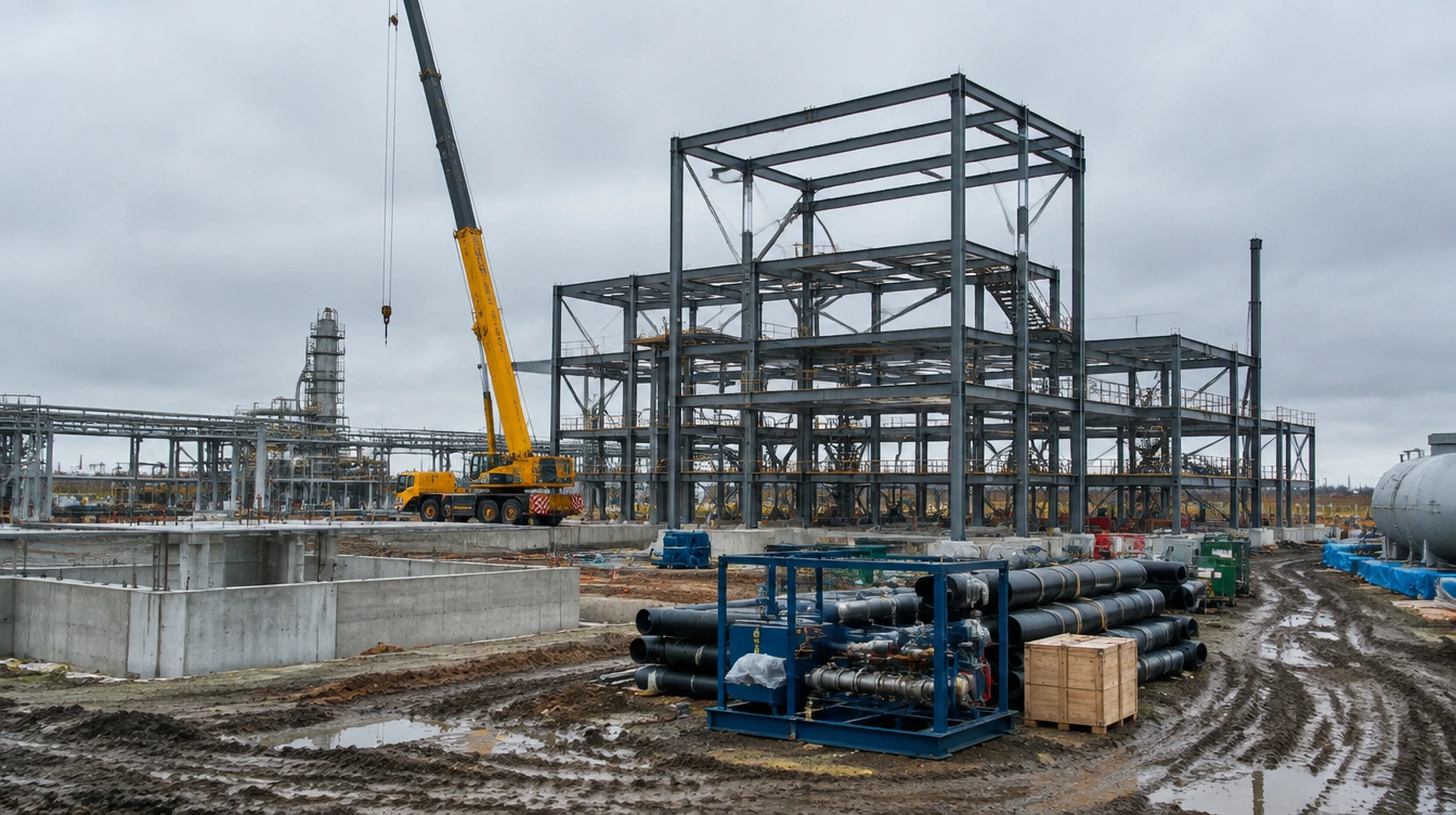
The One Big Beautiful Bill moved the 45V construction deadline to January 1, 2028. What changed, what 'begin construction' requires, and what it means for credit sellers.
Author -
Paulestini Francois
Published -
READ TIME
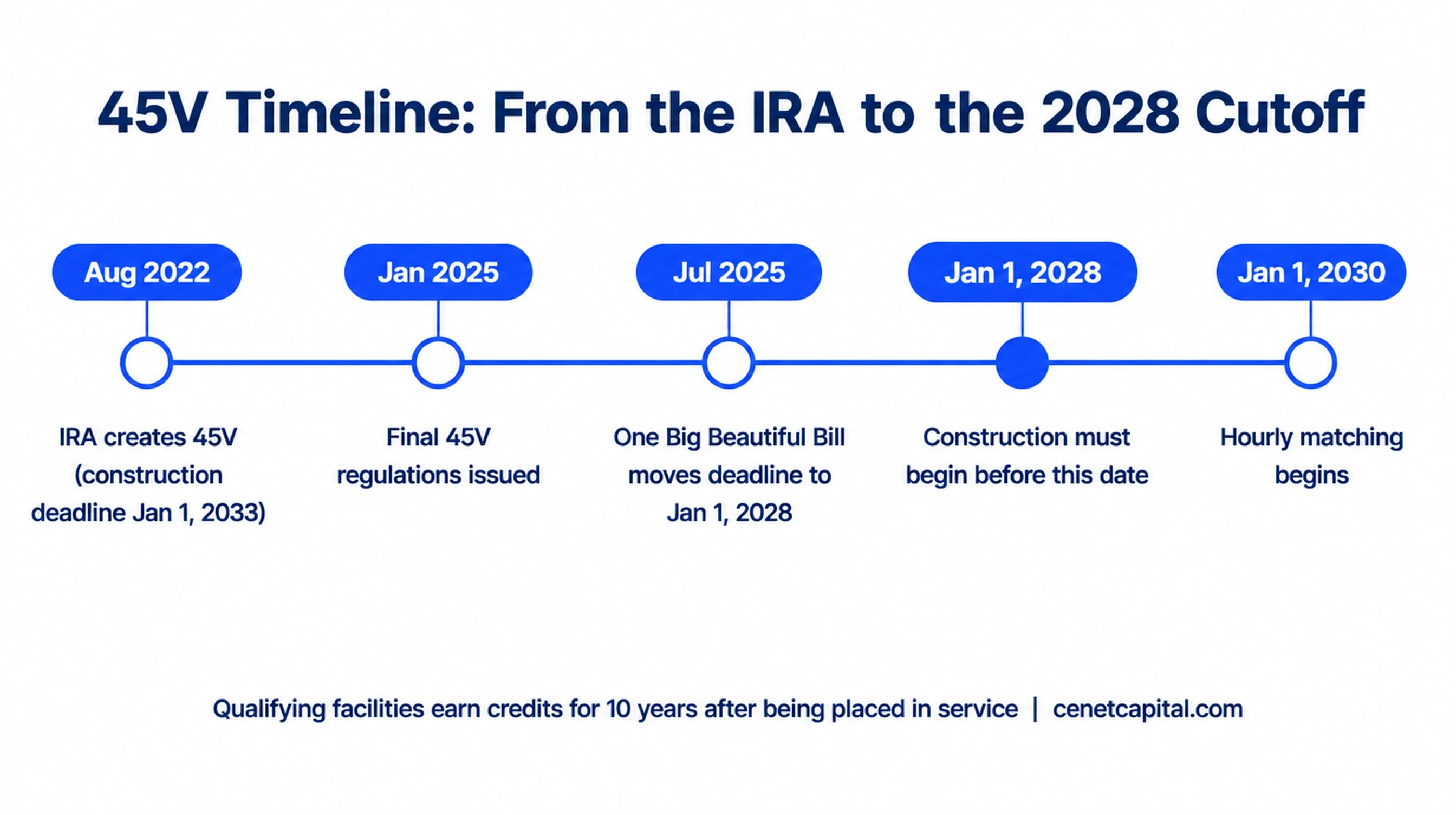
The One Big Beautiful Bill Act didn't kill the 45V clean hydrogen credit, but it did put a clock on it. Hydrogen facilities now have to begin construction before January 1, 2028 to qualify, five years earlier than the Inflation Reduction Act originally allowed. Here's exactly what changed, what "beginning construction" requires, and what the deadline means for developers trying to qualify and for the buyers pricing their credits.
What did the One Big Beautiful Bill Act change for 45V?
It moved the deadline to begin construction on a qualifying hydrogen facility from January 1, 2033 to January 1, 2028. It left the credit’s rates, tiers, 10-year credit period, transferability and direct-pay option in place. The law was signed in July 2025. As Kirkland & Ellis and Gibson Dunn summarized, 45V survived in shortened form rather than being repealed. Earlier House drafts would have cut off projects beginning construction after 2025, so the final 2028 date was a partial reprieve for the industry.
The practical effect is a hard window. A hydrogen project that can’t credibly begin construction in the next 15 months, before January 1, 2028, should be modeled without 45V. A project that does begin construction in time keeps the full benefit: 10 years of credits from whenever it’s placed in service, even if that’s well into the 2030s.
45V feature | Before OBBBA | After OBBBA |
|---|---|---|
Begin-construction deadline | Before January 1, 2033 | Before January 1, 2028 |
Credit period | 10 years from placed in service | Unchanged |
Rates and emissions tiers | Up to $3/kg (inflation-adjusted) | Unchanged ($3.28/kg max in 2026) |
Transferability (§6418) | Allowed | Still allowed |
Direct pay, first 5 years | Allowed | Still allowed |
Final regulations (three pillars, verification) | Issued January 2025 | Still in effect |
Is there a deadline to place a 45V facility in service?
No. The 2028 cutoff applies to when construction begins, not when hydrogen production starts. This is the most commonly misread part of the change, and you’ll find plenty of summaries online saying hydrogen produced after 2028 no longer qualifies. That isn’t what the law says. A facility that begins construction before January 1, 2028 and is placed in service in 2030 can claim 45V on its production through 2040, at that year’s inflation-adjusted rates.
The catch is the continuity requirement, covered below. A project can’t start construction in 2027, stop for years, and then expect to rely on that start date. It has to keep making real progress toward completion.
What does “begin construction” mean for a hydrogen facility?
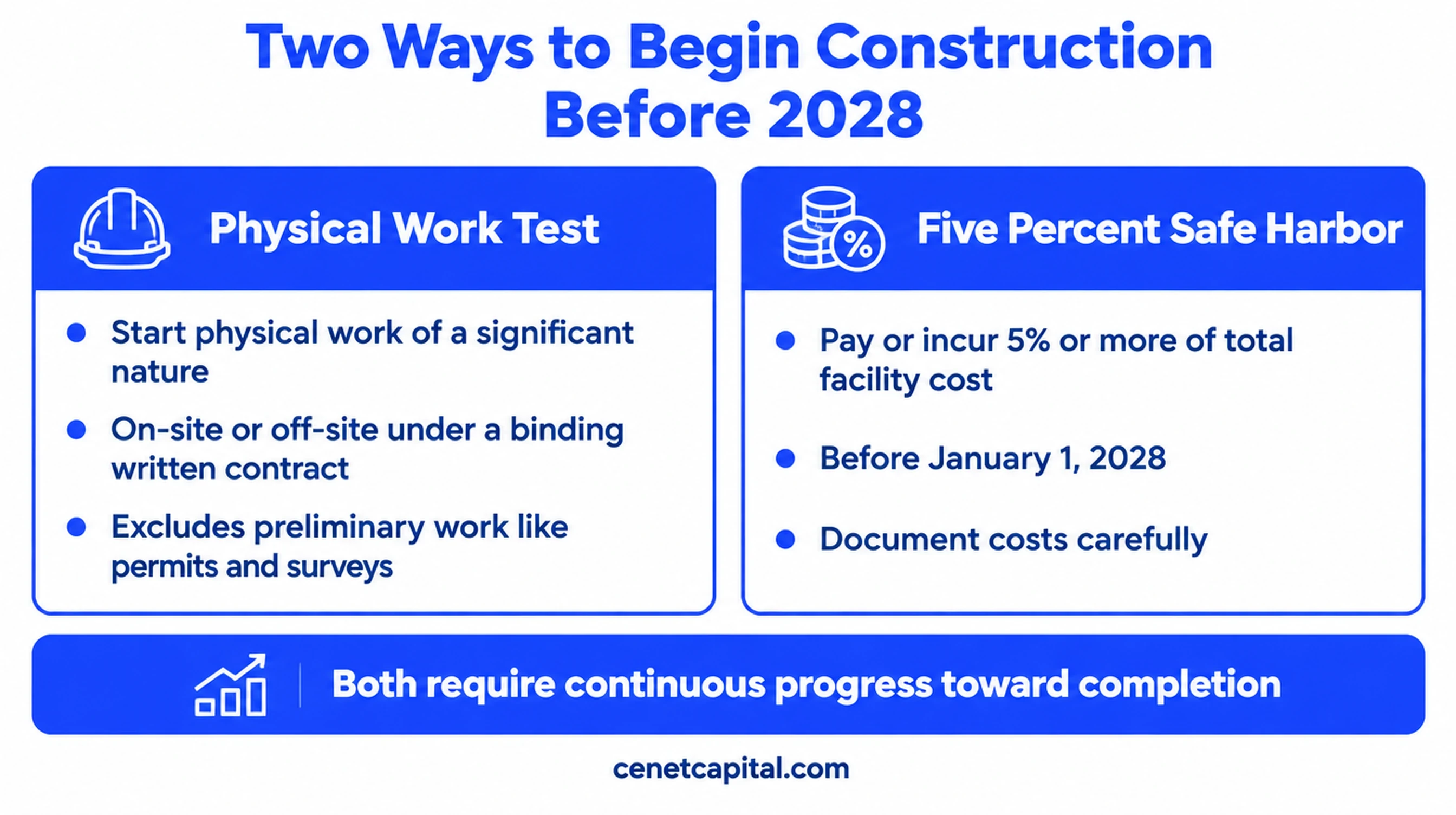
Under the final 45V regulations, a facility begins construction under the same two tests the IRS uses for other energy credits: the Physical Work Test or the Five Percent Safe Harbor. Either way, the taxpayer must then keep making continuous progress toward completion. The final rules point taxpayers to the IRS’s beginning-of-construction guidance, which applies the principles first set out in Notice 2013-29, as Reunion’s guide to beginning-of-construction rules lays out in detail.
Physical Work Test. Construction begins when physical work of a significant nature starts. That can be on-site work, such as foundations for the electrolyzer building or process equipment, or off-site work done for the project under a binding written contract, such as custom fabrication of components. Preliminary activities like permitting, site surveys, clearing and financing don’t count.
Five Percent Safe Harbor. Construction begins when the taxpayer pays or incurs at least 5% of the facility’s total eligible cost. The risk is that if final costs come in higher than budgeted, the early spend may fall below 5% of the real total, and the safe harbor fails.
Continuity. Under either test, the project must then show a continuous program of construction or continuous efforts toward completion. Delays from things outside the developer’s control, like permitting, severe weather or supply-chain disruptions, are generally tolerated. A project simply parked for lack of money or offtake is not.
One distinction worth knowing: after the One Big Beautiful Bill Act, the IRS tightened beginning-of-construction rules specifically for wind and solar projects. Those changes don’t, by their terms, apply to hydrogen facilities, which remain under the general framework above. Confirm the current position with tax counsel before you rely on a particular start date.
Physical work or 5% safe harbor: which should a hydrogen developer use?
Most hydrogen developers will find the Physical Work Test more forgiving, because hydrogen project costs are hard to pin down early and the 5% safe harbor fails if the budget grows. Electrolyzer pricing, balance-of-plant scope and interconnection costs have all moved substantially in recent years. A developer that spends exactly 5% of a $400 million budget in 2027, then finishes at $480 million, has spent about 4.2%, and loses the safe harbor.
The Physical Work Test avoids that arithmetic. A binding contract for custom-fabricated equipment, with fabrication actually under way before January 1, 2028, or real foundation work on-site, can establish the start date without tying it to a cost ratio. Many developers document both, so the second test backs up the first if either is challenged.
Begin-construction checklist | Why it matters |
|---|---|
Binding written contracts for long-lead or custom equipment, signed and with work started before 1/1/2028 | Off-site physical work counts only under a binding contract |
Dated photos, inspection reports and invoices for on-site work | Proves the work was “of a significant nature” and when it happened |
A cost budget with contingency if relying on the 5% safe harbor | Protects against cost growth pushing early spend below 5% |
A written construction schedule and monthly progress log | Supports the continuity requirement |
Records of any delays and their causes | Excusable delays need to be shown, not assumed |
Prevailing wage and apprenticeship tracking from the first day of construction | The 5× rate depends on it |
What happens to projects that miss January 1, 2028?
They can’t claim 45V at all, so the project economics have to stand without a credit worth up to $3.28 per kilogram in 2026. For green hydrogen that typically costs several dollars per kilogram to produce, losing the credit usually decides whether the project gets built. Some developers will look at alternatives. A blue hydrogen project might rely on the 45Q carbon capture credit instead, since 45Q and 45V can’t be claimed on the same facility anyway. Others will pause until the policy picture changes.
For credit buyers, the deadline creates a defined pipeline. Every 45V credit generated through roughly the end of the 2030s will come from facilities that began construction before 2028. Once that pipeline is visible, buyers can underwrite it with more confidence than they could when the window ran to 2033.
Did the law change transferability or direct pay for 45V?
No. 45V credits can still be sold for cash under Section 6418, and producers can still elect direct payment from the IRS for the first five years of production. The One Big Beautiful Bill Act did add restrictions on transfers to “specified foreign entities” for several other credits, and new foreign-entity rules for credits like 48E and 45Y. Developers should still screen ownership and supply chains with counsel, but the core monetization routes for 45V are intact.
That matters because most hydrogen producers don’t have enough federal tax liability to use a credit of this size themselves. Direct pay covers the first five years; after that, a transfer is usually the most efficient way to turn credits into cash. We walk through the mechanics in how to monetize a 45V credit.
How does the 2028 deadline affect what 45V credits sell for?
It mostly helps sellers with documented construction starts and hurts those without them. Buyers pay more for certainty, and the start date is now one of the first things they check. Before the change, a buyer looking at a 45V project mainly worried about the emissions tier and verification. Now it also wants proof the facility began construction before January 1, 2028 and kept going. A credit backed by a binding equipment contract, dated site photos and a continuous progress log is easier to underwrite, and easier to insure, than one resting on a single invoice.
Because 45V is a production credit with no investment-style recapture, well-documented 45V credits can still price toward the top of the 80-to-95-cent range Cenet Capital sees across transferable credits. Gaps in the construction-start record push the price down, or stop the deal entirely. See transferable tax credit pricing for the other factors buyers weigh.
What is your clean hydrogen worth under 45V?
Illustrative only. Uses 2026 amounts from IRS Notice 2026-41 held flat; the IRS adjusts them for inflation each year. Emissions must be determined with the 45VH2-GREET model (or a provisional emissions rate) and verified annually. Facilities must begin construction before January 1, 2028.
Price your 45V credits →What should developers and credit buyers do now?
Developers should treat the end of 2027 as a hard construction deadline, document the start of construction twice over, and line up the buyer or financing for their credits before production begins. Buyers should focus on projects with documented starts and clean verification plans. The 15 months before the cutoff will be crowded. Contractors, electrolyzer manufacturers and tax advisors will all be serving the same rush of projects trying to get in under the wire.
Estimate the prize first. Use our 45V tax credit calculator to size the credit at your expected tier and volume.
Know the rules you’ll be held to. Our 45V tax credit rules guide covers the tiers, the three pillars and annual verification.
Fund the gap. If construction spending comes before credit cash, a bridge loan against future credits can keep the schedule on track.
Cenet Capital buys, insures and finances 45V credits for projects that begin construction before January 1, 2028. Getting your credits priced early tells you exactly what the deadline is worth to your project.
The 2028 clock is running. Lock in what your credits are worth.
Cenet Capital buys, insures and finances 45V credits for projects that begin construction before January 1, 2028. Get your credits priced before you commit capital.

More Insights