
Transferable clean energy credits sell for 80 to 95 cents per dollar. Here's what drives the price: credit type, deal size, seller quality, insurance, and timing.
Author -
Paulestini Francois
Published -
READ TIME
Every transferable clean energy credit sells for less than its face value. The real question is how much less. Across the deals Cenet Capital sees, prices run from about 80 to 95 cents per dollar of credit, and the spread comes down to a handful of factors buyers price on every deal. Here's what each one is worth and what sellers can do about it.
What do transferable tax credits sell for in 2026?
Most transferable clean energy credits sell for somewhere between 80 and 95 cents per dollar of credit. Large, insured, investment-grade deals price near the top, and small, uninsured or heavily documented deals price toward the bottom. That’s the range Cenet Capital sees across the deals it buys and insures. Published market data fits it. Crux’s market intelligence report puts the 2025 ITC average at $0.909, with utility-scale ITCs around $0.926 and residential ITCs around $0.900.
The headline average hides most of the story. Two credits of the same type, from the same year, can trade ten cents apart because of who’s selling them and what can go wrong after the sale.
What could your tax credit sell for?
Illustrative estimate based on Cenet Capital's observed 80–95¢ range and published market data. Not an offer. Actual pricing depends on full diligence.
Get your actual price →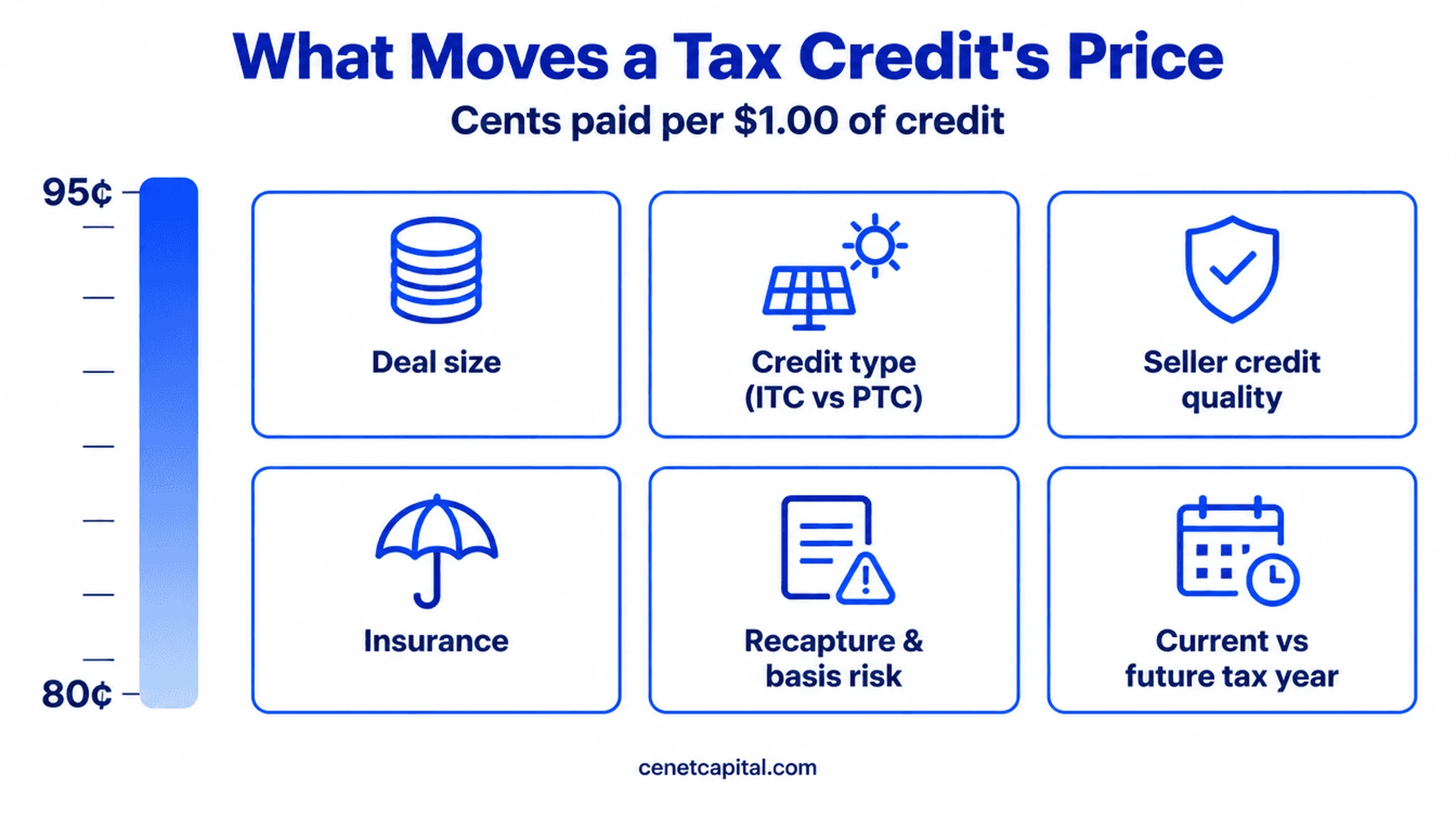
Why do ITCs sell for less than PTCs?
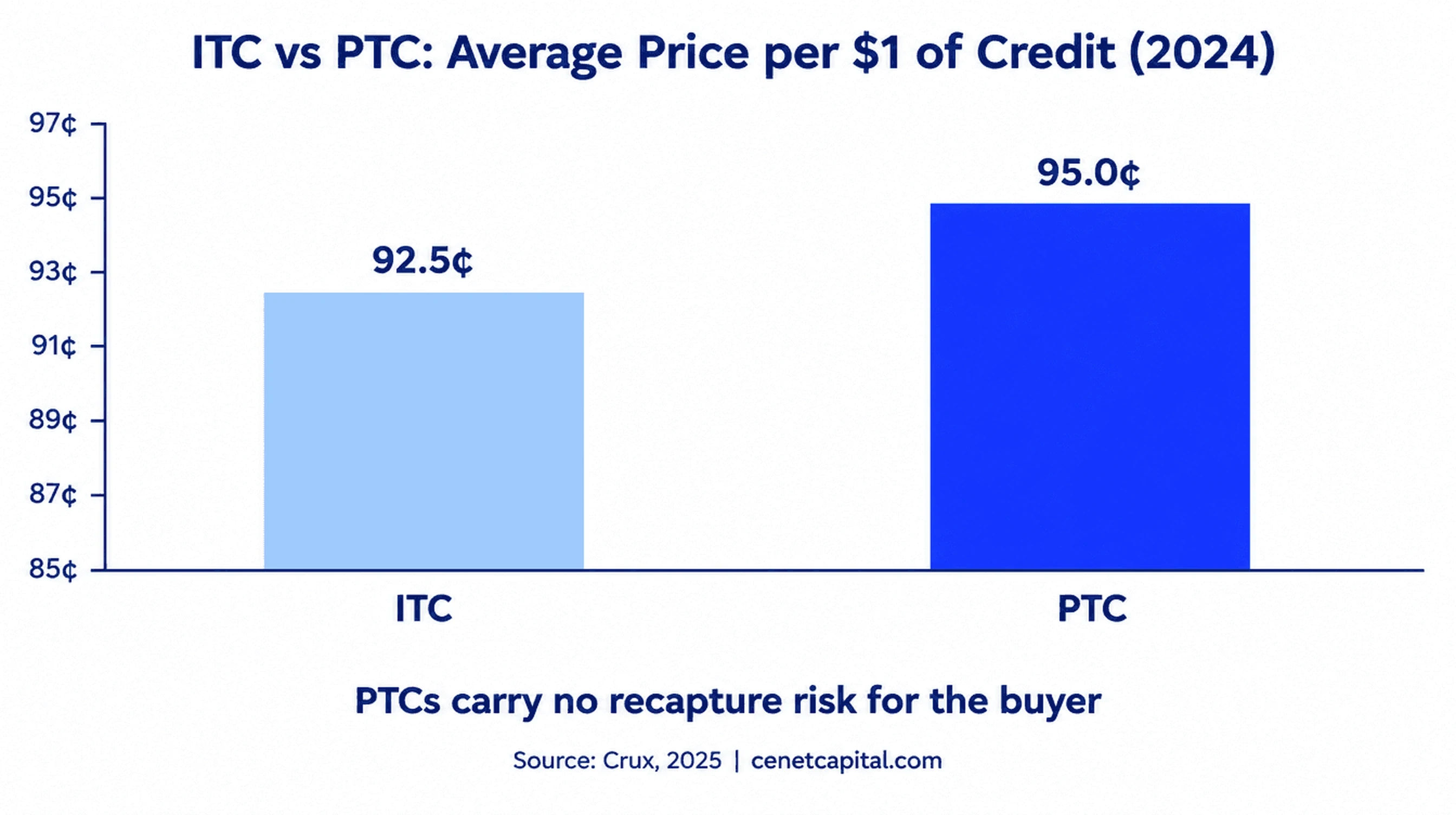
ITCs carry recapture and cost-basis risk for the buyer and PTCs don’t, so buyers pay less for ITCs. In 2024, ITC deals averaged 92.5 cents and PTC deals averaged 95 cents, according to Crux’s analysis of transferable credit pricing, which notes that “PTCs do not convey a risk of recapture to the tax credit buyer.”
The reason is structural. An ITC is claimed all at once on the project’s cost, then subject to recapture for five years if the project is sold or stops operating. A PTC is earned on electricity actually produced, so there’s nothing to claw back and no cost basis to challenge.
ITC vs PTC: what a buyer is really pricing
- How it's earned
- A percentage of the project's eligible cost basis
- When it's claimed
- All at once, in the year the project is placed in service
- Recapture risk for the buyer
- Yes, for five years if the project is sold or stops operating
- Basis risk for the buyer
- Yes, the IRS can challenge the cost the credit is built on
- What buyers diligence most
- Cost basis, placed-in-service date, wage records, bonus adders
- Best fit
- Solar + storage, fuel cells, manufacturing, projects with high upfront cost
Does deal size change the price?
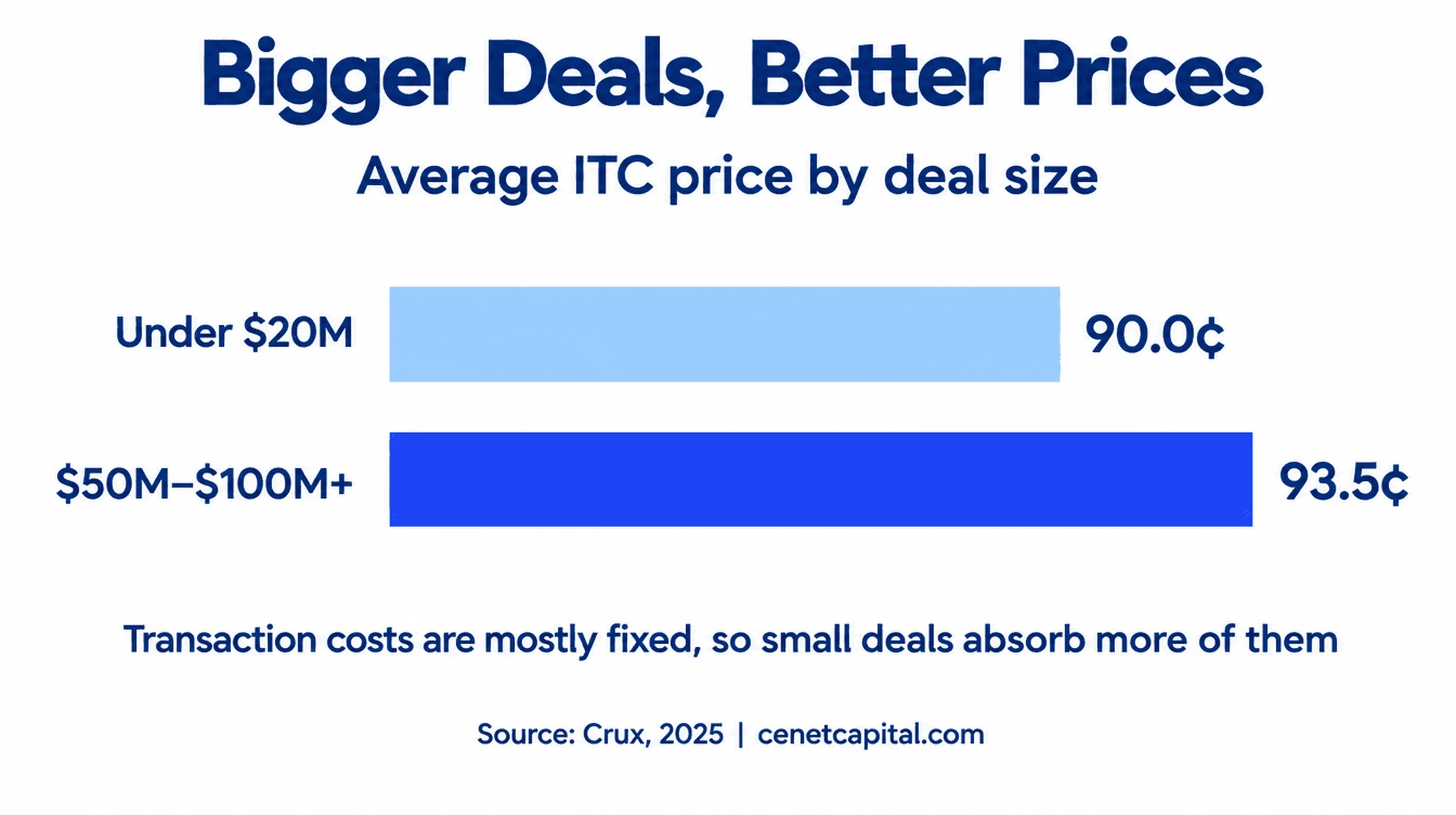
Yes, and it’s one of the biggest drivers. ITCs from deals under $20 million averaged 90.0 cents, while deals of $50 to $100 million and up averaged 93.5 cents, per Crux. Legal fees, diligence and insurance underwriting cost roughly the same whether a deal is $2 million or $200 million. On a small deal, the buyer spreads those costs over far fewer credit dollars and takes it out of the price.
Small-deal pricing also varies the most. Crux’s market report points out that recapture and basis risk “have an outsized role in small credit pricing,” in a segment where insurance can be hard to get at a sensible cost.
How much does the seller’s credit quality matter?
More than anything else, according to buyers. In Crux’s survey, 73% of buyers said the seller’s credit rating was the most important factor in what they’d bid. The reason is the indemnity. If the IRS disallows or recaptures part of the credit, the buyer’s main protection is the seller’s promise to make it whole, and that promise is only worth as much as the seller’s balance sheet. Investment-grade sellers’ ITCs priced at $0.920 to $0.950 in 2025, per Crux.
Does tax credit insurance raise the price?
Usually, for small and mid-size sellers, because insurance substitutes for the balance sheet they don’t have. Crux notes that “many prefer insured deals” but that the link between insurance and price is “less clear” than the link to credit quality, mostly because large investment-grade sellers often don’t need insurance to get a top price. For a sub-$20 million seller without a credit rating, a policy covering recapture and disallowance is often what moves a deal from the middle of the range toward the top.
Do future-year credits sell at a discount?
Yes. Credits for a future tax year typically trade below current-year credits, because the buyer is committing today without knowing whether it will have enough tax liability to use them. Crux also tracked about a 2.5% swing in prices through 2024, with prices generally rising later in the year as buyers looked for credits to offset liability they could now see clearly.
Factor | Pushes price up | Pushes price down |
|---|---|---|
Credit type | PTC, no recapture | ITC, five-year recapture |
Deal size | $50M+ | Under $20M |
Seller | Investment grade, experienced sponsor | Unrated, first-time sponsor |
Risk coverage | Insured, strong indemnity | Uninsured, weak indemnity |
Documentation | Cost segregation, PWA records, adders documented | Gaps in basis or bonus-adder support |
Timing | Current-year credit, later in the year | Future-year credit, early commitment |
How can a seller get closer to 95 cents?
Lower the buyer’s risk before the buyer has to price it in: document everything, insure what you can’t backstop yourself, and go to market early with a current-year credit. In practice that means finishing your IRS pre-filing registration early, getting a cost segregation study, collecting prevailing wage and apprenticeship records, and documenting each bonus adder separately. We go through the full seller checklist in how to sell commercial solar tax credits.
If you want to know where your credit would price, Cenet Capital buys and insures transferable credits across 48E, 48C, 45V and 30C on projects from $250K to $250M+.
Find out where your credit prices.
Cenet Capital buys and insures transferable credits across 48E, 48C, 45V and 30C on projects from $250K to $250M+. Send us your project and we'll give you a straight answer on price.

More Insights