

The 45Z tax credit pays fuel producers $0.20-$1.00 per gallon based on carbon intensity. Here's how the rate is set, who qualifies, and what OBBBA
Author -
Paulestini Francois
Published -
READ TIME
The 45Z tax credit doesn't pay a flat rate the way the solar ITC does — it pays fuel producers a per-gallon amount that moves with how clean the fuel actually is, and that number has changed twice since the credit launched. Here's what 45Z actually pays, how the rate is calculated, who qualifies, and what the One Big Beautiful Bill Act (OBBBA) changed about it.
What is the 45Z Clean Fuel Production Credit?
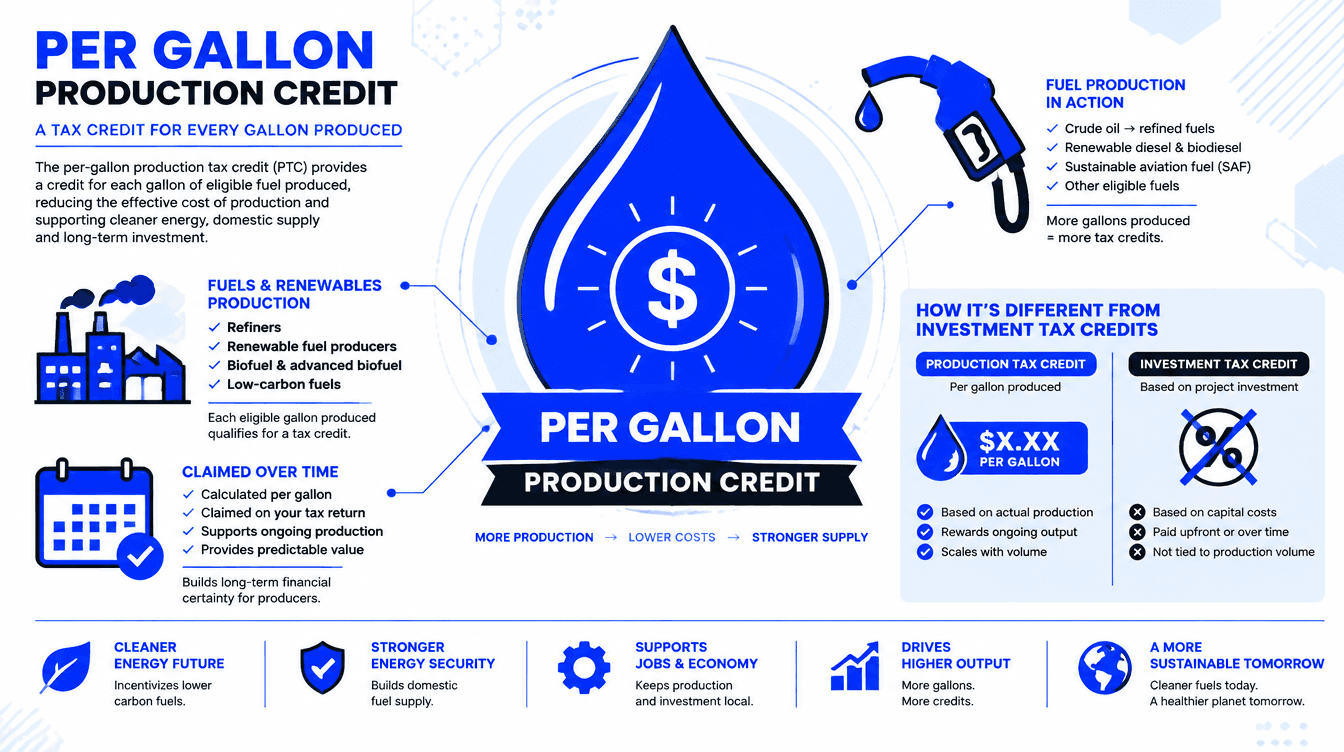
Section 45Z is a per-gallon federal tax credit paid to the producer of a qualifying transportation fuel, based on how low that fuel's lifecycle greenhouse gas emissions are not a flat percentage like the investment credits used for solar and wind. Eide Bailly's overview of the credit confirms "the maximum credit available under Section 45Z is $1.00 per gallon for qualifying transportation fuels, indexed annually for inflation," and that the actual amount a producer gets "depends on the fuel's lifecycle emissions profile." It's a production credit, not an investment credit it's paid per gallon actually produced and sold, not as a percentage of what a facility cost to build.

How much is the 45Z credit actually worth per gallon?
The base rate is $0.20 per gallon, and it multiplies to a maximum of $1.00 per gallon if the production facility meets prevailing wage and apprenticeship requirements the same 5x labor-compliance structure used elsewhere in the clean energy tax code. Pillsbury's breakdown of the proposed regulations states the rate is "$0.20 per gallon (or gallon equivalent), increasing to $1.00 if prevailing wage and apprenticeship requirements are satisfied."
That's a change from how the credit originally worked. Before OBBBA, sustainable aviation fuel (SAF) got a meaningfully higher rate than every other qualifying fuel Pillsbury notes SAF previously earned "$0.35 per gallon (or gallon equivalent), or an increased rate of $1.75" with the labor multiplier. OBBBA erased that premium for fuel produced after December 31, 2025.
Fuel type | Rate before OBBBA (fuel produced through 2025) | Rate after OBBBA (fuel produced after 2025) |
|---|---|---|
Non-SAF (ethanol, biodiesel, renewable diesel, RNG) | $0.20/gal base, $1.00/gal with labor compliance | $0.20/gal base, $1.00/gal with labor compliance (unchanged) |
Sustainable Aviation Fuel (SAF) | $0.35/gal base, $1.75/gal with labor compliance | $0.20/gal base, $1.00/gal with labor compliance (equalized down) |
How does the carbon intensity score determine the exact credit amount?
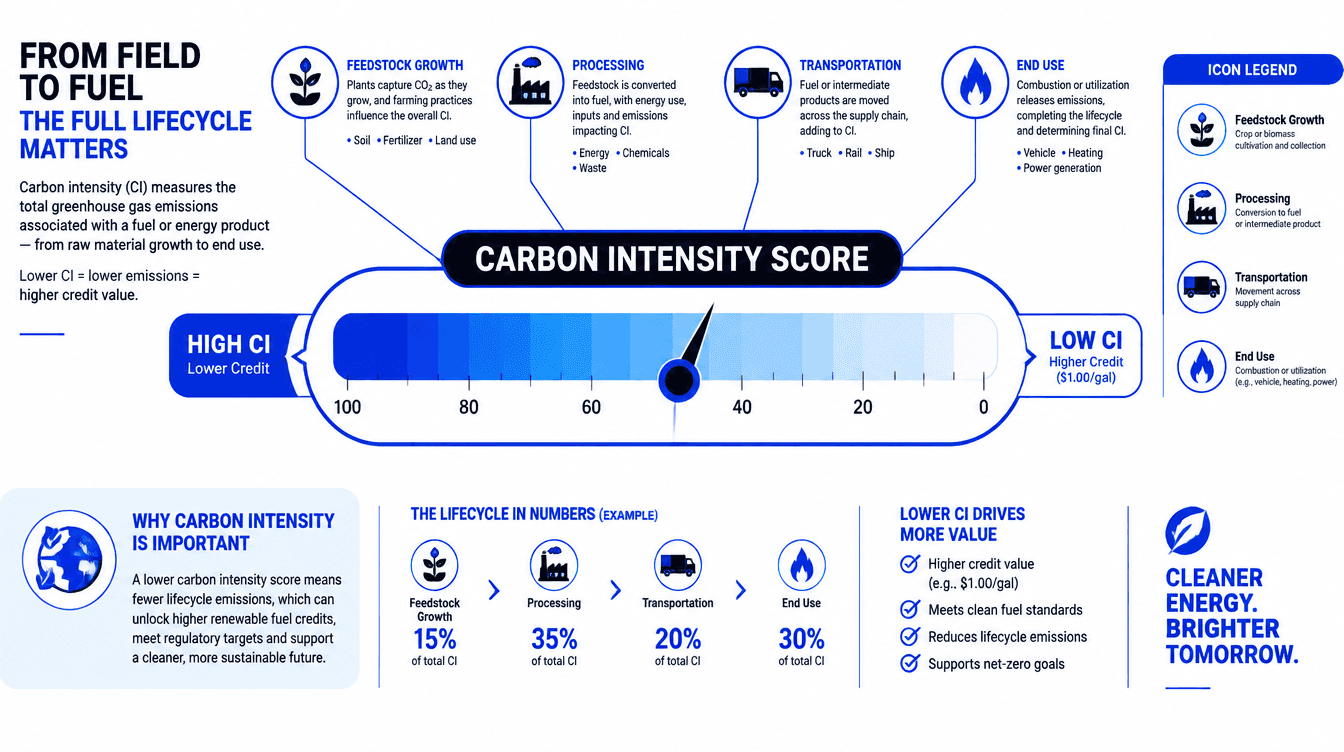
The base and multiplied rates above are ceilings, not flat amounts the actual per-gallon credit slides down from that maximum based on the fuel's carbon intensity (CI) score, so a cleaner fuel earns closer to the full rate and a higher-emissions fuel earns less. Eide Bailly describes carbon intensity as accounting for "emissions generated throughout the entire supply chain, including feedstock production, fuel processing, transportation, distribution, and end use" the full lifecycle, not just what happens at the production facility.
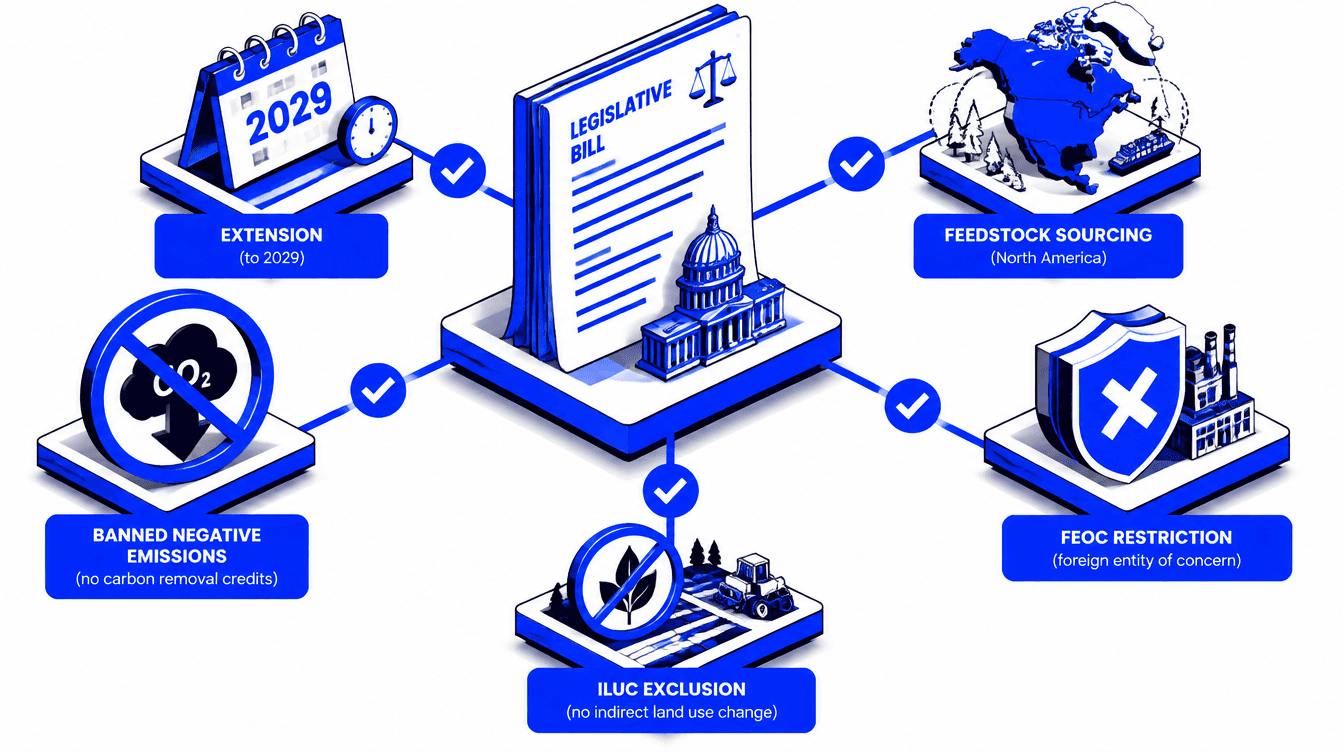
OBBBA changed two things about how that score gets calculated. According to RSM's analysis of OBBBA's effect on clean fuels, the law "excludes emissions attributed to indirect land use change (ILUC) in determining the emissions rate," a change expected to lower the CI score and raise the credit for certain crop-based biofuels by a few points. Separately, OBBBA "prohibits negative emissions rates, except in the case of transportation fuel derived from animal manure," closing off a path some producers had used to push their effective rate above the statutory maximum.

Which fuels and producers actually qualify?
Producers of ethanol, biodiesel, renewable diesel, sustainable aviation fuel, and renewable natural gas (RNG) made from landfill gas, animal manure, or crops are the intended claimants, and OBBBA added a feedstock-origin requirement on top of the existing rules. Per Eide Bailly, these are the fuel categories "expected to benefit from Section 45Z." RSM notes that as of fuel produced after December 31, 2025, OBBBA "requires transportation fuel to be exclusively derived from feedstocks produced or grown in the United States, Canada or Mexico" a sourcing rule that didn't exist when the credit first took effect.
Requirement | Detail |
|---|---|
Qualifying fuel types | Ethanol, biodiesel, renewable diesel, SAF, RNG (landfill gas, manure, crops) |
Who claims the credit | The fuel producer, not the feedstock grower or a downstream blender |
Feedstock origin (after Dec. 31, 2025) | Must come exclusively from the U.S., Canada, or Mexico |
Double-credit prevention | Fuel made from feedstock that already generated a 45Z credit elsewhere doesn't qualify again |
What did OBBBA actually change about the 45Z credit?
OBBBA extended 45Z through 2029, added a North America-only feedstock sourcing rule, excluded indirect land use change from the emissions calculation, closed the negative-emissions-rate loophole outside of manure-derived fuel, and added Foreign Entity of Concern ownership restrictions but it left the core per-gallon mechanism intact. RSM confirms "the OBBBA extends the section 45Z credit for transportation fuel produced and sold through Dec. 31, 2029," and separately restricts credits for entities meeting "foreign-influenced entity" ownership thresholds, effective "for taxable years beginning after July 4, 2025."
The SAF rate equalization above is really part of this same package OBBBA didn't eliminate 45Z's SAF incentive, it just removed the extra premium SAF used to get over every other qualifying fuel.
Can a fuel producer sell a 45Z credit it can't fully use?
Yes Section 45Z is one of the credit types eligible for transfer under Section 6418, so a producer without enough tax liability to absorb the full per-gallon credit can sell all or part of it to an unrelated buyer for cash instead of carrying it forward. Illustrative example: A hypothetical ethanol producer earning a $0.75/gallon effective rate on several million gallons of annual production could generate far more 45Z credit value than its own tax bill can use in a given year. Rather than carrying the excess forward, the producer could transfer that unused credit to an unrelated buyer for cash. This is a generic illustration of how the mechanism works, not a real transaction, and no specific pricing is implied. For the full transfer mechanics, see what transferable tax credits actually are.
So what actually determines a producer's real 45Z rate?
Three things stack together: the $0.20-to-$1.00 base-and-multiplier structure, the carbon intensity score that slides the actual payout between those numbers, and since OBBBA whether the feedstock and ownership meet the new sourcing and foreign-entity restrictions. A producer quoting the flat $1.00/gallon headline number without running the CI math and checking feedstock origin is likely overstating what they'll actually collect.
If you're a producer weighing whether to transfer a 45Z credit you can't fully use, Cenet Capital works with developers on both a direct and correspondent basis to structure and place transfers, at competitive pricing.
Know your CI score before you quote your rate.
The $1.00-per-gallon headline number only applies at the top of the range — your real 45Z credit depends on carbon intensity, feedstock sourcing, and labor compliance. Cenet Capital works with producers on both a direct and correspondent basis to structure and place 45Z credit transfers, at competitive pricing.

More Insights


