

A tax equity bridge loan funds construction before your tax equity investor pays. Here's how TEBLs are structured, priced, secured, and repaid in 2026.
Author -
Paulestini Francois
Published -
READ TIME
A renewable energy project doesn't get paid for its tax credits until long after the contractors and equipment suppliers need to be paid. A tax equity bridge loan exists to close that gap it's short-term financing that lets construction keep moving while the much larger tax equity investment is still working its way through underwriting and closing. Here's exactly how a tax equity bridge loan is structured, what it's secured by, how it gets repaid, and what can go wrong along the way.
What is a tax equity bridge loan, and why do developers need one?
A tax equity bridge loan (TEBL) is a short-term, project-level loan that funds construction before a tax equity investor's capital contribution arrives, closing the timing gap between when contractors need to be paid and when the tax equity investor is actually obligated to fund. As Crux's guide to tax equity bridge loans explains it, developers face a structural mismatch: "Developers face a timing mismatch they must pay contractors and suppliers during construction, but tax equity investors only fund after the project reaches mechanical completion and qualifies for tax credits." The TEBL is purpose-built to sit in that gap.

Where does a tax equity bridge loan sit in the capital stack?
A TEBL sits between the construction loan and the tax equity investment itself, acting as the connective layer that lets the rest of the capital stack close on schedule. Crux describes the sequencing directly: "The TEBL connects all the layers. It funds the project during construction, gets repaid when tax equity funds, and clears the way for back-leverage debt at the holdco level." In practice that means four layers stack in order: a construction loan secured by the project's assets, the TEBL secured by the tax equity commitment, the tax equity investment itself, and finally back-leverage debt at the parent holding company once tax equity has funded.
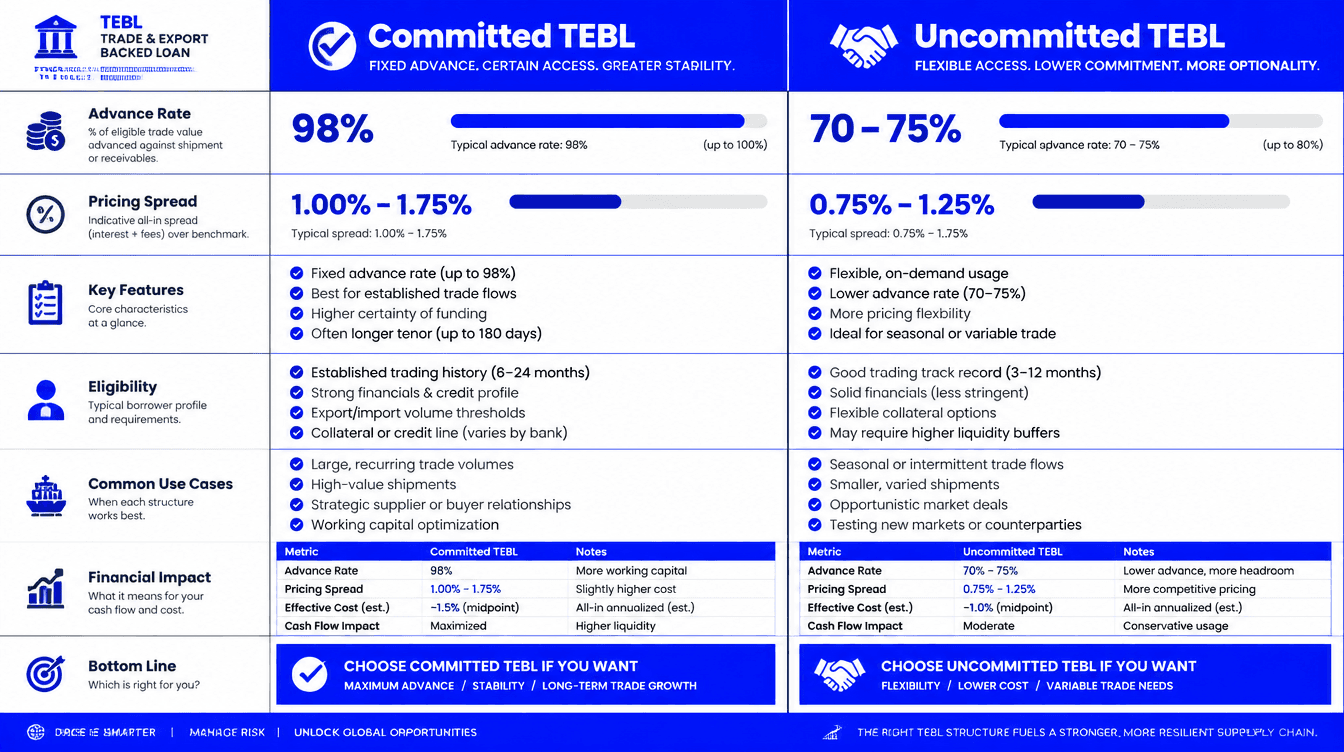
What's the difference between a committed and an uncommitted tax equity bridge loan?
Committed TEBLs backed by an investment-grade tax equity investor under a signed contribution agreement are the standard market product and price meaningfully better than uncommitted structures, which rely on an assumed future tax credit sale rather than a binding investor commitment. Per Crux, committed structures occur "where an investment-grade tax equity investor is bound by an executed contribution agreement," and in 2025 "pricing for committed structures with high-quality buyers and experienced sellers ranged from 150 to 225 basis points above SOFR...with advance rates up to 98%." Uncommitted bridge loans, by contrast, "became very limited in 2025" and offered lower advance rates of 70-75%, based on assumed tax credit sale prices rather than investor commitments.
Structure | Backing | Typical advance rate | Pricing (2025) | Availability |
|---|---|---|---|---|
Committed TEBL | Signed tax equity contribution agreement with an investment-grade investor | Up to 98% | SOFR + 150-225 bps | Standard market product |
Uncommitted TEBL | Assumed future tax credit sale, no binding investor | 70-75% | Wider spread, higher cost of capital | Very limited; generally only well-established sponsors |
The credit quality of the tax equity investor drives pricing more than the project's own economics does. As Crux puts it, "a BBB-rated investor will draw a wider spread than an A- rated investor, since the lender is essentially lending against the investor's credit, not the project's standalone economics." Emerging technologies with limited operating histories also face lower advance rates and wider spreads than mature solar or wind.

What secures a tax equity bridge loan?
A TEBL is secured by the pledged equity interests in the project company and an assignment of the tax equity investor's funding obligation relatively simple collateral compared to a construction loan, but with a real backstop requirement if the investor doesn't pay in full. Crux is explicit on this point: "If the tax equity investor's funding doesn't cover the full bridge balance when it's due, the sponsor backstops the shortfall (typically through an indemnity)." That backstop is why lenders spend as much time underwriting the sponsor's own balance sheet as they do the tax equity investor's.
Lenders focus their underwriting on three things: whether the project actually qualifies for the tax credit (reps, warranties, and covenants built directly into the credit agreement), how reliable the tax equity investor is (reviewing the executed term sheet and the investor's credit rating and track record), and whether the sponsor can actually make good on the backstop if something goes wrong. That third point matters more than it might seem a lender isn't just checking a box on the sponsor's balance sheet, it's confirming the indemnity behind the backstop is something it could actually collect on if the tax equity investor's funding falls short or is delayed past the loan's maturity.

How long does a tax equity bridge loan last, and how does it get repaid?
TEBLs are intentionally short commonly 12 to 24 months and are repaid from the tax equity investor's own funding once the project hits its milestones, with a fixed maturity date that triggers repayment whether or not the tax equity has actually funded yet. Crux describes the repayment mechanic plainly: "A TEBL is repaid from the proceeds of the tax equity takeout. The tax equity investor funds at mechanical and substantial completion milestones, near commercial operation under the equity capital contribution agreement, and the TEBL is repaid in full from that funding." The loan term is sized to construction with a buffer for the placed-in-service date, but that maturity date doesn't move just because the tax equity investor is running late.

Who actually lends on tax equity bridge loans?
The TEBL market is dominated by large commercial and investment banks with established tax equity practices, alongside a smaller but growing group of specialty debt platforms. Crux names the active arrangers directly: "MUFG, KeyBanc, Wells Fargo, JPMorgan, Bank of America, and Santander," with specialty platforms like Apterra and dedicated debt funds expanding their participation in the market as well. That concentration among a handful of large banks is itself a structural feature of the market because a TEBL is really a loan against the tax equity investor's credit rather than the project's own economics, the lenders best positioned to underwrite it are the ones who already have deep tax equity practices and existing relationships with the same investor universe they're being asked to lend against.

What are the biggest risks in a tax equity bridge loan?
The three risks that come up most in TEBL deals are funding delays on the tax equity side, ITC recapture if the lender ever has to foreclose, and compliance with the newer Prohibited Foreign Entity (PFE) rules all of which lenders now build directly into loan documentation. On delays: "the TEBL maturity does not move. Sponsors typically backstop this risk with shortfall indemnities, extension mechanics, and contingent equity." On recapture: "Foreclosure on a TEBL during that period disqualifies the tax credit," which is why lenders lean on special-purpose entity structures and tax credit insurance to mitigate it. And on PFE compliance, Crux notes that "projects that begin construction after December 31, 2025, can be disqualified from claiming tax credits if their supply chain or ownership has ties to a PFE," so "TEBL term sheets increasingly include ongoing PFE representations and covenants." Layered on top of all of this is the straightforward deadline risk: tax credits generally require a project to be placed in service by December 31, 2027, or to have begun construction by July 4, 2026, to safe-harbor eligibility at all.
A related but distinct product is the standard tax credit bridge loan financing sized against a future tax credit sale rather than a tax equity investor's contribution. Crux's broader look at tax credit bridge loans frames it this way: "Tax credit bridge loans are short-term financing tools that provide upfront capital based on future tax credit generation and monetization." Illustrative example: a hypothetical project expecting to generate $20 million in transferable tax credits might receive roughly $16 million upfront at an 80% advance rate, repaid once the credits are actually generated and sold. This is a generic illustration of how the mechanism works, not a real transaction, and no specific pricing is implied.
Does a developer have to bridge the credit, or can they just sell it instead?
Bridging and selling aren't mutually exclusive a TEBL gets a project through construction on the assumption that tax equity (or a credit buyer) will eventually fund, while transferring the credit outright under Section 6418 is how that funding obligation actually gets satisfied. For many developers, the real decision isn't whether to bridge at all, but whether the eventual takeout comes from a traditional tax equity partnership or from selling the credit directly to a buyer for cash. If you're structuring a project and weighing a bridge loan against an outright credit sale, Cenet Capital works with developers on both a direct and correspondent basis to structure and place transfers, at competitive pricing.
Waiting on a tax equity investor to fund isn't a financing plan.
A bridge loan buys time, but it still ends with a takeout you don't fully control. Selling your credit directly is the other way out — Cenet Capital structures and places transfers on both a direct and correspondent basis, at competitive pricing.

More Insights


