The 45V clean hydrogen credit pays up to $3.28/kg in 2026. Here are the rules: emissions tiers, the three pillars, verification, monetization, and the 2028 deadline.
Author -
Paulestini Francois
Published -
READ TIME
The 45V clean hydrogen credit is one of the largest per-unit incentives in the tax code, worth up to $3.28 per kilogram of hydrogen produced in 2026. It's also one of the most rule-heavy. Whether a project earns the top rate, a fraction of it, or nothing depends on its lifecycle emissions, how it sources electricity, whether it pays prevailing wages, and when construction began. Here's every rule that matters, in plain English, with the IRS's 2026 numbers.
What is the 45V tax credit?
Section 45V is a federal production tax credit, paid per kilogram of clean hydrogen, for 10 years after a qualifying facility is placed in service. The cleaner the hydrogen, measured by lifecycle greenhouse gas emissions, the larger the credit. It was created by the Inflation Reduction Act in 2022 and is written into 26 U.S.C. § 45V. Unlike an investment tax credit, which is claimed once on a project’s cost, 45V is earned every year on hydrogen actually produced, sold or used, and verified.
Three things decide whether a project earns it and how much: the facility’s emissions tier, whether it meets prevailing wage and apprenticeship requirements, and whether construction began before the January 1, 2028 deadline set by the One Big Beautiful Bill Act. The rest of this guide covers each rule in the order a developer or credit buyer runs into it.
Rule | What it requires (2026) |
|---|---|
Maximum credit | $3.28 per kg (2026, with prevailing wage & apprenticeship) |
Emissions ceiling | 4 kg CO2e per kg of hydrogen, well-to-gate |
Credit period | 10 years from placed-in-service date |
Construction deadline | Must begin before January 1, 2028 |
Emissions model | 45VH2-GREET, or a provisional emissions rate |
Grid-power rules | Incrementality, deliverability, temporal matching (hourly from 2030) |
Monetization | Transferable for cash; elective (direct) pay for the first 5 years |
How much is the 45V credit worth in 2026?
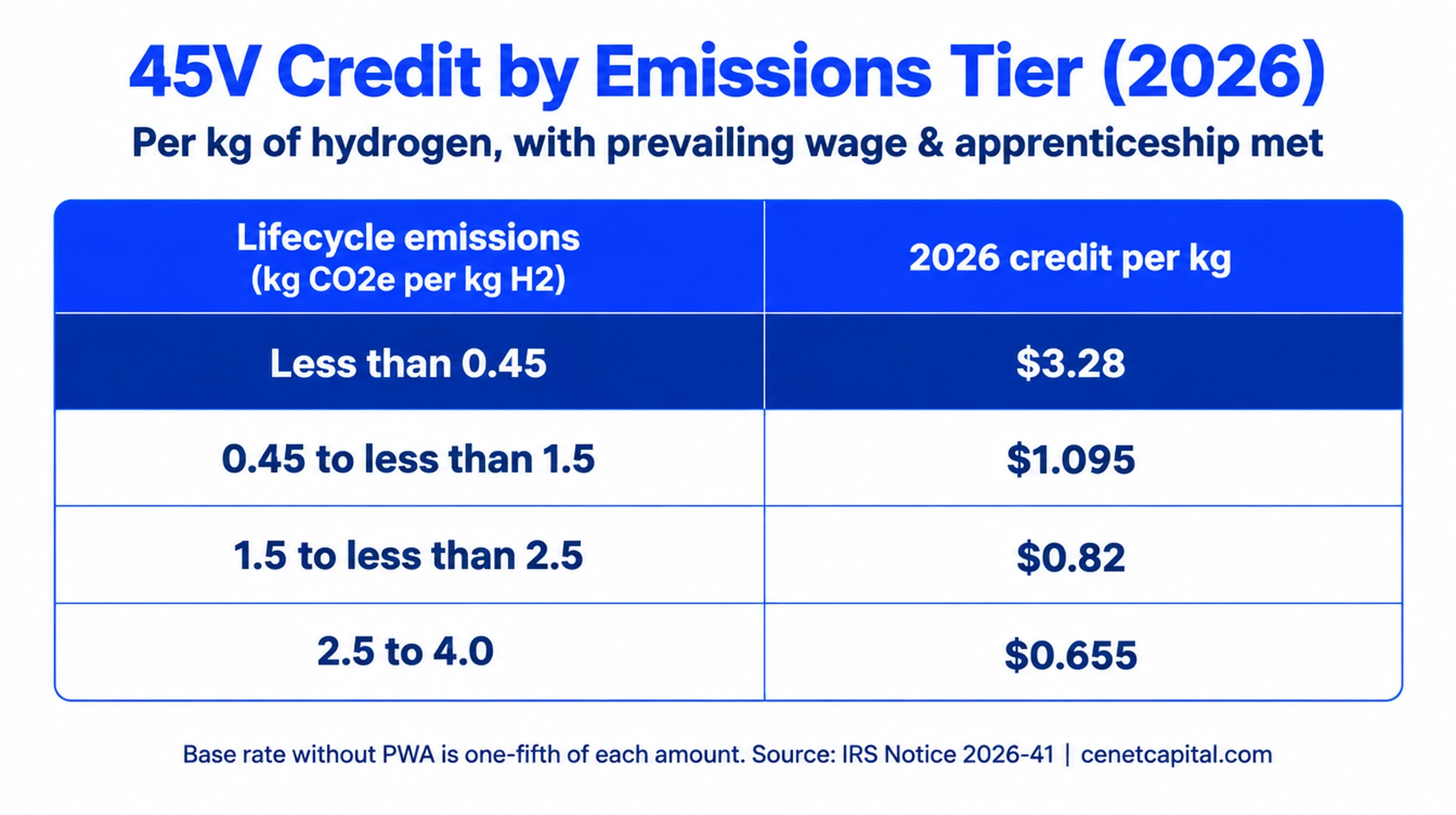
For hydrogen produced in 2026, the credit runs from $0.655 to $3.28 per kilogram for facilities that meet prevailing wage and apprenticeship requirements, and one-fifth of that for facilities that don’t. The IRS adjusts the amounts for inflation every year. For 2026 it published an inflation adjustment factor of 1.0929 and a top base amount of $0.656 per kilogram in Notice 2026-41. The statute multiplies the base amount by five for projects that meet the labor requirements.
Lifecycle emissions (kg CO2e/kg H2) | Share of max | 2026 base rate | 2026 with PWA |
|---|---|---|---|
Less than 0.45 | 100% | $0.656 | $3.28 |
0.45 to less than 1.5 | 33.4% | $0.219 | $1.095 |
1.5 to less than 2.5 | 25% | $0.164 | $0.82 |
2.5 to 4.0 | 20% | $0.131 | $0.655 |
The cliff between the top two tiers is the most important number in hydrogen project finance. Dropping from below 0.45 kg to just above it cuts the credit by two-thirds, from $3.28 to $1.095 per kilogram. For a facility producing 10,000 metric tons a year, that’s the difference between roughly $32.8 million and $10.95 million in annual credits. To run your own numbers, use our 45V tax credit calculator.
What is your clean hydrogen worth under 45V?
Illustrative only. Uses 2026 amounts from IRS Notice 2026-41 held flat; the IRS adjusts them for inflation each year. Emissions must be determined with the 45VH2-GREET model (or a provisional emissions rate) and verified annually. Facilities must begin construction before January 1, 2028.
Price your 45V credits →How is a project’s 45V tier determined?
The tier is set by the hydrogen’s lifecycle greenhouse gas emissions rate, measured “well-to-gate” with the Department of Energy’s 45VH2-GREET model. Production processes the model doesn’t cover can petition for a provisional emissions rate. Well-to-gate means the calculation counts emissions from producing and delivering the inputs, such as electricity, natural gas or biomass, through the point where the hydrogen leaves the production facility. It doesn’t count transport or end use after that. The model and its user manual are published through the Department of Energy’s GREET program.
Above 4 kg CO2e per kilogram, hydrogen earns nothing. Conventional steam methane reforming without carbon capture typically lands well above that line. So in practice 45V goes to electrolytic hydrogen powered by clean electricity, to reforming paired with high-capture carbon capture, and to production from qualifying renewable natural gas or biomass feedstocks.
What are the 45V “three pillars”?
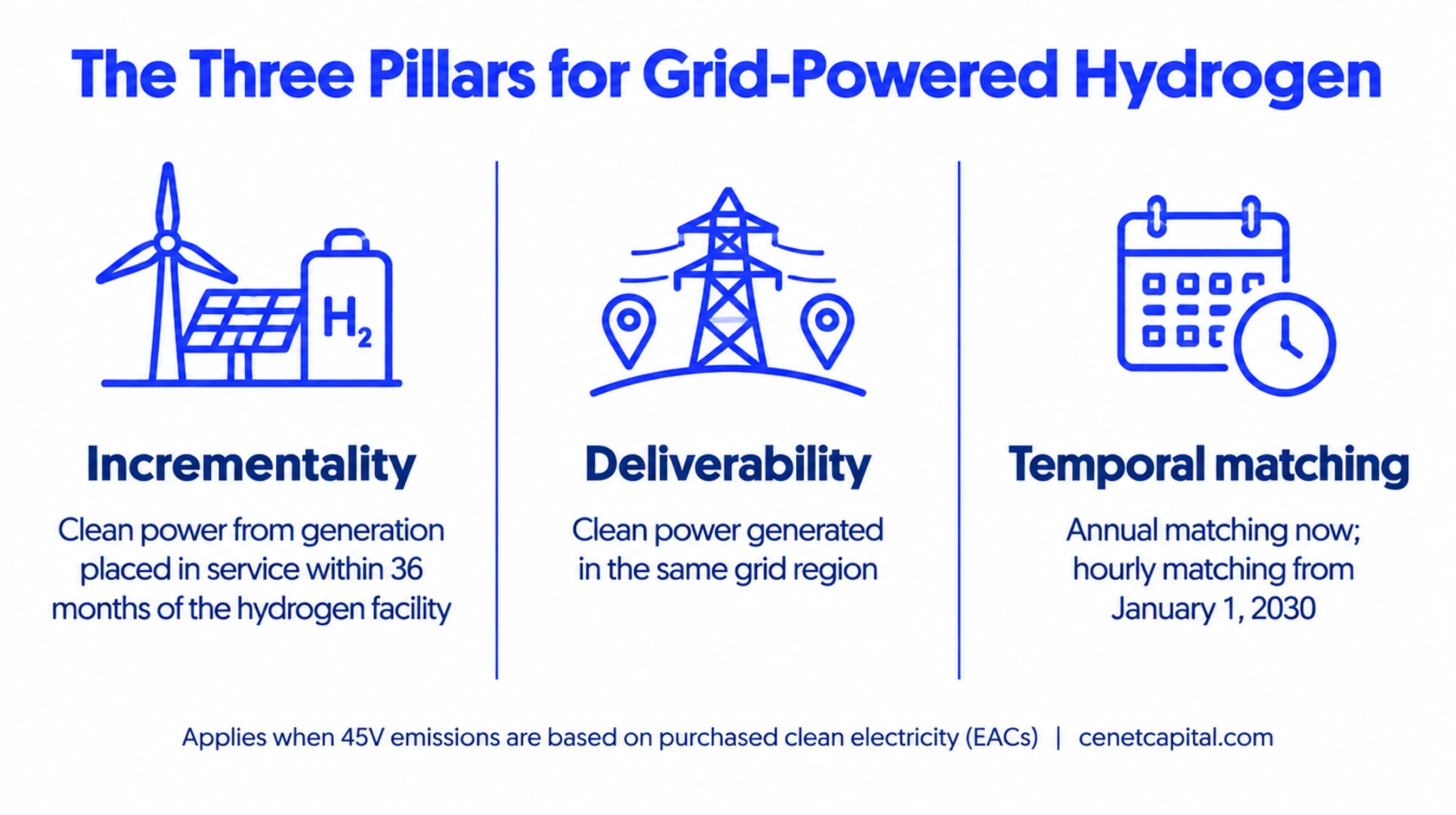
Incrementality, deliverability and temporal matching are the three conditions a hydrogen producer must meet to count purchased clean electricity as zero-emission in its 45V calculation. They apply when a grid-connected electrolyzer relies on energy attribute certificates (EACs) to show its power is clean. According to Baker Botts’ review of the January 2025 final regulations, the rules work like this:
Incrementality. The clean power generally has to come from a generator that began commercial operation no more than 36 months before the hydrogen facility was placed in service, or from a qualifying uprate. The final rules added further routes, including certain generators using carbon capture.
Deliverability. The generator has to be in the same grid region as the hydrogen facility. The final rules allow some cross-region transfers.
Temporal matching. Through 2029, power can be matched to hydrogen production on an annual basis. From January 1, 2030, matching must be hourly.
The 2030 hourly-matching date is the one to model carefully. A project that pencils out on annual matching can look very different once every hour of electrolyzer operation must line up with an hour of clean generation. As Holland & Knight noted, pushing hourly matching from 2028 to 2030 was one of the biggest changes between the proposed and final rules.
What does a producer have to prove each year?
Every year a producer claims 45V, it needs an emissions determination for the hydrogen, evidence that the hydrogen was sold or used, and a verification report from an unrelated, qualified verifier. The final regulations made third-party verification a condition of the credit, not an optional extra. A 45V credit without a clean annual verification file is very hard to sell, because the buyer inherits the risk if the credit is later disallowed.
In practice, a well-run 45V project keeps four records per year: metered production by hour, EAC retirement records matched to that production, the 45VH2-GREET (or provisional rate) calculation, and the signed verification report. Facilities using the 5× rate also need prevailing wage and apprenticeship payroll records for construction, alteration and repair work.
Who can claim 45V, and can it be sold or paid in cash?
The producer that owns the facility claims the credit, but it doesn’t need a large tax bill to benefit. 45V can be sold to another taxpayer for cash under Section 6418, and for the first five years it can be taken as a direct payment from the IRS. The direct-pay route for 45V, 45Q and 45X is available to any taxpayer, not just tax-exempt entities, for five years, as the final elective pay rules explain. After that, a producer without enough tax liability will usually transfer the credit.
Transfers must be made for cash, and each credit can only be transferred once. Because 45V is a production credit, it carries no ITC-style recapture risk for buyers. That’s a big reason production credits have historically priced higher than investment credits. In 2024, PTCs averaged about 95 cents per dollar of credit versus 92.5 cents for ITCs, according to Crux. We explain what moves the price in transferable tax credit pricing, and the transfer process step by step in how to monetize a 45V credit.
What can’t be stacked with 45V?
A facility can’t claim 45V if it includes carbon capture equipment for which the 45Q credit has ever been allowed, to any taxpayer, in that year or any prior year. That rule is in the statute itself (§ 45V(d)(2)). It forces blue-hydrogen developers to pick one credit for the life of the facility: 45Q, which pays per ton of carbon oxide captured, or 45V, which pays per kilogram of hydrogen at the tier the captured carbon helps it reach.
The choice usually comes down to the capture rate. A facility that captures enough carbon to land in the 0.45-to-1.5 tier earns $1.095 per kilogram in 2026. Whether that beats 45Q depends on how many tons of carbon oxide it captures per kilogram of hydrogen, and on whether it’s used or stored. Run both before committing. The election is effectively permanent.
For fuel cells that use hydrogen rather than produce it, the relevant credit is usually an investment credit, not 45V. We cover that distinction in whether a data center fuel cell qualifies for 45V.
What changed under the One Big Beautiful Bill Act?
The One Big Beautiful Bill Act kept 45V but moved the construction deadline from January 1, 2033 to January 1, 2028. Facilities must begin construction before that date to qualify, and those that do keep the full 10-year credit period. That’s how Kirkland & Ellis and Quantum Commodity Intelligence summarized the final law, signed in July 2025. Earlier drafts would have ended the credit for projects starting after 2025, so the final version was a partial reprieve.
The deadline is about when construction begins, not when hydrogen is produced or the facility goes into service. A project that starts construction in 2027 and comes online in 2029 can still earn 45V through 2039. What counts as “beginning construction,” and how to document it, is covered in detail in what the One Big Beautiful Bill did to 45V.
What should developers and credit buyers do with these rules?
Developers should lock in construction start before 2028, model the 2030 hourly-matching shift, and build the annual verification file from day one. Buyers should price the tier, the verification history and the counterparty, not just the headline rate. A 45V credit is only as good as the documents behind it. The projects that sell their credits fastest, and closest to face value, are the ones that can hand a buyer a complete, verified year of production on day one.
If you’re producing clean hydrogen, or about to, Cenet Capital buys and insures 45V credits and can tell you what yours would sell for once you know your expected tier.
Know your 45V tier? Find out what it's worth in cash.
Cenet Capital buys and insures 45V credits from hydrogen producers. Send us your facility details and expected emissions rate and we'll come back with pricing.

More Insights