How to use the DOE energy community map and IRS Notice 2026-39 to check if your project qualifies for the 10% bonus, plus a free eligibility checker.
Author -
Paulestini Francois
Published -
READ TIME
The energy community bonus can add 10 percentage points to an investment tax credit, or 10% to a production tax credit, just for building in the right place. Checking whether a site qualifies takes a few minutes with the Department of Energy's map, once you know which layers to read and which IRS list controls. Here's how to check your project for 2026, step by step, with a quick eligibility checker and the documentation credit buyers expect to see.
How do you check if a project is in an energy community?
Look up the project’s location on the Department of Energy’s Energy Community Tax Credit Bonus map, then confirm it against the IRS’s official lists in the latest annual notice, which for 2026 is Notice 2026-39, released June 10, 2026. A site qualifies if it’s a brownfield, sits in a census tract with a closed coal mine or retired coal plant (or next to one), or is in a metropolitan or non-metropolitan area with significant fossil fuel employment and above-average unemployment. If at least half of the project’s nameplate capacity is inside a qualifying area, the whole project gets the bonus.
The bonus is worth having. It adds 10 percentage points to an investment tax credit, turning a 30% ITC into 40%, or 10% to a production tax credit. On a $4 million solar project that’s $400,000. The DOE map lives at energycommunities.gov. The quick checker below walks through the three tests, and the rest of this guide explains each step.
Does your site qualify as an energy community?
A screening tool, not a determination. The IRS notices control over the DOE map. The PTC bonus is a 10% increase each year, shown here at a flat annual credit.
Get your credit priced →What is an energy community?
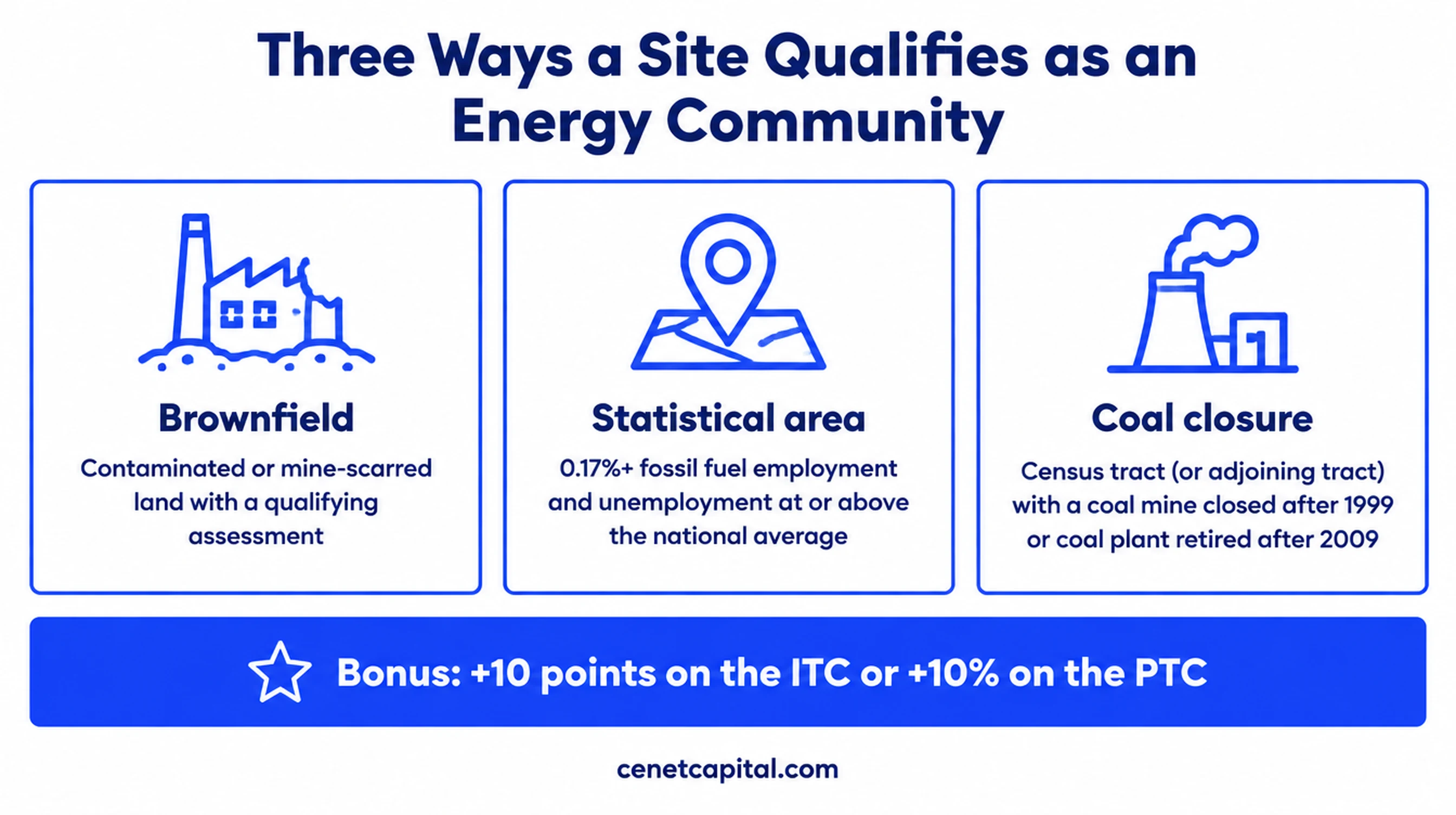
An energy community is a location defined in Section 45(b)(11) of the tax code where clean energy projects earn a bonus credit, to direct investment toward places that depended on fossil fuels. There are three categories, and a site only needs to meet one.
Category | The test | How to check |
|---|---|---|
Brownfield | A brownfield site as defined under federal environmental law, including certain mine-scarred land | Not on the map. Use prior federal or state assessments, a Phase II environmental site assessment, or (for projects of 5 MW or less) a Phase I showing a recognized environmental condition |
Statistical area | A metropolitan or non-metropolitan statistical area with 0.17% or more direct fossil fuel employment (or 25% of local tax revenue from fossil fuels) at any time after 2009, and an unemployment rate at or above the national average for the prior year | DOE map layer; IRS Notice 2026-39, Appendix 1 |
Coal closure | A census tract where a coal mine closed after 1999 or a coal-fired generating unit retired after 2009, plus any directly adjoining tract | DOE map layer; IRS notices, including Notice 2026-39, Appendix 2 |
The statistical area list changes every year because it depends on the prior year’s unemployment rate. For 2026, the IRS used 2025 county unemployment data released by the Bureau of Labor Statistics on May 19, 2026. No new areas met the fossil fuel employment threshold this year, according to Holland & Knight, so changes came from unemployment shifts and newly closed coal facilities.
How do you use the DOE energy community map?
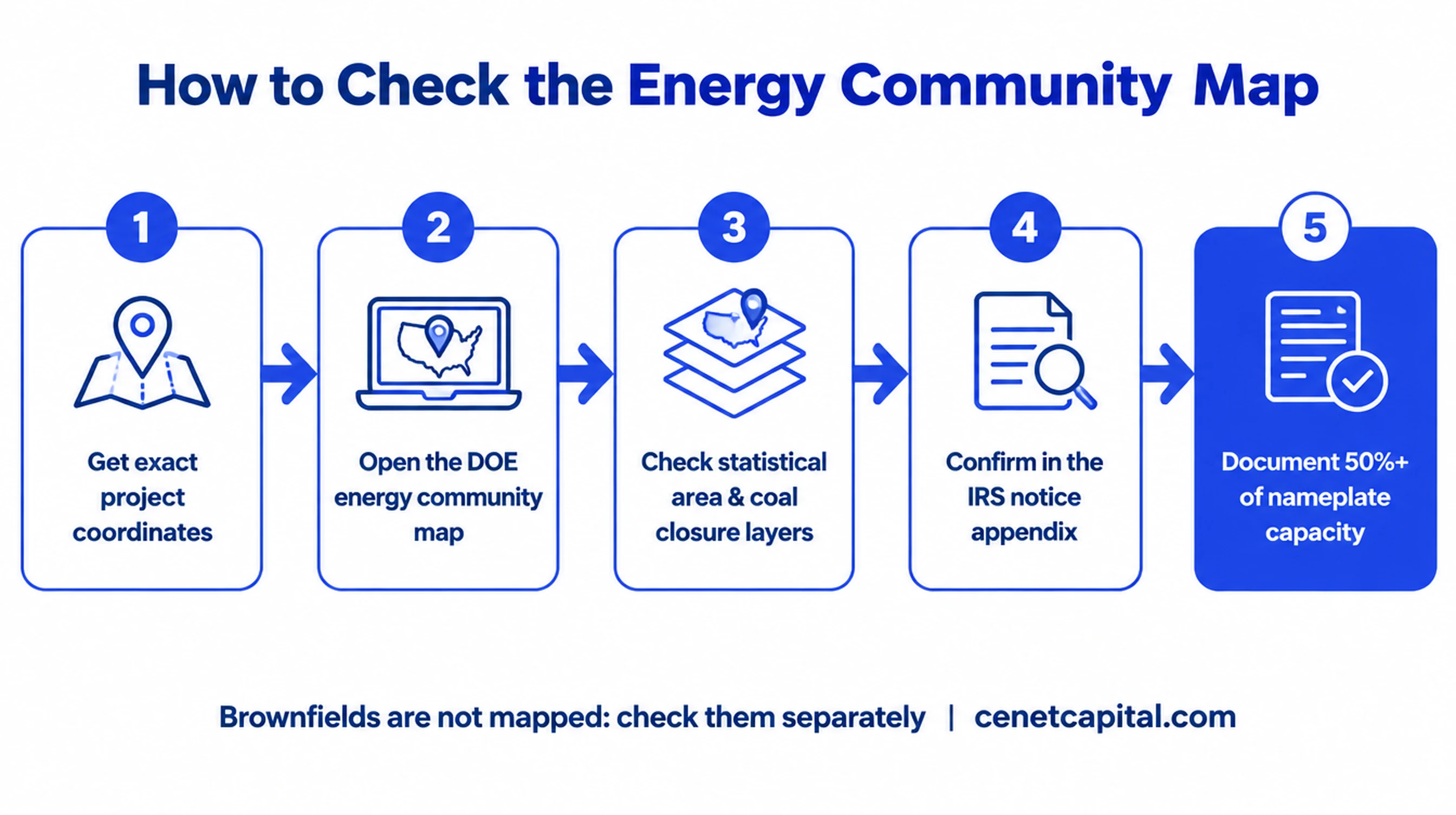
Enter the project address or coordinates, turn on the 2026 statistical area layer and the coal closure layer, and see whether the site falls inside a shaded area. Step by step:
Get exact coordinates. Use the latitude and longitude of the generating equipment, not a mailing address. For large projects, map the full footprint.
Open the map at energycommunities.gov and search the location.
Check the statistical area layer for the year that matters: the year construction began or the year the project is placed in service.
Check the coal closure layer, including tracts adjoining a closure tract, which also qualify.
Confirm with the IRS appendix. The map is a convenience; the lists in the IRS notices control. Save a screenshot and the relevant appendix entry with your project files.
Check brownfield status separately, since brownfields aren’t mapped.
What if only part of a project is in an energy community?
The whole project qualifies if 50% or more of its nameplate capacity is located in an energy community. For facilities without a nameplate capacity, such as some storage or thermal projects, the test uses square footage. A wind farm whose turbines straddle a county line, or a solar array that crosses a census tract boundary, needs its footprint mapped turbine by turbine or block by block. Get this done early; it’s one of the first things a credit buyer’s counsel will ask for.
When does energy community status get locked in?
Under IRS guidance, if a project is in an energy community on the date construction begins, it keeps that status for the life of the credit, even if the area drops off the list later. Otherwise, status is tested when the project is placed in service for an ITC, and each year for a PTC. That beginning-of-construction safe harbor matters because the statistical area list changes every year with unemployment rates. A county that qualifies in 2026 may not in 2027.
For wind and solar, that date also has to fit the One Big Beautiful Bill’s deadline: construction had to begin by July 4, 2026, or the project must be placed in service by December 31, 2027. See our One Big Beautiful Bill guide for every deadline.
How much is the energy community bonus worth?
For an ITC, 10 percentage points of eligible cost (2 points if the project doesn’t meet prevailing wage and apprenticeship rules). For a PTC, a 10% increase in the credit every year for 10 years.
Project | Without bonus | With energy community bonus | Added value |
|---|---|---|---|
$4M commercial solar (ITC, PWA met) | $1.2M (30%) | $1.6M (40%) | $400K |
$40M battery storage (ITC) | $12M | $16M | $4M |
100 MW wind (PTC, 306,600 MWh/yr) | $9.5M/yr | $10.5M/yr | ~$9.5M over 10 years |
The bonus stacks with the domestic content bonus and, for small facilities, the low-income communities bonus. Our investment tax credit guide shows how the adders combine, and the production tax credit guide covers the PTC version.
How do you document the energy community bonus for a credit sale?
Keep a short memo identifying the category, the map screenshot and IRS appendix entry for the relevant year, the beginning-of-construction date, and the footprint analysis showing at least 50% of capacity qualifies. On the tax return, you check the energy community box on Form 3468, Part I, line 10 for an ITC. Buyers and insurers review this file closely, because a bonus that doesn’t hold up becomes an excessive credit transfer, with a 20% penalty on the overstated amount unless the buyer had reasonable cause. Clean documentation protects the price of the credit. See Form 3468 instructions for where the bonus is reported.
How do brownfield sites qualify?
A brownfield qualifies if it fits the federal environmental law definition: real property whose expansion, redevelopment or reuse may be complicated by the presence or potential presence of a hazardous substance, pollutant or contaminant. Mine-scarred land counts too. The IRS gives three safe harbors that make it easier to prove.
Prior assessment. The site was previously assessed through federal, state, territory or tribal brownfield resources as meeting the definition.
Phase II assessment. An ASTM E1903 Phase II environmental site assessment confirms the presence of a hazardous substance or, in some cases, a petroleum product.
Small project Phase I. For projects with a nameplate capacity of 5 MW (AC) or less, an ASTM E1527 Phase I assessment that identifies a recognized environmental condition is enough.
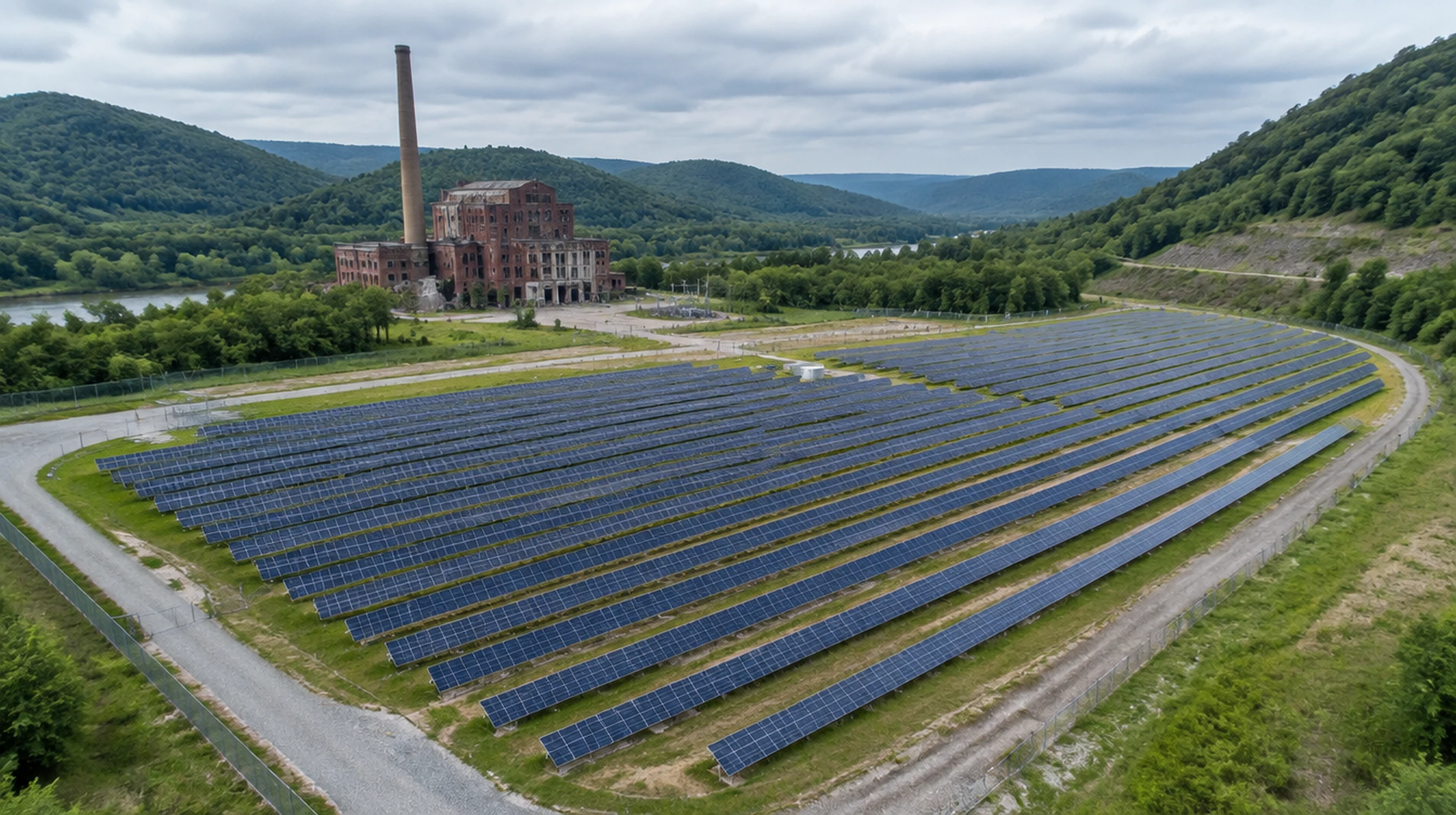
Landfills, closed industrial sites, former mines and old fuel terminals are common brownfield solar locations. They often come with cheap land and existing grid connections, and the bonus improves the economics further. Because brownfields don’t appear on the DOE map, these projects need their environmental reports in the tax file from day one.
Which projects get the most from the bonus?
Capital-heavy ITC projects like battery storage gain the most in dollars, because 10 points of a large cost basis is a big number, and storage keeps full credits for construction beginning through 2033. Wind and solar projects that began construction in a qualifying area before the July 4, 2026 deadline also benefit for the full life of their credits under the beginning-of-construction safe harbor. Geothermal developers in former oil and gas regions, where fossil fuel employment tends to be high, often find their sites already qualify under the statistical area test.
Common energy community mistakes
Using the wrong year’s list. Statistical area status changes annually; use the year construction began (if relying on the safe harbor) or the placed-in-service year.
Using a mailing address. Map the generating equipment, not the parcel’s address.
Missing adjoining tracts. Tracts next to a coal closure tract qualify too.
Assuming a brownfield qualifies without support. Brownfields need an assessment that fits one of the IRS safe harbors.
Treating the map as final. The IRS notice controls if the map and the appendix disagree.
If your project earns the energy community bonus, your credit is worth more in cash too. Cenet Capital buys and insures clean energy tax credits and will review your bonus documentation as part of pricing.
Qualify for the bonus? Your credit is worth more.
Cenet Capital buys and insures clean energy tax credits and reviews your energy community documentation as part of pricing. Send us your project details.

More Insights