The investment tax credit is worth 6% to 30% of project cost, up to 70% with adders. Rates, eligible projects, OBBBA deadlines, and how to claim or sell it.
Author -
Paulestini Francois
Published -
READ TIME
The investment tax credit is the federal incentive behind most commercial solar, battery storage and geothermal projects in the U.S., and since 2023 it's also something a project owner can sell for cash. It's worth 6% to 30% of eligible project cost, and bonus adders can push it to 50% or more. The One Big Beautiful Bill Act changed the deadlines, especially for wind and solar. Here's how the ITC works in 2026: the rates, what qualifies, the new rules, and how owners claim it or turn it into cash.
What is the investment tax credit?
The investment tax credit (ITC) is a federal tax credit equal to a percentage of what a business spends to build and place in service a qualifying clean energy project. In 2026 the rate is 6% of eligible cost, or 30% if the project meets prevailing wage and apprenticeship requirements, and bonus credits can push it to 50% or more. The credit is claimed once, in the year the project is placed in service, and it reduces federal income tax dollar for dollar. Since 2023 it can also be sold for cash to another company, which is why it now finances a large share of American solar, storage and geothermal construction.
Today the energy ITC lives in two sections of the tax code. Section 48 is the legacy energy credit, used mainly by projects that began construction before 2025. Section 48E, the “clean electricity investment credit,” is the technology-neutral version for facilities placed in service after 2024. Both are claimed on IRS Form 3468, and both work the same basic way: rate × eligible basis = credit.
The phrase “investment tax credit” also has an older meaning. From 1962 to 1986, a general ITC applied to almost any equipment purchase, until the Tax Reform Act of 1986 repealed it. When people talk about the ITC in 2026, they almost always mean the energy credit.
How much is the investment tax credit in 2026?
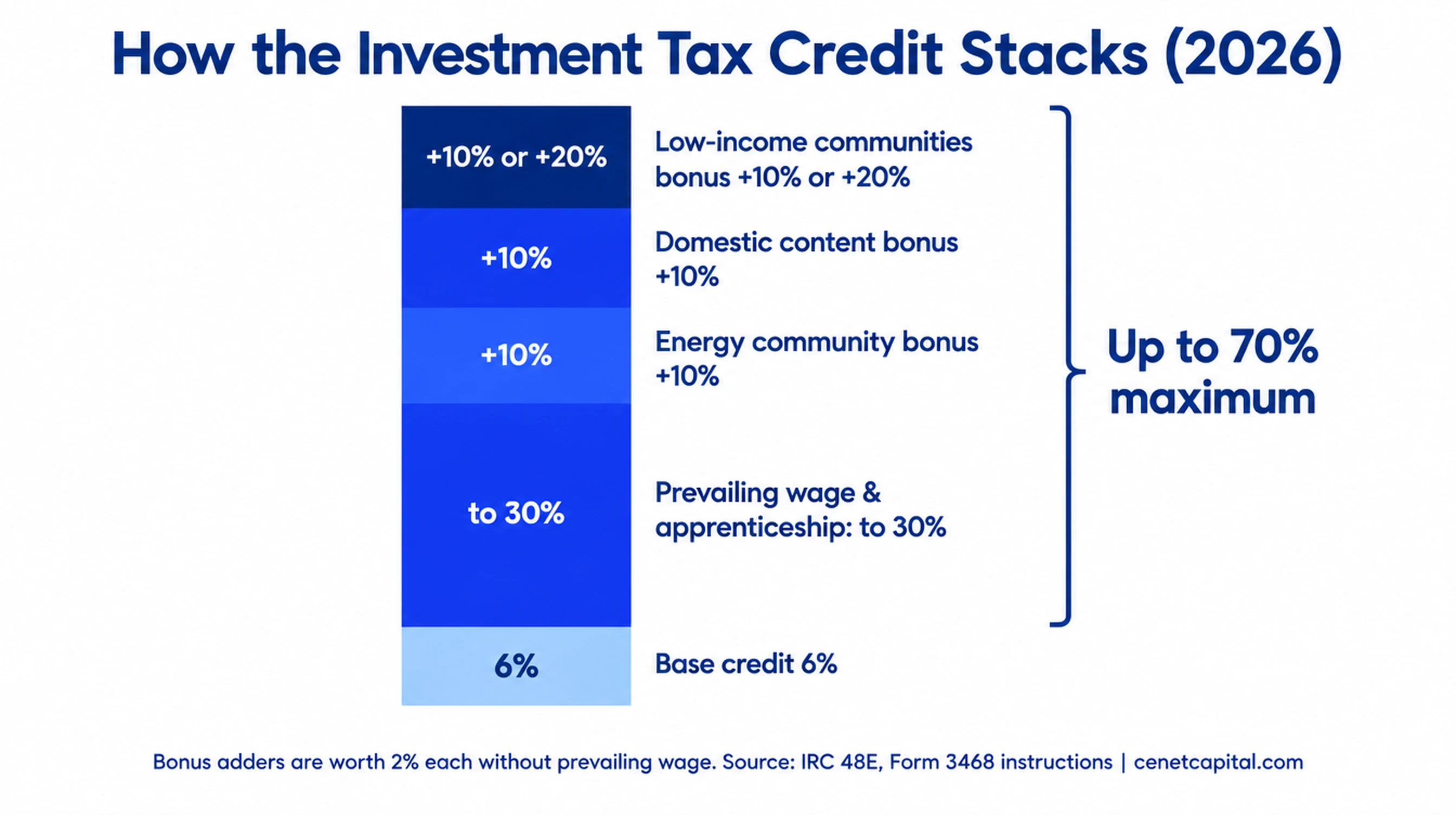
The base rate is 6%. It rises to 30% for projects that meet prevailing wage and apprenticeship (PWA) rules, are smaller than 1 megawatt (AC), or began construction before January 29, 2023. Three bonus adders can add up to 40 more percentage points. Each adder is worth one-fifth as much if the project doesn’t qualify for the 30% rate, which is why PWA compliance is the first thing anyone checks.
Component | With PWA (or exempt) | Without PWA | Who qualifies |
|---|---|---|---|
Base credit | 30% | 6% | Any qualifying facility or energy property |
Energy community bonus | +10 points | +2 points | Brownfields, fossil-fuel employment areas, closed coal mine or plant tracts |
Domestic content bonus | +10 points | +2 points | All structural steel and iron made in the U.S., plus a rising share of manufactured products |
Low-income communities bonus | +10 or +20 points | +10 or +20 points | Facilities under 5 MW that win an allocation from Treasury |
Maximum combined | 70% | 30% | Rare in practice; 40% to 50% is common |
For the domestic content bonus, the required share of U.S.-made manufactured products depends on when construction began: 40% for projects started on or before June 15, 2025, 45% from June 16 through December 31, 2025, and 50% in 2026, according to the 2025 Form 3468 instructions. Offshore wind has lower thresholds. The energy community bonus is checked against the IRS’s annual list of qualifying areas, which you can look up on the Department of Energy’s map.
How do you calculate the ITC?
Multiply the project’s eligible cost basis by the credit rate. A $4 million commercial solar project that meets PWA and sits in an energy community earns a 40% credit, or $1.6 million. Eligible basis generally includes the equipment and the labor to install it: panels, inverters, racking, batteries, wiring, and for small facilities, interconnection costs. It excludes land, buildings and their structural components, and anything paid for with grants that are excluded from income.
Total project cost: $4,300,000.
Minus ineligible costs (land lease prep, a new building roof, permits allocated to non-energy work): $300,000.
Eligible basis: $4,000,000.
Credit rate: 30% base with PWA + 10% energy community = 40%.
Investment tax credit: $4,000,000 × 40% = $1,600,000.
Two side effects belong in every model. First, the project’s depreciable basis is reduced by half the credit, so in this example the owner depreciates $3.2 million, not $4 million. Second, the credit vests over five years. If the project is sold or stops qualifying in that window, part of the credit is recaptured, starting at 100% in year one and dropping 20 points a year.
How much is your investment tax credit worth?
Illustrative only. Wind and solar must have begun construction by July 4, 2026, or be placed in service by December 31, 2027. The low-income bonus requires a Treasury allocation and applies to facilities under 5 MW. Credits are subject to 5-year recapture.
Price your ITC →What projects qualify for the investment tax credit?
Any facility that generates electricity with zero greenhouse gas emissions qualifies under Section 48E, along with standalone energy storage. Under legacy Section 48, the list includes solar, geothermal, fuel cells, microturbines, combined heat and power, small wind, waste energy recovery, biogas, microgrid controllers and storage. The technology-neutral design of 48E means new technologies can qualify if they show a zero emissions rate, rather than waiting for Congress to name them.
Solar: commercial rooftop, ground-mount, community solar and utility-scale. Residential solar owned by a homeowner falls under a different credit (Section 25D), which ended for expenditures after 2025.
Energy storage: batteries and other storage of at least 5 kWh, whether paired with solar or standalone. Storage is exempt from the wind and solar cutoff described below.
Geothermal, hydropower, nuclear and other zero-emission generation: eligible under 48E with a longer runway than wind and solar.
Fuel cells: for fuel cell property beginning construction after 2025, the One Big Beautiful Bill Act set a flat 30% credit with no bonus adders and no zero-emissions requirement. We cover how that plays out for data centers in what a data center fuel cell costs after the credit.
A facility can’t claim the ITC if it, or any prior owner, already claimed a production credit (Section 45 or 45Y) on it. That choice between the ITC and the PTC is one of the first decisions in any project model.
What did the One Big Beautiful Bill change about the ITC?
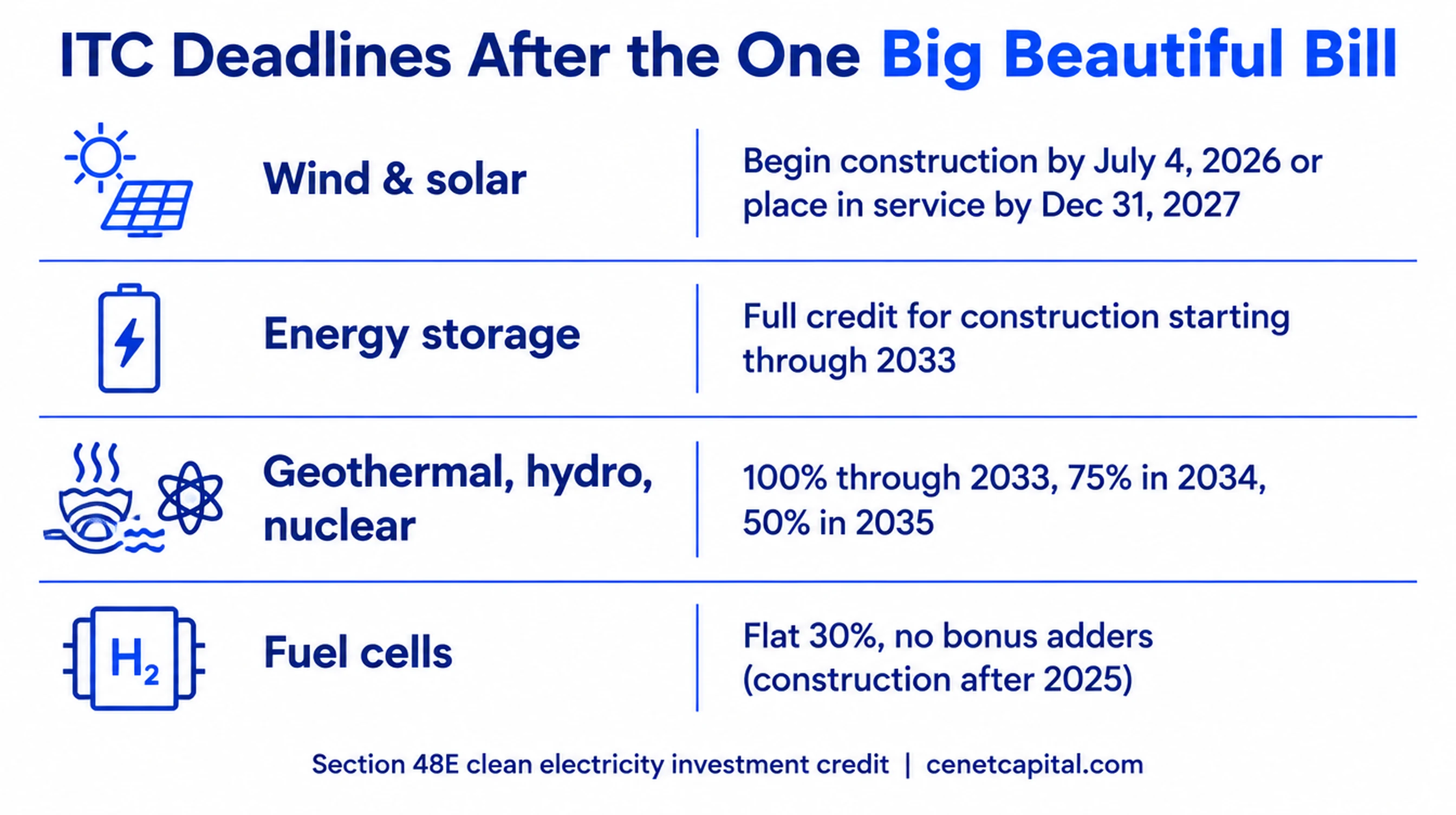
It put wind and solar on a short clock, kept a long runway for storage, geothermal and other technologies, added strict foreign-entity rules, and left transferability in place. The law (P.L. 119-21) was signed on July 4, 2025. These are the changes that matter for the ITC, as summarized by Kirkland & Ellis and reflected in the IRS’s own form instructions.
Technology | Deadline to keep the full 48E credit |
|---|---|
Wind and solar | Begin construction by July 4, 2026, or be placed in service by December 31, 2027 |
Energy storage | Not subject to the wind and solar cutoff; full credit for construction beginning through 2033 |
Geothermal, hydro, nuclear, other zero-emission generation | 100% for construction beginning through 2033, 75% in 2034, 50% in 2035, nothing after |
Fuel cells | Flat 30% for construction beginning after 2025, no adders |
The July 4, 2026 date has now passed. Wind and solar projects that began construction by then generally have four calendar years after the start year to be placed in service under the IRS’s continuity safe harbor. Projects that missed it must be in service by the end of 2027. How a large wind or solar project proves it began construction is itself in flux: the IRS’s Notice 2025-42 eliminated the 5% cost safe harbor for most of them, and a federal district court vacated that notice on June 6, 2026, with an appeal expected. Anyone buying or financing a 2026-start solar project should ask exactly which test the seller relied on.
The foreign-entity rules apply to projects beginning construction after 2025. A facility fails if too much of its cost comes from “prohibited foreign entities.” The required non-prohibited share starts at 40% for generation facilities and 55% for storage in 2026, rising each year to 60% and 75%. The taxpayer itself also can’t be a prohibited foreign entity, and credits can’t be sold to one.
ITC vs. PTC: which should a project claim?
Projects with high upfront cost relative to their output usually choose the ITC; projects that run at high capacity factors with low capital cost usually choose the production tax credit (PTC). The ITC pays once, at placed-in-service, based on cost. The PTC pays per kilowatt-hour for 10 years. Storage can only use the ITC, because it doesn’t generate electricity.
Investment tax credit (48 / 48E) | Production tax credit (45 / 45Y) | |
|---|---|---|
Based on | Eligible project cost | Electricity produced and sold |
Timing | All in the placed-in-service year | Annually for 10 years |
Recapture risk | Yes, for 5 years | No |
Best fit | Commercial solar, storage, geothermal, smaller projects | High-output utility wind and solar |
Typical 2026 sale price | Around 89 to 93 cents | Around 91 to 96 cents |
The price gap comes from recapture. A buyer of an ITC is exposed if the project is sold or stops operating within five years; a buyer of a PTC isn’t. Crux reported 2026 ITCs averaging about $0.895 per dollar early in the year, while 2026 PTCs rose to almost $0.917.
Who can claim the investment tax credit?
The owner of the project claims it. If the owner doesn’t have enough federal tax liability to use it, it can sell the credit to another taxpayer for cash, bring in a tax equity investor, or, if it’s a tax-exempt or government entity, take it as a direct payment from the IRS. Those three routes are why the ITC works for developers, nonprofits, schools and cities, not just profitable corporations.
Use it yourself. A profitable C corporation can offset up to roughly 75% of its federal tax above $25,000 each year with general business credits, carrying unused credits back one year (three for some newer credits) and forward 20 years.
Sell it. Under Section 6418, the owner can transfer all or part of the credit to an unrelated buyer for cash. The cash isn’t taxable to the seller, and the buyer can’t deduct what it paid. See our guide to transferable tax credits.
Tax equity. An investor joins the project partnership and takes most of the credit and depreciation, usually alongside a credit sale in what’s called a hybrid structure.
Elective pay. Tax-exempt organizations, state and local governments, tribes and rural electric co-ops can treat the credit as a payment and receive a refund.
How do you claim the ITC?
Complete a separate Form 3468 for each facility, carry the total to Form 3800 (General Business Credit), and attach both to your federal return for the year the project is placed in service. If you claim the 30% rate based on PWA, attach Form 7220. If you claim a bonus, attach the domestic content certification or energy community support. If you plan to sell the credit or take elective pay, you must first get a registration number from the IRS’s pre-filing registration portal and enter it on Form 3468, Part I, line 1. Our Form 3468 instructions walk through every part.
How much is an ITC worth in cash?
Most investment tax credits sell for 85 to 95 cents per dollar of credit. Small deals, weaker sellers and projects with open compliance questions price toward the bottom of that range. Cenet Capital sees deals across 80 to 95 cents depending on the grade of the credit: the seller’s financial strength, the deal size, whether the credit is insured, and how clean the PWA, basis and bonus documentation is. At 90 cents, the $1.6 million credit in the example above turns into $1.44 million of cash, typically paid when the project is placed in service and the transfer closes.
For a deeper breakdown of what moves the price, read transferable tax credit pricing, and see the latest numbers in our tax credit transfer market report. If you’re on the other side of the table, our buyer’s guide explains how corporations purchase ITCs at a discount.
Investment tax credit checklist
Confirm which section applies: 48 (construction began before 2025) or 48E (placed in service after 2024).
Document the beginning-of-construction date and the test used, especially for wind and solar.
Track prevailing wages and apprentice hours from the first day of construction.
Run the foreign-entity cost test for projects beginning construction after 2025.
Get a cost segregation or basis study so the eligible basis holds up.
Register with the IRS before you sell the credit or elect direct pay.
Plan for five years of recapture exposure and the basis reduction.
If your project is coming online and you’d rather have cash than a credit you can’t use, Cenet Capital buys, insures and finances investment tax credits. Tell us about the project and we’ll tell you what the credit is worth.
Have an ITC you can't use? Turn it into cash.
Cenet Capital buys, insures and finances investment tax credits from solar, storage and geothermal projects. Tell us about your project and we'll price your credit.

More Insights