
A plain-English walkthrough of IRS Form 3468 for 2025: what's new, each part, Part I line by line, Part V for 48E, required attachments, and selling the credit.
Author -
Paulestini Francois
Published -
READ TIME
Form 3468 is where an investment tax credit becomes real: it's the IRS form that calculates the credit for each solar array, battery system, geothermal plant or other qualifying property, and it's the first thing a credit buyer's tax counsel will review. The 2025 version added a new prevailing wage form, foreign-entity rules and new emissions reporting. Here's a step-by-step walkthrough of who files it, what each part does, which attachments you need, and how it works when you sell the credit.
What is Form 3468?
Form 3468, “Investment Credit,” is the IRS form a business uses to figure and claim investment tax credits, including the clean electricity investment credit (Section 48E), the energy credit (Section 48), the advanced energy project credit (48C), the advanced manufacturing investment credit (48D) and the rehabilitation credit for historic buildings. You file a separate Form 3468 for each facility or property, then carry the totals to Form 3800 and attach everything to your income tax return. The form changed substantially for 2025, adding new foreign-entity rules, a new prevailing wage form, and new reporting for emissions values. This walkthrough follows the 2025 Instructions for Form 3468, which the IRS revised in August 2026.
If you’re new to the credit itself, start with our complete guide to the investment tax credit. This article assumes you already know the project qualifies and need to get it onto the return correctly.
Who has to file Form 3468?
Any taxpayer claiming an investment credit for property placed in service during the year files Form 3468: corporations, partnerships, S corporations, individuals, estates, trusts, and tax-exempt or government entities taking the credit as elective pay. Partnerships and S corporations complete the form and pass the credit through to owners on Schedule K-1, and the owners report their shares on their own Form 3468 or Form 3800 as the instructions direct. Cooperatives passing unused credits to patrons use a separate Form 3468 marked “Unused Investment Credit from Cooperatives.”
One group does not file Form 3468 for a credit: companies that bought it. A buyer of a transferred credit reports it on Form 3800, the general business credit form, using the seller’s registration number. More on that below.
What’s new on the 2025 Form 3468?
Five changes matter most: a new Form 7220 for prevailing wage and apprenticeship, a 35% rate for the 48D manufacturing credit, foreign-entity restrictions and a wind and solar termination in Part V, restricted rates for some geothermal and solar property in Part VI, and new emissions-value reporting on line 2b.
Change | Where | What to do |
|---|---|---|
New Form 7220 for PWA verification | Parts III, V and VI | File one Form 7220 per facility when claiming the increased rate based on PWA |
48D rate rises to 35% | Part IV | Property placed in service in 2026 or later uses 35%; earlier property stays at 25% |
Foreign-entity rules and wind/solar termination | Part V (48E) | Confirm material assistance and prohibited foreign entity status; wind and solar starting after July 4, 2026 must be in service by end of 2027 |
Restricted percentages for some geothermal and solar property | Part VI (48) | Check the applicable percentage for your property type and start date |
Line 2b split into two checkboxes plus DOE control number | Part I | Report a provisional emissions rate petition, DOE emissions value or designated LCA model for 48E facilities |
What are the parts of Form 3468?
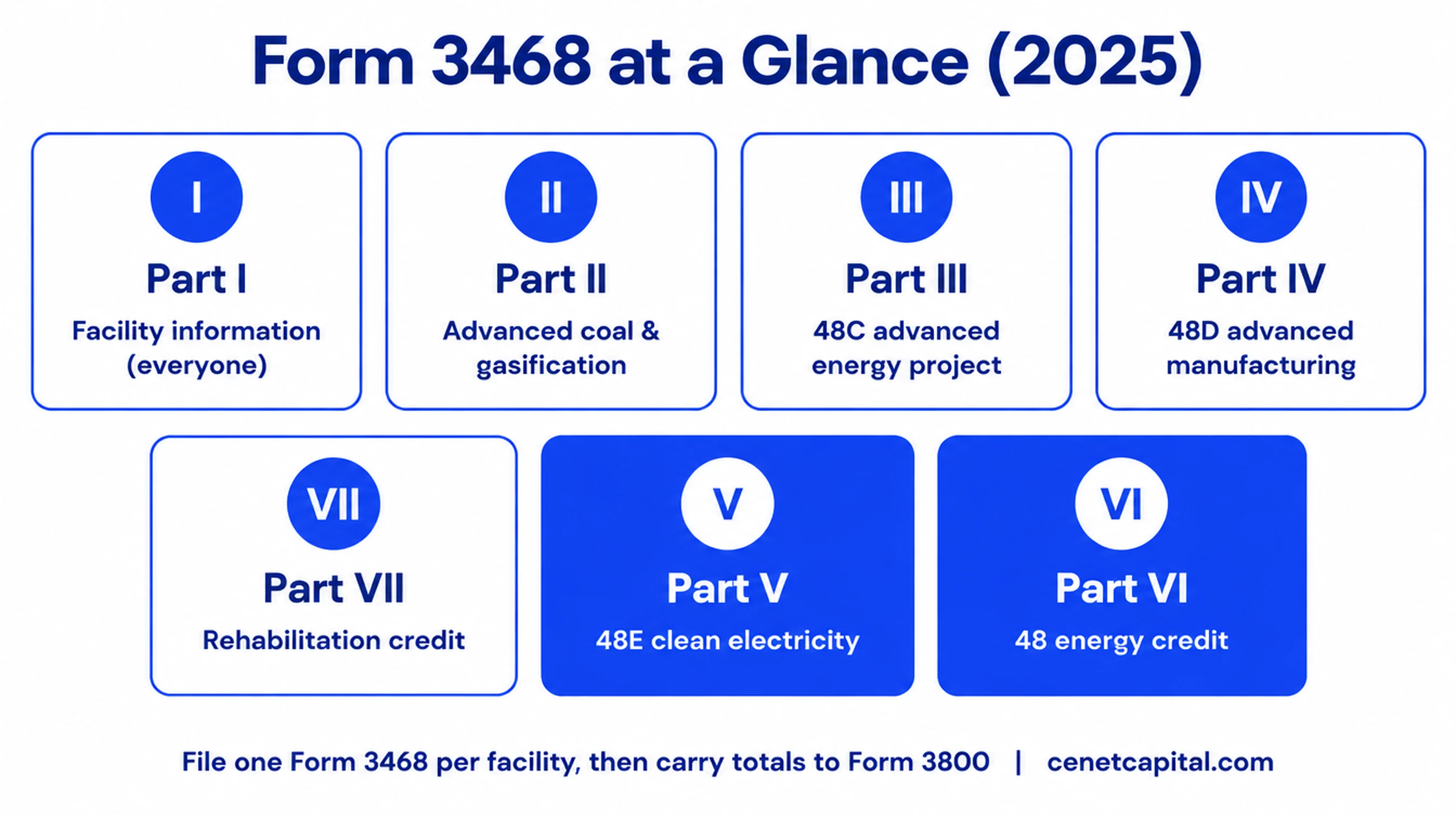
Every filer completes Part I for the facility, then the one part that matches the credit being claimed. For clean energy, that’s almost always Part V (Section 48E) or Part VI (Section 48).
Part | Credit | Typical filer |
|---|---|---|
Part I | Facility or property information (required for all) | Everyone |
Part II | Advanced coal and gasification project credits | Rare; legacy allocations |
Part III | Qualifying advanced energy project credit (48C) | Manufacturers with a DOE allocation |
Part IV | Advanced manufacturing investment credit (48D) | Semiconductor manufacturers |
Part V | Clean electricity investment credit (48E) | Solar, storage, geothermal and other projects placed in service after 2024 |
Part VI | Energy credit (48) | Projects that began construction before 2025, geothermal heat pumps, clean hydrogen facilities electing the ITC |
Part VII | Rehabilitation credit | Historic building owners |
Which parts of Form 3468 do you need?
General guidance based on the 2025 Instructions for Form 3468. File one Form 3468 per facility. Transfer and elective pay elections must be made on a timely filed original return. Confirm with your tax advisor.
Get your credit priced →How do you fill out Part I of Form 3468?
Part I identifies the facility: its IRS registration number, type, owner, location, and which rate and bonus tests it meets. Which lines you complete depends on the part you’re filing. Part V filers complete line 1 and lines 2b through 13; Part VI filers complete line 1 and lines 3 through 13.
Line 1, registration number. Enter the IRS-issued registration number if you’re selling the credit (Section 6418) or taking elective pay (Section 6417). If you’re simply using the credit against your own tax, you don’t need one.
Line 2a and 2b, emissions. Line 2a is for clean hydrogen facilities electing the energy credit in Part VI, Section M. Line 2b is for 48E facilities that petitioned for a provisional emissions rate, received a DOE emissions value, or used an IRS-designated lifecycle model. Most solar and storage filers skip both.
Line 3a through 3e, the facility. Type of property, the owner’s name and TIN if different from the filer, the street address, the latitude and longitude, and a checkbox if the project includes qualified interconnection property.
Lines 7 and 8, the increased rate. Check the box showing why the project qualifies for the 30% rate: under 1 MW, construction began before January 29, 2023, or prevailing wage and apprenticeship met. If PWA is the reason, attach Form 7220.
Line 9, domestic content. Check whether you’re claiming the bonus. If so, attach a domestic content certification statement.
Line 10, energy community. Check whether the project qualifies, and keep the support for which energy community category applies.
Lines 11 and 12, low-income communities bonus. Only for facilities that received a Treasury allocation under Section 48E(h) or 48(e).
Line 13, lease pass-through. If a lessor elects to treat the lessee as having acquired the property, the lessee claims the credit instead.
How do you complete Part V for the Section 48E credit?
Part V figures the credit as the applicable percentage times the qualified investment. Section A covers clean electricity facilities, Section B covers energy storage technology, and Section C totals them. The qualified investment is the basis of qualified property placed in service during the year, plus qualified interconnection costs for facilities of 5 MW AC or less.
Qualified property is tangible property used as an integral part of the facility, not a building or its structural components, and depreciable, with original use starting with you.
Applicable percentage is 6% or 30%, plus any domestic content, energy community and low-income bonus points.
Tax-exempt bond reduction. If the project was financed with tax-exempt private activity bonds or subsidized energy financing, line 6 reduces the credit. If it wasn’t, skip line 6.
Exclusions. You can’t claim 48E for a facility that has ever had a credit under Section 45, 45J, 45Q, 45U, 45Y, 48 or 48A allowed. For tax years beginning after July 4, 2025, residential-type property you lease to others (the kind described in Section 25D) doesn’t qualify.
Tax-exempt entities taking elective pay face an additional rule: if the facility doesn’t meet domestic content requirements, the payment can be reduced unless an exception applies. That phaseout is covered in the Part V instructions.
Which attachments go with Form 3468?
At minimum: Form 3800, plus Form 7220 if you claim the 30% rate based on PWA. Add a domestic content certification statement, energy community support, a transfer election statement or elective payment election as applicable. Missing attachments are one of the most common reasons a buyer’s diligence team sends a deal back.
Attachment | When required |
|---|---|
Form 3800, General Business Credit | Always |
Form 7220, PWA Verification and Corrections | Claiming the increased rate based on PWA (construction began on or after January 29, 2023) |
Increased credit amount statement | Any increased rate claim in Part V or VI, with a signed declaration |
Domestic content certification statement | Claiming the domestic content bonus |
Transfer election statement | Selling the credit under Section 6418 |
PER petition and DOE letter | 48E facilities using a provisional emissions rate |
Form 8453 | Individuals e-filing with required attachments |
How does Form 3468 work when you sell the credit?
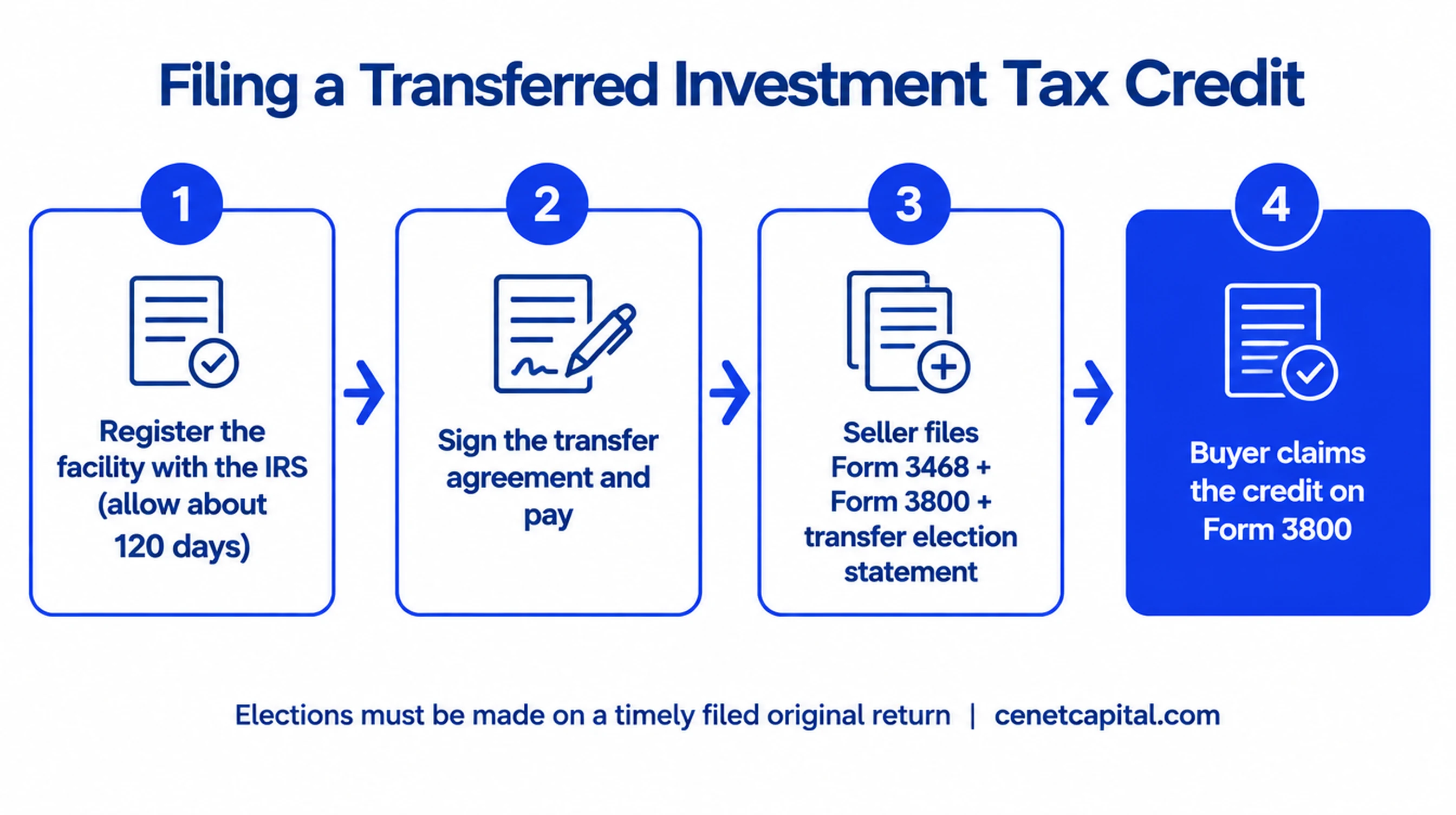
The seller still completes Form 3468 to figure the credit, enters its registration number on line 1, and attaches a transfer election statement signed by both parties to its return. The buyer does not file Form 3468; it claims the purchased credit on Form 3800. The sequence looks like this:
Register the facility. Use the IRS’s Energy Credits Online portal after the property is placed in service. The IRS says to allow about 120 days for a number, and each registration number is good for one tax year only. See IRS pre-filing registration and Publication 5884.
Sign the transfer agreement. Registration doesn’t have to be finished before signing or funding, but it must be done before the return is filed.
Seller files. Form 3468 (Part I and Part V or VI), Form 3800, the transfer election statement and supporting attachments, on an original return filed by the due date including extensions.
Buyer files. The buyer reports the credit on its Form 3800 for the tax year in which the seller’s tax year ends, and attaches the transfer election statement.
The election can’t be made on an amended return, so a missed deadline usually means the credit can’t be sold for that year. If you’re planning a sale, our guide on how to sell commercial solar tax credits covers the commercial side.
What are the most common Form 3468 mistakes?
One form for several projects. Since 2023, each facility needs its own Form 3468.
No registration number on a transferred credit. Without it, the transfer election isn’t valid.
Claiming 30% without Form 7220. The PWA verification form is now required for each facility.
Including ineligible basis. Buildings, roofs, land and grant-funded costs inflate the credit and invite an excessive credit transfer penalty of 20% for buyers.
Wrong part. Projects that began construction before 2025 generally use Part VI (Section 48), not Part V.
Late filing. Transfer and elective pay elections must be on a timely original return.
Do you need a tax professional to file Form 3468?
For anything beyond a simple single-project claim, yes. Basis allocations, bonus documentation, PWA records and the foreign-entity analysis each carry real audit and recapture exposure, and a credit buyer’s due diligence will review every one of them. Use this walkthrough to know what your advisor will ask for, then let them prepare the return.
If you’re filing Form 3468 for a project whose credit you’d rather sell, Cenet Capital buys, insures and finances investment tax credits. We’ll work with your tax advisor so the registration, transfer election and Form 3468 line up with the deal.
Filing Form 3468 for a credit you'd rather sell?
Cenet Capital buys, insures and finances investment tax credits, and works with your tax advisor so the registration, transfer election and Form 3468 line up with the deal.

More Insights