

What transferable tax credits sell for now: 2026 volumes, pricing by credit type and deal size, insurance trends, and what's driving the market. Updated quarterly.
Author -
Paulestini Francois
Published -
READ TIME
The tax credit transfer market is on track for its biggest year yet, after a record second quarter in 2026. But averages hide a wide spread: the same dollar of credit can sell for 80 cents or 96 cents depending on the credit type, the deal size, the seller and the paperwork behind it. This quarterly report brings together the latest public market data and what Cenet Capital is seeing in its own deals, so sellers and buyers know where pricing really stands.
What are transferable tax credits selling for right now?
As of October 2026, most transferable clean energy tax credits are trading between about 88 and 96 cents per dollar of credit. Early-2026 averages were roughly $0.895 for investment tax credits and $0.917 for production tax credits, with clean fuel (45Z) credits lower at about $0.85 to $0.93. Credits from large, investment-grade sellers with insurance trade at the top of the range. Small deals and less established sellers trade at the bottom, and Cenet Capital sees some credits clear as low as 80 cents when size, seller credit or documentation is weak.
This report pulls together the most recent public market data, mainly Crux’s 2026 Mid-Year Market Intelligence Report (August 18, 2026), its 2025 full-year report and first-quarter 2026 update, and adds what Cenet Capital is seeing in its own deal flow. We update it every quarter. The next edition will cover full-year 2026.
How big is the tax credit transfer market in 2026?
About $21 billion of credits were transferred in the first half of 2026, and Crux projects $47.5 to $49 billion for the full year, 13% to 18% above 2025’s record of about $42 billion. The first half was down about 12.5% from the first half of 2025, but almost all of that drop came from fewer multi-year PTC “strip” sales. Excluding them, volume was up about 9%. The second quarter alone set a record at $14.9 billion.
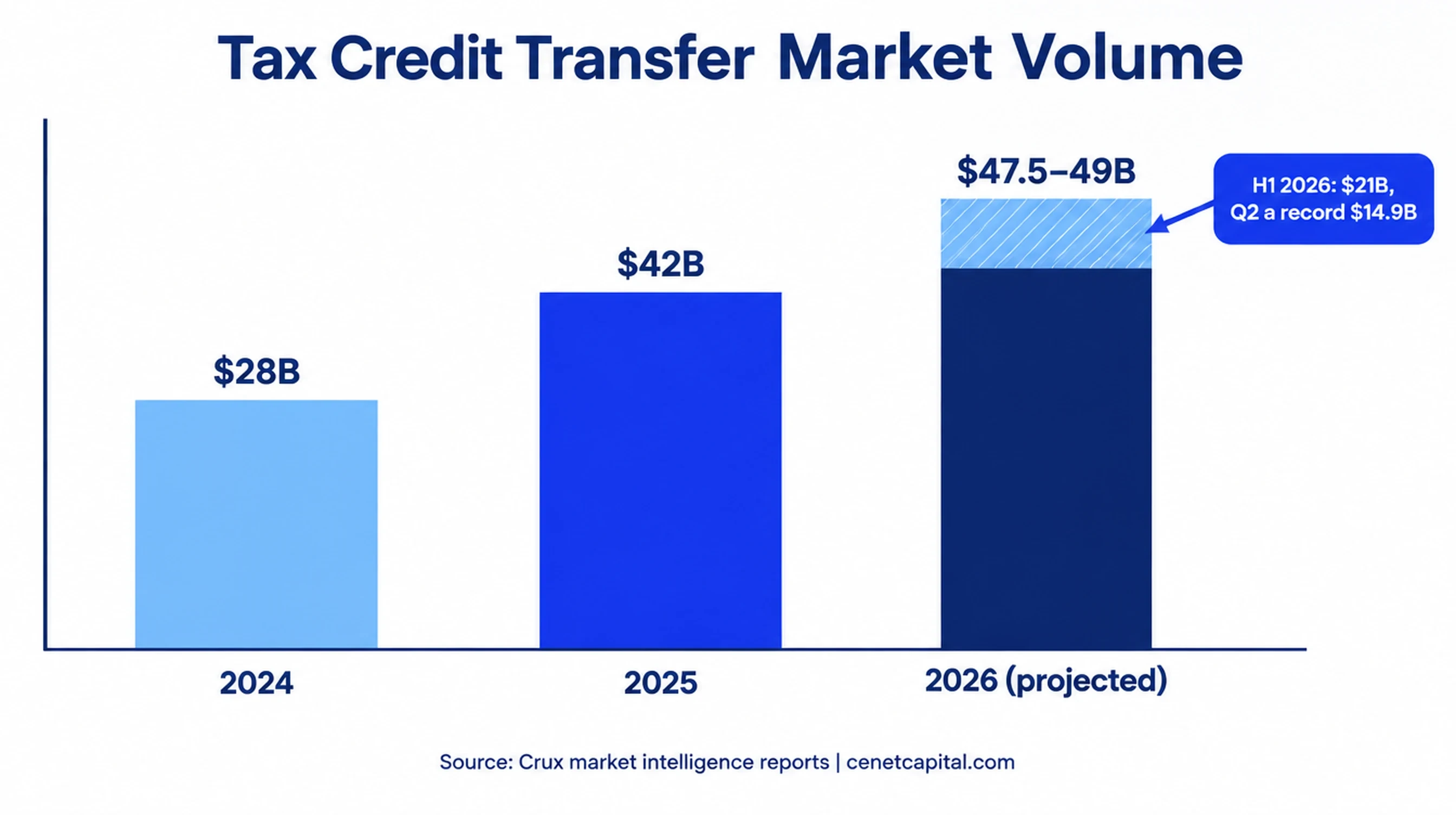
Period | Transfer volume | Change |
|---|---|---|
2024 | ~$28 billion | First full year of a mature market |
2025 | ~$42 billion | +48% year over year |
Q1 2026 | ~$6.1 billion | Slow start as buyers waited on 2025 tax positions |
Q2 2026 | $14.9 billion | Highest quarter on record |
H1 2026 | $21 billion | -12.5% (or +9% excluding PTC strips) |
2026 projection | $47.5 to $49 billion | +13% to +18% |
Transfers are part of a larger picture. Total tax credit monetization, including tax equity and preferred equity, reached about $63 billion in 2025, and Crux forecasts $64 to $69.5 billion for 2026. Tax equity and preferred equity together are projected at $46.3 billion this year, with hybrid structures, where a tax equity investor’s credits are partly sold to transferees, accounting for more than three-quarters of tax equity commitments.
How do prices differ by credit type?
Production credits trade higher than investment credits, and established credits trade higher than newer ones. The gap reflects risk: an ITC buyer carries five years of recapture exposure and basis risk, while a PTC buyer is paid only for power already produced.
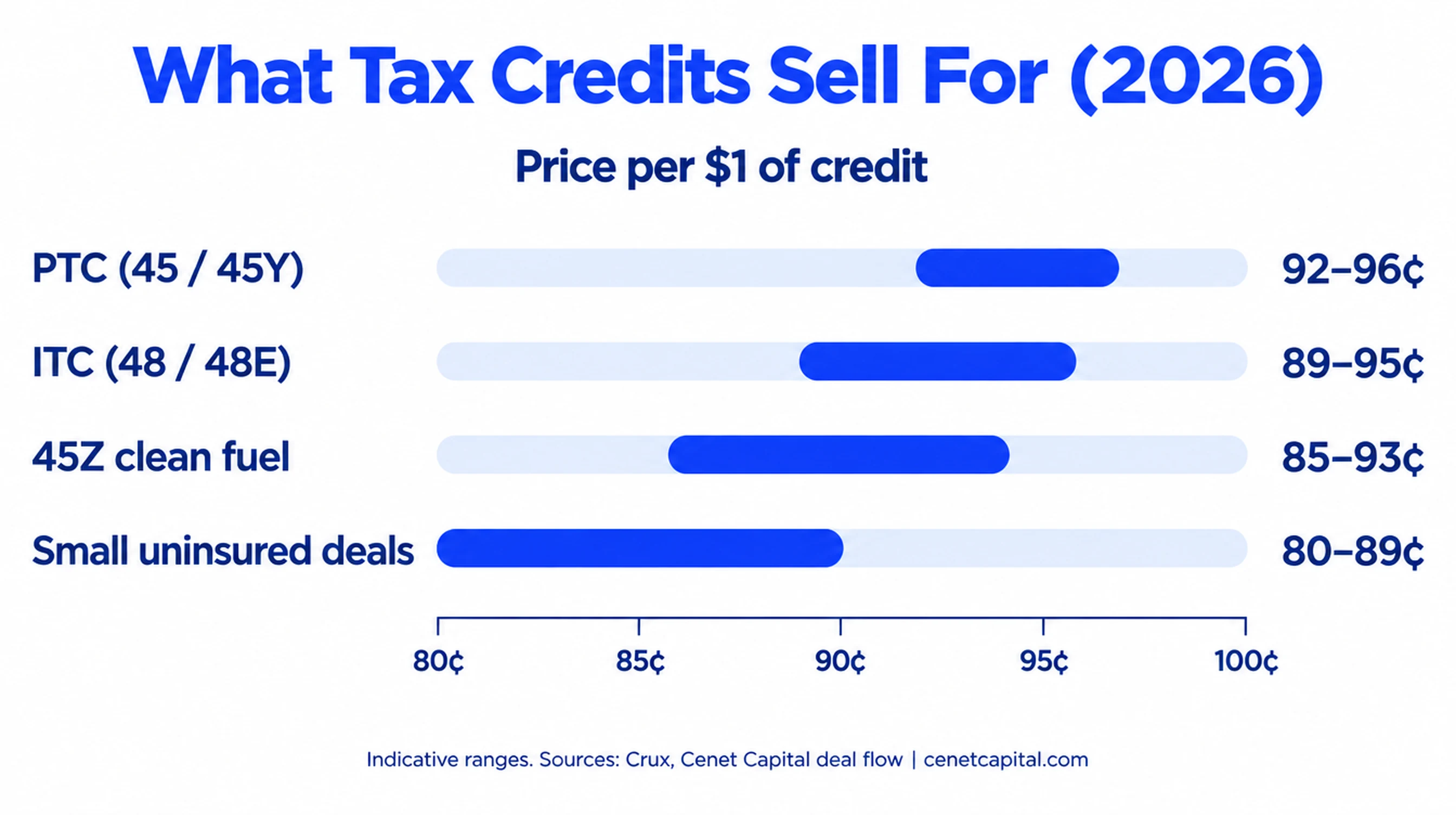
Credit | Recent pricing (per $1 of credit) | What moves it |
|---|---|---|
ITC (48 / 48E), 2026 vintage | ~$0.895 average early 2026; $0.92 to $0.95 for investment-grade sellers | Seller credit, insurance, basis step-up, recapture protections |
PTC (45 / 45Y), 2026 vintage | ~$0.917 average early 2026; $0.92 to $0.96 for investment-grade sellers | Single-year vs. multi-year strip, operating history |
ITC, 2025 vintage | ~$0.909 average for the year | Utility-scale rose to ~$0.926; residential fell to ~$0.900 |
45Z clean fuel | ~$0.85 to $0.93 | Emissions-score certainty, producer strength |
Tech-neutral 45Y / 48E | Measurable discount to legacy 45 / 48 | Newer rules, foreign-entity diligence |
Pricing above is “all-in” to the buyer: in most deals the seller separately pays for insurance and any intermediary. That means the net cash a seller keeps is usually a few cents below the headline price. For the factors behind each number, see transferable tax credit pricing.
Which technologies are selling credits?
Solar is still the largest source, but its share is falling as storage and solar-plus-storage grow and wind sales drop sharply. In the first half of 2026, solar accounted for about 30% of transfer volume, down from 35% a year earlier. Wind fell from 23% to about 7.5%, largely because fewer multi-year wind PTC strips were sold. Solar-plus-storage roughly doubled its share.
Clean fuels are the fastest-growing niche. 45Z transactions reached about $1.7 billion in the first half of 2026, compared with $1.1 billion for all of 2025, as final rules gave buyers more confidence. Manufacturing credits under 45X remain a major source of large, investment-grade supply.
How common is tax credit insurance?
Insurance is now the norm for large deals and for the newer 48E credit, and rare for small ones. Crux found roughly 87% of Section 48E transaction volume came from non-investment-grade sellers and carried insurance, compared with about 40% of legacy Section 48 volume. Across deal sizes, 67% of deals of $10 million or more were insured versus only 11% under $10 million.
The reason is cost. Premiums typically run 2% to 5% of the insured limit, with coverage often set at 90% to 140% of the credit amount, and carrier quotes that ran $150,000 to $350,000 per policy in 2024 reached $450,000 or more in the first half of 2025. On a $3 million credit, that can wipe out most of the seller’s margin, so smaller deals rely on indemnities, holdbacks and conservative pricing instead.
How do deal size and seller quality affect price?
Bigger deals from stronger sellers price higher. A $100 million credit from an investment-grade sponsor can clear several cents above a $2 million credit from a first-time developer. Buyers spend roughly the same legal and diligence budget whether a deal is $5 million or $50 million, so they need a bigger discount to justify small ones. In Cenet Capital’s deal flow, that’s the main reason the range runs from 80 to 95 cents.
Deal profile | Where it tends to price |
|---|---|
$50M+, investment-grade seller, insured or strong guaranty | Top of range (about $0.93 to $0.96) |
$10M to $50M, experienced sponsor, insured | Middle (about $0.89 to $0.93) |
Under $10M, single project, uninsured | Lower (about $0.80 to $0.89) |
Portfolio of small projects, aggregated and insured | Can move up toward the middle |
These bands are Cenet Capital’s observations, not a published index. Individual deals vary with credit type, timing and documentation.
What could your tax credit sell for?
Illustrative estimate based on Cenet Capital's observed 80–95¢ range and published market data. Not an offer. Actual pricing depends on full diligence.
Get your actual price →What’s driving the market in the second half of 2026?
The July 4, 2026 wind and solar deadline has passed. Projects that began construction in time keep their credits for years to come, so expect a steady pipeline. Crux estimates about 170 GW of wind and solar capacity was safe-harbored in 2025 alone.
Beginning-of-construction uncertainty. A federal court vacated IRS Notice 2025-42 on June 6, 2026, restoring the 5% safe harbor for large wind and solar, but an appeal is expected. Buyers are asking which test a project relied on and pricing accordingly.
Foreign-entity diligence. Projects starting construction after 2025 must meet material assistance thresholds. Supply-chain documentation is now a standard diligence item.
Carryover supply. Crux estimated $8 to $10 billion of 2025-vintage credits were still unsold at the start of 2026, with sellers holding out for premium prices.
Buyer readiness. In early 2026, 85% of buyers surveyed expected to know their 2025 tax liability by the end of the first quarter, which helped unlock the record second quarter.
Where are tax credit prices headed in 2027?
We expect prices to stay in roughly the same band, with the gap between strong and weak credits widening rather than the whole market moving. Demand is broad and still growing: more first-time corporate buyers arrive every year, and existing buyers are making multi-year commitments. Supply is also deep, because wind and solar projects that began construction before July 4, 2026 will keep producing credits through the end of the decade, and storage, manufacturing and clean fuel credits continue to grow.
What will separate prices is documentation. Credits backed by a clear beginning-of-construction record, clean foreign-entity analysis, PWA payroll support and, for larger deals, insurance should hold the top of the range. Credits with open questions on any of those points will need bigger discounts or won’t trade at all. Two things could move the whole market: the outcome of the appeal over Notice 2025-42, and any further legislation affecting transferability. Neither has changed the rules for credits already earned.
Signal to watch | Why it matters |
|---|---|
Appeal of the Notice 2025-42 ruling | Determines which wind and solar starts buyers accept without extra protection |
IRS guidance on material assistance | Sets how much supply-chain proof a 2026-start project needs |
Insurance capacity and premiums | Drives pricing for 48E and non-investment-grade sellers |
Corporate tax liability forecasts | Buyers can only buy what they can use |
What should sellers and buyers do now?
Sellers should register early, document beginning of construction and PWA thoroughly, and decide on insurance before going to market. Buyers should commit earlier in the year to see the best inventory and use the estimated-tax timing benefit. The fourth quarter is when the market is most crowded and diligence teams are most stretched.
Sellers: estimate what your credit is worth, then read how to sell commercial solar tax credits.
Buyers: start with our corporate buyer’s guide.
Everyone: our tax credit transfer market statistics page collects the key figures with sources.
Methodology and sources
Market volume, average pricing, technology mix and insurance data come from Crux’s published reports and updates cited above. Deal-size pricing bands reflect Cenet Capital’s own transaction experience and are indicative only. Figures are rounded. This report is general information, not tax or investment advice. Journalists and analysts are welcome to cite it with a link to this page.
Want a price for a specific credit? Cenet Capital buys, insures and finances clean energy tax credits. Tell us the credit type, amount and timing and we’ll tell you where it should land in today’s market.
Where would your credit price today?
Cenet Capital buys, insures and finances clean energy tax credits. Share your credit type, amount and timing and we'll tell you where it should land in this market.

More Insights