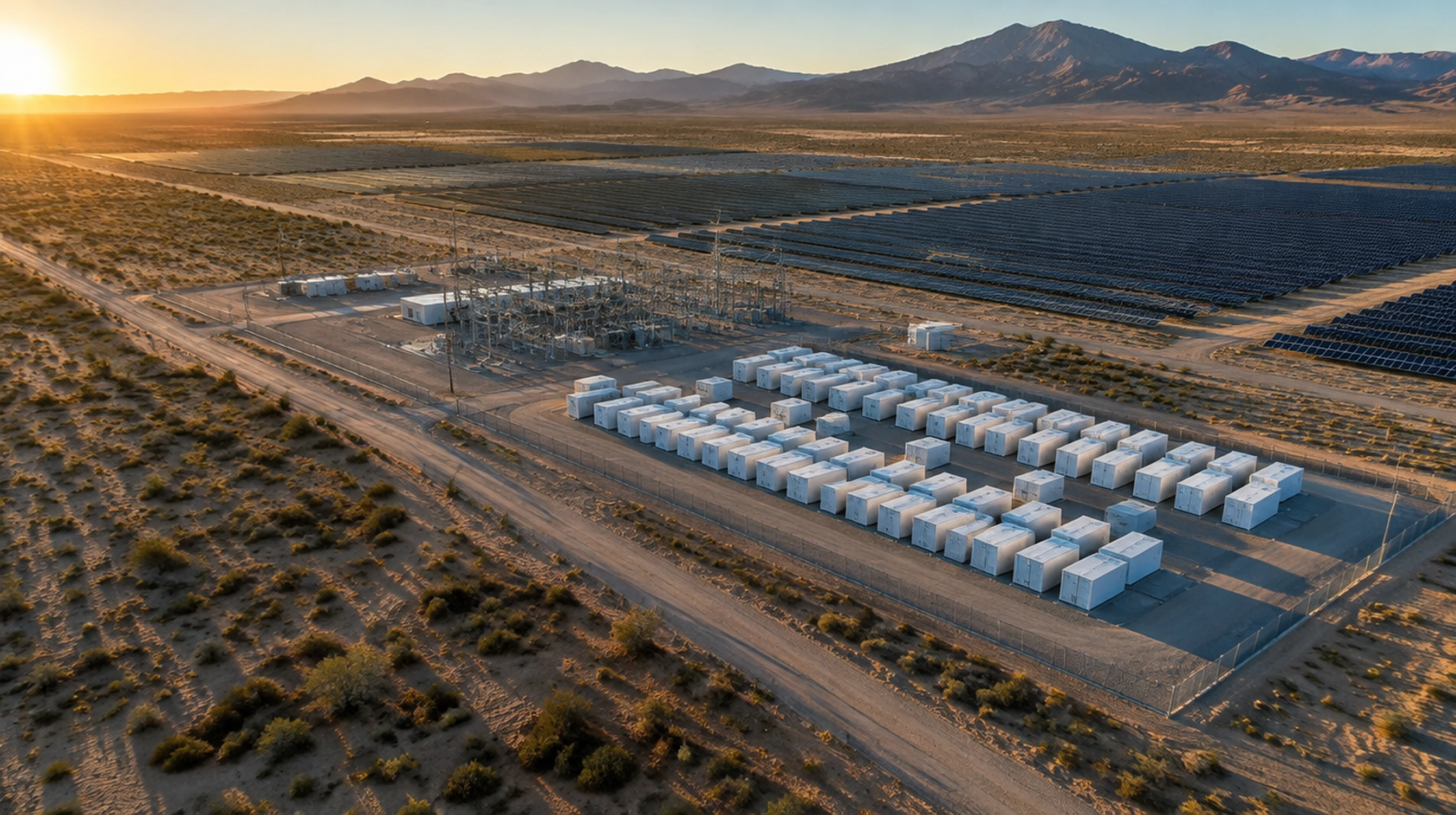

How corporations buy transferable clean energy tax credits at a discount: eligible credits, 2026 pricing, the process, due diligence, savings math and risks.
Author -
Paulestini Francois
Published -
READ TIME
Buying clean energy tax credits has become one of the simplest ways for a profitable company to lower its federal tax bill: pay roughly 88 to 96 cents for each dollar of credit, and claim the full dollar on your return. About one in four Fortune 1000 companies already does it. This guide walks a corporate buyer through the whole process, from sizing your tax capacity to due diligence, pricing, the savings math and the risks, so you know exactly what you're signing up for.
Can a company buy clean energy tax credits?
Yes. Since 2023, any U.S. taxpayer that isn’t related to the seller can buy eligible clean energy tax credits for cash under Section 6418 of the tax code, usually at 5 to 15 cents below face value, and use them to reduce its federal income tax. A company that pays $9.2 million for $10 million of credits saves $800,000 in federal tax. The buyer doesn’t have to own, operate or invest in the project. It simply pays cash for the credit and claims it on its own return.
The market has grown quickly. According to Crux, about $42 billion of credits changed hands in 2025, up from $28 billion in 2024, and roughly one in four Fortune 1000 companies now participates. Crux’s 2026 mid-year report projects $47.5 to $49 billion this year. This guide explains how a corporate buyer gets from interest to a credit on its Form 3800.
Which tax credits can you buy?
Eleven federal credits are transferable. The ones buyers see most often are the investment tax credit (Sections 48 and 48E), the production tax credit (45 and 45Y), the advanced manufacturing credit (45X) and the clean fuel credit (45Z). All of them are general business credits, so they offset federal income tax the same way regardless of which project created them.
Credit | Generated by | Buyer considerations |
|---|---|---|
ITC (48, 48E) | Solar, storage, geothermal, fuel cells | One-time credit; 5-year recapture risk |
PTC (45, 45Y) | Wind, solar, hydro, nuclear output | Annual credits; no recapture; often sold as multi-year strips |
45X | U.S. solar, battery and component manufacturing | Large volumes from creditworthy manufacturers; foreign-entity diligence |
45Z | Biofuel and RNG producers | Emissions-score risk; priced lower |
45Q, 45U, 45V, 48C, 30C | Carbon capture, nuclear, hydrogen, advanced manufacturing projects, EV chargers | Specialized diligence; smaller supply |
Production credits generally carry less risk for a buyer than investment credits, because they’re earned only after power or product is actually produced, and there’s no recapture if the project is later sold. That’s reflected in price. See our investment tax credit guide for how the ITC is calculated and what can trigger recapture.
How does a company buy tax credits, step by step?
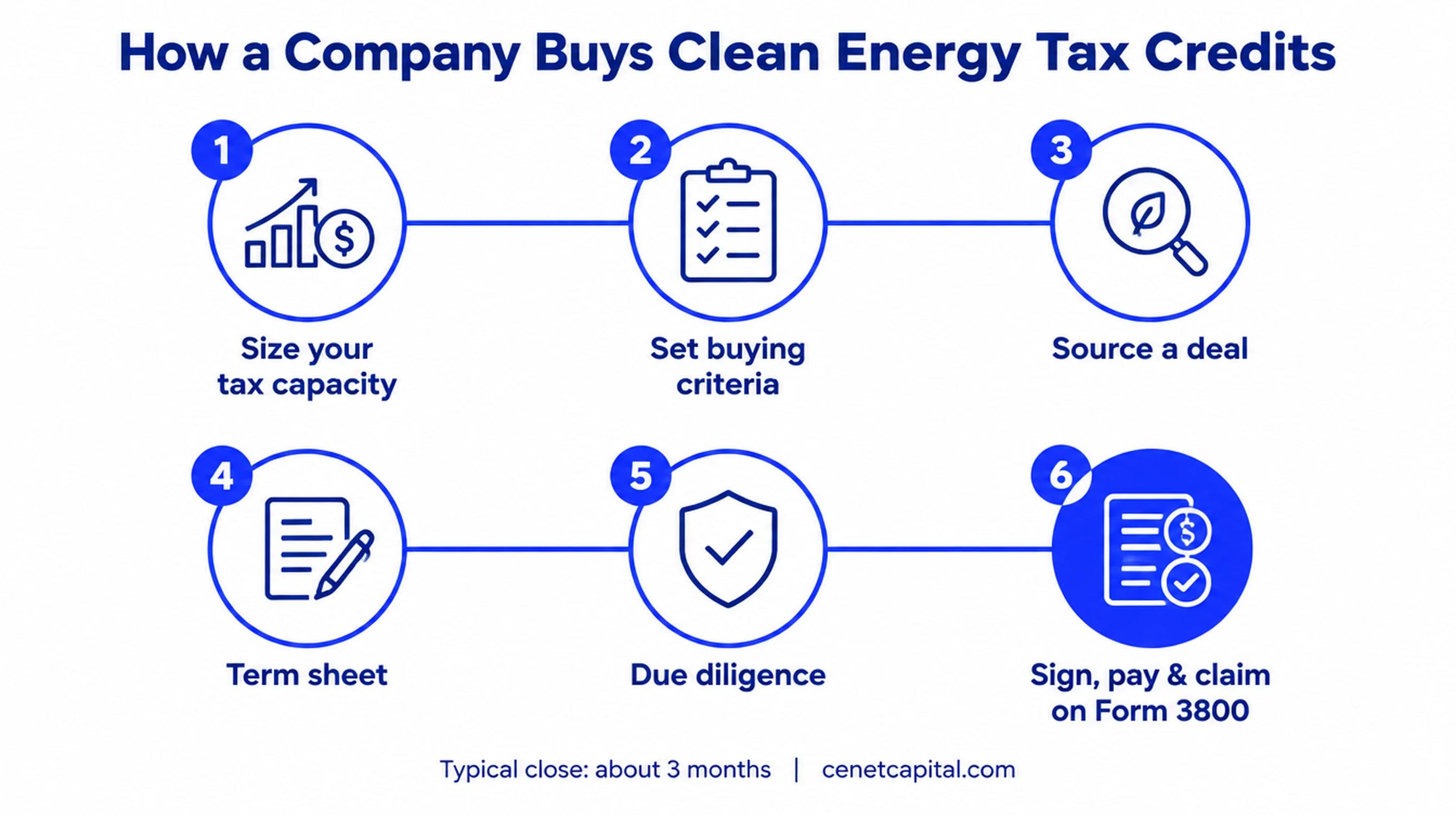
Size your tax capacity, define what you’ll buy, source a deal, negotiate a term sheet, run due diligence, sign a tax credit transfer agreement, pay, and claim the credit on Form 3800. Crux says deals it facilitates close in about three months on average, taking a buyer 20 to 40 hours of internal time.
Estimate your federal tax liability. General business credits can generally offset about 75% of federal income tax above $25,000 in a year. Work with your tax team to find a conservative capacity number for the year you’ll claim the credit, and decide whether you’ll buy all of it in one deal or spread it out.
Set your buying criteria. Credit type, tax year (vintage), deal size, seller credit quality, whether you require insurance, and how much recapture risk you’ll accept. Many first-time buyers start with current-year PTCs or insured ITCs from experienced sponsors.
Source the deal. Through a marketplace, a broker or advisor, or directly from a developer or intermediary such as Cenet Capital. Intermediary fees of 0.5% to 3% are usually paid by the seller.
Sign a term sheet. It sets the price per dollar of credit, the amount, the payment schedule, indemnity, insurance and exclusivity.
Run due diligence. Usually through outside tax counsel. This is where most of the work happens, covered in the next section.
Sign the tax credit transfer agreement (TCTA) and pay cash on the agreed schedule. Payments have to fall within the window that starts on the first day of the seller’s tax year in which the credit arises and ends on the due date of the seller’s transfer election statement.
Claim the credit. The seller registers the facility with the IRS and attaches a transfer election statement to its return. You report the credit on Form 3800 for the tax year in which the seller’s tax year ends, and attach the statement.
What due diligence should a buyer do?
Confirm the credit exists, is calculated correctly, and won’t be clawed back: eligibility, basis, prevailing wage and apprenticeship, bonus adders, foreign-entity compliance, ownership, and recapture protections. If the IRS later disallows part of a credit you bought, you owe the tax on the disallowed amount, plus a 20% penalty on any “excessive credit transfer” unless you can show reasonable cause. Good diligence is the reasonable cause.
Area | What to request |
|---|---|
Eligibility and timing | Placed-in-service evidence, beginning-of-construction support, IRS registration number |
Credit amount | Independent cost segregation or basis report; appraisal if basis was stepped up |
Prevailing wage and apprenticeship | Certified payroll, apprentice hours, Form 7220, cure payments if any |
Bonus adders | Energy community analysis, domestic content certification |
Foreign-entity rules | Ownership and supply-chain review; material assistance calculation for projects started after 2025 |
Seller strength | Financial statements or parent guaranty backing the indemnity |
Recapture | Operating plan, insurance, covenants not to sell the project during the 5-year ITC period |
The amount of diligence should scale with deal size. A $3 million credit from a single rooftop project doesn’t justify the same legal budget as a $150 million utility-scale strip, which is one reason smaller deals trade at lower prices.
How much do tax credits cost to buy?
In 2026, most credits trade between about 88 and 96 cents per dollar. Large, insured credits from investment-grade sellers sit at the top; small deals, newer credit types and weaker sellers sit lower. Crux reported 2025 ITCs averaging $0.909, and early 2026 averages of about $0.895 for ITCs and $0.917 for PTCs. Its published ranges for investment-grade sellers in 2025 were $0.92 to $0.95 for ITCs and $0.92 to $0.96 for PTCs. Clean fuel (45Z) credits traded around $0.85 to $0.93.
Cenet Capital sees pricing from 80 to 95 cents depending on the grade of the credit. The factors that move it are consistent: deal size, seller creditworthiness, credit type, insurance, how early the buyer commits, and how clean the documentation is. We break them down in transferable tax credit pricing, and track current numbers in our tax credit transfer market report.
What does a buyer actually save?
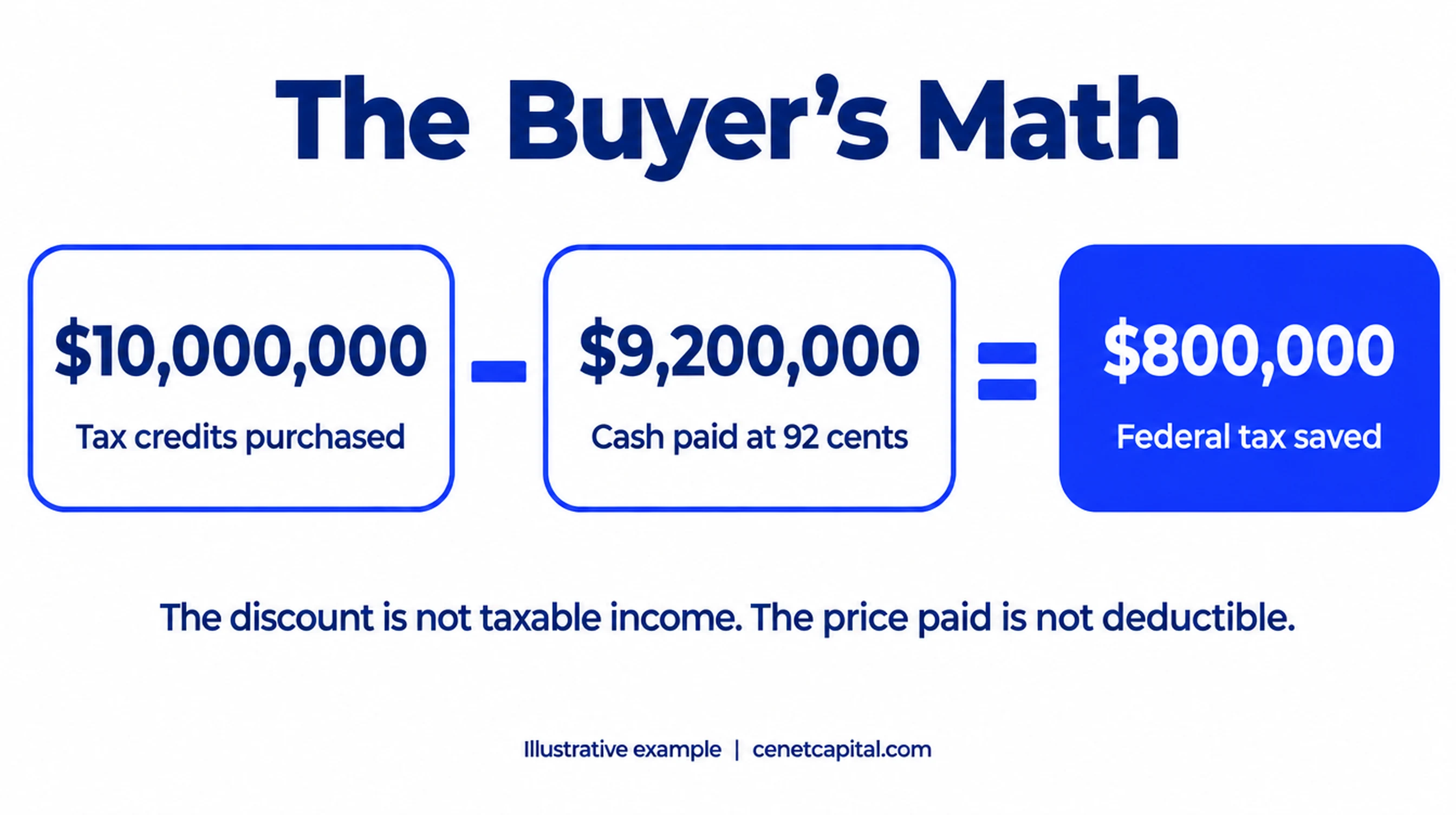
The savings equal the face value of the credit minus the price paid. At 92 cents, every $10 million of credits saves $800,000 of federal tax, an 8.7% return on the cash deployed, usually within the same tax year. The discount isn’t taxable income to the buyer, and the price paid isn’t deductible, so the math is simple.
Credit amount | Price | Cash paid | Federal tax saved |
|---|---|---|---|
$5,000,000 | $0.89 | $4,450,000 | $550,000 |
$10,000,000 | $0.92 | $9,200,000 | $800,000 |
$25,000,000 | $0.935 | $23,375,000 | $1,625,000 |
$50,000,000 | $0.945 | $47,250,000 | $2,750,000 |
Timing improves the return. Treasury’s final regulations let a buyer factor a credit it has purchased, or intends to purchase, into its quarterly estimated tax payments. A buyer can lower its estimates in April and June and pay the seller later in the year, when the project is placed in service. The cash it holds back from the IRS in the meantime effectively funds part of the purchase.
How much could your company save by buying tax credits?
Illustrative only. Capacity uses a simplified general business credit limit (net income tax less 25% of the amount above $25,000) and ignores minimum tax and other credits. Default prices reflect typical 2026 ranges. Confirm with your tax advisor.
See available credits →What are the risks of buying tax credits?
The main risks are disallowance (the credit is smaller than claimed), recapture (an ITC project is sold or stops qualifying within five years), and non-delivery (the project isn’t finished in time). Indemnities, insurance and payment structure manage all three.
Disallowance. The buyer owes the tax, plus the 20% excessive credit transfer penalty unless it had reasonable cause. Seller indemnities and tax credit insurance cover this.
Recapture. For an investment tax credit, the buyer bears recapture if the project is disposed of or stops qualifying during the five-year period. Covenants, notices and insurance address it.
Delivery and timing. If a project slips into the next year, the credit arrives a year late. Pay-at-placed-in-service structures and conditions precedent protect the buyer’s cash.
Your own tax position. If your taxable income falls, you may not be able to use the full credit this year. Unused amounts carry back one year and forward 20, but the economics weaken.
Insurance has become standard on larger deals. Crux found 67% of deals of $10 million or more were insured, against only 11% of deals under $10 million, mainly because premiums of roughly 2% to 5% of the insured amount are hard to absorb on a small credit. Sellers usually pay for it.
Can individuals buy clean energy tax credits?
Technically yes, but rarely usefully. Credits bought by individuals, and by certain closely held corporations, are treated as passive, so they can only offset tax on passive income. Most individual buyers don’t have enough passive income tax to absorb them. The market is overwhelmingly corporate: banks, insurers, technology companies, manufacturers, retailers and other C corporations with steady federal tax bills.
How do you get started as a tax credit buyer?
Bring your tax director and outside counsel into one short conversation, agree on a target amount and risk profile, and then look at live deals. The earlier in the year you commit, the more inventory you’ll see, and the more you can benefit from adjusting your estimated payments. Buyers who wait until the fourth quarter often find the best credits already sold.
If you’re comparing options, our guide to transferable tax credits covers the rules both sides follow, and our tax credit transfer market statistics page shows how large the market has become. When you’re ready to look at specific credits, talk to Cenet Capital about available tax credits. We’ll match you with credits that fit your tax capacity, timing and risk appetite.
Looking to buy tax credits this year?
Cenet Capital sources and insures clean energy tax credits for corporate buyers. Tell us your tax capacity and timing, and we'll match you with credits that fit.

More Insights