
Commercial solar owners can sell 48E credits for cash under Section 6418. Here's what credits sell for, the paperwork buyers need, and a pre-market checklist.
Author -
Paulestini Francois
Published -
READ TIME
A commercial solar project earns its 48E investment tax credit when it's placed in service, but most owners don't have a federal tax bill big enough to use it. Selling the credit turns it into cash. It's simpler than tax equity, but the price you get depends almost entirely on how well you've prepared. Here's what commercial solar credits sell for, the steps from IRS registration to cash, and the documents a buyer will ask for before making an offer.
Can you sell a commercial solar tax credit?
Yes. Since 2023, Section 6418 has let the owner of a commercial solar project sell all or part of its 48E investment tax credit to an unrelated buyer for cash, and the buyer claims the credit on its own return. The IRS transferability FAQ is explicit that a transfer must be made “in exchange for only cash.” The cash the seller receives isn’t taxable income, the buyer can’t deduct what it paid, and the buyer can’t turn around and transfer the credit again. Section 6418(e)(2) allows only one transfer per credit.
For a commercial owner, that changes the math. The alternative used to be finding a tax equity investor, and tax equity rarely bothers with a $2 million rooftop. A credit sale is simpler. It’s a purchase agreement, a diligence package and a wire.
What do commercial solar tax credits sell for?
Commercial solar credits typically sell for 80 to 95 cents per dollar of credit, and where a deal lands depends mostly on the credit’s quality: how clean the documentation is, how strong the seller is, and how much recapture risk the buyer is taking. That’s the range Cenet Capital sees across live deals. Market-wide data points to the same pattern. Crux’s pricing analysis found ITCs from deals under $20 million averaged 90.0 cents, against 93.5 cents for deals of $50 to $100 million and up, because “transaction costs are somewhat inelastic and constitute a fixed cost.”
On a $1 million credit, the gap between 85 and 93 cents is $80,000, so it’s worth knowing what moves the number. We break the drivers down in our guide to transferable tax credit pricing.
Credit profile | Where it tends to price | Why |
|---|---|---|
Insured, clean docs, strong seller | Top of the range (toward 95¢) | Buyer’s recapture and basis risk is covered |
Uninsured, complete docs | Middle of the range | Buyer prices in the indemnity risk |
Bonus adders, thin documentation, small deal | Bottom of the range (toward 80¢) | More diligence, more risk, fixed costs spread over fewer dollars |
What could your tax credit sell for?
Illustrative estimate based on Cenet Capital's observed 80–95¢ range and published market data. Not an offer. Actual pricing depends on full diligence.
Get your actual price →What are the steps to sell a 48E credit?
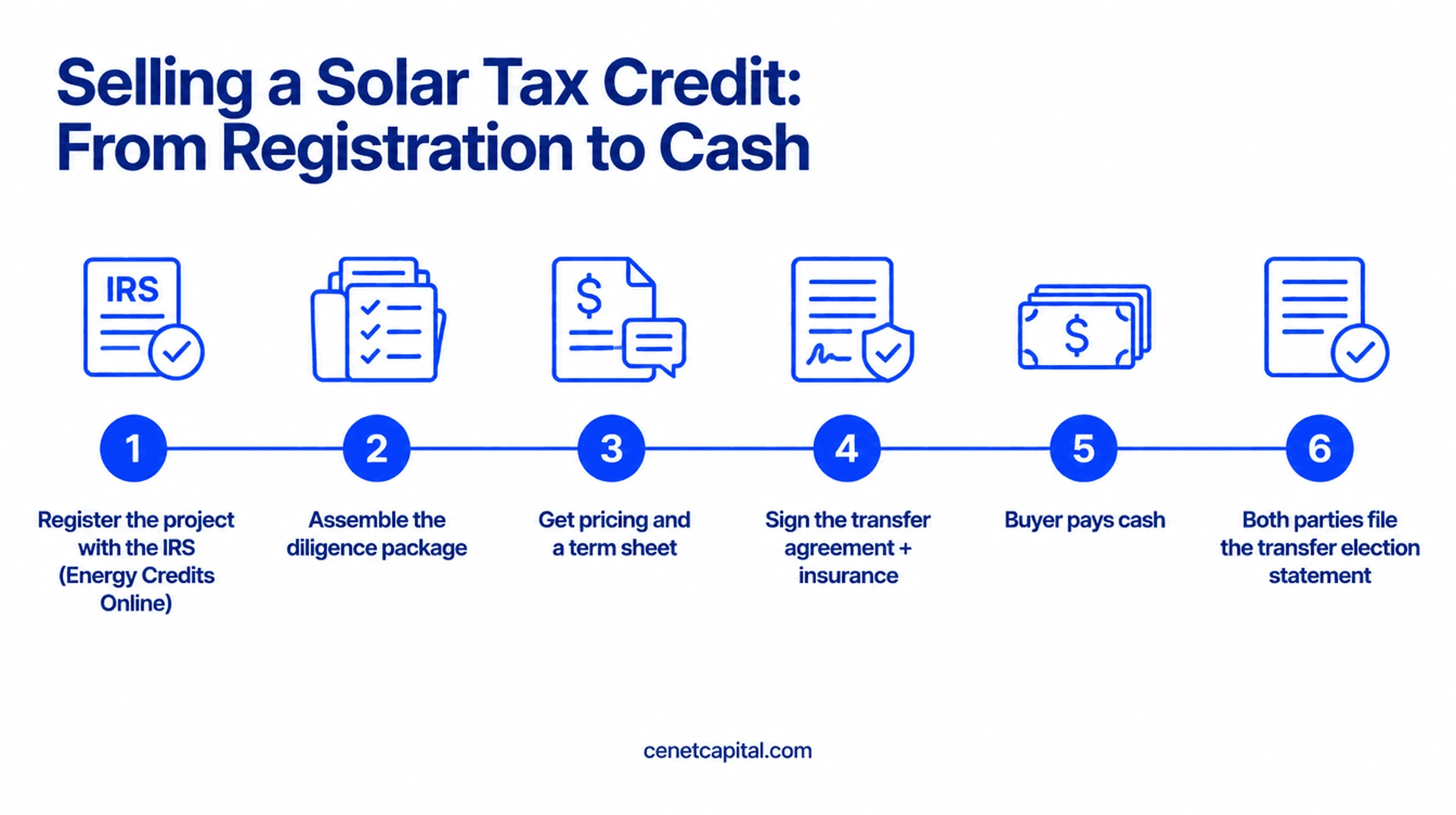
There are six steps: register with the IRS, assemble diligence, get priced, sign the transfer agreement (usually alongside insurance), receive cash, and have both sides file the transfer election statement with their returns.
Register the project. Every credit that’s transferred needs a registration number from IRS Energy Credits Online. Per IRS Publication 5884, register no earlier than the start of the tax year the credit is earned and at least 120 days before you plan to file. Leave more time than that if you can.
Build the diligence package before you talk to buyers (see the checklist below).
Get pricing and a term sheet. Expect the price to come with conditions on insurance, indemnities and payment timing.
Sign the tax credit transfer agreement. If the deal is insured, the policy usually binds at the same time.
Receive cash. Payment can come up front or in installments tied to the buyer’s estimated tax payments.
File the transfer election statement. Seller and buyer both attach it to their returns, with names, taxpayer IDs, the credit amount, the cash paid and the registration number.
What documentation will a buyer ask for?
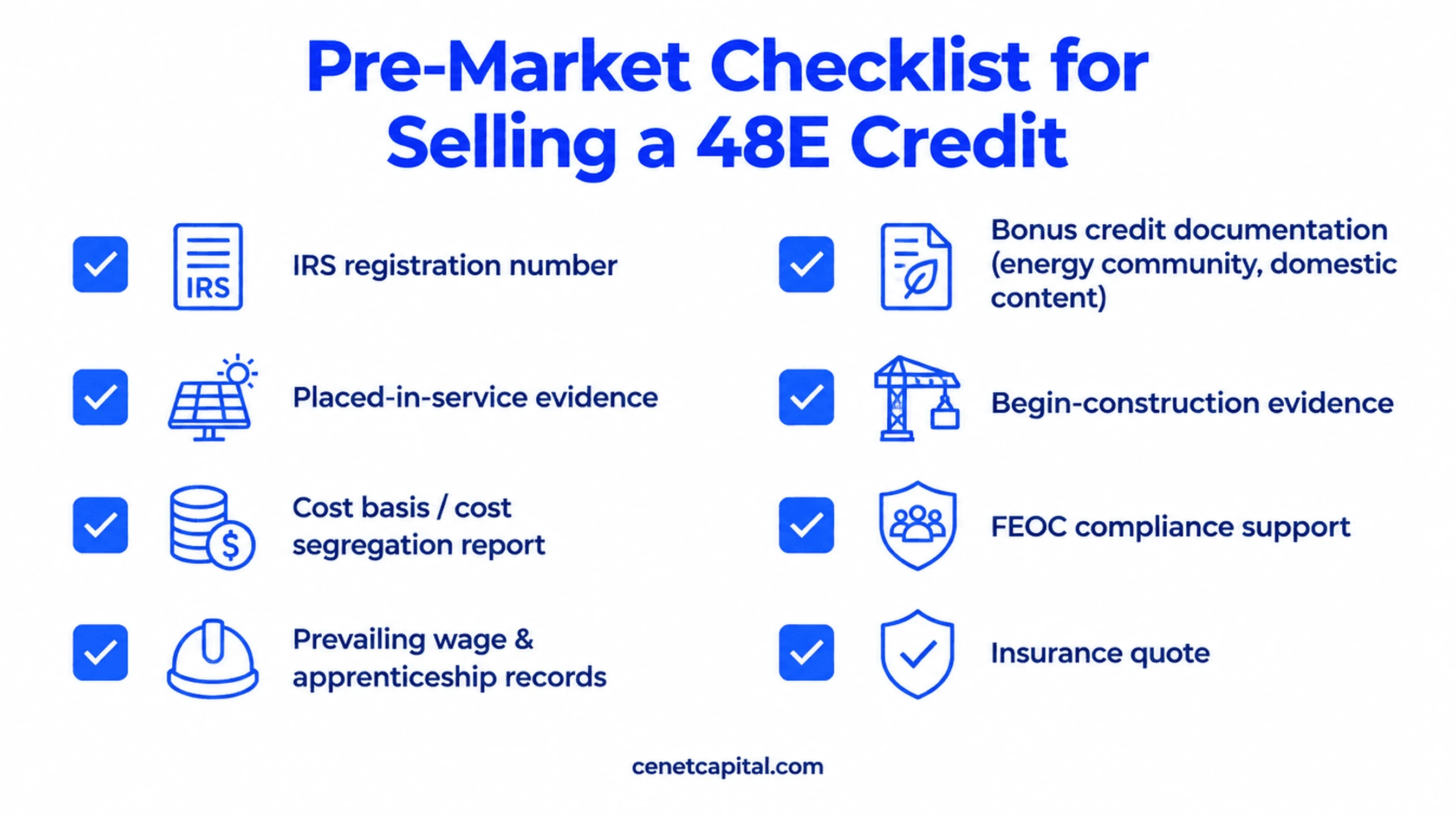
Buyers want proof the credit exists and is the size you say it is, which means evidence of when construction began and when the project was placed in service, a defensible cost basis, prevailing wage and apprenticeship records if you’re claiming the full 30% rate, and support for any bonus adders. Bonus credits for energy community or domestic content are where small deals most often stall, because each adder needs its own paper trail.
Under the One Big Beautiful Bill Act, buyers will also ask for foreign entity of concern (FEOC) support for projects that began construction in 2026 or later. Have your equipment sourcing documented before you go to market, not after a buyer asks.
Is your credit ready to sell?
Tick what you already have. Tap any item to see why buyers ask for it.A general guide to what buyers typically request. Requirements vary by credit type and deal.
Get help closing the gaps →
Who carries the risk if the credit is wrong?
With the IRS, the buyer does. Under the transfer agreement, the seller usually does. Tax credit insurance is how both sides close that gap. The IRS says plainly that for transferred ITCs “the transferee bears the financial responsibility for a recapture event.” If the IRS later decides the credit was overstated, the buyer owes the excess plus a 20% penalty unless it can show reasonable cause, according to the Form 4255 instructions.
That’s why buyers ask sellers for indemnities and why insurance matters so much on smaller deals. The ITC recapture period runs five years from the date the project is placed in service. A buyer is pricing your project’s next five years, not just today’s paperwork.
How did the 2025 law change things for solar sellers?
The One Big Beautiful Bill Act kept transferability but put a hard deadline on solar: projects that didn’t begin construction by July 4, 2026 must be placed in service by December 31, 2027 to earn the 48E credit at all. That’s how Kirkland & Ellis and Chapman and Cutler summarize the change. The law also bars transfers of 48E credits to specified foreign entities.
In practice, owners with projects that qualify have every reason to sell sooner. More 2026 and 2027 credits are coming to market against a fixed pool of corporate buyers, so a well-documented project that’s ready to sell now has a pricing advantage.
Is selling the credit better than tax equity or a bridge loan?
For most commercial projects under about $20 million in credits, a direct sale is the fastest and simplest way to turn a credit into cash. Tax equity still makes sense for larger portfolios that can also use depreciation.
Option | Best for | Tradeoff |
|---|---|---|
Sell the credit (Section 6418) | Commercial projects, $250K to $20M in credits | Price is below face value; buyer needs diligence |
Tax equity partnership | Large portfolios that can also use depreciation | Complex, slow, rarely available for small deals |
Funding construction before a buyer pays | Interest cost; still needs a takeout | |
Use the credit yourself | Owners with large federal tax bills | Only works if you owe enough tax |
If you’re about to take a commercial solar credit to market, Cenet Capital buys and insures 48E credits on projects from $250K up, and typically closes in about 10 business days once diligence is complete.
Your credit is worth more with the paperwork done.
Cenet Capital buys and insures 48E credits from commercial solar projects starting at $250K, and typically closes in about 10 business days once diligence is complete. Send us your project details and we'll tell you where your credit would price.

More Insights