
The production tax credit pays 3.1¢ per kWh in 2026 for 10 years. Rates, bonus adders, who qualifies, OBBBA deadlines, PTC vs. ITC, and how to sell PTCs.
Author -
Paulestini Francois
Published -
READ TIME
The production tax credit is the federal incentive that pays clean energy projects for every kilowatt-hour they generate, year after year, for a decade. In 2026 it's worth 3.1 cents per kWh at the full rate, and it now applies to almost any zero-emission generator, not just wind. Here's how the PTC works today: the 2026 rates, how to calculate it, which projects qualify, what the One Big Beautiful Bill changed, and how owners sell PTCs for cash.
What is the production tax credit?
The production tax credit (PTC) is a federal tax credit paid for each kilowatt-hour of clean electricity a facility produces and sells, for the first 10 years after it’s placed in service. For 2026 it’s worth 3.1 cents per kWh for projects that meet prevailing wage and apprenticeship requirements, or 0.6 cents per kWh for those that don’t. Unlike the investment tax credit, which pays once based on what a project costs, the PTC pays every year based on what it actually generates. That makes it most valuable for projects that run at high output with modest capital cost, such as large wind and solar farms.
The PTC now comes in two versions. The legacy credit under Section 45, created by the Energy Policy Act of 1992, covers projects that began construction before 2025. The technology-neutral Section 45Y “clean electricity production credit” covers zero-emission facilities placed in service after 2024. Both use the same inflation-adjusted rates and the same 10-year clock.
How much is the production tax credit in 2026?
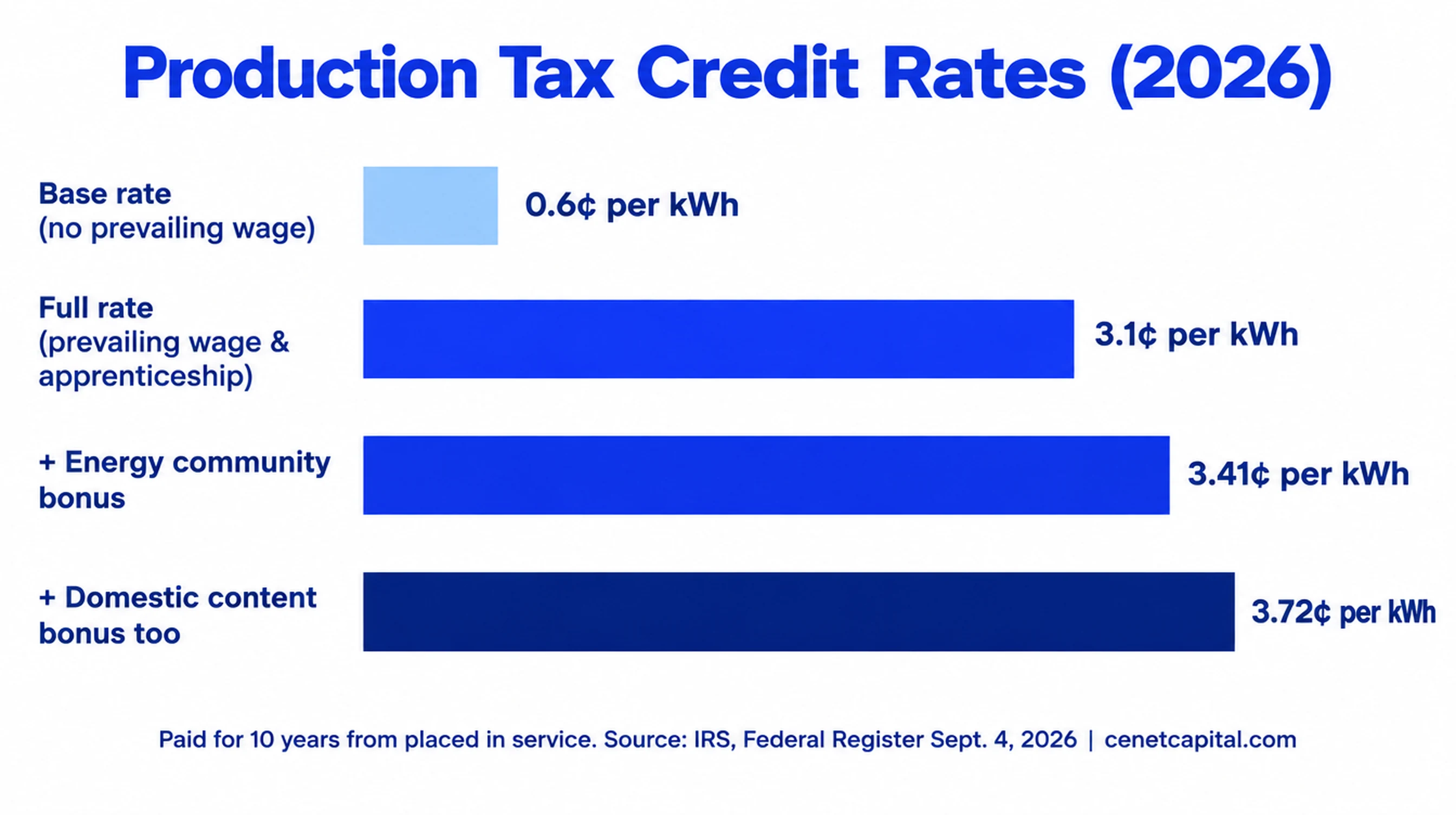
3.1 cents per kWh (or $31 per MWh) at the full rate, and 0.6 cents per kWh at the base rate. Each bonus adder increases the credit by 10%, so a project with both energy community and domestic content bonuses earns about 3.72 cents per kWh. The IRS sets the amounts each year using an inflation adjustment factor, which is 2.0570 for 2026, as published in the Federal Register on September 4, 2026.
2026 PTC rate | Per kWh | Per MWh |
|---|---|---|
Base rate (no PWA) | 0.6¢ | $6 |
Full rate (PWA met, under 1 MW, or construction began before January 29, 2023) | 3.1¢ | $31 |
Full rate + energy community bonus | 3.41¢ | $34.10 |
Full rate + energy community + domestic content | 3.72¢ | $37.20 |
Legacy §45 half-rate resources (landfill gas, trash, open-loop biomass), placed in service after 2021, base | 0.3¢ | $3 |
Because the rate is re-indexed every year, a facility earns that year’s rate on that year’s output. A wind farm placed in service in 2026 will likely earn a little more per kWh in 2030 than it does today.
How do you calculate the production tax credit?
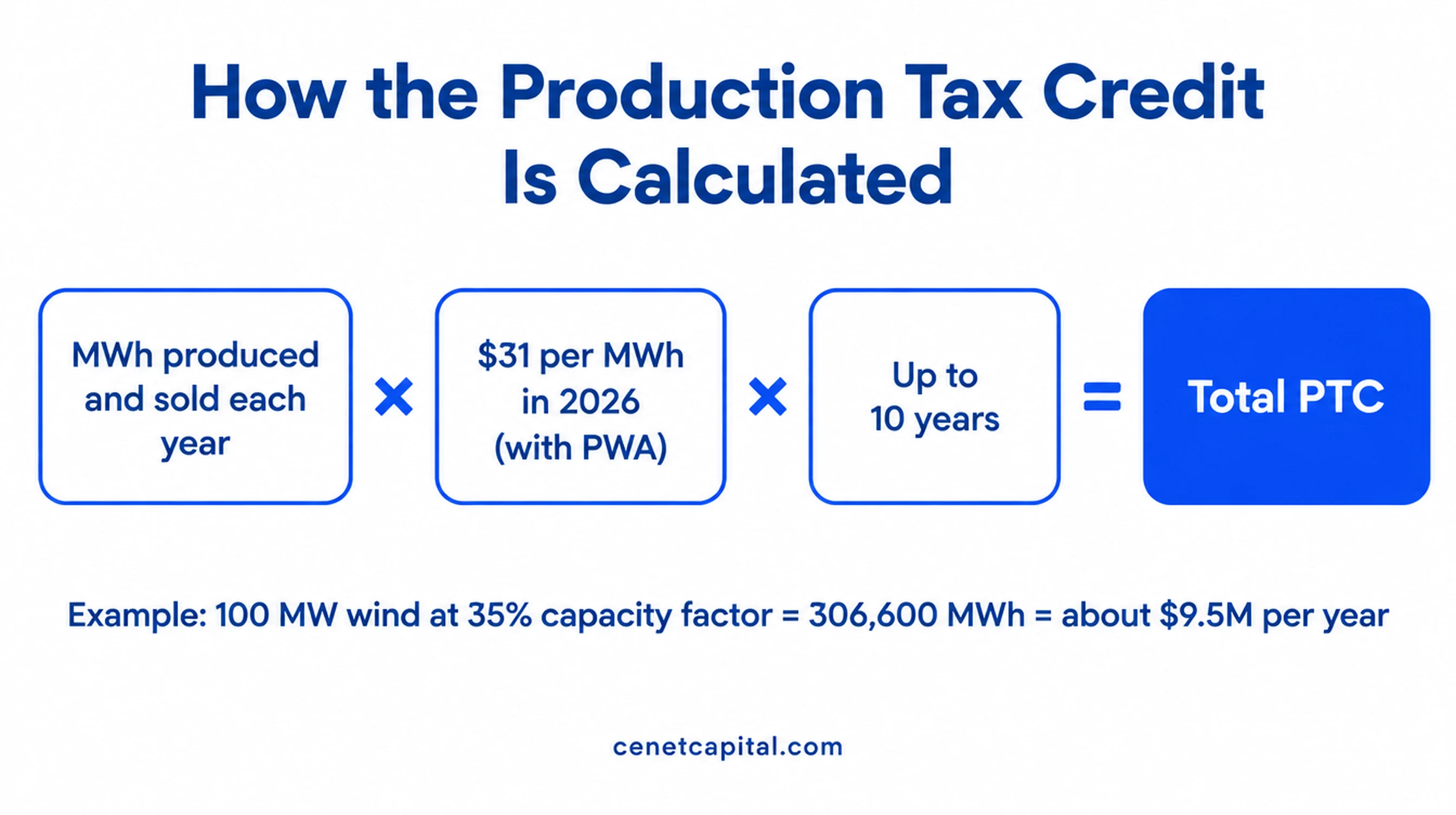
Multiply the electricity produced and sold in the year by the per-kWh rate. A 100 MW wind farm running at a 35% capacity factor produces about 306,600 MWh a year, worth about $9.5 million of PTCs at the 2026 full rate, or roughly $95 million over 10 years. Use the calculator below to run your own project.
Annual output: 100 MW × 8,760 hours × 35% = 306,600 MWh.
Rate: $31 per MWh (3.1¢ per kWh), with PWA met.
Annual PTC: 306,600 × $31 = about $9.5 million.
10-year PTC (flat 2026 rate): about $95 million, before inflation increases.
Cash at 92 cents if sold: about $8.7 million a year.
The electricity has to be sold to an unrelated person and measured at the meter, so curtailment, outages and degradation all reduce the credit directly. That’s why lenders and credit buyers underwrite the PTC on a P50 or P90 production estimate rather than nameplate capacity.
How much is your production tax credit worth?
Illustrative only. Uses 2026 rates held flat (IRS inflation adjustments raise them over time). Credit is paid only on electricity sold to unrelated buyers. Wind and solar must have begun construction by July 4, 2026, or be placed in service by December 31, 2027.
Price your PTCs →Which projects can claim the PTC?
Any zero-emission electricity generator placed in service after 2024 can claim the PTC under Section 45Y, including wind, solar, geothermal, hydropower, marine energy and new nuclear capacity. Energy storage cannot, because it doesn’t generate electricity. Projects that began construction before 2025 use legacy Section 45, which lists specific resources: wind, closed-loop and open-loop biomass, geothermal, solar (for projects starting after 2021), small irrigation power, landfill gas, trash, hydropower and marine energy.
Existing nuclear plants have their own production credit, Section 45U. A facility that claims the PTC can never claim the investment tax credit, and vice versa, so owners make a one-time choice.
What did the One Big Beautiful Bill change for the PTC?
It kept the PTC and its 10-year term but put a deadline on new wind and solar, set an end date for everything else, and added foreign-entity restrictions. Wind and solar facilities that began construction after July 4, 2026 must be placed in service by December 31, 2027 to qualify. Other technologies keep the full credit for construction beginning through 2033, then 75% in 2034 and 50% in 2035. Our One Big Beautiful Bill guide covers every credit, and the investment tax credit guide covers the same deadlines for the ITC.
A wind or solar project that began construction by July 4, 2026 still earns the full 10 years of PTCs once it’s placed in service, generally within four calendar years of the start year. Because the credit runs for a decade after that, PTCs will keep flowing from today’s projects well into the late 2030s.
Can solar projects claim the production tax credit?
Yes. Since the Inflation Reduction Act, solar projects can choose the PTC instead of the ITC, and under Section 45Y any zero-emission generator can. For large solar farms in high-irradiance regions, the PTC is often worth more. Before 2022, solar was limited to the ITC. The change matters because solar costs have fallen far enough that a utility-scale project’s 10-year output, multiplied by $31 per MWh, can exceed 30% of its cost.
Take a 200 MW solar project in Texas at a 27% capacity factor. It produces about 473,000 MWh a year, worth roughly $14.7 million of PTCs at the 2026 full rate, or about $147 million over 10 years before inflation adjustments. If the project costs $220 million, a 30% ITC would be $66 million, paid all at once. Even after discounting the PTC stream, it usually comes out ahead at that cost level. Add an energy community bonus and the gap widens.
What reduces the production tax credit?
Lower output. Curtailment, outages, transmission constraints and equipment degradation all reduce the credit kilowatt-hour for kilowatt-hour.
Missing PWA. Without prevailing wage and apprenticeship compliance, the rate drops from 3.1 cents to 0.6 cents. The requirements also apply to alteration and repair work during the 10-year credit period, not just construction.
Tax-exempt bond financing. Projects financed with tax-exempt bonds can see the credit reduced.
Related-party sales. Electricity must be sold to an unrelated person. Power consumed on-site or sold to an affiliate generally doesn’t count, except in specific circumstances.
Foreign-entity issues. For projects beginning construction after 2025, failing the material assistance test eliminates the credit entirely.
PTC or ITC: which is better?
The PTC usually wins for high-capacity-factor, lower-cost projects; the ITC usually wins for expensive projects with modest output, and it’s the only option for storage. A simple test is to compare the 10-year PTC, discounted to today, against the ITC on the same project.
Production tax credit | Investment tax credit | |
|---|---|---|
Paid on | Each kWh produced and sold | Eligible project cost |
Timing | Annually for 10 years | Once, at placed in service |
Production risk | Owner and buyer bear it | None after placed in service |
Recapture risk | None | 5 years |
Typical 2026 sale price | ~$0.917 average | ~$0.895 average |
For a utility-scale solar project in a sunny region at a 28% to 30% capacity factor with low cost per watt, the PTC often beats a 30% ITC. For a rooftop or small ground-mount system with higher cost per watt, the ITC usually wins. Our market report shows why the PTC also sells for more.
How do you claim the production tax credit?
File Form 7211 for the Section 45Y credit, or Form 8835 for the legacy Section 45 credit, each year of the 10-year period, and carry the result to Form 3800. Projects claiming the full rate on the basis of PWA attach Form 7220. If you’ll sell the credit or take elective pay, register the facility with the IRS each year and enter the registration number. Note that a PTC registration number is good for one tax year, so a 10-year PTC stream means 10 registrations.
Can you sell production tax credits?
Yes, and PTCs are among the easiest credits to sell. They can be sold one year at a time or as a multi-year “strip” covering several future years, usually at 90 to 96 cents per dollar. Because the credit is earned only after power is generated, there’s no recapture risk for the buyer. Crux reported early-2026 PTC pricing averaging about $0.917, and as high as $0.96 for investment-grade sellers.
Multi-year strips give the seller certainty of cash for several years and give buyers a predictable credit pipeline. They’re priced a little lower than single-year deals because the buyer takes on production risk over a longer period. Sellers usually provide a production estimate, a guaranty or insurance, and an adjustment mechanism if output comes in low. See our buyer’s guide for how corporate buyers evaluate them.
Production tax credit checklist
Confirm 45 or 45Y eligibility and document the beginning-of-construction date.
Track prevailing wages and apprentice hours during construction and for alteration or repair work during the 10-year period.
Document energy community and domestic content support if claiming adders.
Keep revenue-grade meter data and sales records to unrelated buyers.
Register with the IRS every year you’ll sell or take elective pay.
Model output conservatively; the credit only pays on what you actually sell.
If your project earns PTCs you can’t use, Cenet Capital buys and insures production tax credits, for single years or multi-year strips. Run your numbers in the calculator above, then send them to us for a price.
Earning PTCs you can't use? Sell them.
Cenet Capital buys and insures production tax credits, for a single year or as a multi-year strip. Tell us about your project and we'll price your PTCs.

More Insights