

Tax credit insurance for clean energy credits: what it covers, what it excludes (including FEOC), what it costs, who pays, when it's worth it, and how to get it.
Author -
Paulestini Francois
Published -
READ TIME
Tax credit insurance is often what turns a hesitant corporate buyer into a closed deal. It protects the buyer if the IRS cuts or claws back a clean energy credit, and it's now standard on most mid-size investment tax credit sales. But it isn't cheap, it doesn't cover everything, and for small deals it may not be worth it. Here's what tax credit insurance covers, what it costs, who pays, and when it makes sense.
QUICK ANSWER
Tax credit insurance is a policy, bought for a specific credit transaction, that reimburses the credit buyer (or tax equity investor) if the IRS later reduces, disallows or recaptures the clean energy tax credit it purchased.
KEY FACTS
What it is: an insurance policy that pays the buyer of a clean energy tax credit if the IRS disallows or recaptures the credit, covering the lost credit plus related taxes, interest and penalties.
Cost: typically 2% to 5% of the insured limit, usually paid by the seller.
Coverage: limits commonly set at 90% to 140% of the credit amount, to include tax gross-ups and penalties.
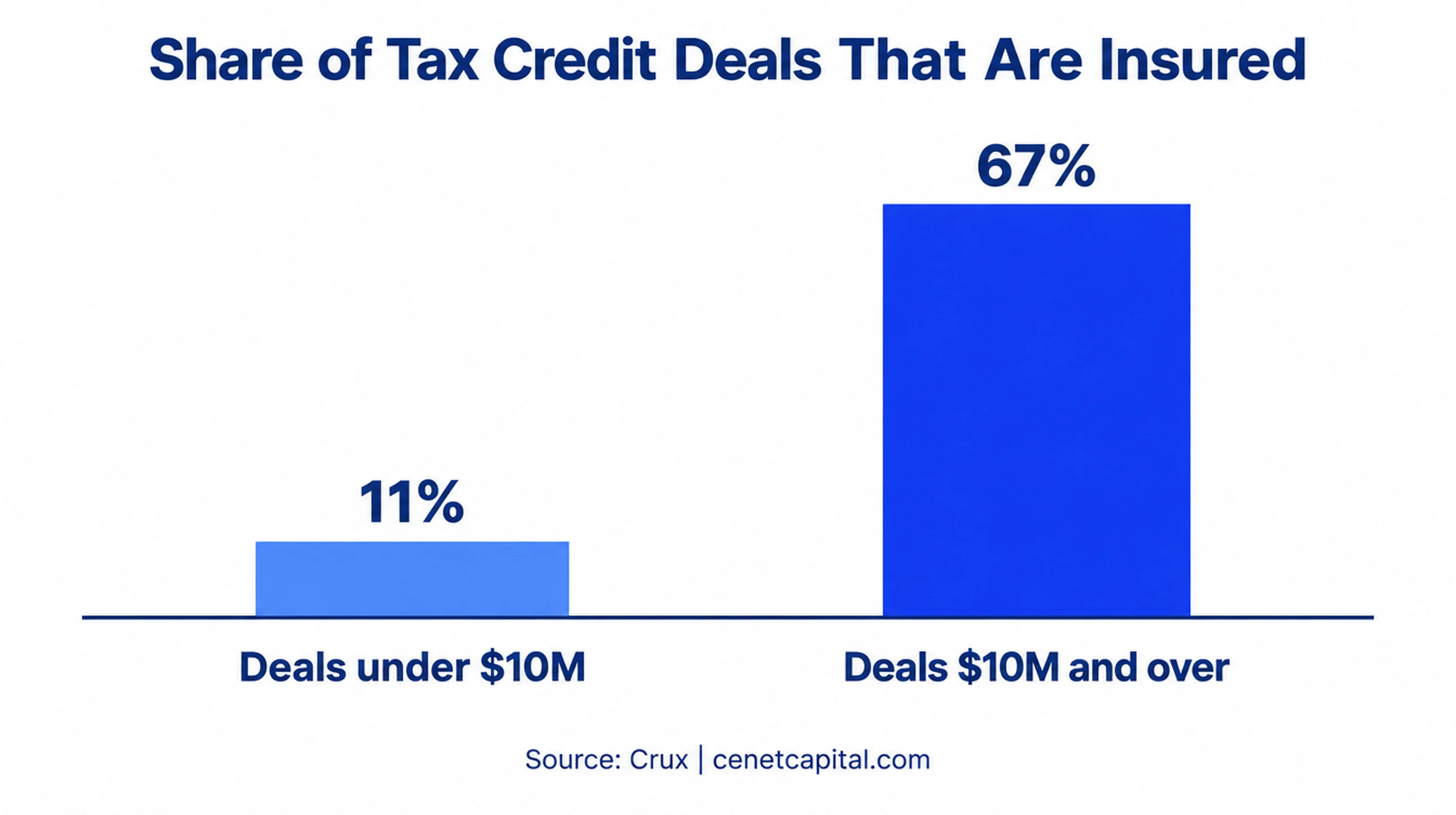
Who uses it: 67% of credit deals of $10 million or more were insured, versus 11% of deals under $10 million (Crux).
Biggest gap: it does not currently cover prohibited foreign entity (FEOC) risk.
What is tax credit insurance?
Tax credit insurance is a policy, bought for a specific credit transaction, that reimburses the credit buyer (or tax equity investor) if the IRS later reduces, disallows or recaptures the clean energy tax credit it purchased. It turns a tax risk the buyer can’t control, such as whether the seller’s cost basis or prevailing wage records hold up in an audit, into an insured loss. In the U.S. clean energy market it’s most often used on investment tax credit sales, where basis and recapture risk are highest.
It matters because a credit buyer’s downside is real. If the IRS disallows part of a transferred credit, the buyer owes the tax, interest and, for an “excessive credit transfer,” a 20% penalty unless it shows reasonable cause. Insurance is often what lets a corporate tax department say yes to a deal from a seller it doesn’t know well.
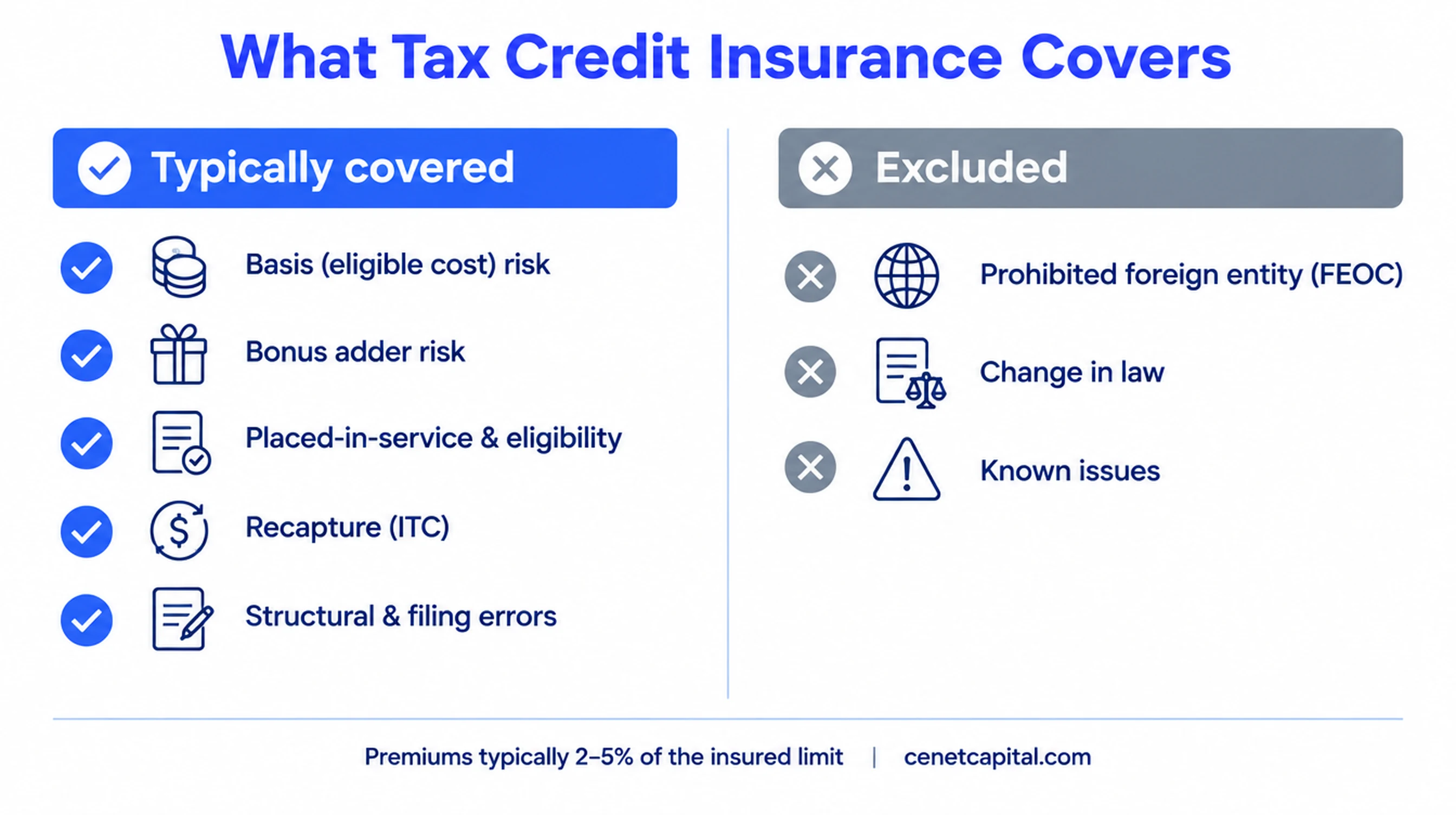
What does tax credit insurance cover?
The main risks that could shrink or eliminate a credit after the buyer pays for it.
Risk | What could go wrong | Typically covered? |
|---|---|---|
Basis risk (ITC) | IRS says eligible cost, or a stepped-up value, was overstated | Yes |
Bonus adder risk | Prevailing wage, domestic content or energy community support fails | Yes |
Placed-in-service and eligibility risk | Project didn’t qualify or wasn’t in service when claimed | Yes |
Recapture (ITC) | Project is sold or stops operating within 5 years | Often, with conditions |
Structural risk | Errors in the transfer election, registration or entity setup | Yes |
Prohibited foreign entity (FEOC) | Ownership, effective control or material assistance failure | No, currently excluded |
Change in law | Congress or Treasury changes the rules retroactively | Usually excluded |
Known issues | Problems disclosed or known before binding | Excluded |
For production tax credits, the policy can cover the full 10-year credit period or only the years being transferred. The FEOC exclusion is the most important gap in 2026: as Crux reported in its insurance guide, insurers are not currently covering PFE risk, so buyers handle it through indemnities and diligence instead. See our FEOC rules guide.
How much does tax credit insurance cost?
Premiums typically run 2% to 5% of the insured limit, and limits are usually 90% to 140% of the credit, so the cost is often roughly 2 to 6 cents per dollar of credit. Carrier-quoted premiums of $150,000 to $350,000 per policy in 2024 rose to $450,000 or more in the first half of 2025, according to Crux.
Credit size | Limit (120%) | Premium at 3% | Cost per $1 of credit |
|---|---|---|---|
$5M | $6M | $180K (often a minimum premium applies) | 3.6¢ or more |
$25M | $30M | $900K | 3.6¢ |
$100M | $120M | $3.6M | 3.6¢ |
Minimum premiums and fixed underwriting costs make insurance expensive for small deals, which is why so few credits under $10 million are insured. Use the estimator below to see what a policy would cost on your credit and how it affects your net proceeds.
What would insuring your credit cost?
Illustrative only. Premiums typically run 2%–5% of the limit, with minimum premiums (assumed $150K here). Policies currently exclude prohibited foreign entity (FEOC) risk. Real quotes depend on underwriting.
Get an insured quote →Who pays for tax credit insurance?
Usually the seller, either directly or through a lower price. The buyer is the insured party, but in most transfer deals the seller procures and pays for the policy as part of offering a “clean” credit. Some deals split the cost. Either way, insurance shows up in the seller’s net proceeds: a credit sold at 93 cents with a 3.5-cent insurance cost nets the seller about 89.5 cents before broker and legal fees. Our pricing guide explains how this plays into the headline price.
When is tax credit insurance worth it?
Mid-size and large ITC deals ($10M to $150M): usually yes. These are the most frequently insured, and insurance often unlocks a better price or a broader buyer pool.
Very large deals from investment-grade sellers: often not needed, because buyers accept the seller’s indemnity.
Deals under $10M: often uneconomic; consider pooling credits from several projects into one insured sale.
Tech-neutral 48E credits from non-investment-grade sellers: nearly always. About 87% of that volume carried insurance in the first half of 2026, per Crux.
PTCs from operating projects: less often, because there’s no recapture and production is measurable.
How do you get tax credit insurance?
Through a specialist insurance broker, typically while the transfer agreement is being negotiated.
Agree on scope with the buyer early: which risks, what limit, which party pays.
Prepare the diligence package: tax opinion or memo, cost segregation or appraisal, PWA records, bonus adder support, registration.
Receive indications from several insurers through the broker.
Underwriting call with the selected insurer, then negotiate exclusions.
Bind at closing of the credit sale.
Basis is where underwriters dig deepest, especially when a project’s value has been stepped up above cost. Strong documentation shortens the process and lowers the premium.
What are the alternatives to tax credit insurance?
Parent guaranty: a creditworthy parent company backs the seller’s indemnity.
Holdback or escrow: part of the purchase price is held until the audit risk window passes.
Price discount: the buyer accepts uninsured risk for a lower price.
Pay-as-you-go: for PTCs, paying as credits are generated limits exposure.
Sources
Crux, Tax credit insurance: coverage, cost, and how to procure
Crux 2026 Mid-Year Report, via National Law Review
Frequently Asked Questions
What does tax credit insurance cost?
Typically 2% to 5% of the insured limit, which is often 90% to 140% of the credit, with minimum premiums that make small policies proportionally more expensive.
Does tax credit insurance cover FEOC risk?
Is tax credit insurance required to sell a credit?
Is this the same as ACA health insurance tax credits?
Can Cenet Capital buy or insure clean energy tax credits?
Get an insured price on your credit.
Cenet Capital arranges tax credit insurance and buys insured credits, so you get a cleaner deal, more buyers and a better price. Tell us about your credit.

More Insights