

Tax equity vs. selling tax credits: how they differ, when each wins, how hybrid deals combine them, a worked example, and a tool to compare options for your project.
Author -
Paulestini Francois
Published -
READ TIME
Should a clean energy project bring in a tax equity investor or simply sell its tax credits? It's one of the most consequential financing decisions a developer makes, and since 2023 the answer has changed. Here's a clear comparison of tax equity and transferability, when each one wins, how hybrid structures combine them, a worked example, and a tool to compare the options for your own project.
QUICK ANSWER
Neither is better in general. Tax equity monetizes more of a project’s tax benefits (credits and depreciation), but it’s slower, costlier and only practical for larger projects. Selling the credit is faster, cheaper and works at almost any size, but it only monetizes the credit.
KEY FACTS
Tax equity: an investor joins the project partnership and takes most of the tax credits and depreciation for upfront capital. About $36.6 billion was invested in 2025 (Crux).
Transferability: the project owner sells the credit for cash to an unrelated buyer under Section 6418, typically at 88 to 96 cents per dollar. About $42 billion of credits were sold in 2025.
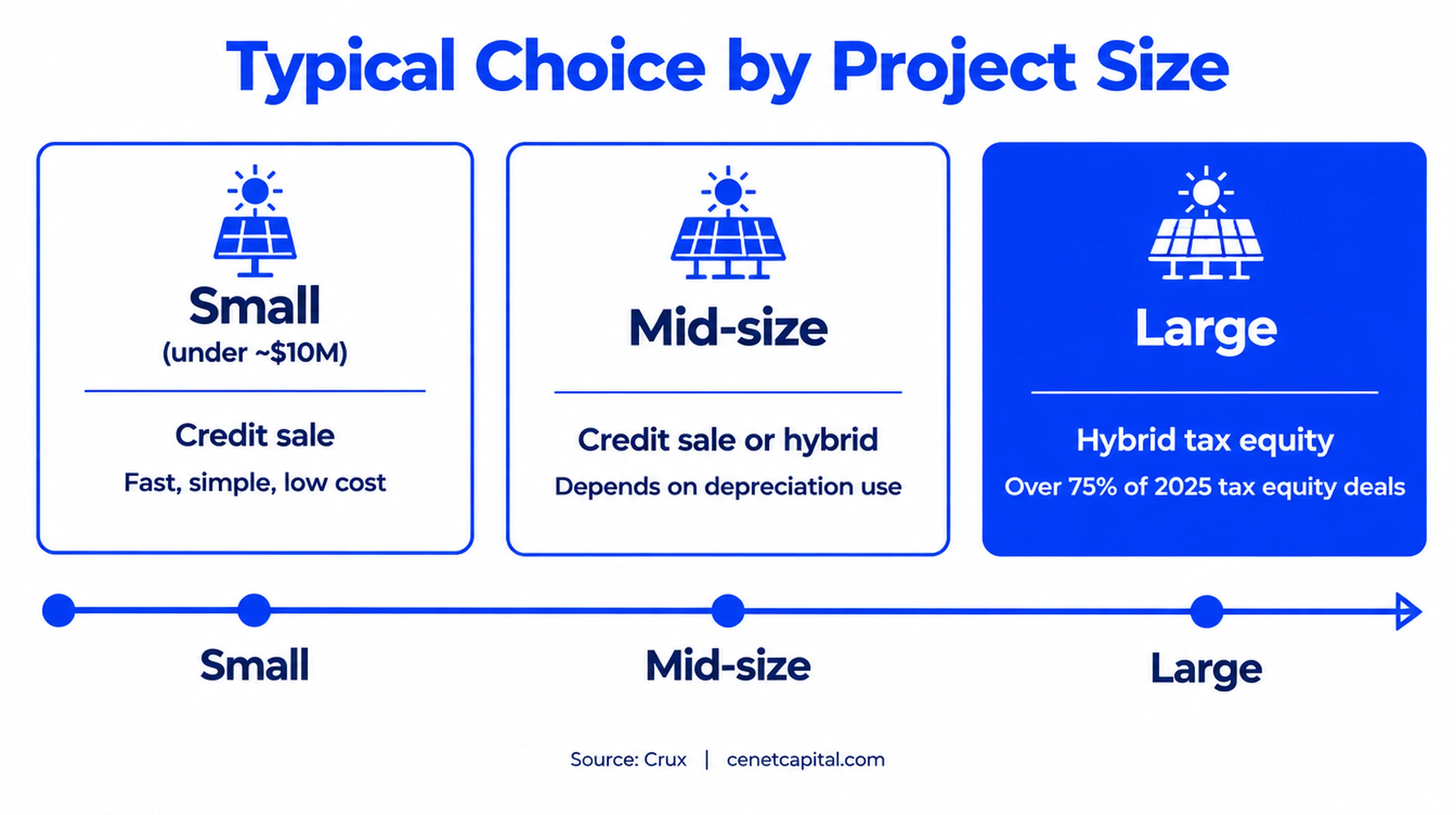
Hybrid: a tax equity partnership that also sells credits. More than 75% of 2025 tax equity commitments used hybrid structures.
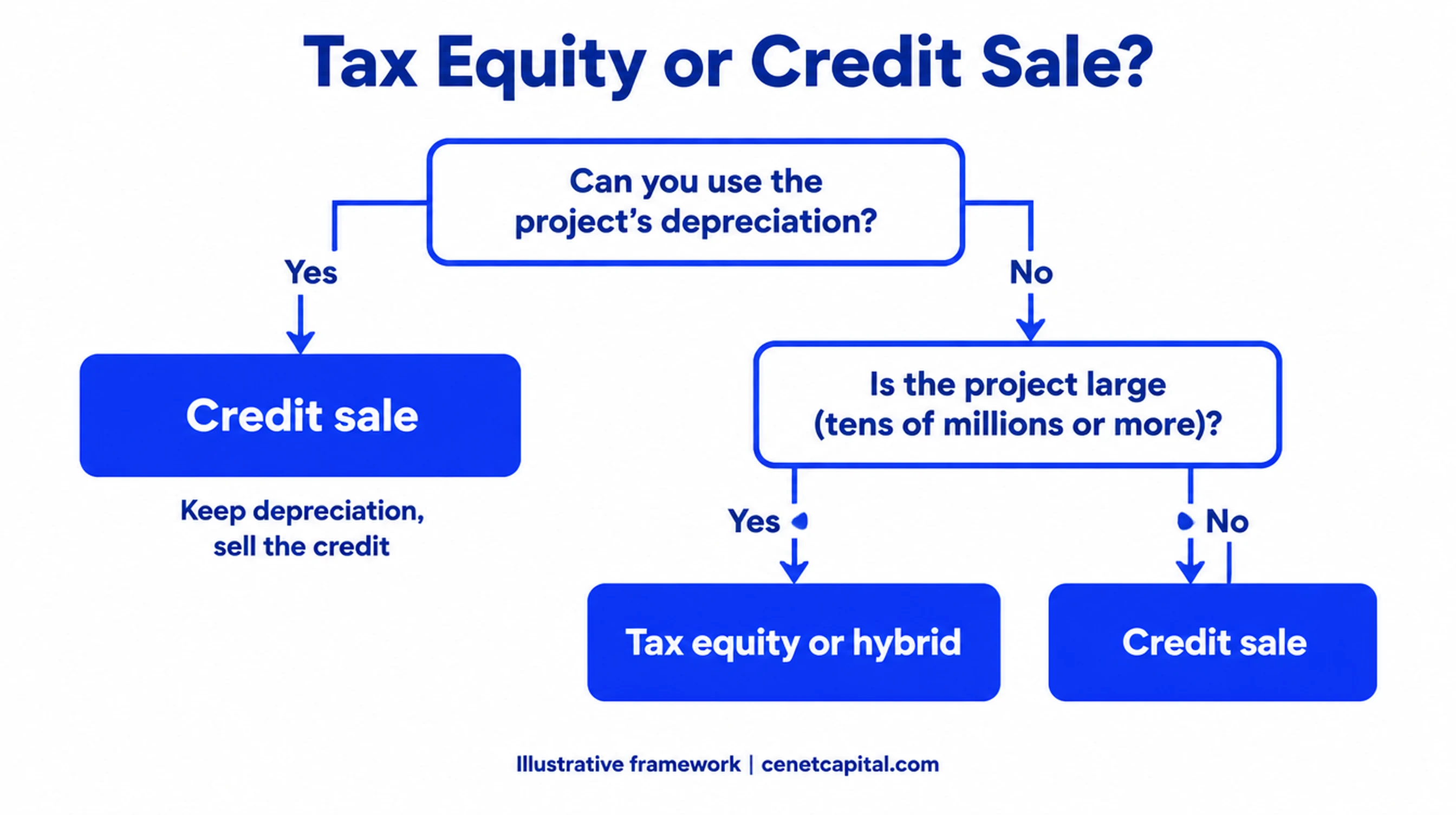
Rule of thumb: choose tax equity (or a hybrid) when the project is large and the sponsor can’t use depreciation; choose a straight credit sale when the project is small, the sponsor can use depreciation, or speed and simplicity matter most.
Is tax equity or selling the credit better?
Neither is better in general. Tax equity monetizes more of a project’s tax benefits (credits and depreciation), but it’s slower, costlier and only practical for larger projects. Selling the credit is faster, cheaper and works at almost any size, but it only monetizes the credit. The right answer depends on four things: project size, whether the sponsor can use the depreciation, how quickly cash is needed, and how much control the sponsor wants to keep.
The choice is no longer either/or. Most new tax equity deals are hybrids, in which a bank funds part of the project for depreciation and cash flow while the credits are sold to corporate buyers. For background, read what is tax equity and our guide to transferable tax credits.
What’s the difference between tax equity and transferability?
Tax equity | Transferability (credit sale) | |
|---|---|---|
What the investor gets | ~99% of credits and depreciation pre-flip, plus some cash | The credit only |
Ownership | Investor becomes a partner for 5–10 years | Sponsor keeps 100% ownership |
Investor pool | A few dozen banks and insurers | Hundreds of corporations |
Time to close | Several months or longer | About 3 months on average |
Transaction costs | High: partnership docs, modeling, ongoing reporting | Lower: transfer agreement, diligence, often insurance |
Minimum practical size | Generally larger projects or portfolios | Under $1M possible |
Depreciation | Monetized through the investor | Stays with the sponsor |
Cash timing | At mechanical completion and placed in service | Usually at placed in service and closing |
When does tax equity make more sense?
The sponsor can’t use depreciation. On a solar or storage project, federal depreciation can be worth roughly 15% to 20% of project cost. A credit sale leaves that unmonetized unless the sponsor has taxable income.
The project is large. Tax equity’s fixed costs make sense on big projects and portfolios.
The sponsor wants a long-term capital partner that also brings structuring expertise.
When does a credit sale make more sense?
Small and mid-size projects that can’t attract tax equity.
Sponsors that can use depreciation themselves, such as profitable corporations installing on-site solar.
Speed: a credit sale can close in about three months.
Control: no partner, no flip, no buyout negotiation.
Non-power credits like 45X, 45Z and 45V, which are sold rather than financed through tax equity.
Worked example: a $50 million storage project
Consider a $50 million standalone battery project earning a 40% ITC ($20 million) plus federal depreciation worth roughly $8.4 million undiscounted. The sponsor is a developer with little taxable income.
Route | Upfront value (illustrative) | Trade-offs |
|---|---|---|
Sell the credit at 92¢ | ~$18M after ~2% costs | Fast, simple; depreciation unused |
Tax equity | ~$24M after costs | Captures depreciation; investor partner for years, shares cash |
Hybrid | ~$24M after costs | Two counterparties; bank takes depreciation, buyer takes credit |
On these assumptions, tax equity or a hybrid raises more up front because it monetizes depreciation the developer can’t use. If the same project belonged to a profitable company that could use the depreciation itself, the straight credit sale would come out ahead once you count the depreciation it keeps. The numbers are illustrative and assume tax equity pays about 95 cents per dollar of credit and 75 cents per dollar of depreciation; real quotes vary with the project, sponsor and market.
What do tax equity investors and credit buyers look for?
Both: clean eligibility and beginning-of-construction records, PWA documentation, bonus adder support and a foreign-entity analysis for projects starting after 2025.
Tax equity investors also want: a creditworthy offtaker, an independent engineer’s report, operating and maintenance plans, and a sponsor they’re comfortable partnering with for years.
Credit buyers also want: a clear transfer agreement, IRS registration, indemnities from a creditworthy party and, on many deals, tax credit insurance.
How does a hybrid structure combine both?
In a hybrid, often called a “T-flip,” the tax equity partnership sells some or all of its credits to a third-party buyer, while the tax equity investor keeps the depreciation and a share of cash. The investor contributes less capital because it isn’t absorbing all the credits, and the credit buyer pays cash for the rest. It’s the dominant structure today: hybrids made up more than 75% of 2025 tax equity commitments, and tax equity and preferred equity together are projected at $46.3 billion for 2026, according to Crux.
Tax equity, credit sale or hybrid: which nets more?
Illustrative, undiscounted comparison. Depreciation benefit is a rough federal estimate (21% of basis reduced by half the credit). Tax equity also takes a share of project cash and requires a multi-year partnership, not reflected here. Assumes ~2% transfer costs and ~4% tax equity costs.
Get a transfer quote →How do you decide for your project?
Size the tax benefits: credit amount plus depreciation value.
Decide who can use depreciation. If you can, a credit sale is often best.
Get both quotes: a credit transfer price and a tax equity term sheet.
Compare net present value after costs, including the cash flow you give up in tax equity and the fees in each.
Weigh control and timing, not just price.
The comparison tool below runs a simplified version of this math. Because it’s illustrative, use it to frame the decision, then confirm with real quotes.
Sources
Crux 2025 Market Intelligence Report, via Renewable Energy Magazine
Crux 2026 Mid-Year Report, via National Law Review
Frequently Asked Questions
Can you use tax equity and transferability together?
Yes. Hybrid structures, in which a tax equity partnership sells credits to third parties, are now the most common form of tax equity.
Which is cheaper, tax equity or selling credits?
Did the One Big Beautiful Bill change either option?
How long does each take?
Can Cenet Capital buy or insure clean energy tax credits?
See what a credit sale nets next to your tax equity offer.
Send us your project and any tax equity term sheet. We'll show you side by side what a direct credit sale would put in your pocket, and how fast it can close.

More Insights