
The 48C credit explained: 30% for clean energy manufacturing, how the $10B allocation program worked, OBBBA's no-reallocation rule, timelines, and selling 48C credits.
Author -
Paulestini Francois
Published -
READ TIME
The 48C credit funded about 250 new and retooled clean energy factories with $10 billion in tax credits, and every dollar has now been awarded. For companies holding an allocation, the work now is finishing on time, keeping the 30% rate, and turning the credit into cash. Here's how 48C works, what changed under the One Big Beautiful Bill Act, the timeline every allocatee has to meet, and how 48C compares with 45X.
QUICK ANSWER
The 48C credit is a federal investment tax credit of up to 30% of the cost of qualifying advanced energy projects: factories that make or recycle clean energy equipment, industrial facilities that cut greenhouse gas emissions by at least 20%, and facilities that process or recycle critical materials.
KEY FACTS
What it is: Section 48C, the qualifying advanced energy project credit, an investment tax credit for building, expanding or re-equipping clean energy manufacturing and industrial decarbonization projects.
Amount: 30% of qualified investment with prevailing wage and apprenticeship, 6% without.
Allocation required: the credit is only available to projects awarded an allocation by the IRS on DOE’s recommendation.
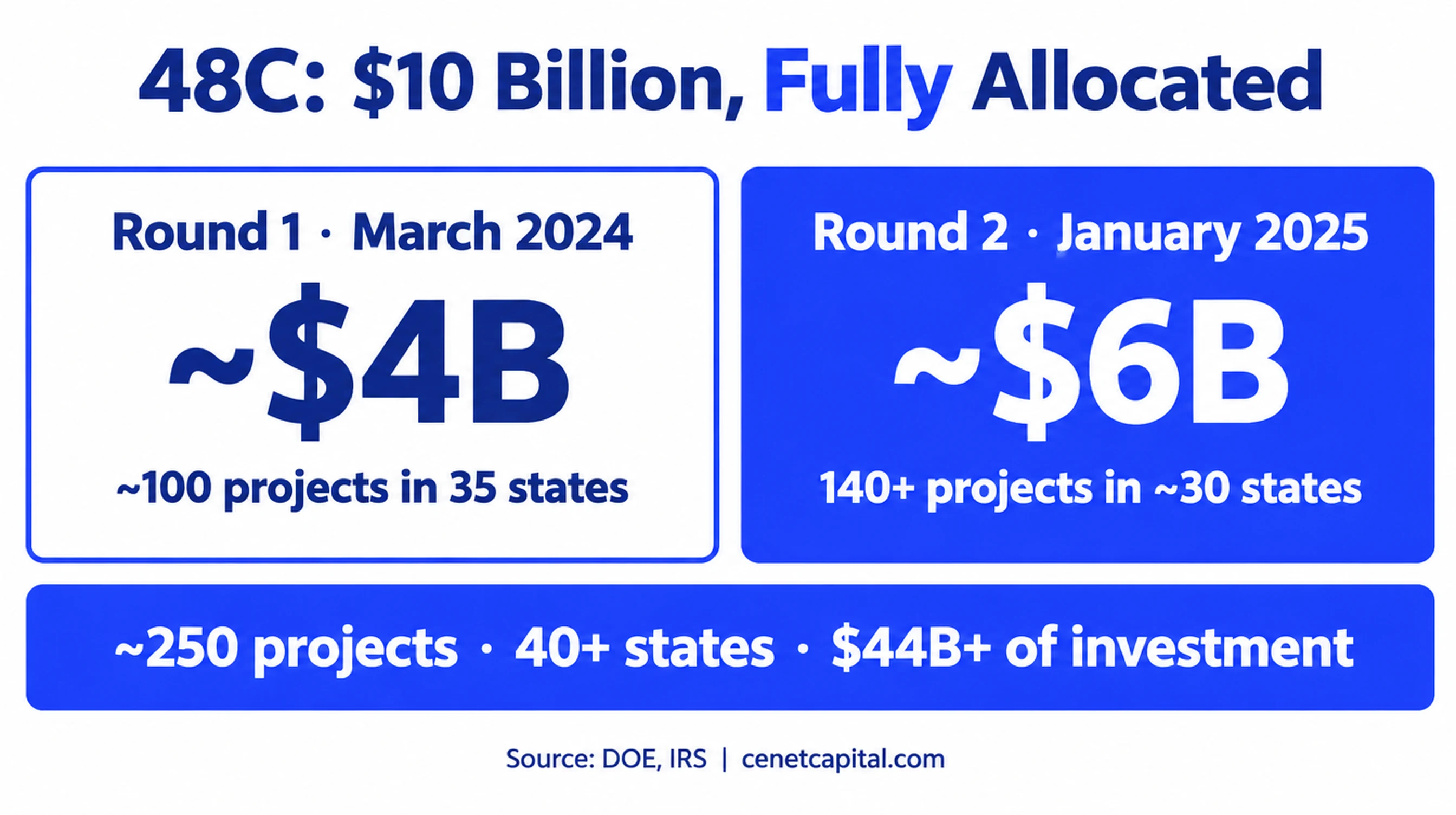
Program size: $10 billion, fully allocated in two rounds (about $4 billion in March 2024 and about $6 billion in January 2025) to roughly 250 projects in more than 40 states.
One Big Beautiful Bill change: caps 48C at $10 billion and bars reallocating credits that are rescinded, effective July 4, 2025.
Monetization: transferable for cash under Section 6418; elective pay for tax-exempt entities.
What is the 48C tax credit?
The 48C credit is a federal investment tax credit of up to 30% of the cost of qualifying advanced energy projects: factories that make or recycle clean energy equipment, industrial facilities that cut greenhouse gas emissions by at least 20%, and facilities that process or recycle critical materials. Unlike most energy credits, it isn’t automatic: a project must win a competitive allocation from the Department of Energy and the IRS.
Congress created 48C in 2009, and the Inflation Reduction Act refilled it with $10 billion in 2022, at least $4 billion of it reserved for projects in energy communities. That $10 billion has now been fully awarded, according to the DOE’s 48C program page, which means 48C today is mainly relevant to companies holding an allocation that need to finish their projects, claim the credit, or sell it.
How much 48C credit has been awarded?
All $10 billion, in two rounds.
Round | Announced | Credits allocated | Projects |
|---|---|---|---|
Round 1 | March 2024 | ~$4 billion | ~100, in 35 states |
Round 2 | January 10, 2025 | ~$6 billion (~$2.5 billion in energy communities) | 140+, in ~30 states |
Total | ~$10 billion | ~250 projects, 40+ states, $44B+ of investment |
Treasury had said a third round would only happen if allocations were rescinded or withdrawn. The One Big Beautiful Bill Act closed that door: credits returned after July 4, 2025 can’t be reallocated. For companies without an allocation, the comparable manufacturing incentive is the 45X production credit, which needs no application.
What projects qualify for 48C?
Clean energy manufacturing and recycling: re-equipping, expanding or building facilities that produce or recycle solar, wind, storage, EV, grid, hydrogen, carbon capture and energy efficiency equipment.
Industrial decarbonization: re-equipping an industrial or manufacturing facility with equipment that reduces its greenhouse gas emissions by at least 20%.
Critical materials: facilities that process, refine or recycle critical materials.
The qualified investment is the basis of eligible property (generally depreciable, tangible personal property necessary for the project) placed in service under the allocation.
How does a 48C allocation turn into a credit?
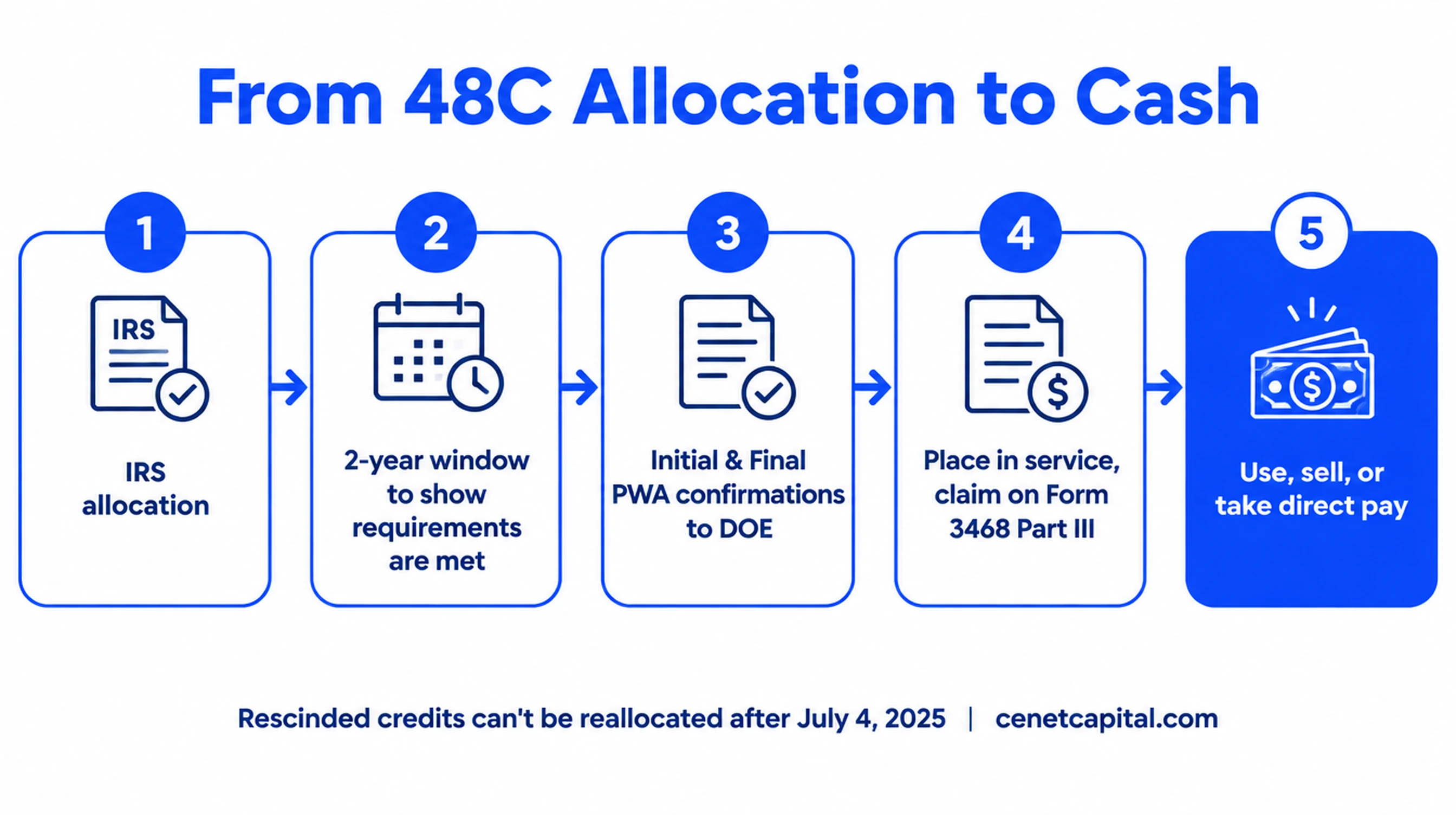
After an allocation, the company has two years to show it has met the certification requirements, and it must then place the project in service. The credit is claimed for the year the eligible property is placed in service.
Allocation: IRS issues the allocation letter based on DOE’s recommendation.
Two-year window: the company provides evidence that requirements are met, including permits, and notifies DOE when the project is placed in service.
PWA confirmations: to keep the 30% rate, it files an Initial and a Final PWA Confirmation with DOE; without them, the credit drops to 6% and the rest of the allocation is forfeited, per the Form 3468 instructions.
Claim: Form 3468, Part III, carried to Form 3800, with Form 7220.
Monetize: use the credit, sell it, or take elective pay if eligible.
Missing the timeline means losing the allocation, and under the One Big Beautiful Bill Act those credits won’t be reissued. Use the estimator below to size your credit and check where you stand.
What is your 48C allocation worth?
Illustrative only. 48C requires an IRS allocation; all $10 billion has been awarded. Credit is claimed on Form 3468, Part III for the year eligible property is placed in service and is subject to 5-year recapture.
Price my 48C credit →Can you sell a 48C credit?
Yes. 48C is transferable under Section 6418, and because it’s earned on factory investment by often well-capitalized manufacturers, it can price competitively. As an investment credit, it carries five-year recapture risk, so buyers look closely at the manufacturer’s plans to keep the facility operating. The seller registers the property with the IRS before filing. A manufacturer that receives a 48C allocation can’t also claim 45X on components produced with the same property, so many weigh both credits before deciding how to finance an expansion. See our buyer’s guide for how purchasers evaluate investment credits.
Example: what a 48C allocation is worth
Take a manufacturer with a 48C allocation to build a $200 million battery component plant. If it meets prevailing wage and apprenticeship requirements and files both DOE confirmations, the credit is 30% of qualified investment. If $180 million of the cost is eligible property (excluding the building shell and land), the credit is $54 million, claimed in the year the plant is placed in service.
Without PWA confirmations: the credit drops to 6%, or $10.8 million, and the remainder of the allocation is forfeited.
If sold at 92 cents: the $54 million credit converts to about $49.7 million of cash.
Depreciation: the plant’s depreciable basis is reduced by half the credit, $27 million.
Recapture: if the plant is sold or stops operating in the first five years, part of the credit is recaptured.
Common 48C pitfalls
Missing the two-year window. Allocations that aren’t supported in time are lost, and under current law they won’t be reissued.
Scope changes. Material changes to the project described in the application can jeopardize the allocation.
Skipping the PWA confirmations. Both the Initial and Final confirmations must be filed with DOE to keep the 30% rate.
Overstating eligible basis. Buildings, land and general-purpose assets usually don’t qualify.
Ignoring 45X interaction. Claiming 48C on a facility rules out 45X on its production, so model both before choosing.
48C vs. 45X: which matters for manufacturers?
48C | 45X | |
|---|---|---|
Pays for | Investment in the facility | Components produced and sold |
Amount | Up to 30% of qualified investment | Fixed per unit (e.g., 7¢/W modules) |
Application | Competitive allocation (now fully awarded) | None |
Timing | Once, when placed in service | Every year of production |
Recapture | 5 years | None |
Sources
U.S. Department of Energy, 48C program
IRS, 48C FAQs
Frequently Asked Questions
Is there going to be another round of 48C?
Unlikely. The $10 billion has been fully allocated, and the One Big Beautiful Bill Act bars reallocating rescinded credits after July 4, 2025.
How much is the 48C credit?
How long do companies have to complete a 48C project?
Can 48C credits be transferred?
Can Cenet Capital buy or insure 48C credits?
Holding a 48C allocation? Lock in its cash value.
Cenet Capital buys and finances 48C credits from manufacturers, including bridge financing before placed in service. Share your project timeline and we'll price it.

More Insights