The 45X credit pays U.S. manufacturers per unit: 7¢/W for solar modules, $35/kWh for battery cells. Rates, phase-out, OBBBA changes, and selling 45X credits.
Author -
Paulestini Francois
Published -
READ TIME
The 45X advanced manufacturing production credit is the reason new solar, battery and inverter factories keep opening across the U.S. It pays a fixed amount for every eligible component a factory makes and sells, with no cap and no recapture, and the credit can be sold for cash. Here's how 45X works in 2026: the rate for every component, how to calculate it, the phase-out schedule, what the One Big Beautiful Bill changed, and how manufacturers monetize it.
What is the 45X tax credit?
Section 45X, the advanced manufacturing production credit, is a federal tax credit paid to U.S. manufacturers for each eligible clean energy component they produce and sell: solar cells, modules, wafers and polysilicon, inverters, tracker parts, battery cells and modules, electrode materials, critical minerals, and (through 2027) wind components. The credit is a fixed amount per unit, such as 7 cents per watt for a solar module or $35 per kilowatt-hour for a battery cell. It’s one of the largest credits in the tax code by dollar volume, because it pays on every unit that leaves the factory, and it can be sold for cash or taken as a direct payment.
Created by the Inflation Reduction Act in 2022, 45X has driven a wave of new U.S. factories for solar, batteries and inverters. The One Big Beautiful Bill Act kept it, but ended the credit for wind components after 2027, added a phase-out for critical minerals, tightened the rules for integrated components, and added foreign-entity restrictions. The text of the credit is at 26 U.S.C. 45X.
How much is the 45X credit for each component?
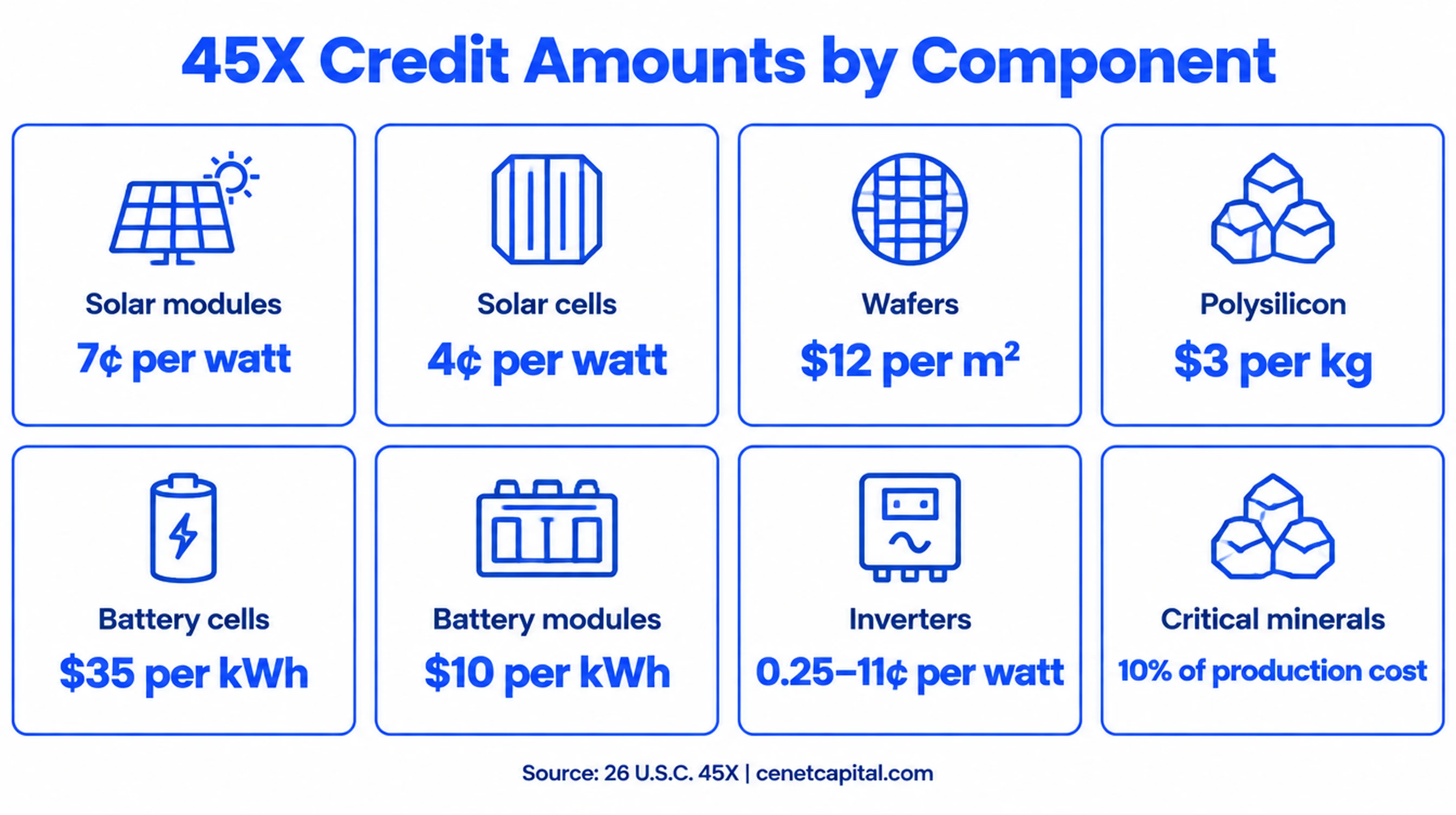
The amounts are set in the statute and aren’t adjusted for inflation. Solar modules earn 7 cents per watt, solar cells 4 cents per watt, battery cells $35 per kWh, battery modules $10 per kWh, and electrode active materials and critical minerals 10% of production costs.
Component | 45X credit |
|---|---|
Solar grade polysilicon | $3 per kilogram |
Photovoltaic wafers | $12 per square meter |
Photovoltaic cells (thin film or crystalline) | 4 cents per watt (DC) |
Solar modules | 7 cents per watt (DC) |
Polymeric backsheet | 40 cents per square meter |
Torque tubes / structural fasteners | 87 cents per kg / $2.28 per kg |
Inverters | 0.25¢/W (central), 1.5¢/W (utility), 2¢/W (commercial), 6.5¢/W (residential), 11¢/W (microinverter) |
Battery cells | $35 per kWh |
Battery modules | $10 per kWh ($45 if made without cells) |
Electrode active materials | 10% of production costs |
Critical minerals | 10% of production costs |
Metallurgical coal (through 2029) | 2.5% of production costs |
Wind blades / nacelles / towers (through 2027) | 2¢ / 5¢ / 3¢ per watt of turbine capacity |
Offshore wind foundations (through 2027) | 2¢ (fixed) / 4¢ (floating) per watt |
Because the credit stacks along the supply chain, a fully integrated U.S. solar module can generate credits at several stages: polysilicon, wafer, cell and module, each claimed by whoever makes and sells that component. Use the calculator below to estimate a facility’s annual credit.
How much 45X credit does your factory earn?
Illustrative only. Uses statutory 45X amounts (not inflation-adjusted). Units must be produced in the U.S. and sold to unrelated buyers. Foreign-entity and material assistance rules apply from 2026; integrated component rules tighten for tax years beginning after 2026.
Price your 45X credits →How is the 45X credit calculated?
Multiply the units produced and sold to unrelated buyers during the year by the component’s credit amount, then apply the phase-out percentage for that year. A 2 GW module factory selling its full output earns about $140 million a year (2 billion watts × $0.07). A 10 GWh battery cell plant earns about $350 million (10 million kWh × $35). There’s no cap, no basis calculation and no recapture, which is why 45X credits are popular with buyers.
Count eligible units sold to an unrelated person during the tax year (sales to a related party count only if that party resells to an unrelated person).
Multiply by the credit amount for that component.
Apply the phase-out if the component is sold in 2030 or later (or 2031 or later for critical minerals).
Confirm foreign-entity compliance for the year.
When does the 45X credit phase out?
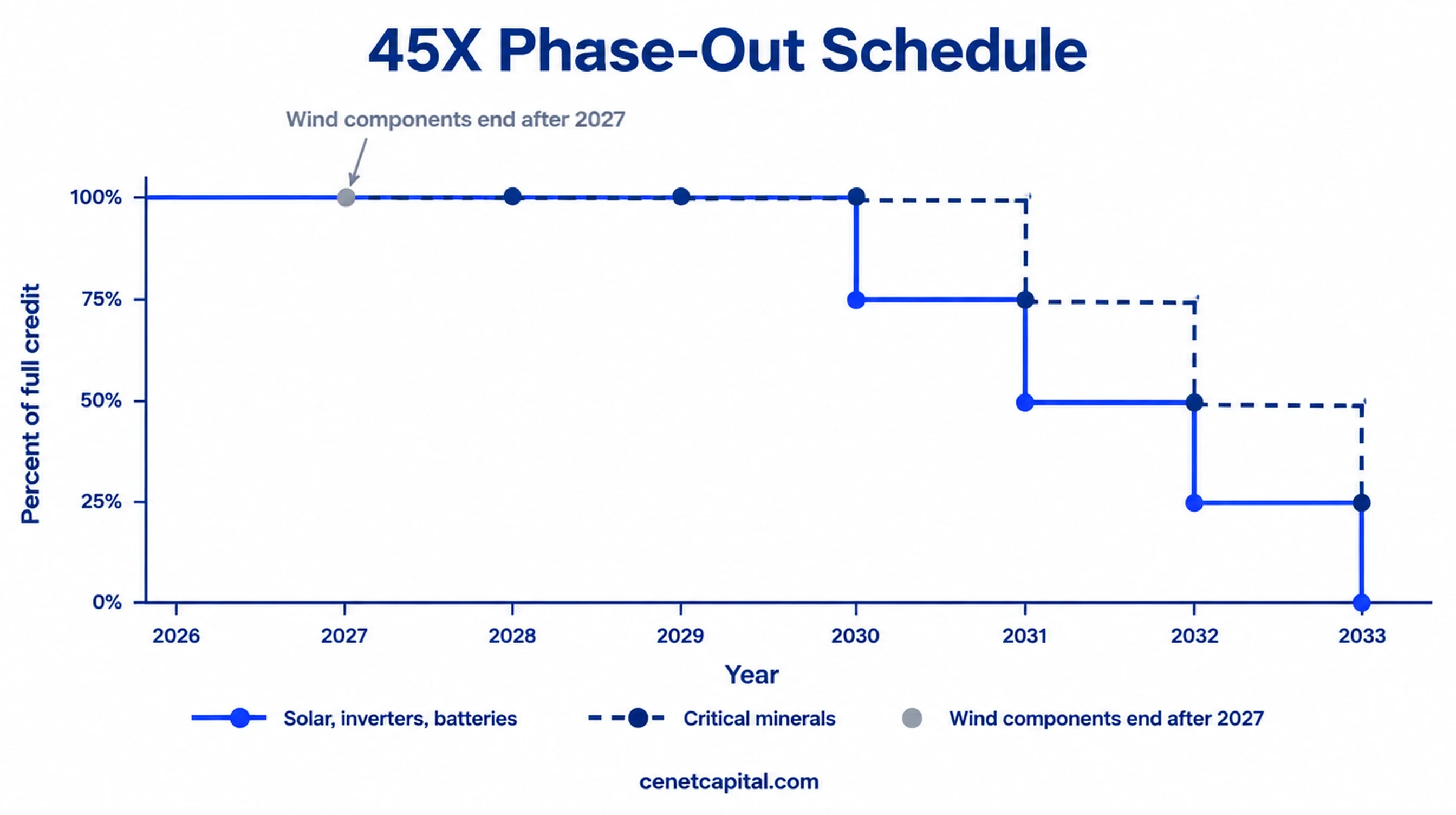
Most components earn the full credit through 2029, then 75% in 2030, 50% in 2031, 25% in 2032, and nothing after. Critical minerals follow the same steps one year later (75% in 2031 through 25% in 2033). Wind components end entirely after December 31, 2027. Metallurgical coal qualifies only through 2029. The critical mineral phase-out and the early wind cutoff were added by the One Big Beautiful Bill Act; before it, critical minerals had no end date.
Year sold | Solar, inverters, trackers, batteries | Critical minerals | Wind components |
|---|---|---|---|
2026–2027 | 100% | 100% | 100% |
2028–2029 | 100% | 100% | 0% |
2030 | 75% | 100% | 0% |
2031 | 50% | 75% | 0% |
2032 | 25% | 50% | 0% |
2033 | 0% | 25% | 0% |
What did the One Big Beautiful Bill change for 45X?
Four things: wind components end after 2027, critical minerals now phase out from 2031, integrated components face a stricter test from 2027, and foreign-entity rules apply both to who claims the credit and what goes into the product.
Integrated components. For tax years beginning after 2026, a manufacturer that builds a component into a larger product it also makes can claim the credit on the inner component only if at least 65% of the larger product’s total direct material costs come from primary components mined, produced or manufactured in the U.S., and the larger product is sold to an unrelated person.
Prohibited foreign entities. A taxpayer that is a “specified foreign entity” or “foreign-influenced entity” (tied to China, Russia, Iran or North Korea) can’t claim 45X.
Material assistance. Components fail if too much of their direct material cost comes from prohibited foreign entities. The required non-prohibited share starts at 50% for solar components and inverters, 60% for battery components and 85% for wind components in 2026, and rises each year.
Transfers. 45X credits can’t be sold to a specified foreign entity.
The full list of changes across every credit is in our One Big Beautiful Bill guide.
Which components generate the most 45X credit?
Battery cells and solar modules dominate in dollar terms, because the per-unit amounts are large relative to selling prices and factories run at high volume. At $35 per kWh, a battery cell credit can equal a large share of a cell’s selling price; together with a $10 per kWh module credit, an integrated U.S. battery pack line can earn $45 per kWh. Solar modules at 7 cents per watt, plus 4 cents for cells made in the same plant, add up to 11 cents per watt for a cell-and-module factory, a significant share of module prices that averaged about 33 cents per watt in mid-2026.
Example facility | Annual output | Approximate 45X credit |
|---|---|---|
Solar module assembly | 2 GW | $140M |
Integrated cell + module | 2 GW | $220M |
Battery cells | 10 GWh | $350M |
Commercial inverters | 3 GW | $60M |
Torque tubes | 50,000 metric tons | $43.5M |
45X vs. 48C: what’s the difference?
45X pays per unit produced and sold; 48C pays once, as an investment credit of up to 30% of the cost of building or retooling a factory, but only if the Department of Energy awards an allocation. A factory can’t claim both on the same property: if 48C was allowed for a facility, its production doesn’t earn 45X. In practice, most manufacturers rely on 45X because it scales with output and doesn’t require winning a competitive allocation round. 48C has been used mostly for projects where up-front capital is the binding constraint. Both credits can be sold for cash.
Who can claim 45X?
The U.S. taxpayer that produces the component in the U.S. (or a U.S. territory) in its trade or business and sells it to an unrelated person. Contract manufacturing arrangements need care: the credit generally goes to the party that actually performs the production activities, not just the brand owner. The component must be produced after 2022 and sold during the tax year. There’s no prevailing wage requirement for 45X, unlike most energy credits.
How do manufacturers monetize 45X credits?
Three ways: use them against their own tax, sell them for cash under Section 6418, or elect direct payment from the IRS for up to five years. Because many new factories aren’t yet profitable, most 45X credits are sold or taken as direct pay. A manufacturer that elects direct pay can do so for five consecutive years; once that window ends or the election is revoked, it can’t elect again, so many switch to selling credits.
45X credits are popular with buyers: they’re earned only on actual sales, have no recapture, and often come from large, creditworthy manufacturers. They typically trade around 91 to 94 cents per dollar. Crux reported 45X pricing recovering to about $0.937 in early 2026 before easing to about $0.925 in the second quarter. Manufacturers claim the credit on Form 7207 for each facility, carried to Form 3800. For sale mechanics, see our guide on how buyers purchase credits.
45X checklist for manufacturers
Map every component you produce to its 45X category and unit of measure.
Track units sold to unrelated buyers by tax year, with invoices.
Run the material assistance calculation annually and keep supplier certifications.
Review integrated component flows before your 2027 tax year begins.
Decide between direct pay and sale before your first return, and register each facility with the IRS.
Plan for the 2030 step-down in capital and pricing models.
If you manufacture eligible components and want cash for your credits, Cenet Capital buys and insures 45X credits. Estimate your credit with the calculator above, then send us the result.
Manufacturing in the U.S.? Turn your 45X credits into cash.
Cenet Capital buys and insures 45X credits from solar, battery, inverter and component manufacturers. Send us your production volumes and we'll price your credits.

More Insights