Section 48E explained: who qualifies, the 6%/30% rates and bonus adders, energy storage, 48 vs. 48E, OBBBA deadlines, FEOC rules, recapture, and selling 48E credits.
Author -
Paulestini Francois
Published -
READ TIME
Section 48E is now the investment tax credit for nearly every new clean electricity and storage project in the U.S. It replaced the old technology-by-technology energy credit with a single rule: zero emissions qualifies. Here's how 48E works in 2026, what qualifies, how much it's worth, how it differs from Section 48, what the One Big Beautiful Bill changed, and how owners claim or sell it.
What is the Section 48E tax credit?
Section 48E, the clean electricity investment credit, is the federal investment tax credit for zero-emission electricity facilities and energy storage placed in service after 2024. It’s worth 6% of the qualified investment, or 30% if the project meets prevailing wage and apprenticeship requirements, plus up to 40 more percentage points of bonus adders. It replaced the technology-specific Section 48 energy credit for new projects and is “technology-neutral”: any facility that generates electricity with a greenhouse gas emissions rate of zero or less qualifies, not just the technologies Congress named.
48E was created by the Inflation Reduction Act, finalized in Treasury regulations published on January 15, 2025, and amended by the One Big Beautiful Bill Act in July 2025. It’s claimed on Part V of IRS Form 3468. For a broader overview of investment credits, see our investment tax credit guide.
What qualifies for the 48E credit?
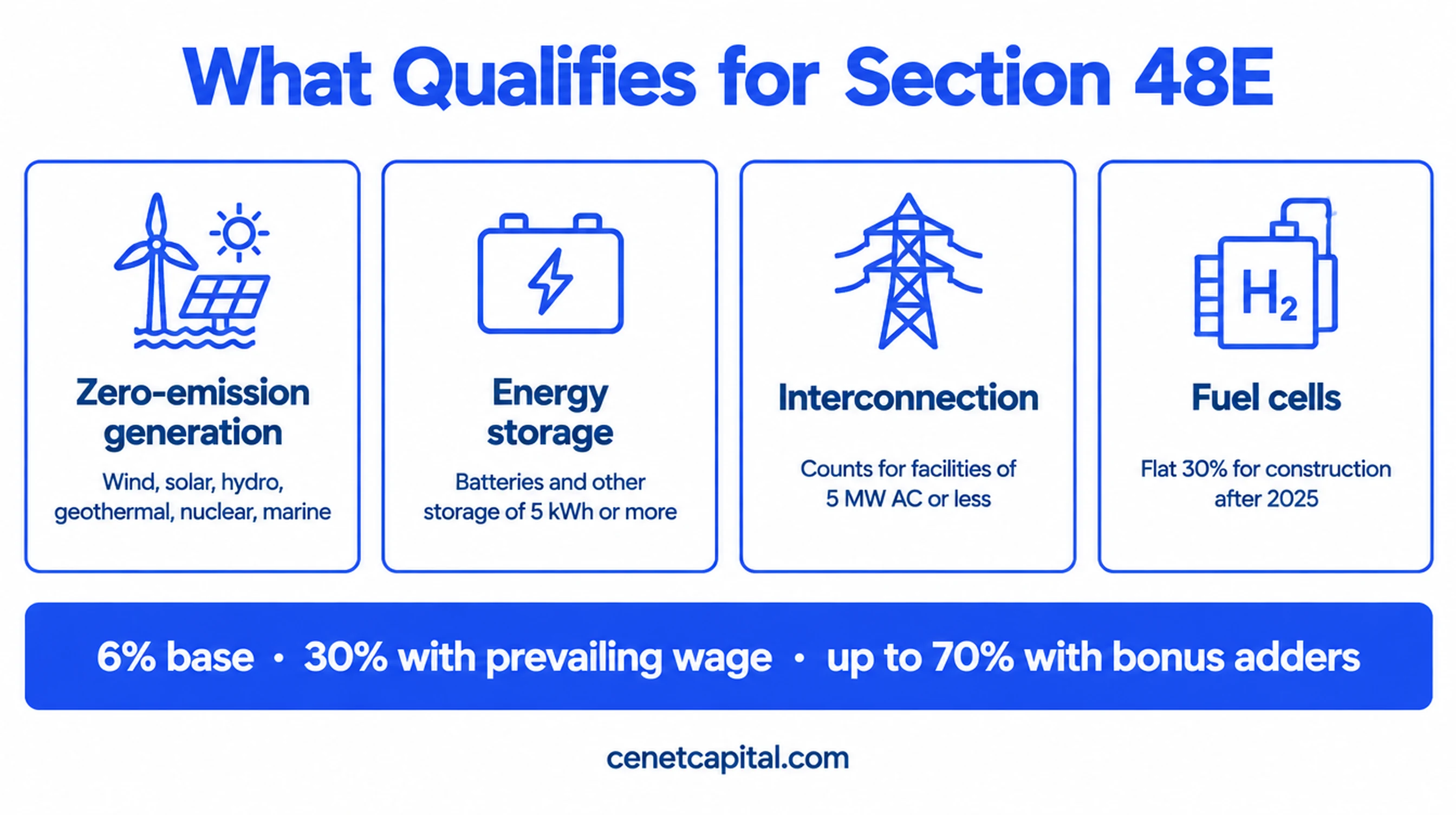
Three kinds of property: qualified clean electricity facilities (any generator with a zero greenhouse gas emissions rate), energy storage technology, and, for facilities of 5 MW AC or less, the cost of interconnection.
Zero-emission facilities. The final regulations list technologies treated as zero-emission without further analysis: wind, solar, hydropower, marine and hydrokinetic, geothermal, nuclear fission and fusion, and certain waste energy recovery. Other technologies, such as combustion of biomass or renewable natural gas, must show a zero or negative lifecycle emissions rate.
Energy storage. Batteries and other technology that stores energy for conversion to electricity (minimum 5 kWh), plus certain thermal storage, standalone or co-located.
Qualified interconnection property. For facilities with maximum net output of 5 MW AC or less, interconnection costs the owner pays count toward the credit, even if the utility owns the equipment.
Fuel cells. Added by the One Big Beautiful Bill Act at a flat 30% for construction beginning after 2025, without bonus adders and without the zero-emission requirement.
Expansions. New units or added capacity at an existing facility qualify to the extent of the increased output.
A facility can’t claim 48E if it, or a prior owner, claimed the PTC (45 or 45Y), 45Q, 45U, legacy 48 or several other credits on it.
How much is the 48E credit?
Rate × qualified investment. The rate is 6% base, 30% with prevailing wage and apprenticeship (or for projects under 1 MW AC, or that started before January 29, 2023), plus energy community (+10), domestic content (+10) and low-income communities (+10 or +20) bonuses. Without PWA, each of the first two bonuses is worth only 2 points.
Scenario | 48E rate | Credit on $20M of qualified investment |
|---|---|---|
Base, no PWA | 6% | $1.2M |
PWA met | 30% | $6.0M |
PWA + energy community | 40% | $8.0M |
PWA + energy community + domestic content | 50% | $10.0M |
Fuel cells (construction after 2025) | 30% flat | $6.0M |
The domestic content bonus requires all structural steel and iron to be U.S.-made, and a minimum share of manufactured products: 50% for projects beginning construction in 2026, per the 2025 Form 3468 instructions. Our energy community guide explains how to check location eligibility. Use the calculator below to run your own numbers; it applies the same 48E rate rules.
How much is your investment tax credit worth?
Illustrative only. Wind and solar must have begun construction by July 4, 2026, or be placed in service by December 31, 2027. The low-income bonus requires a Treasury allocation and applies to facilities under 5 MW. Credits are subject to 5-year recapture.
Price your ITC →What’s the difference between Section 48 and 48E?
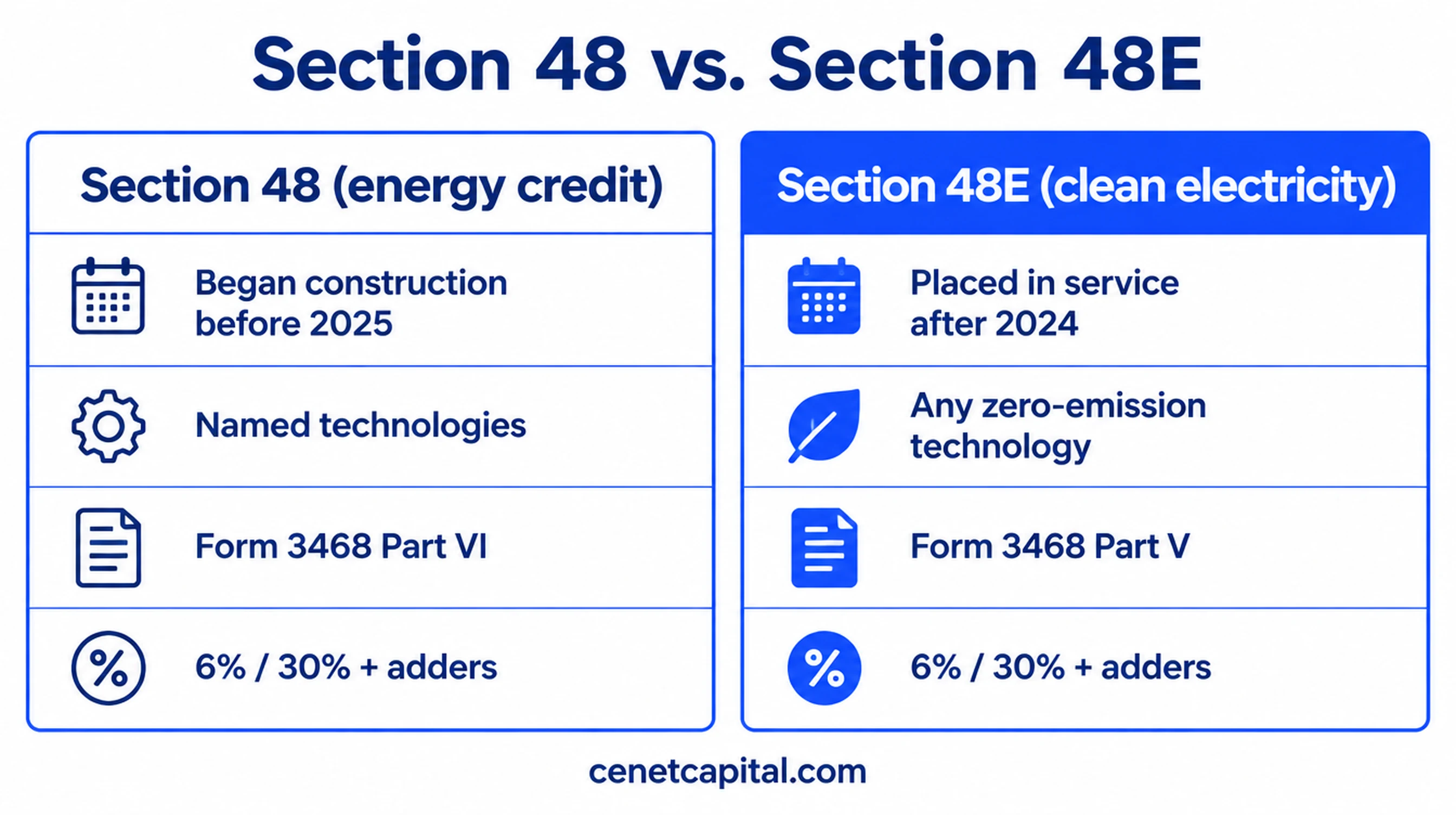
Section 48 lists specific technologies and generally covers projects that began construction before 2025. Section 48E is technology-neutral and covers facilities placed in service after 2024. The rates and bonus adders are the same.
Section 48 (energy credit) | Section 48E (clean electricity) | |
|---|---|---|
Which projects | Began construction before 2025 (plus some property types) | Placed in service after 2024 |
Eligibility test | Named technologies | Zero greenhouse gas emissions rate |
Rate | 6% / 30% + adders | 6% / 30% + adders |
Unit of credit | Energy project | Qualified facility |
Form 3468 | Part VI | Part V |
Transfer pricing | Well established | Small discount, more insurance |
A project that began construction in 2024 and was placed in service in 2025 can generally choose which regime to use. Most stick with Section 48 because buyers and insurers know it better.
What did the One Big Beautiful Bill change for 48E?
It set deadlines by technology and added foreign-entity rules. Wind and solar facilities must have begun construction by July 4, 2026, or be placed in service by December 31, 2027. Energy storage is exempt from that cutoff. Geothermal, hydro, nuclear and other zero-emission facilities keep the full credit for construction beginning through 2033, then 75% in 2034 and 50% in 2035. For projects beginning construction after 2025, a material assistance test requires at least 40% non-prohibited content for generation facilities and 55% for storage in 2026, rising each year. Full details are in our One Big Beautiful Bill guide.
How does 48E work for energy storage?
Storage is one of 48E’s biggest winners: it qualifies on its own, it isn’t subject to the wind and solar deadline, and it keeps the full credit for construction beginning through 2033. Batteries, pumped hydro, compressed air and certain thermal storage qualify if they can store at least 5 kWh. A battery doesn’t have to be charged by solar, and it doesn’t need to be paired with any generator. Storage that’s co-located with solar is treated as a separate energy storage technology for the credit, so it keeps its eligibility even if the solar portion misses a deadline.
Example: a 100 MW / 400 MWh standalone battery with $120 million of qualified cost, meeting PWA and sited in an energy community, earns a 40% credit of $48 million. Because standalone storage can’t use the production tax credit, 48E is the only federal credit available to it, which is why storage has become one of the fastest-growing sources of supply in the credit transfer market. Starting construction in 2026 means meeting the 55% non-prohibited content threshold, a real constraint for battery supply chains.
What are 48E recapture rules?
Like other investment credits, 48E vests over five years. If the facility is sold, stops operating, or (for buyers) the credit is otherwise disallowed during that period, part of the credit is recaptured: 100% in year one, then 80%, 60%, 40% and 20%. 48E adds a further rule: if a facility’s greenhouse gas emissions rate is later shown to be above 10 grams of CO2e per kWh, the credit can be recaptured. That’s rarely a concern for wind, solar or storage but matters for combustion-based technologies. Fuel cells under the One Big Beautiful Bill’s flat 30% rule are exempt from the emissions-based recapture.
Can tax-exempt organizations use 48E?
Yes, through elective (direct) pay, but with a domestic content catch. Nonprofits, governments, tribes and rural electric cooperatives can receive the 48E credit as a cash payment from the IRS. For facilities of 1 MW or more, that payment is reduced or eliminated unless the project meets domestic content requirements or qualifies for an exception. Projects starting construction in 2026 should plan for the domestic content requirement from day one.
How are 48E credits sold?
Like any other investment credit: the owner registers the facility, signs a transfer agreement, and gets paid in cash, usually at 88 to 95 cents per dollar. Crux has reported that tech-neutral 48E and 45Y credits trade at a measurable discount to legacy Section 48 and 45 credits, and that about 87% of 48E transfer volume from non-investment-grade sellers carried insurance in the first half of 2026. Buyers want to see the emissions eligibility, the beginning-of-construction record and the foreign-entity analysis. See our buyer’s guide and market report.
48E checklist
Confirm the technology is on the zero-emission list, or obtain an emissions determination.
Document beginning of construction and, for wind and solar, the July 4, 2026 analysis.
Track PWA and file Form 7220.
Support each bonus adder you claim.
Run the material assistance calculation for construction starting after 2025.
Separate qualified property from buildings and other ineligible costs.
Register before selling or electing direct pay.
If you’re placing a 48E facility in service, Cenet Capital buys, insures and finances 48E credits. Run the numbers above and send them to us for pricing.
Placing a 48E facility in service? Get your credit priced.
Cenet Capital buys, insures and finances 48E credits from solar, storage, geothermal and other clean electricity projects. Send us your project details.

More Insights