
Every federal clean energy tax credit for businesses in one place: what each pays, who qualifies, 2026 deadlines, which can be sold, and how to claim them.
Author -
Paulestini Francois
Published -
READ TIME
The federal government offers about a dozen tax credits for building clean power, storing energy, manufacturing components and producing clean fuels, and most of them can be sold for cash. Keeping track of them, especially after the One Big Beautiful Bill reshaped the deadlines, is hard. This guide puts every major business clean energy credit in one place: what it pays, who qualifies, where it stands in 2026, and how to turn it into money.
What are clean energy tax credits?
Clean energy tax credits are federal tax credits that reduce a business’s income tax, dollar for dollar, when it builds clean electricity or storage projects, manufactures clean energy components, or produces clean fuels, hydrogen or captured carbon. Most can also be sold to another company for cash or, for tax-exempt organizations, paid out directly by the IRS. There are about a dozen business credits in the tax code, most created or expanded by the Inflation Reduction Act of 2022 and reshaped by the One Big Beautiful Bill Act of 2025.
This hub explains every major credit in one place: what it pays, who qualifies, the 2026 deadlines, and whether it can be sold. Each section links to a detailed guide.
What clean energy tax credits are available to businesses?
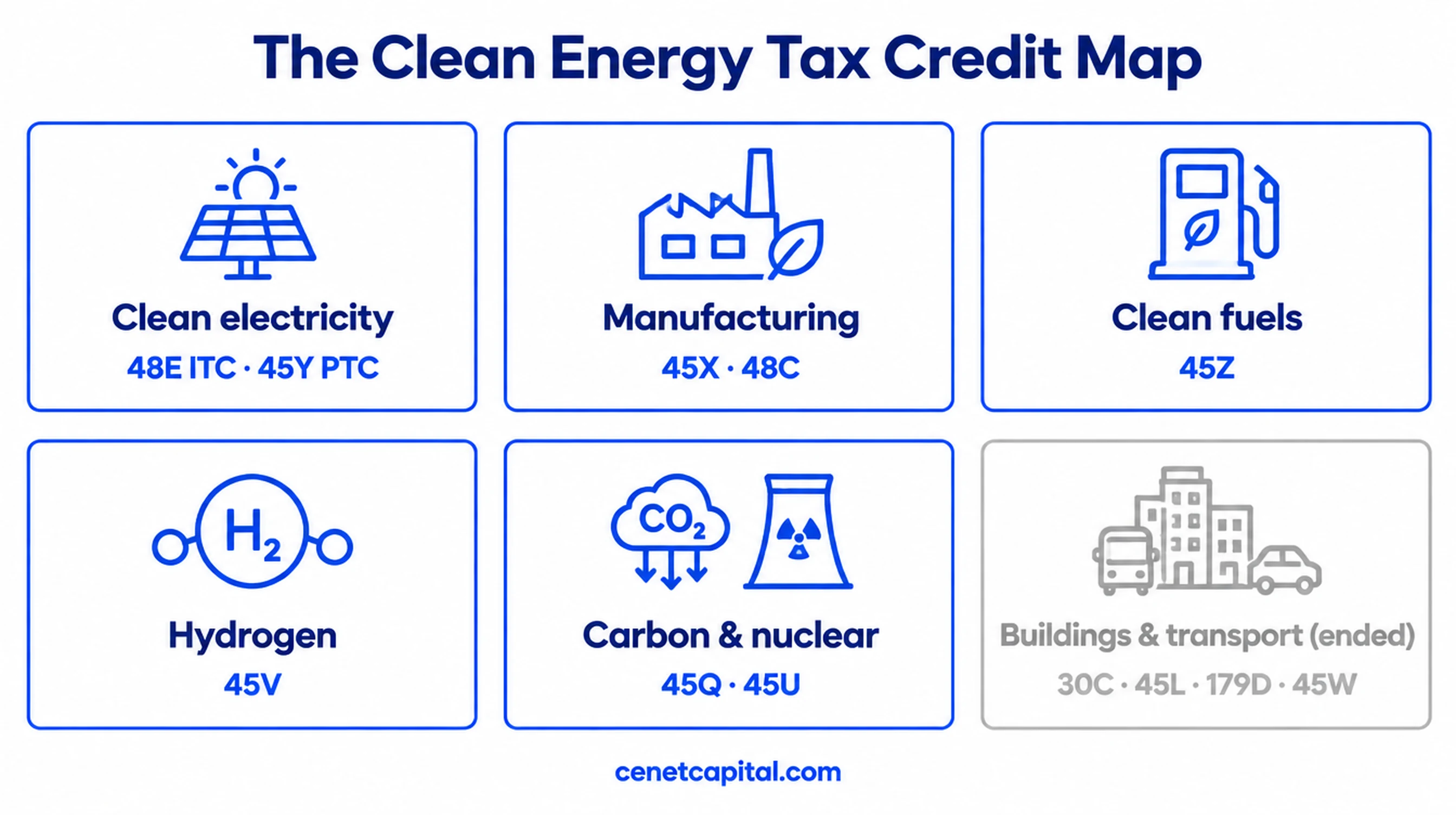
Here is every major business clean energy credit and where it stands in 2026.
Credit | Pays for | 2026 value | Sellable? | Status |
|---|---|---|---|---|
48E / 48 ITC | Building clean power, storage, fuel cells | 6%–30% of cost, up to 70% with adders | Yes | Wind/solar deadlines; others through 2033 |
45Y / 45 PTC | Clean electricity produced | 3.1¢/kWh for 10 years | Yes | Same as ITC |
45X | Manufacturing components | Fixed per unit | Yes | Full through 2029 |
48C | Factory investments with DOE allocation | Up to 30% of investment | Yes | Allocation-based |
45Z | Clean transportation fuels | Up to $1.00/gal | Yes | Through 2029 |
45V | Clean hydrogen | Up to $3.28/kg | Yes | Construction before 2028 |
45Q | Carbon capture and storage or use | Per metric ton | Yes | Construction before 2033 |
45U | Existing nuclear output | Per kWh, price-adjusted | Yes | Through 2032 |
30C | EV charging property | Up to 30%, $100K per item | Yes | Ended June 30, 2026 |
45W, 45L, 179D | Commercial EVs, efficient homes and buildings | Varies | No | Ended 2025–2026 |
Detailed guides: investment tax credit, production tax credit, 45X, 45Z, 45V, and the One Big Beautiful Bill changes. For a 2026 snapshot, see energy tax credits in 2026.
How do clean energy tax credits work?
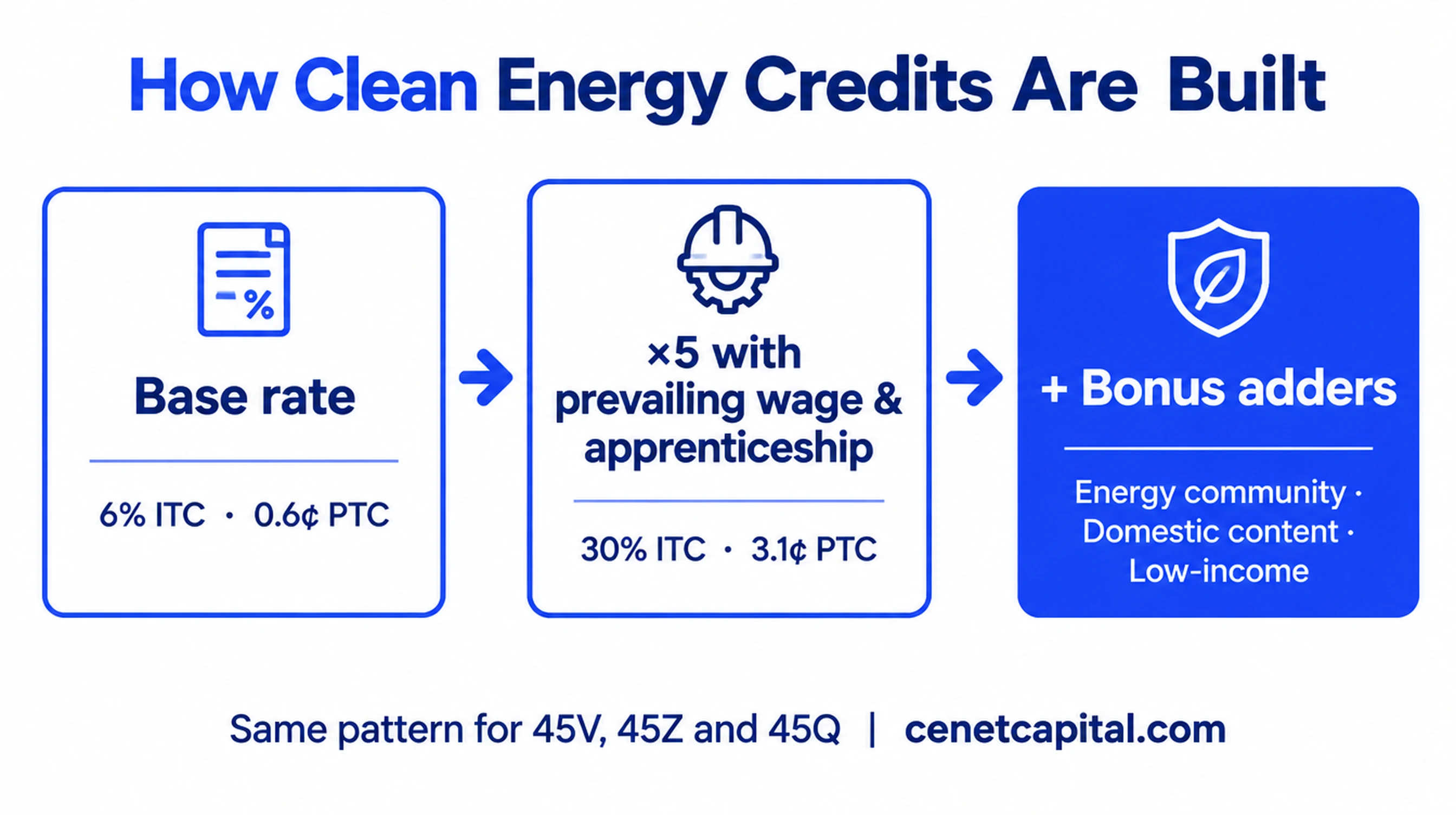
Most credits have a small base rate that grows fivefold when a project pays prevailing wages and uses registered apprentices, plus bonus adders for location and U.S. content. The credit then reduces federal income tax in the year it’s earned. The same building blocks recur across credits:
Base vs. increased rate. The ITC is 6% or 30%; the PTC is 0.6 or 3.1 cents per kWh; 45V, 45Z and 45Q follow the same 5x pattern. Small projects under 1 MW and those that started before January 29, 2023 get the higher rate automatically.
Bonus adders. The energy community and domestic content bonuses each add 10 points to the ITC or 10% to the PTC; the low-income communities bonus adds 10 or 20 points to the ITC for small allocated projects.
Timing. Investment credits are earned when a project is placed in service; production credits are earned as output is produced and sold.
Limits. General business credits can offset roughly 75% of federal tax above $25,000 a year. Unused credits carry back (generally one year, three for many energy credits) and forward 20 years.
Who uses clean energy tax credits?
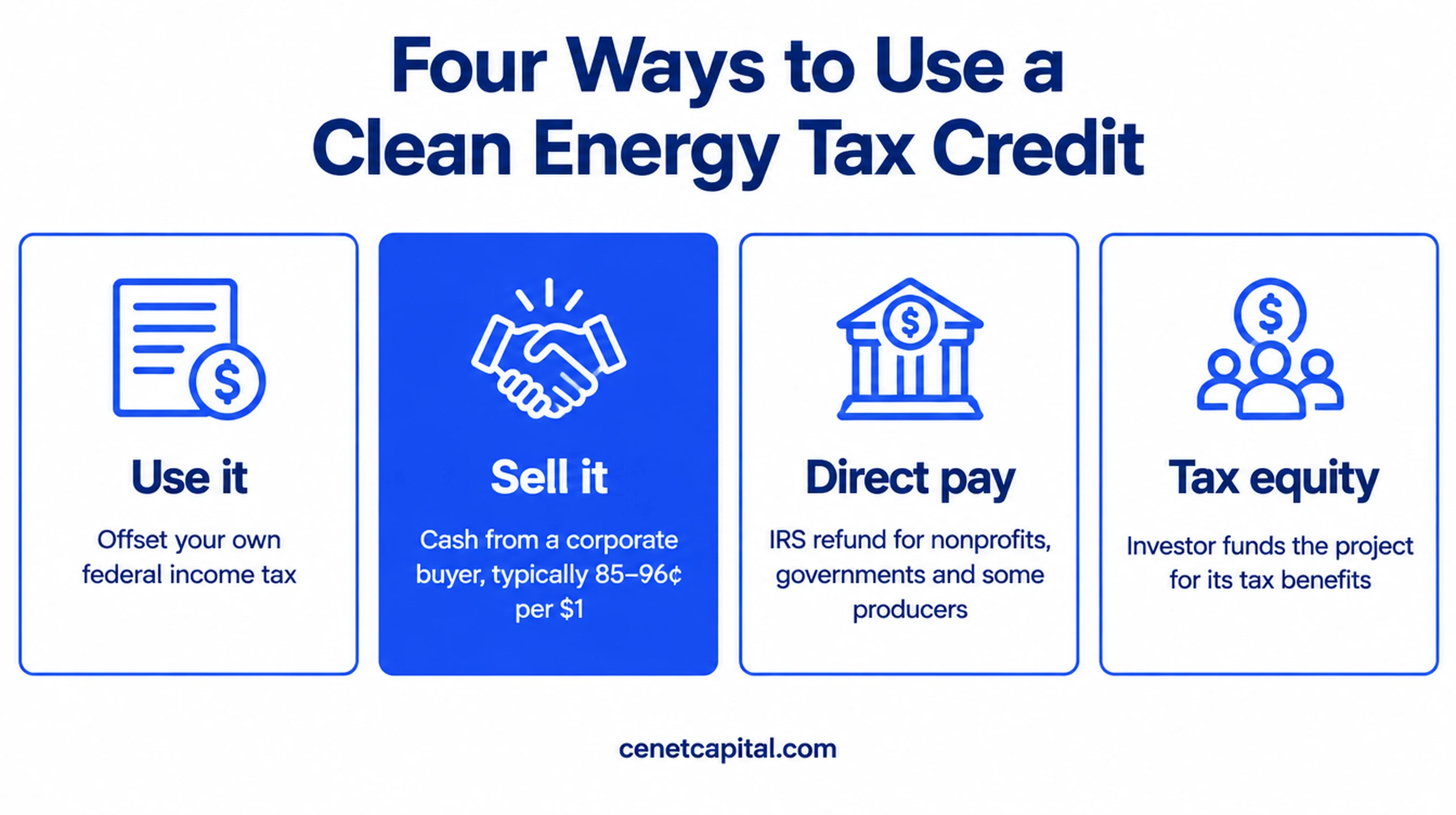
Five groups: project developers, manufacturers, fuel and hydrogen producers, tax-exempt organizations, and corporate credit buyers.
Developers and project owners earn the ITC or PTC on solar, wind, storage, geothermal and other projects, and usually sell the credits or use tax equity.
Manufacturers earn 45X on components and sometimes 48C on factory investments.
Fuel, hydrogen and carbon capture producers earn 45Z, 45V or 45Q per unit produced.
Nonprofits, schools, cities and tribes use elective pay to receive credits as cash refunds.
Profitable corporations buy credits at a discount to reduce their federal taxes. About one in four Fortune 1000 companies does, as our buyer’s guide explains.
What are the most common clean energy tax credit mistakes?
Missing prevailing wage records, which cuts most credits by 80%.
Assuming an old deadline still applies. Wind, solar, chargers and building credits all had 2026 cutoffs.
Including ineligible costs like roofs, buildings or land in an ITC basis.
Registering late. A credit can’t be sold or paid directly without an IRS registration number.
Ignoring foreign-entity rules for projects starting construction after 2025.
Selling small credits one at a time when pooling them would get a better price.
Can you sell clean energy tax credits?
Yes. Eleven credits can be sold for cash under Section 6418: 45, 45Q, 45U, 45V, 45X, 45Y, 45Z, 48, 48C, 48E and 30C. Most trade at 88 to 96 cents per dollar of credit. The seller registers the project with the IRS, signs a transfer agreement with an unrelated buyer, and gets paid in cash. The cash isn’t taxable to the seller. About one in four Fortune 1000 companies now buys credits, and roughly $42 billion traded in 2025.
Price depends on the credit type, deal size, the seller’s strength, insurance and documentation. Production credits and 45X usually trade higher than investment credits because buyers take no recapture risk. Use the calculator below to estimate what your credit is worth in cash, then read our guides on tax credit pricing and how to sell credits.
What could your tax credit sell for?
Illustrative estimate based on Cenet Capital's observed 80–95¢ range and published market data. Not an offer. Actual pricing depends on full diligence.
Get your actual price →Which clean energy credit should your project claim?
For power projects, the main choice is between the ITC and the PTC; for everything else, the credit is set by what you make.
Storage: ITC only.
Solar and wind: ITC for higher-cost or lower-output projects, PTC for large, high-output projects. See the comparison in our PTC guide.
Factories: 45X for components produced and sold; 48C if you won an allocation for the investment itself.
Fuel producers: 45Z for biofuels and RNG; 45V for hydrogen; 45Q for capture. Some of these can’t be combined at the same facility.
What rules apply to every clean energy credit?
Prevailing wage and apprenticeship (PWA). Required for the full rate on most credits; verified on Form 7220.
Beginning of construction. Determines which rules and deadlines apply. Wind and solar timing is especially important after July 4, 2026.
Foreign entities of concern. Since 2025–2026, taxpayers tied to prohibited foreign entities can’t claim most credits, and projects starting after 2025 must meet material assistance thresholds.
Recapture. Investment credits vest over five years; selling or abandoning a project early triggers partial repayment.
Registration. Required before selling a credit or taking direct pay.
How big is the clean energy tax credit market?
Very large and still growing. Total clean energy tax credit monetization, through sales, tax equity and preferred equity, reached about $63 billion in 2025, and the transfer market alone is projected at $47.5 to $49 billion in 2026. Clean energy and manufacturing capital spending hit a record $155 billion in 2025, according to Crux. Our market statistics page collects the key numbers.
Whatever credit your project earns, Cenet Capital buys, insures and finances clean energy tax credits. Estimate your credit’s cash value above and send us the details.
Whatever credit you earn, turn it into cash.
Cenet Capital buys, insures and finances clean energy tax credits of every type. Send us your project and we'll tell you what your credit is worth.

More Insights