
Every clean energy tax credit change in the One Big Beautiful Bill: wind and solar deadlines, FEOC rules, 45X, 45Z, 45V, EV and home credits, and transferability.
Author -
Paulestini Francois
Published -
READ TIME
The One Big Beautiful Bill Act rewrote the timeline for nearly every clean energy tax credit in the U.S. Some credits ended outright, some got short new deadlines, and a few came through almost untouched. Just as important, the ability to sell credits for cash survived. Here's every change, credit by credit, with the dates that apply now, a deadline checker for your own project, and what it all means for developers and credit buyers.
How did the One Big Beautiful Bill change clean energy tax credits?
The One Big Beautiful Bill Act (P.L. 119-21), signed July 4, 2025, kept most business clean energy credits but cut their runway: wind and solar got a short deadline, consumer and EV credits ended, clean fuel and hydrogen credits got new end dates, and nearly every credit picked up “foreign entity of concern” restrictions. Transferability, the ability to sell credits for cash, survived intact. For anyone developing, financing or buying clean energy projects, the law turned a decade-long window into a series of specific dates. This guide goes credit by credit, with the deadlines that apply now, in October 2026.
Use the deadline checker below to test a specific project, then read the sections that apply to you.
Does your project still qualify?
General guidance based on P.L. 119-21 and IRS guidance as of October 2026. Beginning-of-construction rules for wind and solar are in litigation. Confirm eligibility with your tax advisor.
Get your credit priced →Which credits did the One Big Beautiful Bill end or shorten?
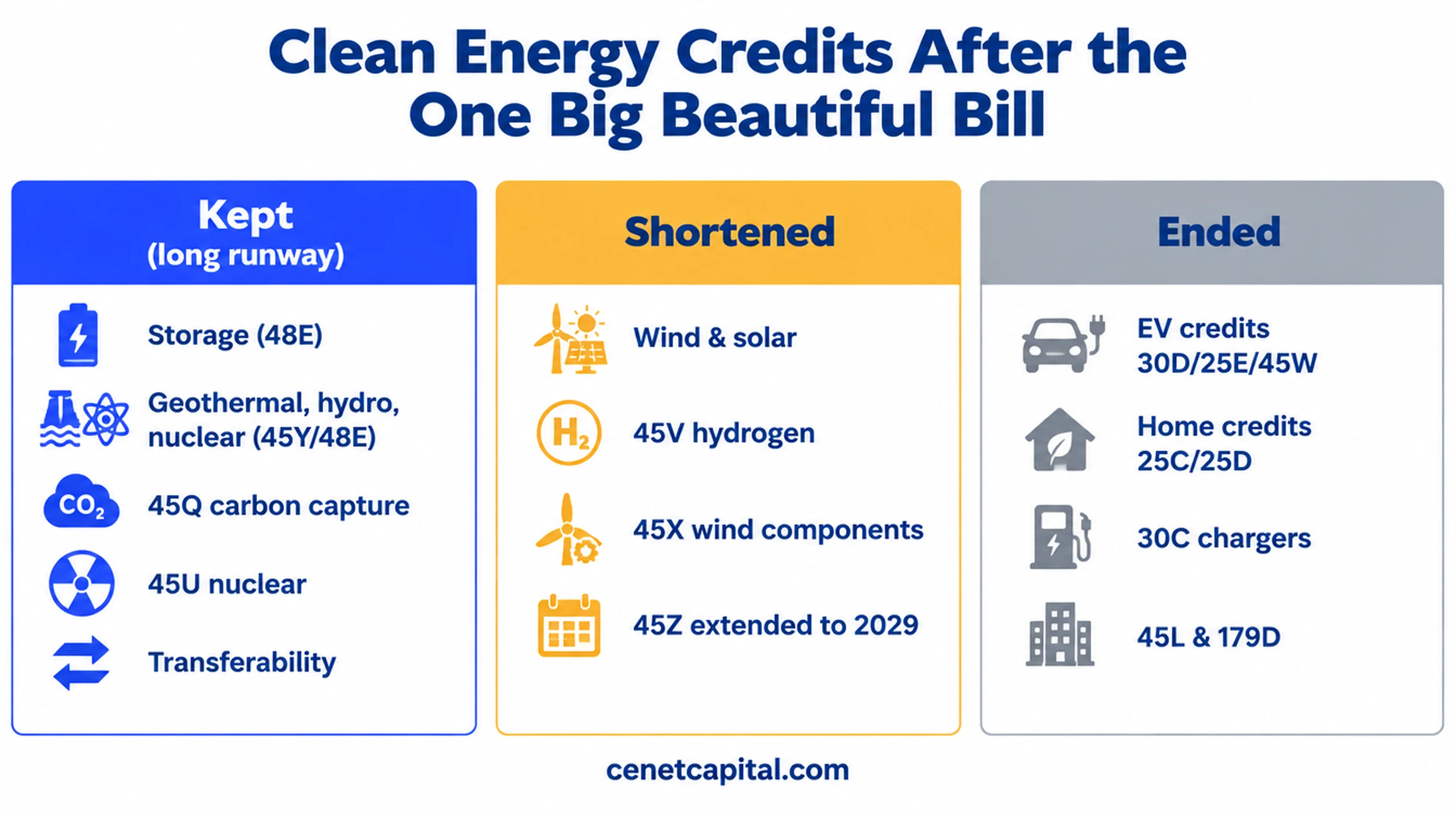
Consumer credits ended first: EV credits after September 30, 2025, and home energy credits after December 31, 2025. Business credits were shortened rather than repealed, with the earliest cutoffs hitting wind, solar, EV chargers and building-efficiency credits in 2026 and 2027.
Credit | What it covers | Status after OBBBA |
|---|---|---|
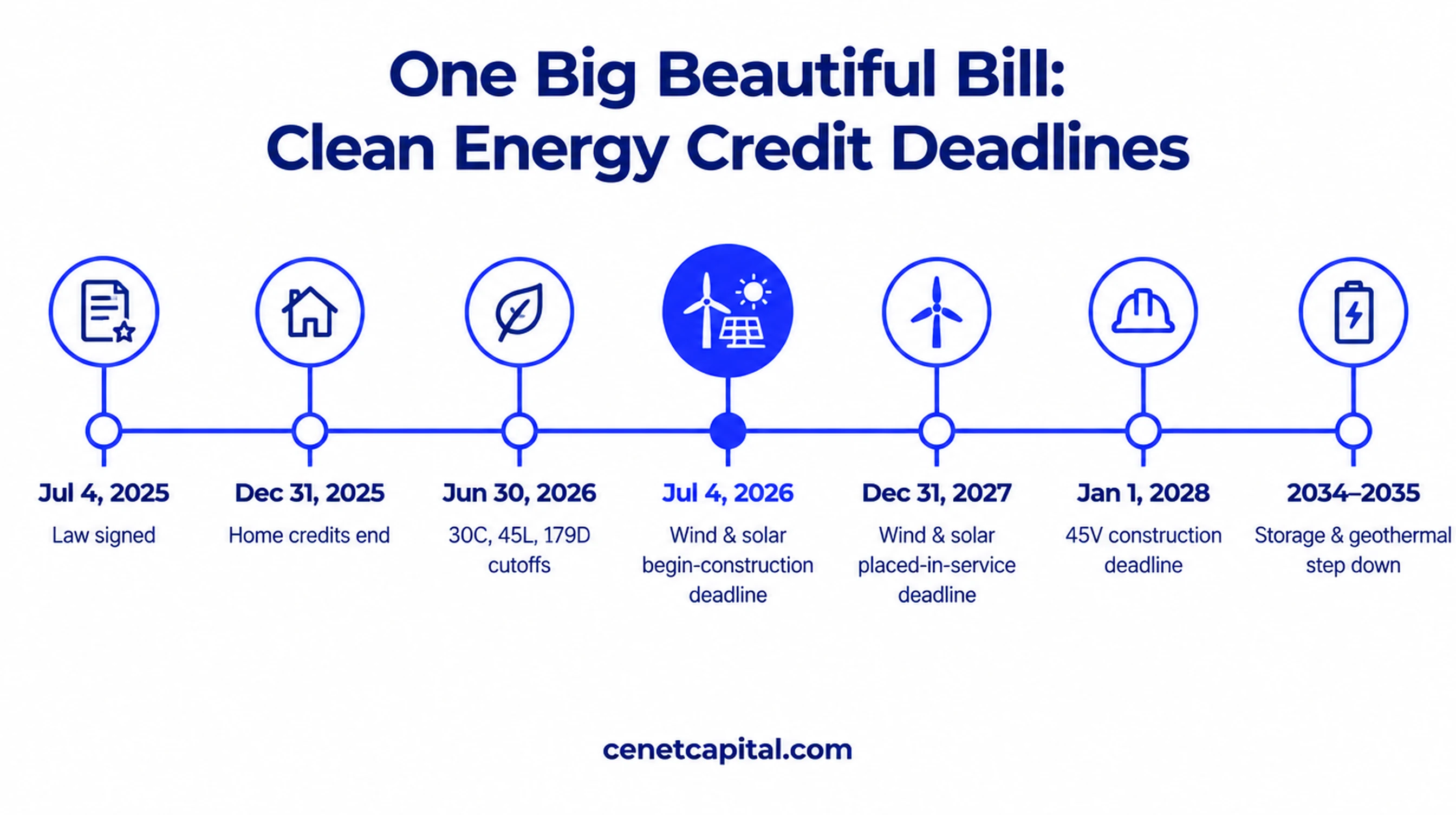
45Y / 48E (wind and solar) | Clean electricity PTC and ITC | Begin construction by July 4, 2026, or be placed in service by December 31, 2027 |
45Y / 48E (storage, geothermal, hydro, nuclear, other) | Clean electricity PTC and ITC | Full credit for construction beginning through 2033; 75% in 2034; 50% in 2035; none after |
48E fuel cells | Fuel cell property | Newly eligible at a flat 30% for construction beginning after 2025; no bonus adders |
45X | Advanced manufacturing | Wind components end after 2027; critical minerals phase down 2031–2033; metallurgical coal added through 2029 |
45Z | Clean fuel production | Extended through 2029; SAF premium removed from 2026; North American feedstock rule |
45V | Clean hydrogen | Begin construction before January 1, 2028 |
45Q | Carbon capture | Kept; utilization credit raised to match storage |
45U | Existing nuclear | Kept through 2032, with foreign-entity limits |
30C | EV charging property | Property placed in service after June 30, 2026 not eligible |
45L and 179D | Efficient homes and commercial buildings | End for homes acquired, or construction beginning, after June 30, 2026 |
30D, 25E, 45W | New, used and commercial EVs | Ended for vehicles acquired after September 30, 2025 |
25C and 25D | Home efficiency and residential clean energy | Ended after December 31, 2025 |
Sources: the law as summarized by RSM and Kirkland & Ellis, and the IRS’s 2025 Form 3468 instructions.
What happened to the solar and wind tax credits?
They survive only for projects that began construction by July 4, 2026, or that are placed in service by December 31, 2027. Projects that started in time generally have four calendar years after the start year to be placed in service under the IRS continuity safe harbor, and then earn the full ITC or 10 years of PTCs. Projects that didn’t start in time have until the end of 2027 to be placed in service.
How a project proves it started construction has been contested. The IRS’s Notice 2025-42 eliminated the 5% cost safe harbor for most wind and solar, leaving only the physical work test except for solar under 1.5 MW. A federal district court vacated that notice on June 6, 2026, and an appeal is expected. Credit buyers now ask exactly which test a project relied on, and price uncertainty accordingly. Our ITC guide and PTC guide walk through the rates.
What about storage, geothermal, nuclear and hydro?
These technologies kept the long runway. They earn the full technology-neutral credit for construction beginning through 2033, then 75% in 2034 and 50% in 2035. Energy storage is explicitly exempt from the wind and solar cutoff, even when paired with a solar farm. That’s why storage and solar-plus-storage have been growing as a share of the credit transfer market while standalone wind has shrunk.
What are the new foreign entity of concern (FEOC) rules?
Starting with tax years beginning after July 4, 2025, a taxpayer that is a “prohibited foreign entity” can’t claim most clean energy credits. For projects beginning construction after 2025, a project also fails if too much of its cost comes from prohibited foreign entities, a “material assistance” test.
Construction begins in | Required non-prohibited share: generation facilities | Required non-prohibited share: energy storage |
|---|---|---|
2026 | 40% | 55% |
2027 | 45% | 60% |
2028 | 50% | 65% |
2029 | 55% | 70% |
2030 and later | 60% | 75% |
In practice, this means tracing where modules, cells, inverters, batteries and their components come from. Manufacturers claiming 45X face their own version of the test. Foreign-entity documentation has become a standard item in tax credit due diligence for any project starting in 2026 or later.
Did the One Big Beautiful Bill change transferability?
No. Every credit that could be sold for cash before the law can still be sold, under the same Section 6418 rules. The only new limit is that credits under 45Q, 45X, 45Y, 45Z and 48E can’t be sold to a “specified foreign entity.” Elective (direct) pay for tax-exempt and government entities also survived. That’s why the transfer market grew 48% to about $42 billion in 2025 and is on pace for $47.5 to $49 billion in 2026, according to Crux. Earlier House drafts would have ended transferability, so its survival mattered as much as any deadline.
How did the law change 45X, 45Z and 45V?
45X advanced manufacturing: wind energy components sold after 2027 no longer qualify. Critical minerals, which previously had no phase-out, now phase down from 2031 and end after 2033. Metallurgical coal was added as a critical mineral through 2029. Material assistance rules apply.
45Z clean fuels: extended through 2029. For fuel produced after 2025, the higher rate for sustainable aviation fuel is gone, indirect land use change is excluded from emissions rates, and feedstocks must come from the U.S., Mexico or Canada. Manure-based fuels can have negative emissions rates. See our 45Z guide.
45V clean hydrogen: facilities must begin construction before January 1, 2028, five years earlier than before. Our 45V deadline guide covers the details.
What didn’t change?
The credit rates, the bonus adders, prevailing wage and apprenticeship rules, the 10-year PTC period, five-year ITC recapture, and the mechanics of selling credits all stayed the same. The energy community, domestic content and low-income bonuses still add 10 to 20 percentage points to the ITC and 10% to the PTC. A project that qualifies on timing is economically almost identical to one built before the law passed, apart from the new foreign-entity diligence.
Key One Big Beautiful Bill dates at a glance
Date | What happens |
|---|---|
July 4, 2025 | Law signed; foreign-entity taxpayer rules apply to tax years beginning after this date |
September 30, 2025 | Last day to acquire a vehicle for the 30D, 25E or 45W EV credits |
December 31, 2025 | 25C and 25D home credits end; projects starting construction after this date face material assistance rules |
June 30, 2026 | Last day for 30C chargers to be placed in service, 45L homes to be acquired and 179D construction to begin |
July 4, 2026 | Last day for wind and solar to begin construction without the 2027 placed-in-service cutoff |
December 31, 2027 | Placed-in-service deadline for wind and solar that started after July 4, 2026; last year for 45X wind components |
January 1, 2028 | 45V hydrogen facilities must have begun construction before this date |
December 31, 2029 | Last day for 45Z clean fuel sales; metallurgical coal leaves 45X |
2031 to 2033 | 45X critical minerals phase down |
2034 and 2035 | Storage, geothermal, nuclear and other 45Y/48E credits step down to 75%, then 50% |
What does the law mean for tax credit prices?
So far, not much at the top of the market, and more at the bottom. Prices for well-documented credits from strong sellers have held near 90 to 96 cents because buyer demand kept growing. The spread has widened for credits with open questions about beginning of construction or foreign-entity compliance, which now need more diligence, insurance or a bigger discount. In other words, the law made documentation worth more. A seller who can show a clean construction-start record and supply-chain file is still selling into a deep, competitive market.
What should developers and credit buyers do now?
Developers: document your beginning-of-construction date and test now, build a foreign-entity supply-chain file for any project starting in 2026 or later, and line up a buyer for your credits before placed-in-service. Wind and solar projects that missed July 4, 2026 should be planning around December 31, 2027.
Buyers: expect steady supply from projects that started in time, but ask for beginning-of-construction support and FEOC analysis on every deal. Read our buyer’s guide and the latest market report.
Everyone: watch the appeal over Notice 2025-42 and any IRS guidance on material assistance. Both could shift how credits are priced.
If you have credits from a project that qualifies under the new deadlines, Cenet Capital buys, insures and finances clean energy tax credits. Run your project through the deadline checker, then send us the result.
Does your project still qualify? Turn it into cash.
Cenet Capital buys, insures and finances clean energy tax credits from projects that meet the new deadlines. Send us your project details and we'll price your credits.

More Insights