Which energy tax credits businesses can still claim in 2026, which ended, the remaining deadlines, how to claim them, and how to turn them into cash.
Author -
Paulestini Francois
Published -
READ TIME
Energy tax credits look very different in 2026 than they did a year ago. Homeowner and EV credits are gone, several business credits ended in mid-2026, and wind and solar now face a hard deadline. But most business credits are still here, and they can still be sold for cash. Here's exactly what a business can claim in 2026, what ended and when, the deadlines that remain, and a finder tool to check your own project.
What energy tax credits are available in 2026?
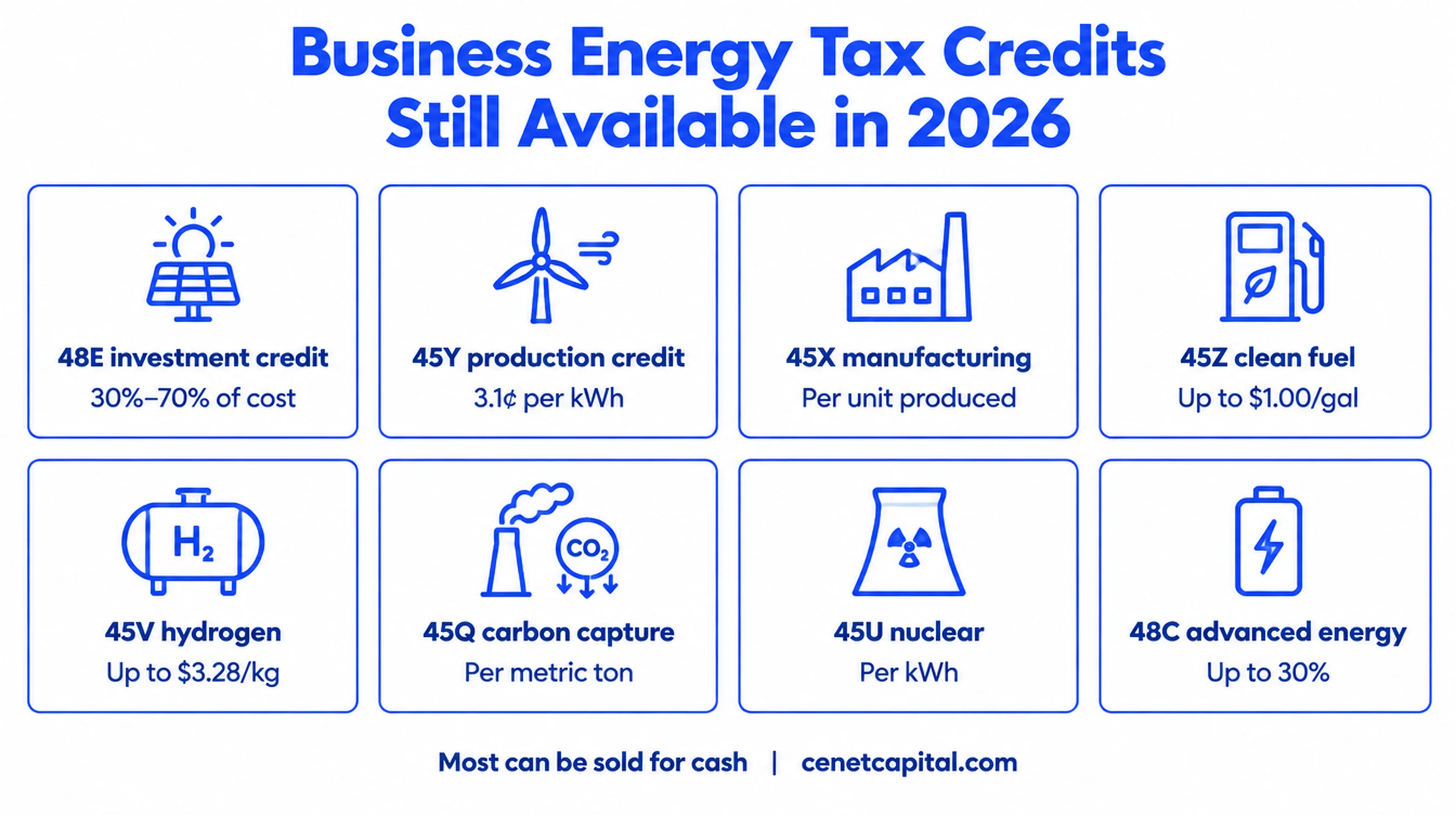
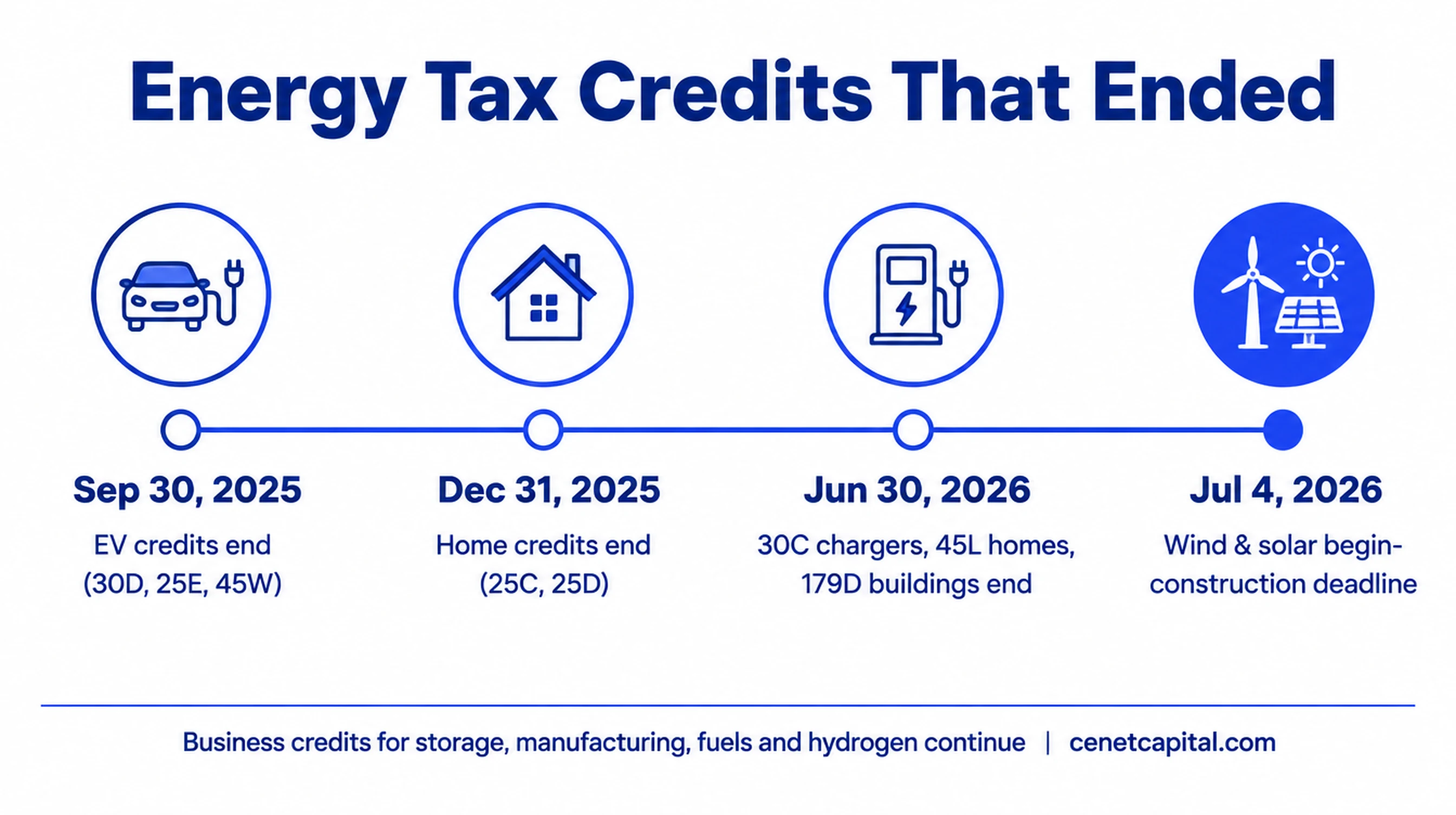
For businesses, most federal clean energy credits are still available in 2026: the investment and production tax credits for storage, geothermal, hydro and nuclear (and for wind and solar that started construction by July 4, 2026), the 45X manufacturing credit, the 45Z clean fuel credit, 45V hydrogen, 45Q carbon capture and 45U nuclear. For homeowners, the residential solar and home improvement credits ended after December 31, 2025, and the EV credits ended September 30, 2025. The One Big Beautiful Bill Act, signed July 4, 2025, is the reason for the split: it kept most business credits on shorter timelines and ended most consumer ones.
This guide lists what a business can still claim in 2026, what ended, and how to turn the credits that remain into cash. Use the credit finder below to see what applies to your project.
Which energy tax credits can you still claim?
General guidance based on federal law and IRS guidance as of October 2026. Full rates assume prevailing wage and apprenticeship requirements are met. Confirm eligibility with your tax advisor.
Get your credit priced →Which business energy tax credits can you still claim in 2026?
These credits are available for projects that meet their 2026 timing rules.
Credit | Who it’s for | 2026 value | Key deadline |
|---|---|---|---|
48E investment tax credit | Solar, storage, geothermal, hydro, nuclear, fuel cells | 6% base, 30% with PWA, up to 70% with adders (fuel cells flat 30%) | Wind/solar: started by July 4, 2026 or in service by end of 2027; others: construction through 2033 |
45Y production tax credit | Zero-emission generators | 3.1¢/kWh with PWA, 0.6¢ base, for 10 years | Same as 48E |
45X manufacturing credit | U.S. component manufacturers | Fixed per unit (e.g., 7¢/W modules, $35/kWh cells) | Full through 2029; wind components end after 2027 |
45Z clean fuel credit | Biofuel, RNG and SAF producers | Up to $1.00/gal, scaled by emissions | Fuel sold through 2029 |
45V clean hydrogen | Hydrogen producers | Up to $3.28/kg in 2026 | Construction before January 1, 2028 |
45Q carbon capture | Capture and storage or utilization | Per metric ton, same rate for use and storage | Construction before 2033 |
45U existing nuclear | Existing nuclear plants | Per kWh, reduced at higher power prices | Through 2032 |
48C advanced energy project | Manufacturers with a DOE allocation | Up to 30% of investment | Per allocation terms |
Each credit has its own guide: the investment tax credit, the production tax credit, 45X, 45Z and 45V. For the 2026 PTC rate, see the IRS’s Federal Register notice.
Which energy tax credits ended before or during 2026?
The consumer credits ended first, and several building and EV-charging credits ended mid-2026.
Credit | What it covered | Ended |
|---|---|---|
30D, 25E, 45W | New, used and commercial EVs | Vehicles acquired after September 30, 2025 |
25D | Homeowner solar, batteries, geothermal heat pumps | Expenditures after December 31, 2025 |
25C | Home insulation, windows, heat pumps | Property placed in service after December 31, 2025 |
30C | EV charging property | Placed in service after June 30, 2026 |
45L | Energy-efficient new homes | Homes acquired after June 30, 2026 |
179D | Efficient commercial buildings deduction | Construction beginning after June 30, 2026 |
If you placed property in service before these dates, you can still claim the credit on your return for that year. A company that installed EV chargers in an eligible census tract before July 1, 2026, for example, still claims 30C on its 2026 return. The details and reasoning are in our One Big Beautiful Bill guide.
Can homeowners still get an energy tax credit in 2026?
Generally no, for new purchases. The residential clean energy credit (25D) and the energy efficient home improvement credit (25C) ended for expenditures and property after 2025. Homeowners who installed solar or heat pumps in 2025 claim those credits on their 2025 returns, filed in 2026. A homeowner who leases solar or buys power under a third-party agreement may still benefit indirectly, because the installer that owns the system can claim the business investment credit for solar electric systems and pass some savings through in the price. State and utility incentives also continue in many places.
What are the energy tax credit deadlines for the rest of 2026 and 2027?
Already passed in 2026: June 30 (30C chargers, 45L homes, 179D construction start) and July 4 (wind and solar construction start to avoid the 2027 cutoff).
December 31, 2026: the end of the first year in which projects starting construction must meet foreign-entity material assistance rules (40% non-prohibited content for generation, 55% for storage), stepping up in 2027.
December 31, 2027: wind and solar that began construction after July 4, 2026 must be placed in service; last year for 45X wind components.
December 31, 2027 (by January 1, 2028): 45V hydrogen facilities must have begun construction.
What changed between 2025 and 2026?
Three things: the consumer credits disappeared, foreign-entity rules started applying to new projects, and several mid-year deadlines passed. In 2025, a homeowner could still claim 30% for rooftop solar and a business could still claim 30C for chargers and 179D for efficient buildings. By the second half of 2026, those are gone for new projects. Meanwhile, projects beginning construction in 2026 became the first subject to the material assistance test, which makes supply-chain documentation part of every credit claim. The 2026 PTC rate also rose to 3.1 cents per kWh with inflation.
Example: what a business project can claim in late 2026
Consider a manufacturer that adds a 2 MW rooftop solar system and a 4 MWh battery at its plant in an energy community, with construction starting in October 2026.
Solar: construction started after July 4, 2026, so the system must be placed in service by December 31, 2027. If it is, it earns a 48E credit of 30% plus 10% for the energy community, 40% of eligible cost, assuming PWA is met.
Battery: not subject to the solar cutoff. It earns the same 40% whenever it’s placed in service, as long as construction began before 2034.
Foreign entities: because construction began after 2025, the project needs at least 40% non-prohibited content for the solar and 55% for the battery.
Monetization: if the manufacturer’s tax bill is small, it can sell both credits for cash, typically at 85 to 92 cents for a deal this size.
How do businesses turn 2026 energy credits into cash?
Most business energy credits can be sold for cash to another company under Section 6418, usually for 88 to 96 cents per dollar of credit. Tax-exempt and government entities can take most of them as a direct payment from the IRS. That matters because many projects are owned by companies without enough federal tax to use the credits themselves.
Sell the credit. About $42 billion of credits were sold in 2025, and Crux projects $47.5 to $49 billion in 2026. See our market report for current prices.
Elective (direct) pay. Available to nonprofits, governments, tribes and rural co-ops for most credits, and to any taxpayer for the first five years of 45V, 45Q and 45X.
Tax equity. Larger projects can bring in an investor; see what is tax equity.
How do you claim energy tax credits for a business in 2026?
Each credit has its own form, and all of them flow to Form 3800, the general business credit, on your federal return.
Credit | Form |
|---|---|
48 / 48E / 48C investment credits | Form 3468 (see our Form 3468 instructions) |
45Y production credit | Form 7211 |
Legacy 45 production credit | Form 8835 |
45X manufacturing credit | Form 7207 |
30C charging credit | Form 8911 |
Prevailing wage and apprenticeship verification | Form 7220 |
If you plan to sell a credit or take direct pay, register the project with the IRS’s pre-filing registration portal first. The IRS suggests allowing about 120 days, and the registration number goes on the credit form.
Not sure which credits your project qualifies for, or what they’re worth in cash? Cenet Capital buys, insures and finances clean energy tax credits. Run the credit finder above, then send us your project for pricing.
Find out what your 2026 credits are worth.
Cenet Capital buys, insures and finances business energy tax credits. Tell us about your project and we'll price the credits you can still claim.

More Insights