
FEOC (prohibited foreign entity) rules explained: the three tests, MACR formula and 2026 thresholds, Notice 2026-15 safe harbors, and the impact on selling credits.
Author -
Paulestini Francois
Published -
READ TIME
The foreign entity rules added by the One Big Beautiful Bill Act are now the biggest question in clean energy tax credits. A project can meet every other requirement and still earn nothing if too much of its equipment traces back to China-linked suppliers, or if its owner has the wrong investors or lenders. Here's how the FEOC (prohibited foreign entity) rules work in 2026: the three tests, how to calculate the material assistance cost ratio, the IRS safe harbors, and what it all means for selling credits.
QUICK ANSWER
The FEOC rules, officially “prohibited foreign entity” rules, bar clean energy tax credits for taxpayers owned or controlled by entities tied to China, Russia, Iran or North Korea, and for facilities and components that rely too heavily on equipment or materials from those entities.
KEY FACTS
What they are: “Prohibited foreign entity” (PFE) rules added by the One Big Beautiful Bill Act (P.L. 119-21) that deny clean energy credits to companies tied to China, Russia, Iran or North Korea, and to projects built with too much content from them.
Credits affected: 45Y, 48E, 45X, 45Q, 45Z and 45U (taxpayer rules); 45Y, 48E and 45X (material assistance rules).
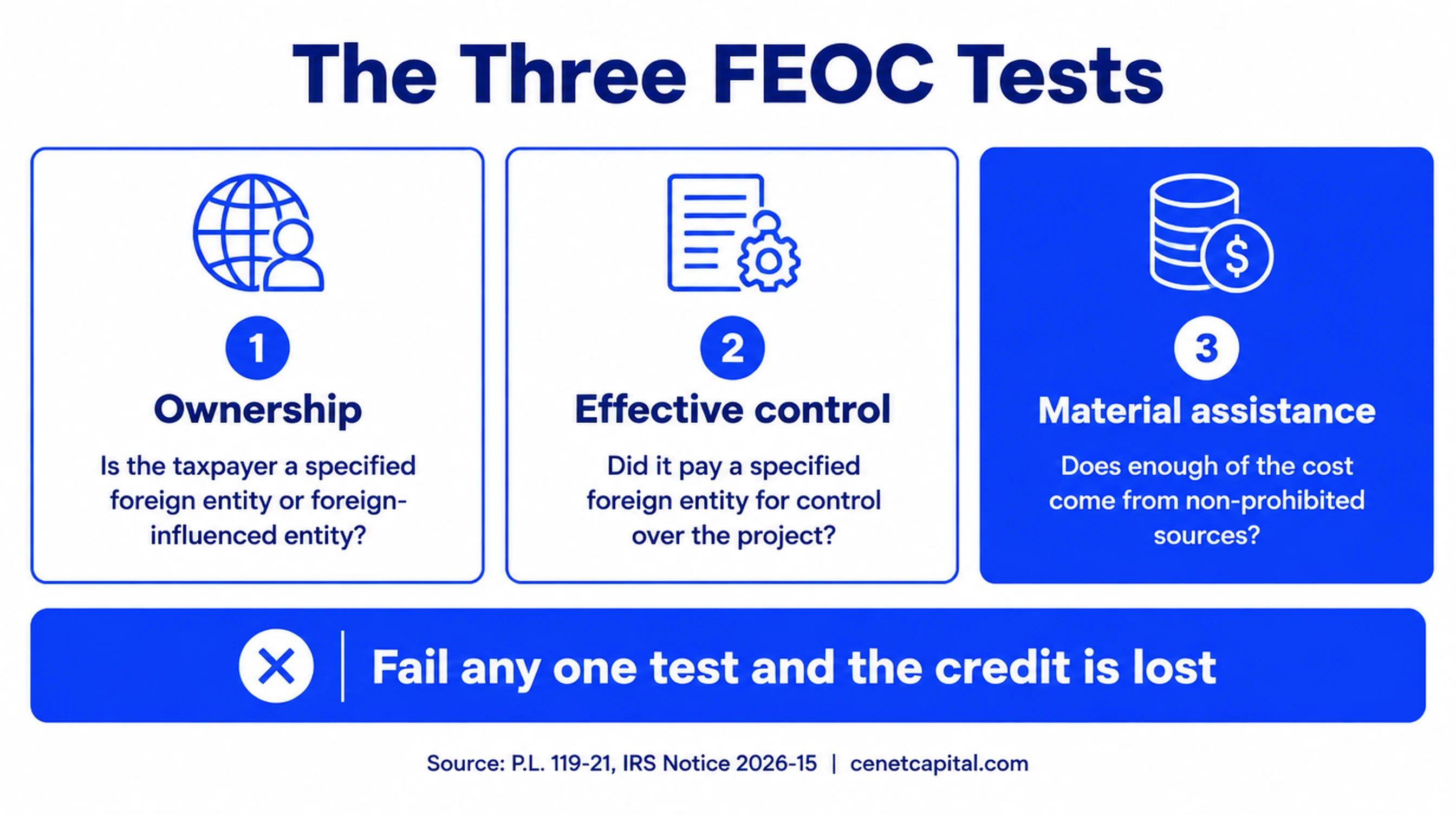
Three tests: ownership (is the taxpayer a PFE?), effective control (did it pay a PFE for control over the project?), and material assistance (how much of the project’s cost came from PFEs?).
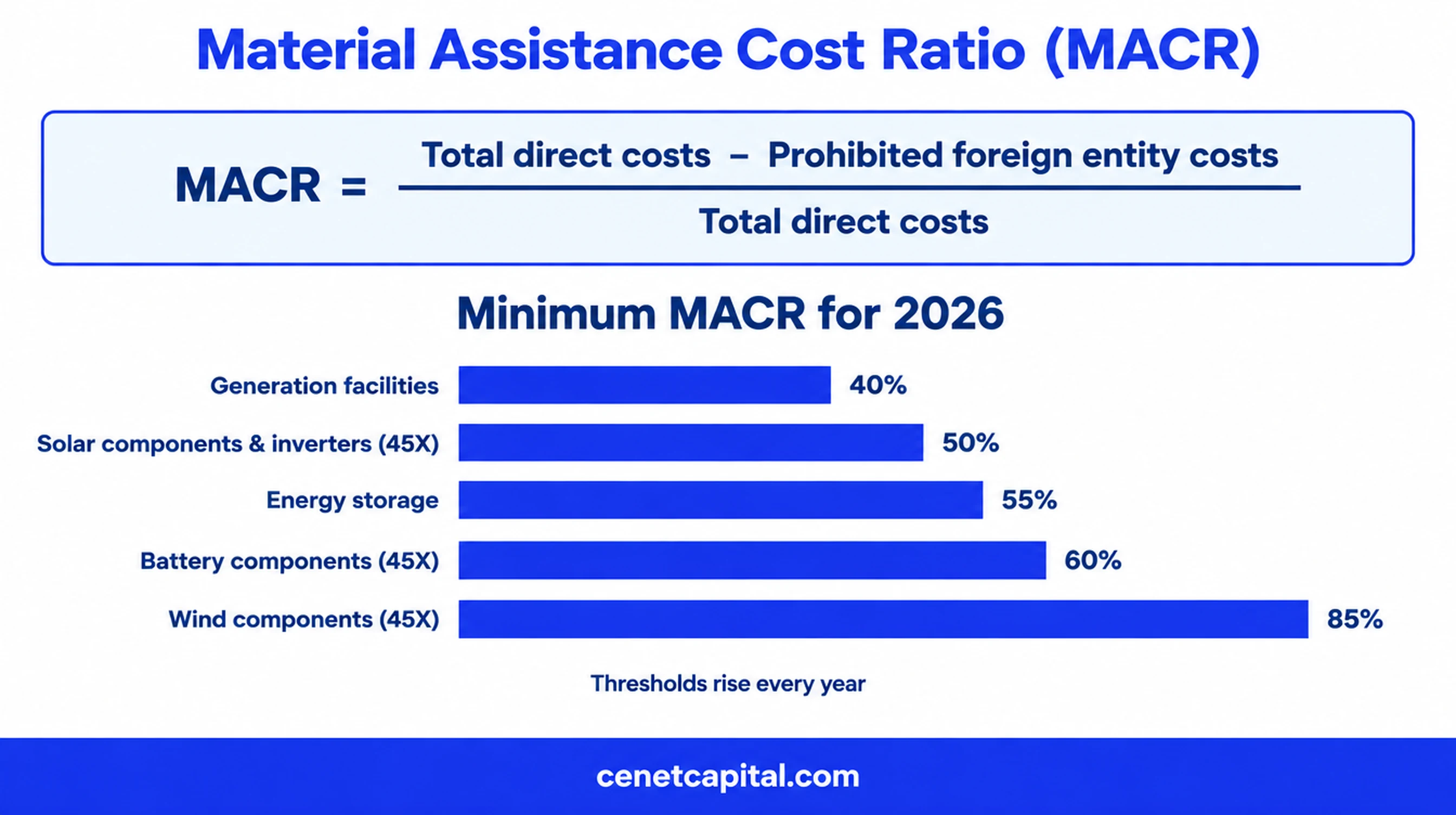
Material assistance thresholds for 2026: at least 40% non-PFE content for generation facilities, 55% for energy storage, 50% for 45X solar components and inverters, 60% for battery components, 85% for wind components, all rising each year.
Key guidance: IRS Notice 2026-15 (February 12, 2026) set the cost ratio formula and three interim safe harbors.
Market impact: about $4 billion of PFE-exposed credits traded in the first half of 2026, roughly 20% of the market, and tax credit insurance does not currently cover PFE risk (Crux).
What are the FEOC rules for clean energy tax credits?
The FEOC rules, officially “prohibited foreign entity” rules, bar clean energy tax credits for taxpayers owned or controlled by entities tied to China, Russia, Iran or North Korea, and for facilities and components that rely too heavily on equipment or materials from those entities. They were added by the One Big Beautiful Bill Act in July 2025 and replaced the narrower “foreign entity of concern” (FEOC) rules that previously applied only to the consumer EV credit, which is why most people still call them FEOC rules.
For developers, manufacturers and credit buyers, they’re now the single biggest diligence question on new projects. Crux reported in mid-2026 that PFE exposure had become “the dominant driver of tax credit pricing,” ahead of deal size and seller credit quality, in its second-quarter 2026 analysis.
What are the three FEOC tests?
A credit can fail on any one of three tests.
Test | The question | Applies to | Starts |
|---|---|---|---|
1. Ownership | Is the taxpayer itself a specified foreign entity or foreign-influenced entity? | 45Y, 48E, 45X, 45Q, 45Z, 45U | Tax years beginning after July 4, 2025 |
2. Effective control | Has the taxpayer paid a specified foreign entity under a contract or license that gives it control over the project or production? | 45Y, 48E, 45X | Phased in; includes a recapture rule for 48E |
3. Material assistance | Does enough of the project’s or component’s direct cost come from non-prohibited sources? | 45Y, 48E, 45X | Facilities beginning construction after 2025; components sold in 2026 and later |
Who is a prohibited foreign entity?
Two groups: “specified foreign entities” and “foreign-influenced entities.”
Specified foreign entities include designated foreign terrorist organizations, entities on certain U.S. sanctions and military-company lists, entities identified under the Uyghur Forced Labor Prevention Act, and entities owned, controlled by or subject to the jurisdiction of the governments of China, Russia, Iran or North Korea, as defined by reference to existing federal statutes.
Foreign-influenced entities are companies where a specified foreign entity can appoint an officer or board member, owns at least 25% (or specified foreign entities together own at least 40%), or holds at least 15% of the company’s debt, or companies that make certain payments giving a specified foreign entity effective control.
Public companies, U.S. subsidiaries of foreign parents, and joint ventures with Asian manufacturers all need to run this analysis, because ownership chains and debt can trigger the rules even when a business operates entirely in the U.S.
How do you calculate the material assistance cost ratio?
MACR = (A − B) ÷ A, where A is the total direct cost of the manufactured products (or materials) in the facility or component, and B is the portion of that cost attributable to prohibited foreign entities. The result must meet or beat the threshold for the year construction began (or, for 45X, the year the component is sold). The formula comes from IRS Notice 2026-15.
Construction begins | Generation facility (45Y/48E) | Energy storage (48E) |
|---|---|---|
2026 | 40% | 55% |
2027 | 45% | 60% |
2028 | 50% | 65% |
2029 | 55% | 70% |
2030 and later | 60% | 75% |
For 45X manufacturers, the 2026 thresholds are 50% for solar components and inverters, 60% for battery components and 85% for wind components, increasing annually. Example: a solar farm beginning construction in 2026 with $50 million of direct manufactured-product costs, $25 million of which traces to prohibited foreign entities, has a MACR of 50% and passes the 40% threshold. If $32 million traced to PFEs, the MACR would be 36% and the facility would earn no credit at all. Use the calculator below to test your own numbers.
Does your project pass the FEOC material assistance test?
Screening tool only. MACR = (A − B) ÷ A per IRS Notice 2026-15. 45Y/48E thresholds are statutory; 45X thresholds show the 2026 level and rise in later years. Ownership and effective control tests apply separately.
Review my FEOC risk →What safe harbors does Notice 2026-15 provide?
Three interim safe harbors, usable until 60 days after Treasury publishes new safe harbor tables:
Identification safe harbor: use the 2023–2025 domestic content safe harbor tables to identify which manufactured products and components go into the calculation.
Cost percentage safe harbor: use the cost percentages assigned in those tables instead of actual supplier costs.
Certification safe harbor: rely on supplier certifications, signed under penalties of perjury, stating whether products came from prohibited foreign entities, unless you know or have reason to know a certification is wrong.
Suppliers must keep records for six years. Practitioners warn that a single certificate isn’t enough on its own: buyers and their counsel want to see the process the developer used to review certifications and resolve questions.
How do FEOC rules affect selling tax credits?
They’ve become the first question buyers ask on any project that began construction in 2026 or later, and they directly affect price. Three practical consequences:
No insurance backstop. As of mid-2026, tax credit insurers were not covering PFE risk, so buyers rely on seller indemnities, documentation and price.
Buyer selectivity. About 70% of surveyed investors described themselves as “selective” on PFE-exposed credits, according to Crux.
Transfer limits. 45Q, 45X, 45Y, 45Z and 48E credits can’t be sold to a specified foreign entity at all.
Projects that began construction before 2026 aren’t subject to the material assistance test, which makes their credits easier to sell. See the transfer market report for current pricing and the One Big Beautiful Bill guide for every related deadline.
FEOC compliance checklist
Map ownership, board rights and debt holders up the corporate chain.
Review licenses and service contracts for effective control provisions.
Build a bill of materials using the safe harbor tables.
Collect supplier certifications and document how you reviewed them.
Calculate MACR for the year construction began, with a margin above the threshold.
Keep everything for at least six years, and prepare a FEOC memo for credit buyers.
Sources
P.L. 119-21 (One Big Beautiful Bill Act), as summarized by Kirkland & Ellis
IRS Notice 2026-15, via Morgan Lewis
Frequently Asked Questions
Do FEOC rules apply to projects that started before 2026?
The material assistance test applies only to facilities beginning construction after December 31, 2025. The ownership test applies based on the taxpayer's tax year, starting with tax years beginning after July 4, 2025, regardless of when the project started.
Do FEOC rules apply to energy storage?
Can tax credit insurance cover FEOC risk?
What happens if a project fails the material assistance test?
Can Cenet Capital buy or insure clean energy tax credits?
Don't let FEOC rules sink your credit sale.
Cenet Capital reviews your supply chain documentation, prices FEOC-exposed credits and connects you with buyers who will close. Send us your project details for a fast read.

More Insights