Credit Guides
Fuel tax credits in 2026: which still exist, who qualifies, per-gallon rates on Form 4136, quarterly refunds, tax treatment, what replaced biodiesel credits.
Author -
Paulestini Francois
Published -
READ TIME
Businesses that burn taxed gasoline or diesel off the highway, on a farm or in a generator are owed part of that fuel tax back, and many never claim it. At the same time, several well-known fuel credits disappeared at the end of 2024. Here's which fuel tax credits still exist in 2026, who qualifies, what each gallon is worth, how to claim, how the credit is taxed, and a calculator to estimate yours.
QUICK ANSWER
Fuel tax credits refund federal excise tax on fuel a business uses off the highway, on a farm or for another nontaxable purpose: 18.3 cents per gallon of gasoline and 24.3 cents per gallon of undyed diesel in 2026, claimed on Form 4136 or Form 8849. The biodiesel and alternative fuel credits expired after 2024.
KEY FACTS
Rates: 18.3 cents per gallon of gasoline, 19.3 cents for aviation gasoline and 24.3 cents for undyed diesel and kerosene.
Who qualifies: The ultimate purchaser using fuel for farming, off-highway business use, commercial fishing and other nontaxable uses.
How to claim: Form 4136 with the income tax return, or quarterly on Form 8849 Schedule 1 once a quarter reaches $750.
Tax treatment: Generally included in gross income if the fuel cost was deducted.
Expired: Biodiesel, renewable diesel and alternative fuel credits after 2024; SAF mixture credit after September 30, 2025.
How are fuel tax credits different from clean fuel credits like 45Z? Fuel tax credits refund excise tax on fuel used for nontaxable purposes. Clean fuel credits, mainly the 45Z clean fuel production credit, instead reward producers of low-emission transportation fuel with up to $1.00 per gallon, and unlike excise refunds they can be sold to other taxpayers.
What are fuel tax credits?
Fuel tax credits refund the federal excise tax a business paid on gasoline, diesel, kerosene or aviation fuel that it used for a nontaxable purpose, such as running farm equipment, off-highway construction machinery or generators. In 2026 the main credit is 18.3 cents per gallon of gasoline and 24.3 cents per gallon of undyed diesel, claimed on Form 4136. A separate set of incentive credits once paid for blending biodiesel and alternative fuels, but most of those expired after 2024.
The logic is simple. Federal fuel taxes are meant to pay for highways, so fuel burned somewhere other than a public road in a registered vehicle generally shouldn’t bear them. The IRS calls it a refundable credit, which means you get it back even if you owe no income tax. It isn’t available for personal use: the IRS states plainly that commuting, personal vehicles and driving for ride-share services don’t qualify.
Which fuel tax credits still exist in 2026?
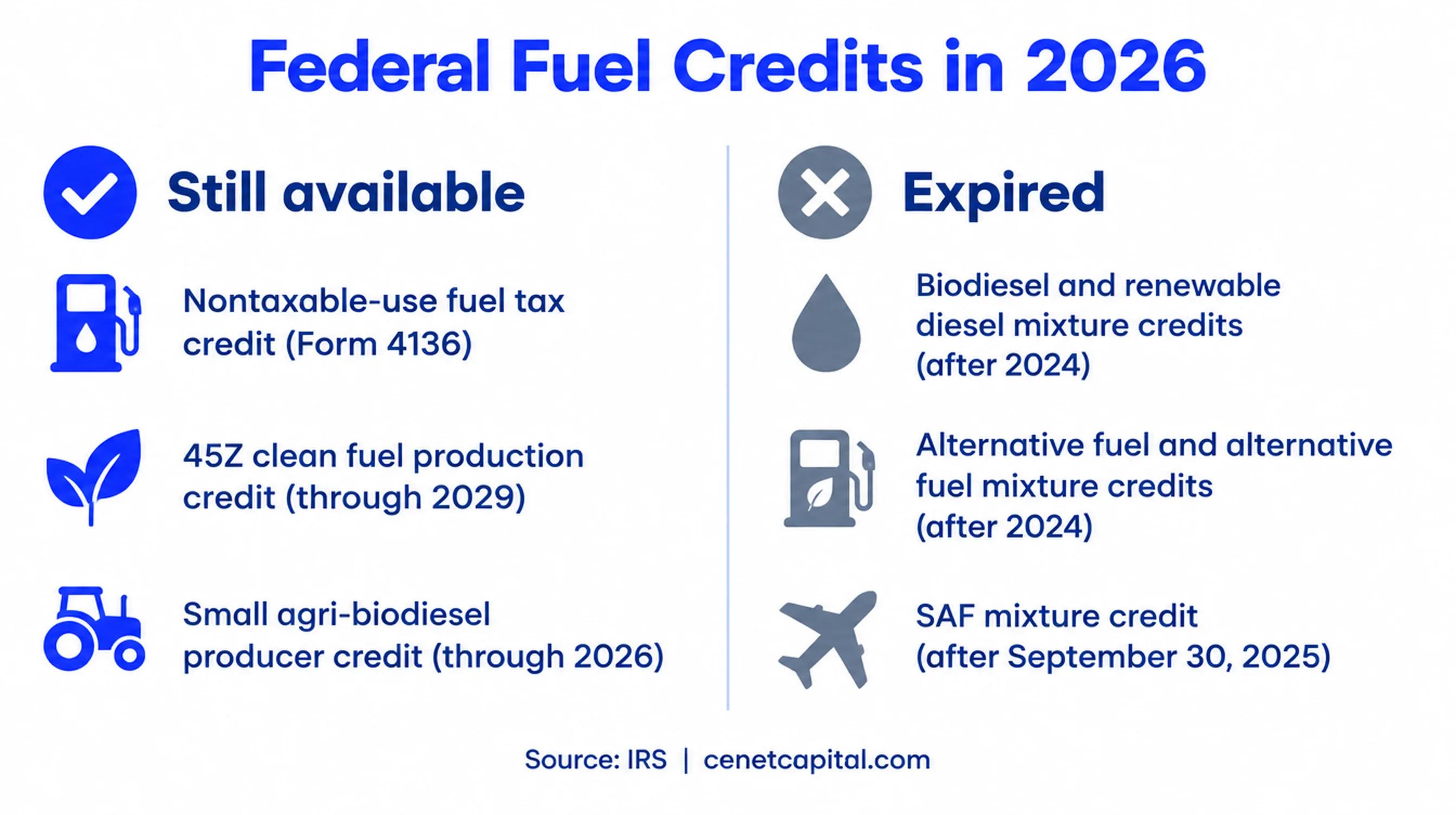
The nontaxable-use credit on Form 4136 is permanent and still available, and the 45Z clean fuel production credit runs through 2029. The biodiesel, renewable diesel, alternative fuel and alternative fuel mixture credits expired after December 31, 2024, and the sustainable aviation fuel mixture credit ended after September 30, 2025.
Credit | Status in 2026 |
|---|---|
Nontaxable use of fuel (Form 4136, Form 8849 or Form 720) | Available, no expiration |
45Z clean fuel production credit | Available for fuel produced and sold through December 31, 2029 |
Small agri-biodiesel producer credit | Extended through December 31, 2026 at 20 cents per gallon |
Biodiesel and renewable diesel (mixture) credits | Expired after December 31, 2024 |
Alternative fuel and alternative fuel mixture credits | Expired after December 31, 2024 |
Sustainable aviation fuel mixture credit | Ended after September 30, 2025 |
Second generation biofuel producer credit | Expired after December 31, 2024 |
The expirations are confirmed on the IRS page for excise fuel incentive credits. For biofuel makers, the expired blending credits were replaced by 45Z, a production credit scaled to each fuel’s carbon intensity. Our 45Z tax credit guide explains how it works.
Who can claim the fuel tax credit?
Generally the ultimate purchaser of the fuel, the business that bought it and used it for a qualifying nontaxable purpose. Farms, construction and logging companies, manufacturers running stationary engines, commercial fishing boats and some bus operators are the most common claimants.
The Form 4136 instructions list 16 types of nontaxable use. The ones most businesses rely on are:
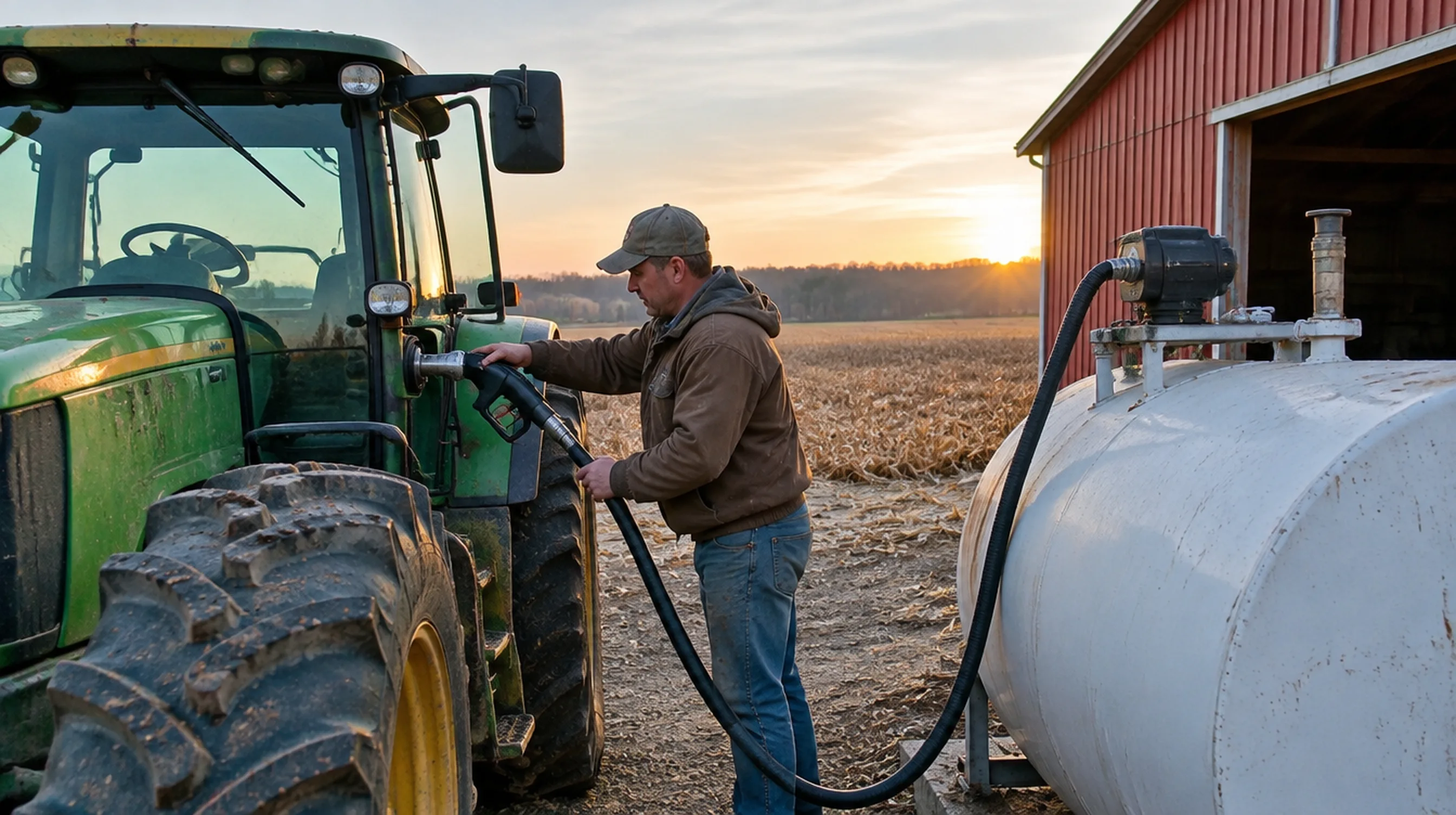
Farming (type 1): fuel used on a farm for farming purposes, including livestock, dairy, poultry, orchards and nurseries. Mowing your lawn doesn’t count.
Off-highway business use (type 2): fuel used in a business other than in a vehicle registered or required to be registered for public highways, such as bulldozers, forklifts, generators, compressors and power saws.
Commercial fishing (type 4): fuel in a boat used for commercial fishing.
Buses (types 5 to 7): certain intercity, local and school buses.
Government and nonprofit schools (types 13 and 14): exclusive use by a state or local government or a nonprofit educational organization.

How much is the fuel tax credit per gallon?
The credit equals the federal excise tax minus the 0.1-cent Leaking Underground Storage Tank tax, which isn’t refunded. That works out to 18.3 cents per gallon of gasoline, 24.3 cents for undyed diesel or kerosene, and 19.3 cents for aviation gasoline. The tax itself is 18.4 cents on gasoline and 24.4 cents on diesel, according to IRS Publication 510.
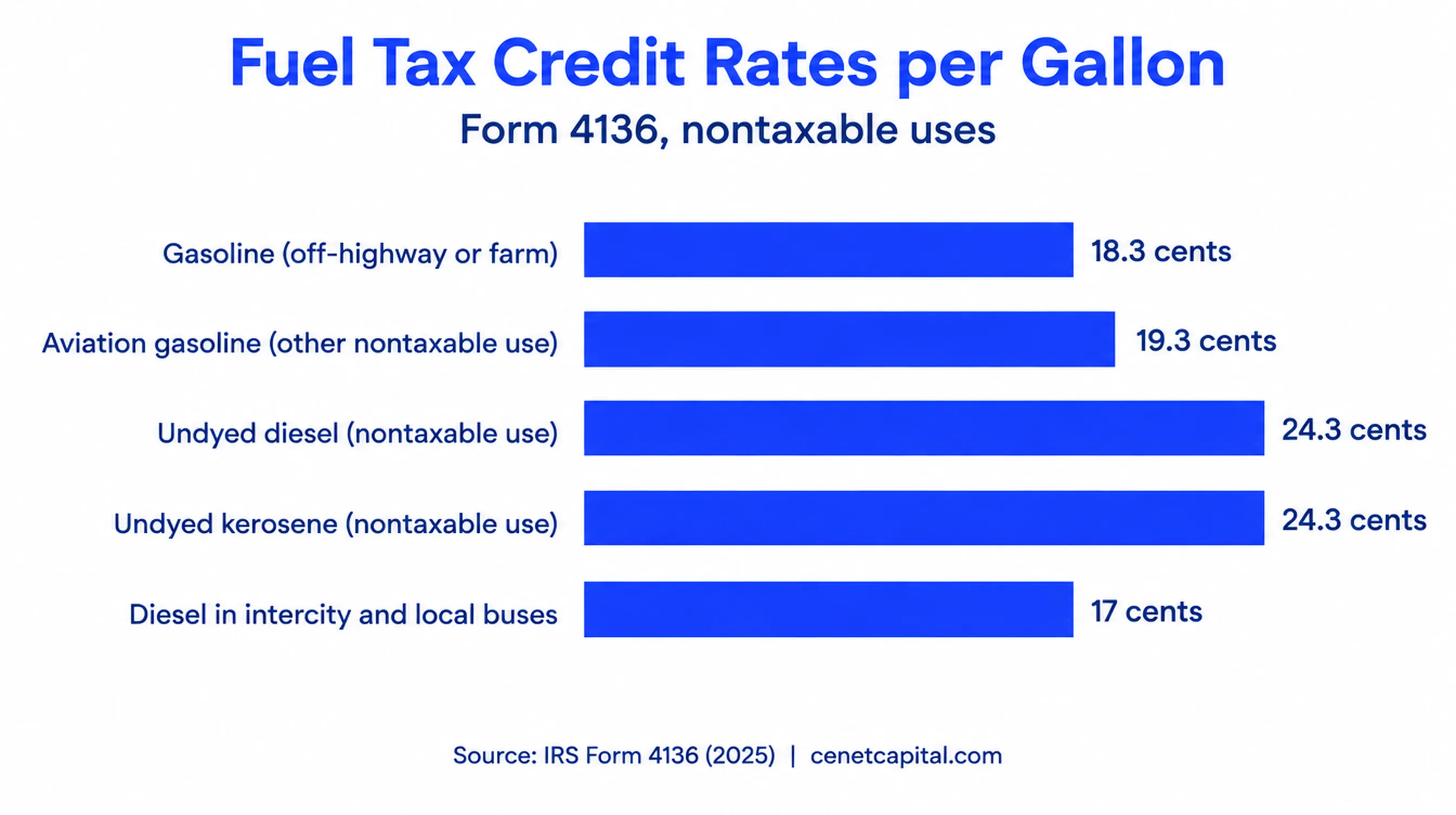
The rates come straight from Form 4136. Exported fuel gets the full tax back, 18.4 or 24.4 cents, and diesel used in certain intercity and local buses is credited at 17 cents. A contractor that burns 40,000 gallons of undyed diesel a year in off-road equipment is owed $9,720 (40,000 × $0.243). Most farm and off-road diesel is dyed and sold tax-free, so there’s nothing to claim on it. The credit matters when a business buys taxed, undyed fuel and uses it off the road.
How do you claim the fuel tax credit?
Most businesses claim it once a year on Form 4136, attached to their income tax return. If your claim reaches $750 in a quarter, you can instead get a quarterly refund on Schedule 1 of Form 8849, and businesses that file Form 720 can take it against their excise tax.
Track gallons by use: log purchases, dates, sellers and which equipment burned the fuel.
Pick the route: claims under $750 for the year must go on Form 4136. Larger claims can be filed quarterly on Form 8849.
Complete Schedule A: starting with 2025 returns, Form 4136 asks for business activity and equipment details, plus a separate Schedule A for each qualifying activity.
Keep records three years: the IRS can impose a $5,000 penalty for an incorrect claim.
You can’t claim the same gallons twice across Form 4136, Form 8849 and Form 720. Use the calculator below to estimate your credit and see whether quarterly claims are worth filing.
How much fuel tax can your business get back?
Illustrative only. Uses 2025 Form 4136 rates for fuel that was taxed when bought; dyed diesel is already tax-free and earns nothing. Quarterly claims assume even use across the year. Producing clean fuel instead? 45Z credits can be sold for cash.
Price my 45Z credits →Is the fuel tax credit taxable income?
Usually yes. If you deducted the full cost of the fuel, including the excise tax, as a business expense, you must include the credit or refund in gross income. Cash-basis taxpayers report it in the year they receive the refund; accrual-basis taxpayers follow the timing rules in Publication 510.
That makes the after-tax value smaller than the headline number. At a 21% corporate rate, a $9,720 diesel credit is worth about $7,680 after tax. It’s still money most eligible businesses leave on the table, because they don’t separate taxed fuel used off-road from fuel used on the highway.
What replaced the biodiesel and alternative fuel credits?
The Section 45Z clean fuel production credit. Instead of paying blenders a flat amount per gallon, it pays domestic producers up to $1.00 per gallon, scaled to how far the fuel’s lifecycle emissions fall below 50 kilograms of CO2e per MMBtu. It applies to fuel produced in the U.S. and sold from 2025 through December 31, 2029, and fuel produced after 2025 must use feedstocks grown in the U.S., Mexico or Canada, according to the IRS 45Z page.
Unlike the old excise credits, 45Z is an income tax credit that producers can sell for cash. That’s a big change for ethanol, renewable diesel and RNG producers without enough tax liability to use it. Our guide to the 45Z proposed regulations covers registration and emissions rates.
Sources
Frequently Asked Questions
What is the fuel tax credit for 2026?
It refunds federal excise tax on fuel used for nontaxable purposes: 18.3 cents per gallon of gasoline, 19.3 cents for aviation gasoline and 24.3 cents per gallon of undyed diesel or kerosene, based on the current Form 4136.
Who qualifies for the fuel tax credit?
Is the alternative fuel tax credit still available?
Do you have to pay tax on the fuel tax credit?
Can Cenet Capital buy fuel tax credits?
Producing clean fuel? Your 45Z credit can be sold.
The old blending credits are gone, but 45Z credits from ethanol, renewable diesel, SAF and RNG producers can be sold for cash. Cenet Capital buys them directly. Send us your volumes for a price.

More Insights