
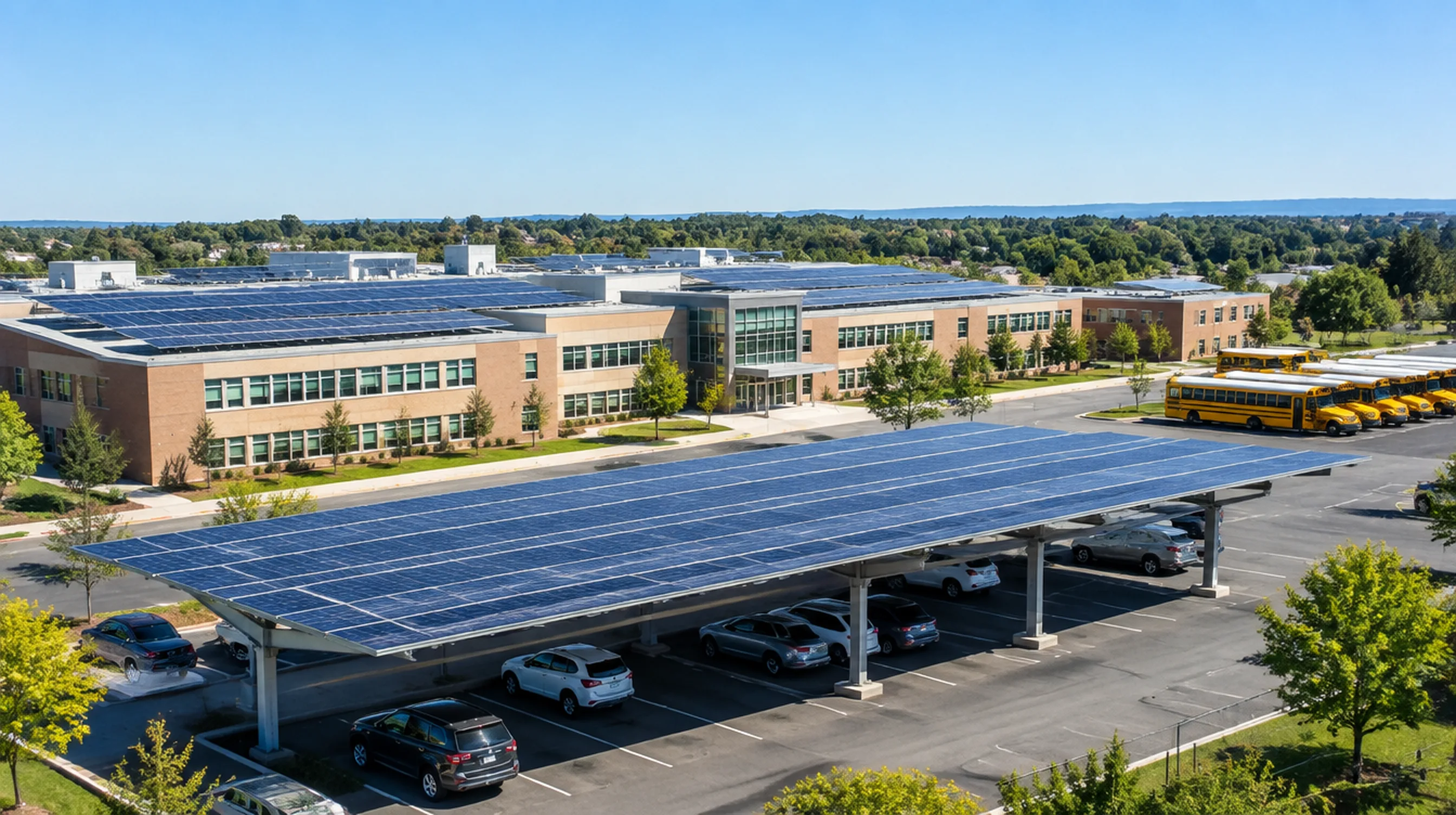
Elective pay explained: who qualifies, the 12 eligible credits, domestic content and bond haircuts, registration and Form 990-T deadlines, and an eligibility checker.
Author -
Paulestini Francois
Published -
READ TIME
For cities, school districts, tribes, hospitals, universities and other organizations that don't pay income tax, elective pay turns clean energy tax credits into cash from the IRS. It can cut the cost of a solar array, battery or geothermal system by 30% or more. Here's who qualifies, which credits are eligible after the One Big Beautiful Bill Act, what reduces the payment, how to register and file on time, and a checker to estimate your payment.
QUICK ANSWER
Elective pay, or direct pay, lets tax-exempt organizations, governments, tribes, territories, rural electric co-ops and other applicable entities receive clean energy tax credits as a cash payment from the IRS. Any taxpayer can elect it for five years for 45Q, 45V and 45X. Entities must pre-register each facility and file a timely return, such as Form 990-T.
KEY FACTS
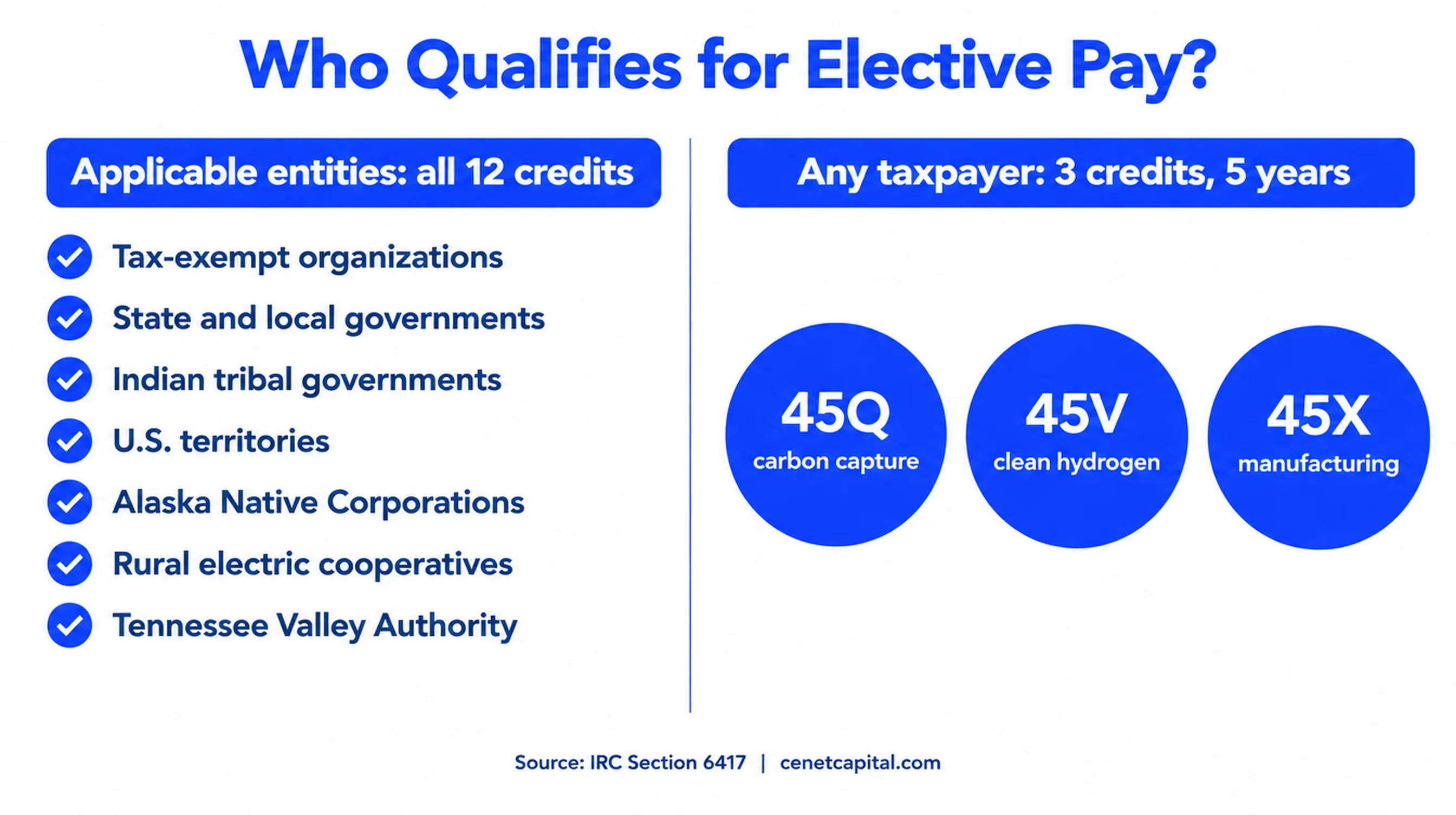
Who qualifies: Tax-exempt organizations, states and local governments, tribal governments, U.S. territories, Alaska Native Corporations, rural electric co-ops and TVA.
Eligible credits: 12 clean energy credits including 48E, 45Y, 45X, 45Q, 45V and 45Z, plus the 48D semiconductor credit.
Domestic content haircut: Projects of 1 MW or more that miss domestic content get 90% (2024 start), 85% (2025) or 0% (2026+) unless an exception applies.
Deadlines: Register in IRS Energy Credits Online, ideally 120 days before filing; Form 990-T is due the 15th day of the 5th month, with a 6-month extension.
Penalty: Excessive payments must be repaid plus 20% unless there's reasonable cause.
What is elective pay for clean energy tax credits?
Elective pay, often called direct pay, lets tax-exempt organizations, state and local governments, tribes and other applicable entities receive the full value of clean energy tax credits as a cash payment from the IRS, even though they owe no income tax. The IRS treats the credit as a tax payment and refunds the overpayment. Any taxpayer can also use it for five years for the 45Q carbon capture, 45V clean hydrogen and 45X manufacturing credits.
Elective pay was created by the Inflation Reduction Act in Section 6417 of the tax code and survived the One Big Beautiful Bill Act of 2025, though that law shortened deadlines for several of the underlying credits. For a city, school district, hospital or university, it turns a solar array, battery or geothermal system into a project that can be 30% to 50% cheaper.
Who qualifies for elective pay?
Applicable entities can use elective pay for all 12 eligible credits, for as long as the credit lasts. They include:
Organizations exempt from income tax, such as charities, hospitals, universities and churches
States, political subdivisions such as cities, counties and school districts, and their agencies and instrumentalities
Indian tribal governments and Alaska Native Corporations
U.S. territories and their political subdivisions
Rural electric cooperatives and the Tennessee Valley Authority
Any other taxpayer, including a for-profit corporation or a partnership, can elect direct payment of only three credits: 45Q, 45V and 45X. For 45Q and 45V the election covers five consecutive years starting with the year the facility is placed in service; for 45X it covers five years starting with the year of the election, and not past 2032.
Which credits are eligible for elective pay?
Twelve clean energy credits, plus the CHIPS Act semiconductor credit under Section 48D. Several now have hard deadlines.
Credit | Typical use by applicable entities | Key 2026 status |
|---|---|---|
48E clean electricity ITC | Solar, storage, geothermal, fuel cells | Wind and solar must begin construction by July 4, 2026 or be placed in service by end of 2027 |
45Y clean electricity PTC | Larger solar, wind, hydro | Same wind and solar deadlines as 48E |
48 and 45 (legacy ITC and PTC) | Projects that began construction before 2025 | Still available for those projects |
30C EV charger credit | Public and fleet chargers | Ended for property placed in service after June 30, 2026 |
45W commercial clean vehicles | Electric buses and fleet vehicles | Ended for vehicles acquired after Sept. 30, 2025 |
45Q, 45V, 45X, 45Z, 45U, 48C | Carbon capture, hydrogen, manufacturing, clean fuels, nuclear, advanced energy projects | Each has its own deadlines; see our 2026 credit roundup |
How much is elective pay worth?
The full credit amount, less any required haircuts. A $10 million solar project earning a 40% ITC produces a $4 million payment, compared with about $3.6 million if a for-profit owner sold the same credit at 90 cents. Three rules can reduce the payment:
Domestic content phase-out: for projects of 1 MW (AC) or more that don’t meet the domestic content requirement, the payment is 90% of the credit if construction began in 2024, 85% in 2025, and zero for projects starting in 2026 or later, unless an exception applies. The exceptions cover cases where U.S. materials would raise total costs by more than 25% or aren’t available in sufficient quantity or quality.
Tax-exempt bond financing: the credit is reduced by the share of the project financed with tax-exempt bonds, up to 15%.
Grants and forgivable loans: under the final regulations they reduce the credit only to the extent the grant plus the credit would exceed the project’s cost.
The usual credit rules still apply. Projects of 1 MW or more need prevailing wage and apprenticeship compliance to get the 30% rate instead of 6%, and bonus adders for domestic content and energy communities add 10 points each. Use the checker below to estimate your payment.
Can you get paid directly, and how much?
Illustrative only, for a calendar-year entity. Registration date assumes the IRS's recommended 120 days before filing. Excludes the low-income bonus, grant reductions and credit-specific deadlines. Payment arrives after the IRS processes the return.
Check my payment →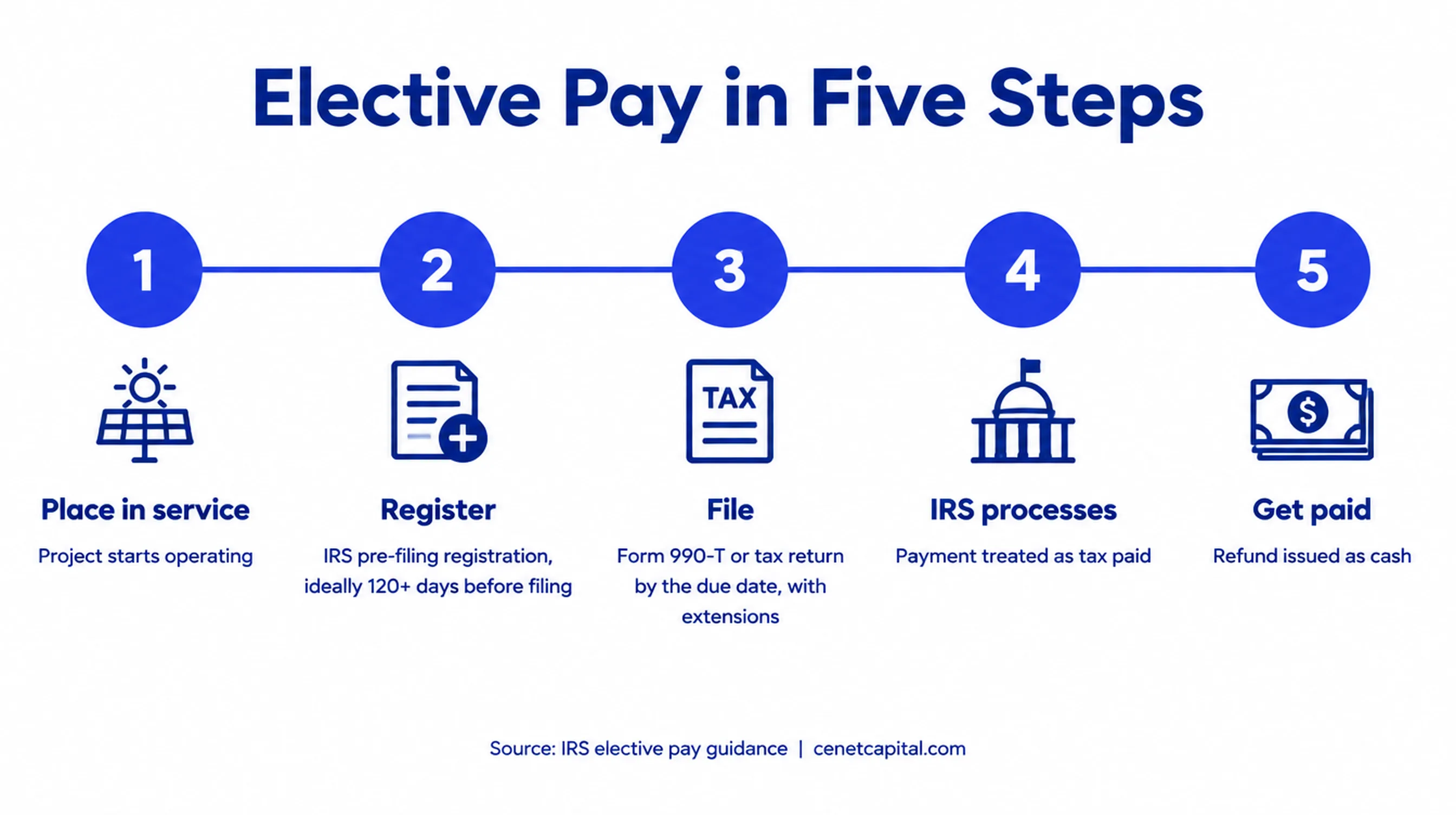
How do you claim elective pay?
Register each facility with the IRS before filing, then make the election on a timely filed original return for the year the credit arises.
Place the project in service and confirm the credit amount, including any bonus adders and haircuts.
Complete pre-filing registration in the IRS Energy Credits Online portal for each facility. The IRS recommends registering at least 120 days before you plan to file. You’ll receive a registration number for each facility.
File the return. Tax-exempt organizations and governments use Form 990-T, even if they wouldn’t otherwise file one, with Form 3800 and the form for the credit, such as Form 3468 for an investment credit. Include the registration numbers.
Meet the deadline. For entities without a regular filing requirement, the return is due on the 15th day of the 5th month after the tax year ends, and an automatic 6-month extension is available on Form 8868. A calendar-year city has until May 15, or November 15 with the extension.
Receive payment once the IRS processes the return.
The election can’t be made for the first time on a late or amended return, so a missed registration or deadline usually means losing that year’s credit. Keep cost, payroll, domestic content and placed-in-service records ready in case the IRS asks.
When does the money arrive?
After the return is filed and processed, which means many months after the project is finished. A project placed in service in March 2026 by a calendar-year school district can’t file until 2027. If the district files in May 2027, it’s waiting more than a year from completion for the cash, and longer if the IRS has questions. Many applicable entities bridge that gap with a short-term loan against the expected payment, similar to a tax equity bridge loan.

Can partnerships and for-profit companies use elective pay?
Only for 45Q, 45V and 45X. For every other credit, a for-profit owner monetizes by selling the credit under Section 6418 instead. A partnership that makes the election receives the payment itself and can distribute it to partners. Partnerships owned by applicable entities have one more option: co-owners such as two municipal utilities can elect out of partnership tax treatment under the final regulations, so each owner claims elective pay for its share.
Elective pay (6417) | Transferability (6418) | |
|---|---|---|
Who can use it | Applicable entities; anyone for 45Q, 45V, 45X | Taxable owners; applicable entities can’t sell |
Value received | 100% of the credit, less haircuts | Roughly 85 to 96 cents per dollar |
Who pays | The IRS | A corporate buyer |
When | After the return is processed | As early as construction, under a forward deal |
Domestic content haircut | Yes, for 1 MW+ projects | No |
For more on selling credits, see our transferable tax credits guide and tax equity vs. transferability.
What can go wrong with elective pay?
If the IRS finds the payment was too large, the entity repays the excess plus a 20% penalty, unless it shows reasonable cause. The most common problems are overstated cost basis, a bonus adder that doesn’t hold up, missing prevailing wage records and the domestic content haircut being overlooked. The foreign-entity rules added by the One Big Beautiful Bill Act also apply to projects beginning construction after 2025, so equipment sourcing needs review; see our FEOC rules guide. Investment credits can be recaptured if the property is sold or stops being used within five years.
Sources
Cornell Law School, 26 U.S. Code § 6417, elective payment of applicable credits
Federal Register, Elective payment of applicable credits, final rules
Congressional Research Service, Domestic content requirements for electricity tax credits
IRS, Notice 2024-9, domestic content requirements for elective payment
Frequently Asked Questions
Who is eligible for elective pay?
Applicable entities: tax-exempt organizations, states and their political subdivisions, Indian tribal governments, U.S. territories, Alaska Native Corporations, rural electric cooperatives and the Tennessee Valley Authority. Any taxpayer can also elect it for five years for the 45Q, 45V and 45X credits.
What is the deadline to claim elective pay?
Do you have to register before claiming elective pay?
Can a for-profit company use elective pay?
How can Cenet Capital help with elective pay projects?
Don't qualify for direct pay? Sell the credit instead.
Cenet Capital buys clean energy credits from for-profit owners, including developers building for schools, cities and nonprofits. Tell us about your project and we'll compare a credit sale with direct pay.

More Insights