
The 45Z proposed regulations explained: registration, facility and sale rules, emissions rates, post-2025 changes, Notice 2026-53 and what producers should do now.
Author -
Paulestini Francois
Published -
READ TIME
Treasury's proposed 45Z regulations are the first complete rulebook for the clean fuel production credit, and producers can rely on them today. They decide who can register, which sales count, how emissions rates are set and how the One Big Beautiful Bill Act's feedstock and foreign-entity limits apply from 2026. Here's what the proposal says, what's changed since, what's still open, and a calculator to estimate what your fuel earns.
QUICK ANSWER
The 45Z proposed regulations, published February 4, 2026, set the rules for the clean fuel production credit: Form 637 registration, single-production-line facilities, sales to unrelated buyers including resellers, and emissions rates from the 45ZCF-GREET model. Producers can rely on them if they apply them consistently. Final regulations are still pending.
KEY FACTS
Credit formula: Up to $1.00 per gallon (20 cents without prevailing wage and apprenticeship) times an emissions factor of (50 − emissions rate) ÷ 50, adjusted for inflation.
Registration: Every producer registers on Form 637, separately for each EIN, and must pass activity, acceptable risk and tax history tests.
Qualified sale: A sale to an unrelated person for business use, including a distributor that resells the fuel.
After 2025: No indirect land use change, a zero floor on emissions rates except manure-based fuels, and North American feedstocks only.
Since February: DOE updated 45ZCF-GREET in June and September 2026, and Notice 2026-53 published the 2026 emissions rate table on September 8.
What do the 45Z proposed regulations say?
The 45Z proposed regulations, published by Treasury and the IRS on February 4, 2026, set out how producers qualify for and calculate the clean fuel production credit: who must register, what counts as a production facility and a qualified sale, how emissions rates are determined with the 45ZCF-GREET model, and how the One Big Beautiful Bill Act’s changes apply to fuel produced after 2025. The credit pays up to $1.00 per gallon (adjusted for inflation) for transportation fuel produced in the U.S. after 2024 and sold before 2030, scaled by how clean the fuel is.
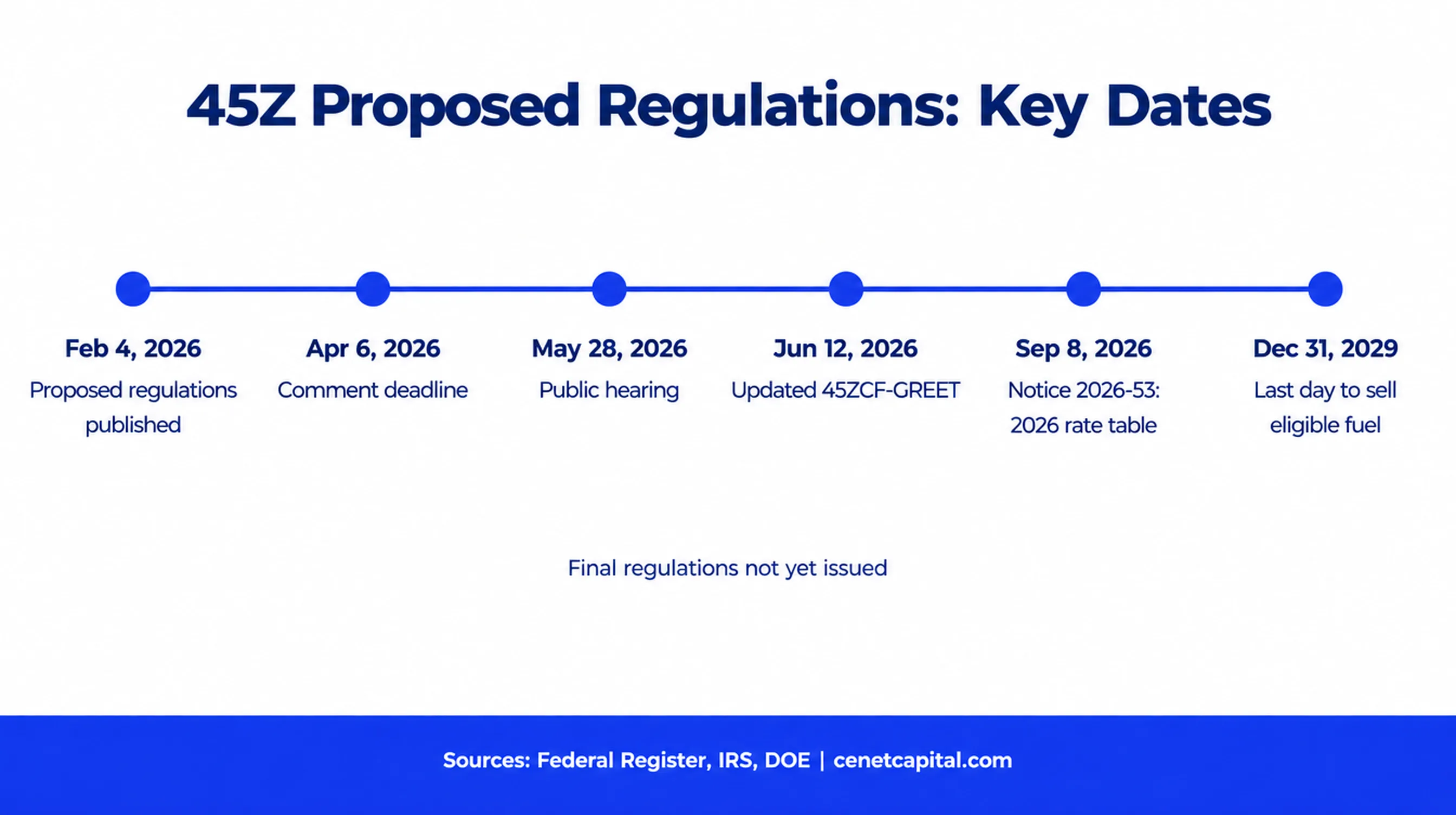
The proposal (REG-121244-23, 91 FR 5160) is the first full rulebook for 45Z. Before it, producers worked from notices and the annual emissions rate table. Comments closed April 6, 2026, a public hearing was held May 28, 2026, and final regulations have not yet been issued. For the basics of how the credit works, see our 45Z tax credit guide.
Can producers rely on the proposed regulations now?
Yes, as long as they apply them in their entirety and consistently. Producers can’t pick the favorable rules and ignore the rest. Most provisions take effect only when final regulations are published, but the emissions rate rules apply to qualifying sales in taxable years ending on or after January 10, 2025, the date the first emissions rate table was released.
For most producers, relying on the proposal is the practical choice, but keep records that would support your credit if final rules tighten.
How do the proposed rules calculate the credit?
Credit per gallon equals the applicable amount times the fuel’s emissions factor, with every figure rounded the way the regulations prescribe. The applicable amount is $1.00 per gallon for producers that meet the prevailing wage and apprenticeship requirements and one-fifth of that, 20 cents, for those that don’t. Both are adjusted for inflation for years after 2024.
Element | Rule in the proposed regulations |
|---|---|
Emissions factor | (50 − emissions rate) ÷ 50, with the rate in kg CO2e per MMBtu |
Rounding the emissions rate | To the nearest 0.1; a hundredths digit of 5 or more rounds up |
Rounding the credit | To the nearest cent; 0.5 cents or more rounds up |
Gallon equivalent (gaseous fuels like RNG) | 116,090 Btu, the lower heating value of a gallon of gasoline |
SAF produced after 2025 | Same $1.00 applicable amount as other fuels; the old $1.75 rate is gone |
Fuel at 50 kg or above | No credit |
A renewable diesel plant with an emissions rate of 30 kg CO2e/MMBtu has an emissions factor of 0.4 and earns 40 cents per gallon before inflation, so 50 million gallons a year is worth about $20 million in credits. Use the calculator below to run your own facility.
What is your fuel worth under 45Z?
Illustrative only, before the annual inflation adjustment. Emissions rates come from the 45ZCF-GREET model under the IRS emissions rate table. Default rates are examples, not industry averages. Fuel produced after 2025 must use U.S., Mexican or Canadian feedstocks.
Price your 45Z credits →Who must register as a 45Z producer?
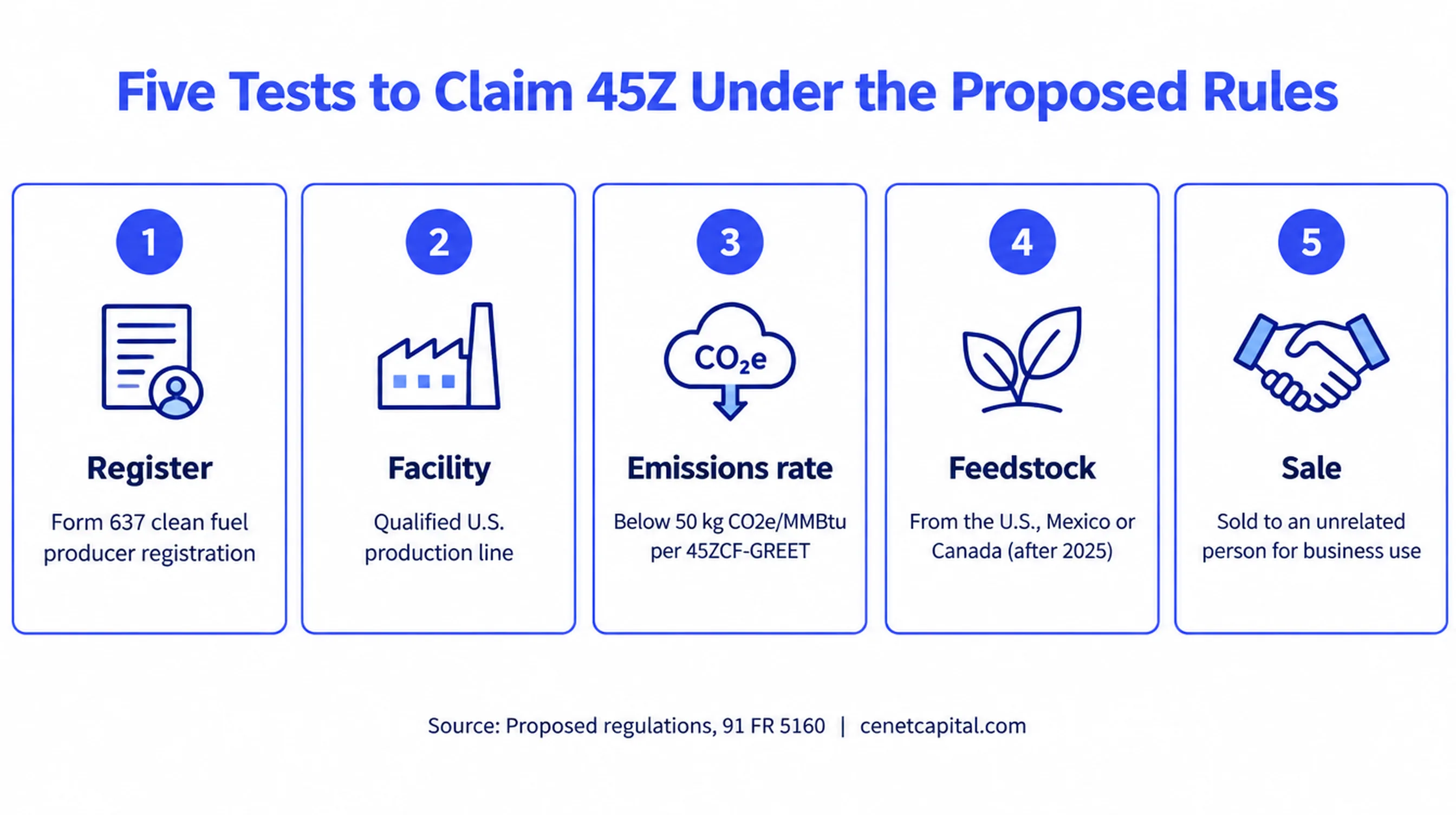
Every person that intends to claim the credit must register with the IRS on Form 637, and each business unit with its own employer identification number registers separately. The IRS will register only applicants that pass three tests:
Activity test: the applicant is regularly engaged in producing clean transportation fuel, or will be.
Acceptable risk test: no history of wrongful acts or tax evasion that would make registration a risk.
Satisfactory tax history test: the applicant is current on filing and deposit obligations.
What counts as a qualified facility and a qualified sale?
A facility is a single production line whose equipment works together to produce fuel, and a qualified sale is a sale to an unrelated person for use in a trade or business, including a sale to a distributor that resells the fuel.
Facility boundaries: feedstock handling, electricity generation and equipment used only to condition, blend, pressurize or transport fuel are not part of the facility.
Blended fuel: a producer still qualifies when its fuel is blended with other fuels and the blend is sold.
Related parties: a sale to a member of the same consolidated group counts once that member sells the fuel to an unrelated person.
Purchaser certificate: a safe harbor lets producers prove a qualified sale with a buyer’s certificate in the form the regulations provide.
No stacking: a facility claiming the 45V hydrogen credit, the 45Q carbon capture credit or the hydrogen storage ITC under Section 48(a)(15) can’t claim 45Z for the same year. The 48(a)(15) election is irrevocable.

How are emissions rates determined?
Producers use the emissions rate table published by Treasury that’s in effect on the first day of their taxable year, which directs non-SAF fuels to the Department of Energy’s 45ZCF-GREET model. Producers use the most recent version available on the first day of the taxable year, or can elect a newer version released during the year if it adds their fuel type.
SAF: producers can use CORSIA default or actual values or 45ZCF-GREET, and need a certification from an unrelated qualified certifier, such as one accredited by the California Air Resources Board, ISCC or RSB.
Provisional emissions rates: a fuel or pathway not in the table can get a provisional rate. The producer submits an emissions value request to DOE, receives a calculated emissions value letter, then attaches its petition to Form 7218 with a timely filed return.
Clean electricity: using renewable energy certificates to lower an emissions rate requires incrementality, temporal matching and deliverability. For incrementality, the generator must have started operating no more than 36 months before the first day of the taxable year.
What changed for fuel produced after 2025?
The proposed regulations build in four One Big Beautiful Bill Act changes: indirect land use change is excluded, emissions rates can’t go below zero except for manure-based fuels, feedstocks must come from the U.S., Mexico or Canada, and foreign-entity limits apply.
Rule | Effective | Who it helps or hurts |
|---|---|---|
Indirect land use change excluded | Fuel produced after Dec. 31, 2025 | Helps corn ethanol and soybean biodiesel |
Emissions rate floor of zero (except animal manure) | Fuel produced after Dec. 31, 2025 | Caps credits for most RNG; manure-based fuels can still exceed $1.00 |
North American feedstocks only | Fuel produced after Dec. 31, 2025 | Hurts producers using imported used cooking oil and tallow |
No credit for specified foreign entities | Tax years beginning after July 4, 2025 | Excludes producers owned or controlled by China, Russia, Iran or North Korea |
No credit for foreign-influenced entities | Tax years beginning after July 4, 2027 | Reaches producers with certain ownership, debt or contract ties to those entities |
Our FEOC rules guide explains how the foreign-entity tests work, and the One Big Beautiful Bill guide covers the changes to every other credit.
What’s happened since the proposed regulations?
DOE and USDA have filled in the model and feedstock rules, and the IRS released the 2026 emissions rate table, but final regulations are still pending.
June 12, 2026: DOE released an updated 45ZCF-GREET model.
June 29, 2026: USDA published its final feedstock guidance for climate-smart agricultural practices.
September 8, 2026: the IRS issued Notice 2026-53 with the 2026 emissions rate table, and DOE revised 45ZCF-GREET to add renewable natural gas pathways and farm-specific emissions rates for dairy and swine manure.
The notice lets producers use USDA’s 2026 feedstock carbon intensity calculator with the updated model, waives the pre-application nutrient budget requirement for 2025 and 2026 fuel (applied nutrients still have to be substantiated), and lets manure-based producers use a farm-specific alternative fate reflecting prior manure management, such as uncovered lagoons.
What do the proposed rules leave open?
Imported feedstock substantiation, some registration timing questions and the final shape of the anti-abuse rules are still open. Treasury said the model has no pathway for imported used cooking oil and that it’s considering added substantiation and recordkeeping for it. The proposal also doesn’t settle whether Form 637 registration must be in place before production begins, and it doesn’t address transfer or elective pay mechanics, which follow the general Section 6418 and 6417 rules.
What should 45Z producers do now?
Confirm registration, lock down your emissions rate support and document every sale, then decide whether to use or sell the credit.
Confirm each EIN that produces fuel has an approved Form 637 registration.
Identify which 45ZCF-GREET version applies to each taxable year, and rerun 2026 rates under the September 2026 model if it helps.
Keep feedstock origin records that prove North American sourcing for fuel produced after 2025.
Collect purchaser certificates for every sale, and keep payroll and apprentice records.
Producers without enough tax liability can sell 45Z credits for cash. They traded at roughly 85 to 93 cents per dollar in 2026, below solar and wind credits because buyers price emissions-score risk. Clean registration, model and sales records move a credit toward the top of that range. See transferable tax credit pricing or estimate your number with our tax credit price calculator.
Sources
Federal Register, Section 45Z Clean Fuel Production Credit, proposed rule (91 FR 5160)
IRS, IRS issues notice on 45Z clean fuel production tax credit (Notice 2026-53)
Holland & Knight, What to know about the Section 45Z PTC proposed regulations
Mayer Brown, Treasury issues proposed regulations for Section 45Z
Holland & Knight, Section 45Z 2026 emissions rate table and updated GREET model published
Frequently Asked Questions
Are the 45Z proposed regulations final?
No. They were published February 4, 2026, comments closed April 6 and a hearing was held May 28, 2026. Final regulations have not been issued, but producers can rely on the proposed rules if they apply them in their entirety and consistently.
When do the 45Z proposed regulations take effect?
Does selling fuel to a distributor count as a qualified sale for 45Z?
Can fuel made from imported used cooking oil qualify for 45Z?
Can Cenet Capital buy 45Z credits?
Your 45Z credits are only as good as your records.
Cenet Capital buys 45Z credits from registered producers and reviews registration, GREET modeling and sales records up front, so you know your price before you file. Send us your volumes.

More Insights