
Tax equity explained: how partnership flips, sale-leasebacks and hybrid deals work, who invests, what it costs, and how it compares with selling tax credits.
Author -
Paulestini Francois
Published -
READ TIME
Tax equity is how many of America's largest wind and solar farms got built: a bank invests in the project in exchange for its tax credits and depreciation. Since 2023, developers have had a simpler alternative, selling credits outright, and most new deals now blend the two. Here's how tax equity works in 2026, the main structures, who the investors are, what it costs, and a tool to compare tax equity with a straight credit sale for your project.
What is tax equity?
Tax equity is an investment in a clean energy project, usually by a large bank or corporation, in which the investor provides upfront capital in exchange for most of the project’s tax benefits (its tax credits and depreciation) plus a share of its cash flow. It lets developers who can’t use those tax benefits themselves turn them into construction capital. For two decades, tax equity was the main way wind and solar projects in the U.S. monetized their credits. Since 2023, it competes and increasingly combines with a simpler option: selling the credits outright.
The market is still large and growing. Tax equity investment reached about $36.6 billion in 2025, up 22%, and tax equity plus preferred equity is projected at $46.3 billion in 2026, according to Crux’s 2025 and 2026 mid-year reports. More than three-quarters of 2025 tax equity commitments used hybrid structures that also sell credits to third parties.
How does tax equity financing work?
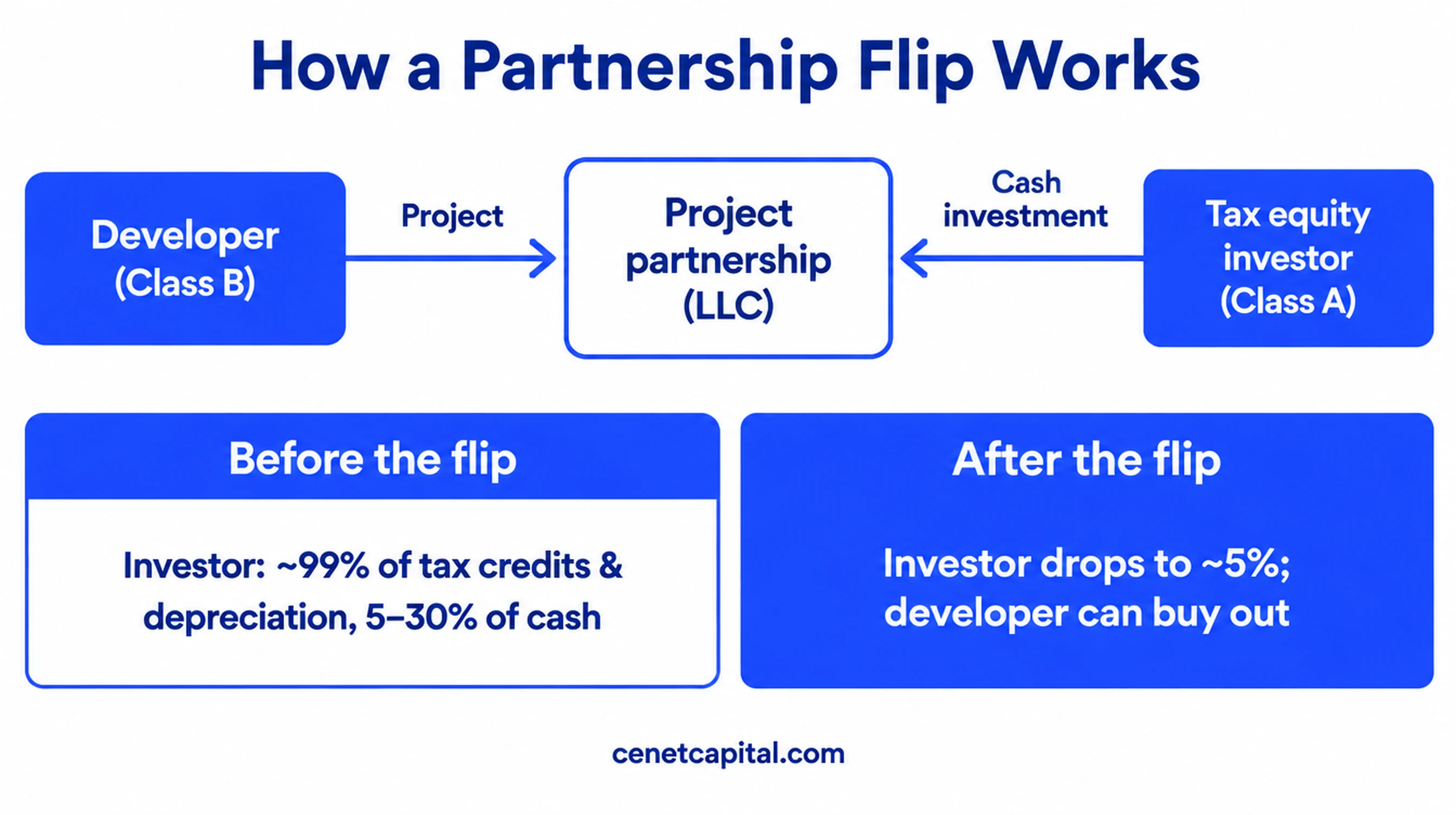
In the most common structure, the developer and the investor form a partnership that owns the project. The investor contributes cash, typically 30% to 60% of the project’s capital, and receives about 99% of the tax credits and depreciation and a minority share of cash, until it reaches a target return. Then the allocations “flip” and the developer takes most of everything. This is called a partnership flip, and it’s used for both ITC and PTC projects.
Formation. The developer (Class B member) and tax equity investor (Class A member) form a project LLC taxed as a partnership.
Funding. The investor funds part of its contribution at mechanical completion and the rest at placed in service, often with a bridge loan covering the gap during construction.
Pre-flip. The investor gets roughly 99% of tax benefits and typically 5% to 30% of cash distributions.
Flip. When the investor hits its target internal rate of return (a yield-based flip) or a fixed date (time-based, no earlier than five years after placed in service for an ITC, to clear recapture), its share drops to about 5%.
Buyout. The developer usually has an option to buy out the investor’s remaining interest at fair market value.
What are the main tax equity structures?
Partnership flips dominate, but sale-leasebacks and inverted leases are also used, mainly for solar and storage.
Structure | How it works | Typical use |
|---|---|---|
Partnership flip | Investor and developer co-own the project; allocations flip after target return | Wind and solar, ITC or PTC |
Sale-leaseback | Developer sells the project to the investor and leases it back; investor claims credits and depreciation | Commercial and distributed solar, storage (ITC only) |
Inverted (pass-through) lease | Developer leases the project to the investor and elects to pass the ITC through to it; developer keeps depreciation | Distributed solar (ITC only) |
Hybrid (transfer flip) | Partnership flip in which the partnership sells some or all credits to a third-party buyer under Section 6418 | Most new deals since 2024 |
Who are tax equity investors?
Mostly large U.S. banks, which have historically supplied about 80% of the market, along with insurance companies and some large corporations with steady, predictable federal tax bills. Tax equity requires deep expertise in partnership tax, project risk and long-term asset management, so the investor pool has always been small: a few dozen institutions. That scarcity is one reason tax equity is relatively expensive and why small projects often can’t access it at all.
Tax equity vs. selling the credits: which is better?
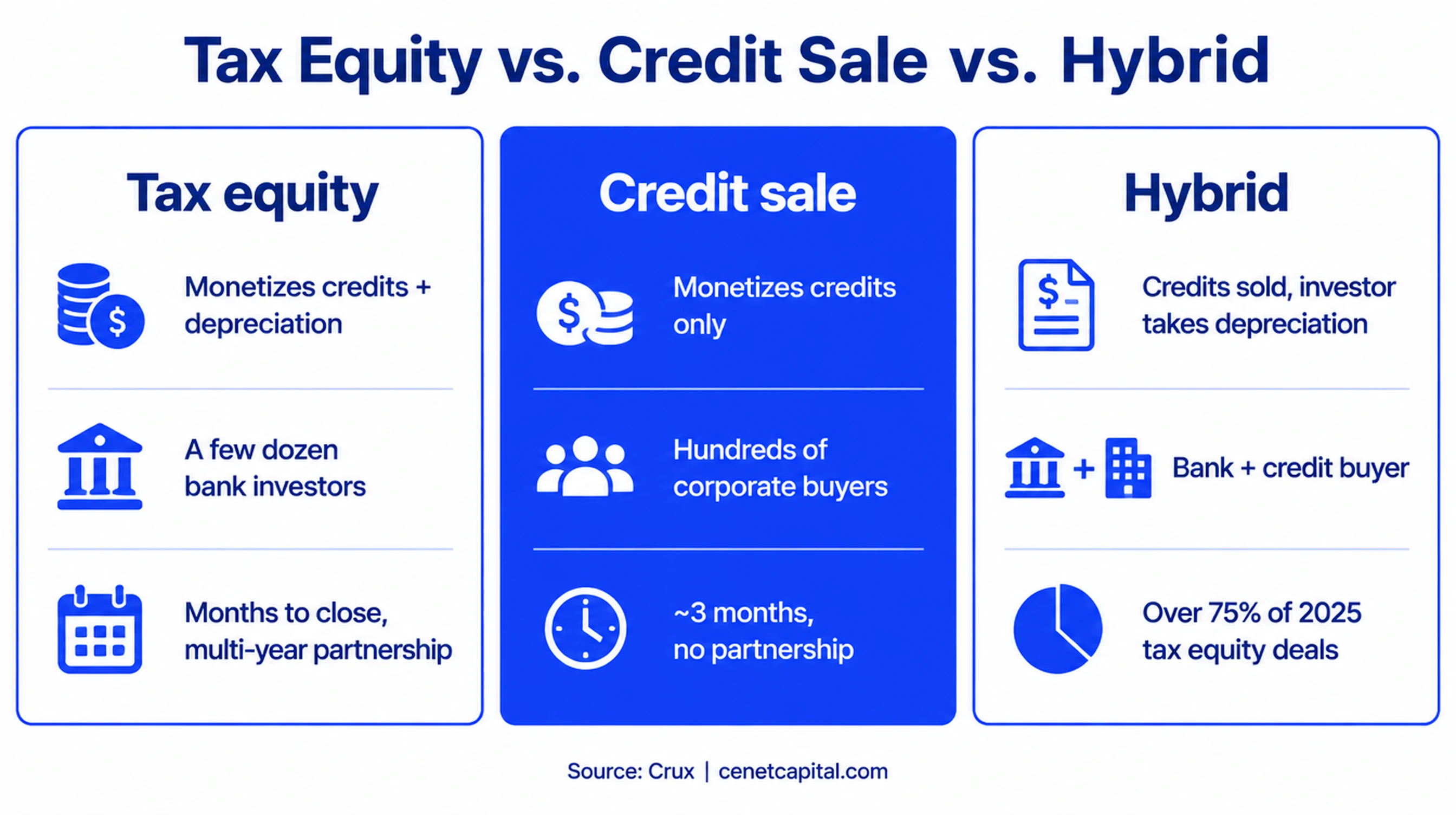
Tax equity monetizes both the credits and depreciation, but it’s complex, expensive and only available for larger projects. Selling credits under Section 6418 is faster, cheaper and open to almost any project size, but it monetizes only the credit, not depreciation. Many projects now do both in a hybrid.
Tax equity | Credit transfer (sale) | |
|---|---|---|
What’s monetized | Credits + depreciation + some cash | Credits only |
Investor pool | A few dozen banks and insurers | Hundreds of corporations (about 1 in 4 of the Fortune 1000) |
Typical time to close | Several months to a year | About 3 months |
Deal size | Generally larger projects or portfolios | From under $1M up |
Developer keeps | Minority of tax benefits pre-flip; most of cash | Depreciation, all cash flow, full ownership |
Ongoing partnership | Yes, typically 5 to 10 years | No |
The deciding question is usually depreciation. If the developer can’t use the project’s depreciation, tax equity captures value that a credit sale leaves on the table. If the developer can use it, or the project is too small for tax equity, a credit sale is simpler. Use the comparison tool below to see how the two compare on your project, then read our guide to transferable tax credits.
Tax equity, credit sale or hybrid: which nets more?
Illustrative, undiscounted comparison. Depreciation benefit is a rough federal estimate (21% of basis reduced by half the credit). Tax equity also takes a share of project cash and requires a multi-year partnership, not reflected here. Assumes ~2% transfer costs and ~4% tax equity costs.
Get a transfer quote →What is hybrid tax equity?
Hybrid tax equity is a partnership flip in which the partnership sells some or all of its tax credits to a third-party buyer, while the tax equity investor keeps the depreciation and part of the cash flow. The investor contributes less capital, because it isn’t absorbing all the credits, and the credit buyer pays cash for the rest. Sales of credits out of tax equity partnerships made up nearly 30% of the 2024 transfer market, and hybrids accounted for more than 75% of tax equity commitments in 2025, per Crux.
Hybrids work for investors that have appetite for depreciation and project returns but not for the full credit amount. For developers, they widen the pool of capital: one bank, plus one or more corporate credit buyers, instead of a single bank taking everything.
What does tax equity cost a developer?
More than a credit sale, in both fees and economics. Tax equity deals carry heavy legal, accounting and modeling costs, and the investor’s target return is built into how long it keeps the tax benefits and cash. Investors typically want at least a modest pre-tax cash yield on top of the tax benefits, and they price in the work of managing a partnership for years. Yield-based flips in solar commonly reach their target in six to eight years; fixed-date flips are usually set at five to six years after placed in service.
That’s why many developers now compare every tax equity term sheet with a straight credit sale. If a credit buyer will pay 90 to 95 cents per dollar of credit, the question becomes whether the tax equity investor’s additional payment for depreciation and project cash flow is worth giving up control, cash and years of partnership oversight.
Tax equity glossary
Flip point: the date or return level at which allocations shift from the investor to the developer.
Target yield: the after-tax internal rate of return the investor must reach before a yield-based flip.
Class A / Class B: the investor’s and developer’s membership interests in the project partnership.
Capital account deficit: a limit on how much loss an investor can be allocated, which affects deal sizing.
Pay-go: a structure where part of the investor’s contribution is paid over time as PTCs are generated.
T-flip: a hybrid partnership flip that sells credits under Section 6418.
How did the One Big Beautiful Bill affect tax equity?
It left the tax equity and transfer structures themselves alone but shortened the pipeline for new wind and solar, which have historically been tax equity’s core. Wind and solar that began construction by July 4, 2026 still qualify, and storage, geothermal and other technologies keep a long runway, so tax equity demand remains strong in the near term. New foreign-entity rules add diligence to every deal starting construction after 2025. Our One Big Beautiful Bill guide has the details.
How do you get tax equity for a project?
Size matters. Most tax equity investors focus on larger projects or portfolios. Smaller developers often aggregate projects or go straight to a credit sale.
Bring a bankable package. Investors want a creditworthy offtaker, an independent engineer’s report, a solid construction contract, and clean title and permits.
Line up bridge financing. Investors fund at completion, so most developers need a tax equity bridge loan during construction.
Compare against a sale. Get a credit transfer quote alongside any tax equity term sheet so you know what the tax equity is really costing you.
Not sure whether tax equity, a credit sale, or a hybrid fits your project? Cenet Capital buys, insures and finances clean energy tax credits, and we can show you how a direct credit sale compares with the tax equity terms you’ve been offered.
Compare your tax equity offer with a credit sale.
Cenet Capital buys, insures and finances clean energy tax credits. Send us your project and any tax equity terms, and we'll show you what a direct credit sale would net.

More Insights