
How buying tax credits cuts federal tax: savings at today's prices, the 75% credit limit, estimated tax timing, carrybacks, individual limits and a purchase planner.
Author -
Paulestini Francois
Published -
READ TIME
Buying clean energy tax credits is one of the few ways a profitable company can cut its federal tax bill with cash it already has, and the math is simpler than most tax strategies. You pay less than a dollar for each dollar of credit, and the difference is your saving. This guide walks through exactly how much you can save, how much credit your tax bill can absorb, how timing raises the return, what happens to unused credits, and the risks that can change the numbers.
QUICK ANSWER
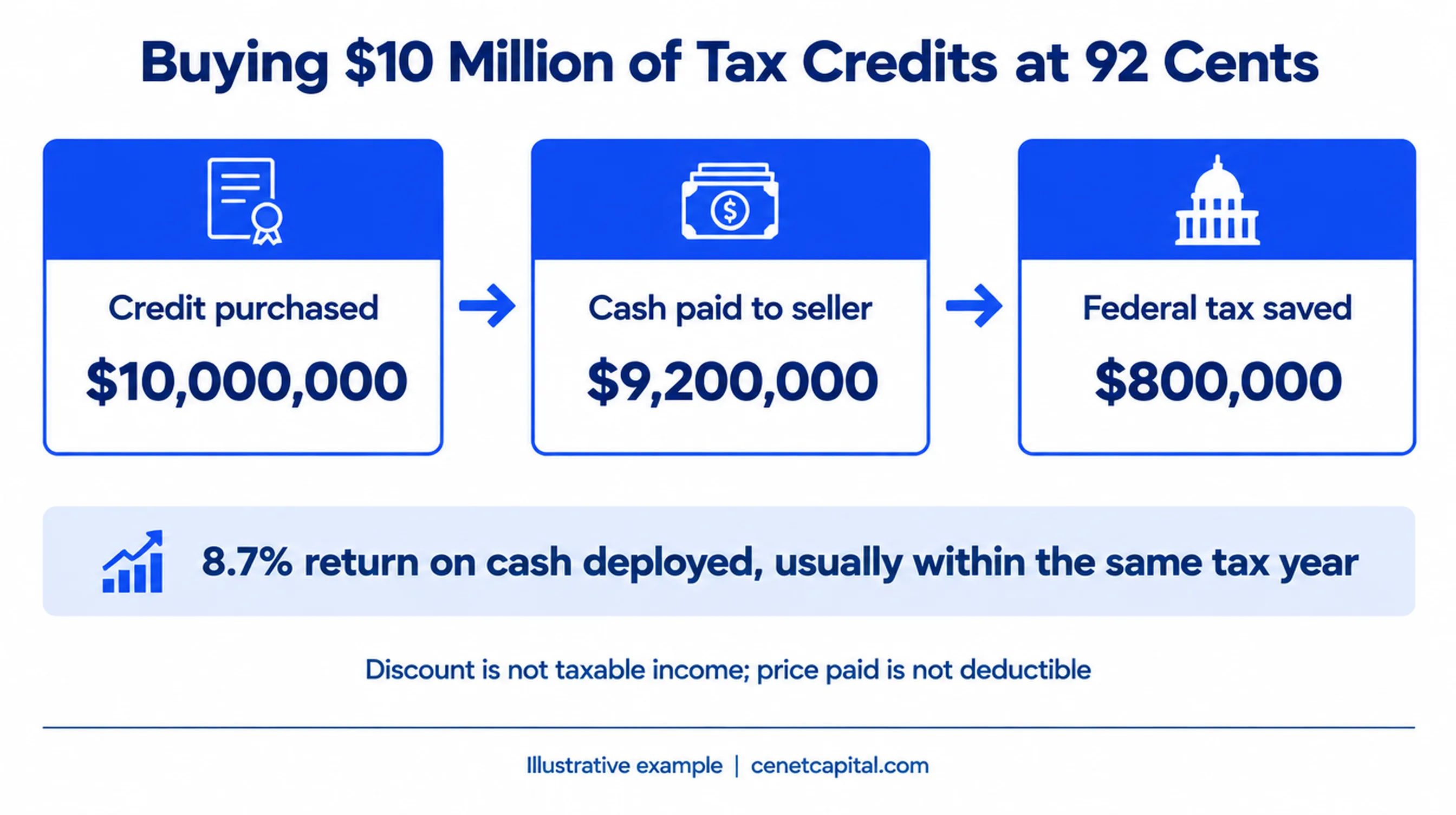
Buying a clean energy tax credit saves the gap between face value and price. At 92 cents, $10 million of credits costs $9.2 million and cuts federal tax by $10 million, saving $800,000. Credits can offset roughly 75% of federal income tax above $25,000, and lowering estimated payments before paying the seller raises the return.
KEY FACTS
Savings: Most credits trade at 88 to 96 cents in 2026, so buyers save 4 to 12 cents per dollar of credit.
Credit limit: Tax minus 25% of tax above $25,000, shared with research and other general business credits.
Tax treatment: The discount isn't taxable income and the price isn't deductible.
Timing: Buyers can lower quarterly estimated payments for credits they've bought or intend to buy.
Unused credits: Generally carry back 3 years and forward 22 years; individuals face passive activity limits.
How much can a company save by buying tax credits?
A company saves the difference between a credit’s face value and the price it pays. Buying $10 million of clean energy tax credits at 92 cents per dollar costs $9.2 million and cuts federal income tax by $10 million, an $800,000 saving and an 8.7% return on the cash, usually within the same tax year. In 2026 most credits trade between about 88 and 96 cents, so savings typically run 4 to 12 cents per dollar of credit.
Credit bought | Price per $1 | Cash paid | Federal tax saved | Return on cash |
|---|---|---|---|---|
$5,000,000 | $0.89 | $4,450,000 | $550,000 | 12.4% |
$10,000,000 | $0.92 | $9,200,000 | $800,000 | 8.7% |
$25,000,000 | $0.935 | $23,375,000 | $1,625,000 | 7.0% |
$50,000,000 | $0.945 | $47,250,000 | $2,750,000 | 5.8% |
Bigger deals price higher, so the percentage return falls as size rises, but the dollar savings keep growing. Smaller buyers can earn the widest discounts. For the step-by-step buying process, see our corporate buyer’s guide.
How does a purchased credit reduce federal tax?
Dollar for dollar. A purchased credit is a general business credit that the buyer reports on Form 3800, and it reduces federal income tax the same way the seller’s own credit would have. Section 6418 of the tax code lets an unrelated buyer pay cash for eligible credits from projects such as solar, wind, storage, battery manufacturing and clean fuels, with no ownership in the project.
The discount isn’t income. The buyer doesn’t recognize the $800,000 gap between face value and price as taxable income.
The price isn’t deductible. The $9.2 million is simply the cost of the credit, so there’s no second tax effect to model.
Timing follows the seller. The buyer claims the credit in its taxable year that ends with or after the end of the seller’s taxable year in which the credit arose.
That makes credits more valuable than a deduction of the same size. A $10 million deduction saves a corporation $2.1 million at the 21% rate; a $10 million credit saves $10 million, for $9.2 million.
How much tax can credits offset?
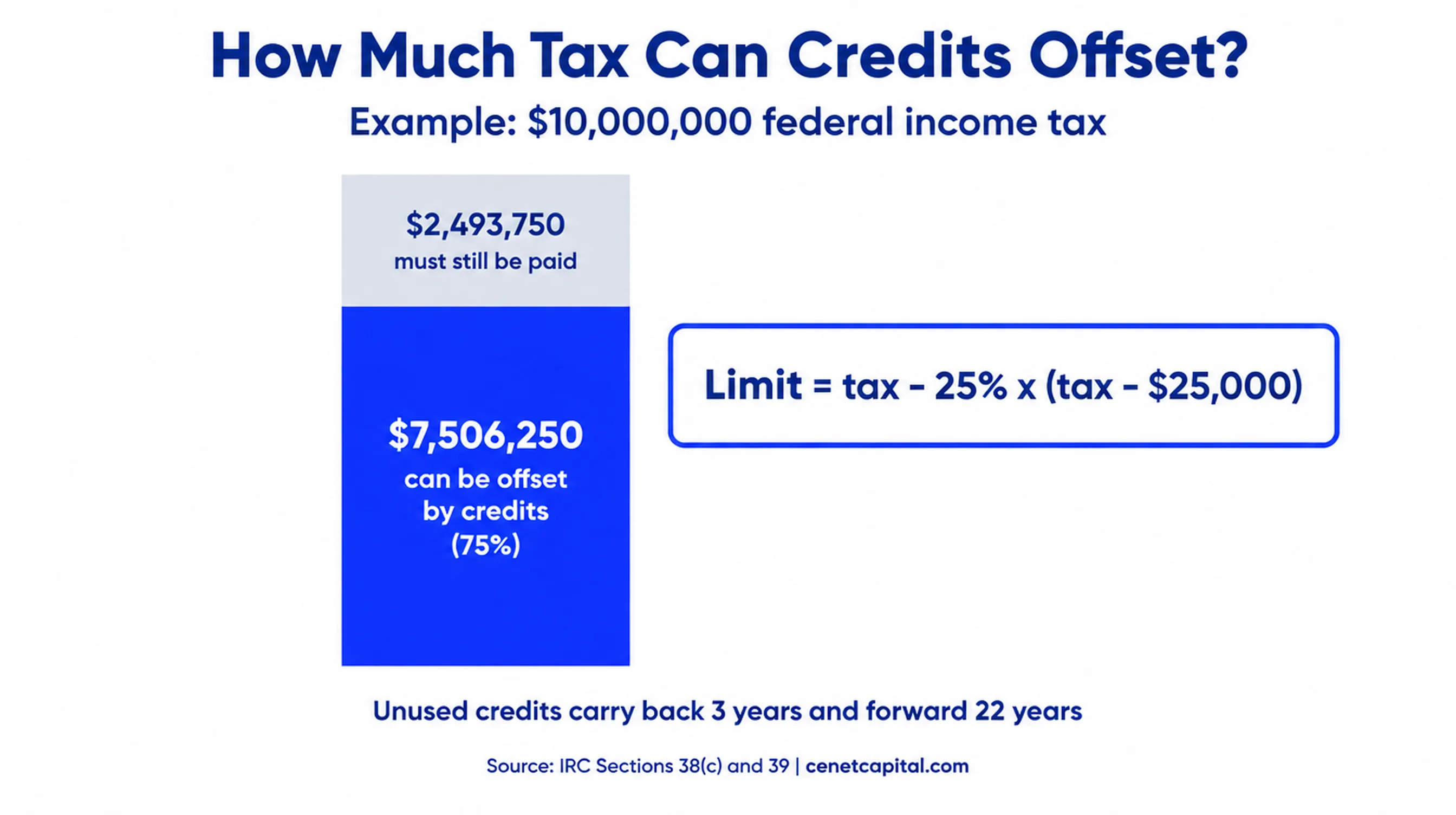
About 75%. General business credits can offset federal income tax up to the full amount of the first $25,000, plus 75% of tax above that. The limit in Section 38(c) works out to tax minus 25% of the amount over $25,000. Since the Inflation Reduction Act, the same capacity can also offset the 15% corporate alternative minimum tax.
Federal income tax | Maximum credits usable | Tax still payable |
|---|---|---|
$1,000,000 | $756,250 | $243,750 |
$10,000,000 | $7,506,250 | $2,493,750 |
$40,000,000 | $30,006,250 | $9,993,750 |
$100,000,000 | $75,006,250 | $24,993,750 |
The capacity is shared. Research credits, low-income housing credits and any other general business credits a company already claims come out of the same 75%, so subtract them before sizing a purchase. The calculator below does this for you.
How many credits can you use, and what will you save?
Illustrative only, for a calendar-year C corporation. Assumes estimates are lowered by a quarter of the credit in each selected month and the seller is paid in December. Unused credits can generally be carried back 3 years and forward 22. Individuals face passive activity limits.
Plan my purchase →How do estimated tax payments improve the return?
Treasury’s final regulations let a buyer reduce its quarterly estimated tax payments for a credit it has bought, or intends to buy, so the company can keep cash it would otherwise send the IRS and pay the seller later in the year. That turns an 8.7% discount into a much higher annualized return.
Say a calendar-year corporation plans to buy $10 million of credits from a solar project placed in service in the fall. It lowers its April, June and September estimates by $2.5 million each and pays the seller $9.2 million in December. It keeps the $800,000 saving, and also earns interest on the $7.5 million it held back for an average of almost six months: roughly $160,000 at a 4.5% money market rate.
The risk is the deal falling through. If the purchase doesn’t close, the company owes the underpaid estimates plus an underpayment penalty, so most buyers only reduce estimates once a term sheet is signed and the project is on schedule.
What happens to credits you can’t use this year?
Unused purchased credits can generally be carried back 3 years and forward 22 years. The final Section 6418 regulations confirm a buyer can use the extended carryback that applies to clean energy credits, so an overestimate of this year’s tax isn’t a loss, just a refund claim or a delay. Even so, buying more than you can use in the current year ties up cash, and an amended return or refund claim adds work. Size purchases to a conservative estimate of this year’s liability and top up later in the year if needed.

What does the math look like for a real buyer?
A company with $40 million of federal income tax and $3 million of research credits can use about $27 million of purchased credits this year.
Capacity: $40,000,000 − 25% × ($40,000,000 − $25,000) = $30,006,250.
Less existing credits: $30,006,250 − $3,000,000 = $27,006,250 of room.
Purchase: $25 million of insured investment tax credits at 93.5 cents costs $23,375,000.
Saving: $1,625,000 of federal tax, a 7.0% return, plus interest on estimates held back.
Cushion: about $2 million of unused capacity covers a weaker-than-expected year.
The same company buying the $25 million in two $12.5 million tranches, one in spring and one in the fall, could match purchases to its actual results as the year develops. Expect to pay a little more per dollar on smaller tranches.
Can individuals buy tax credits to reduce their taxes?
Yes, but the passive activity rules usually limit the benefit. The final regulations treat credits bought by individuals, estates, trusts and certain closely held corporations as arising from a passive activity, and an investor generally can’t materially participate in someone else’s project. In practice, an individual can use purchased credits only against federal tax on passive income, such as income from rental real estate or investment partnerships where they don’t work. Widely held C corporations aren’t subject to these limits, which is why corporations buy the large majority of credits.
What risks can change the math?
If the IRS later reduces a credit, the buyer owes the tax on the disallowed amount, plus a 20% penalty on any excessive credit transfer unless it shows reasonable cause. For investment tax credits, the buyer also bears recapture tax if the project is sold or stops operating within five years.
Risk | How buyers protect themselves |
|---|---|
Overstated credit (cost basis, bonus adders) | Diligence, independent cost reports, seller indemnity |
Prevailing wage or apprenticeship failure | Payroll review, cure provisions in the purchase agreement |
ITC recapture | Seller covenants and recapture insurance |
Seller can’t pay an indemnity claim | Tax credit insurance or a parent guaranty |
Foreign-entity rules | Ownership and supply chain review for projects started after 2025 |
These protections cost money, mostly paid by the seller, which is part of why insured credits from strong sellers trade at the top of the price range. Our tax credit pricing guide breaks down how each factor moves the price.
Sources
Federal Register, Transfer of Certain Credits, final regulations (T.D. 9993)
Cornell Law School, 26 U.S. Code § 38, general business credit
Cenet Capital analysis of 2026 pricing and worked examples
Frequently Asked Questions
How much do you save by buying tax credits?
The face value of the credit minus the price you pay. Buying $10 million of credits at 92 cents costs $9.2 million and cuts federal income tax by $10 million, an $800,000 saving and an 8.7% return on the cash.
How much tax can purchased credits offset?
Is the discount on a purchased tax credit taxable?
Can individuals buy clean energy tax credits?
Can Cenet Capital sell tax credits to my company?
Know your capacity? Lock in your discount.
Cenet Capital sells insured, fully diligenced clean energy credits sized to your tax capacity, with closings timed to your estimated payments. Tell us your tax year and target amount.

More Insights