

Estimate what your transferable tax credit sells for in 2026 and how much cash you keep after insurance and fees, with pricing by credit type, deal size and timing.
Author -
Paulestini Francois
Published -
READ TIME
A transferable clean energy tax credit is worth less than its face value in cash, but how much less depends on a handful of factors you can measure. This free calculator estimates the price a buyer is likely to pay for your credit in today's market and the net cash you'd keep after insurance, legal and broker costs. Below it, we explain the methodology, what each credit type sells for in 2026, when buyers pay, and how to move your credit toward the top of the range.
QUICK ANSWER
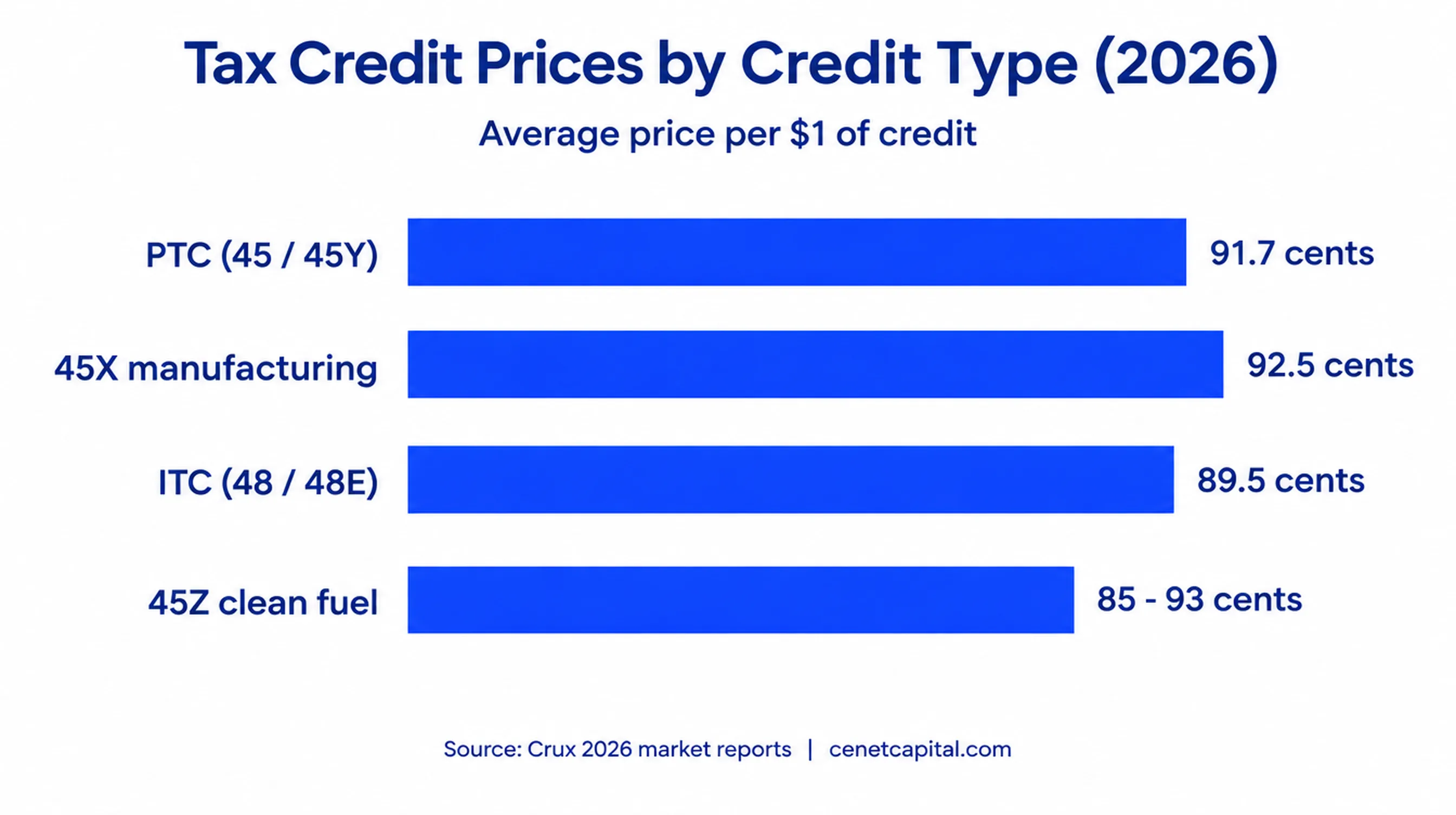
Most transferable clean energy tax credits sell for 80 to 96 cents per dollar in 2026. Production tax credits average about $0.917, investment tax credits about $0.895 and 45Z clean fuel credits about $0.85 to $0.93. Large, insured, investment-grade deals price near the top; small uninsured deals price near the bottom.
KEY FACTS
Credit type: PTCs trade highest because buyers carry no recapture risk; 45X averaged about $0.925 in Q2 2026.
Deal size: ITCs from deals under $20 million averaged 90.0 cents vs. 93.5 cents for $50–$100 million deals, per Crux.
Seller strength: 73% of buyers say seller credit quality matters most; investment-grade sellers' ITCs priced at $0.920–$0.950 in 2025.
FEOC exposure: In H1 2026, prohibited foreign entity exposure became the strongest predictor of deal price.
Net cash: Insurance (2%–5% of the insured limit), legal costs and any 1%–3% broker fee usually leave sellers 1 to 6 cents below the headline price.
How much cash is a transferable tax credit worth?
Most transferable clean energy tax credits sell for 80 to 96 cents per dollar of credit in 2026, so a $1 million credit is typically worth $800,000 to $960,000 in cash before the seller’s own costs. Production tax credits average about $0.917, investment tax credits about $0.895, and clean fuel (45Z) credits about $0.85 to $0.93. Where a specific credit lands depends on its type, the deal size, the seller’s financial strength, insurance, foreign-entity exposure, documentation and timing.
The calculator below estimates both numbers that matter: the price a buyer is likely to pay, and the net cash you keep after insurance, legal and intermediary costs. It uses the same factors buyers use, calibrated to published market data from Crux and to what Cenet Capital sees in its own deal flow as a direct buyer.
What is your tax credit worth in cash?
Estimate only, based on 2026 market data (Crux) and Cenet Capital deal flow. Insurance assumes ~2.75% of the credit with a $150K minimum; legal assumes $40K + 0.2%. Real bids depend on diligence and buyer demand.
Get my real price →How does the calculator estimate price?
It starts from the price a large, investment-grade, insured seller gets for that credit type today, then subtracts the discount buyers typically apply for each added risk or cost. The adjustments are averages; a real bid can move a cent or two either way.
Factor | Typical effect on price |
|---|---|
Deal size under $5 million | About 4 cents lower than a $50 million+ deal |
Deal size $10 to $20 million | About 2 cents lower |
Seller without an investment-grade rating | About 1.5 cents lower |
Unrated seller with no insurance | About 3.5 cents lower, and fewer bidders |
Foreign-entity (FEOC) exposure not documented | About 2.5 cents lower, or no bid |
Future-year (forward) credit | About 1.5 cents lower |
Gaps in cost basis, PWA or bonus documentation | About 3 cents lower |
These line up with published data. Crux found ITCs from deals under $20 million averaged 90.0 cents while deals of $50 to $100 million averaged 93.5 cents, and investment-grade sellers’ ITCs priced at $0.920 to $0.950 in 2025. We explain each factor in detail in transferable tax credit pricing.
What do different credit types sell for?
Production credits trade highest because buyers carry no recapture risk; investment credits come next; newer and more complex credits trade lower.
Credit | 2026 pricing (per $1) | Why |
|---|---|---|
PTC (45 / 45Y) | ~$0.917 average; $0.92–$0.96 investment grade | Paid on power already produced; no recapture |
ITC (48 / 48E) | ~$0.895 average; $0.92–$0.95 investment grade | Five-year recapture and cost-basis risk |
45X manufacturing | ~$0.925 (Q2 2026 average) | Large, often investment-grade manufacturers |
45Z clean fuel | ~$0.85–$0.93 | Emissions-score and producer risk |
Tech-neutral 45Y / 48E | Measurable discount to legacy 45 / 48 | Newer rules and foreign-entity diligence |
Figures are from Crux’s 2026 market reports as summarized in our tax credit transfer market report, which we update quarterly.
How much do deal size and seller strength matter?
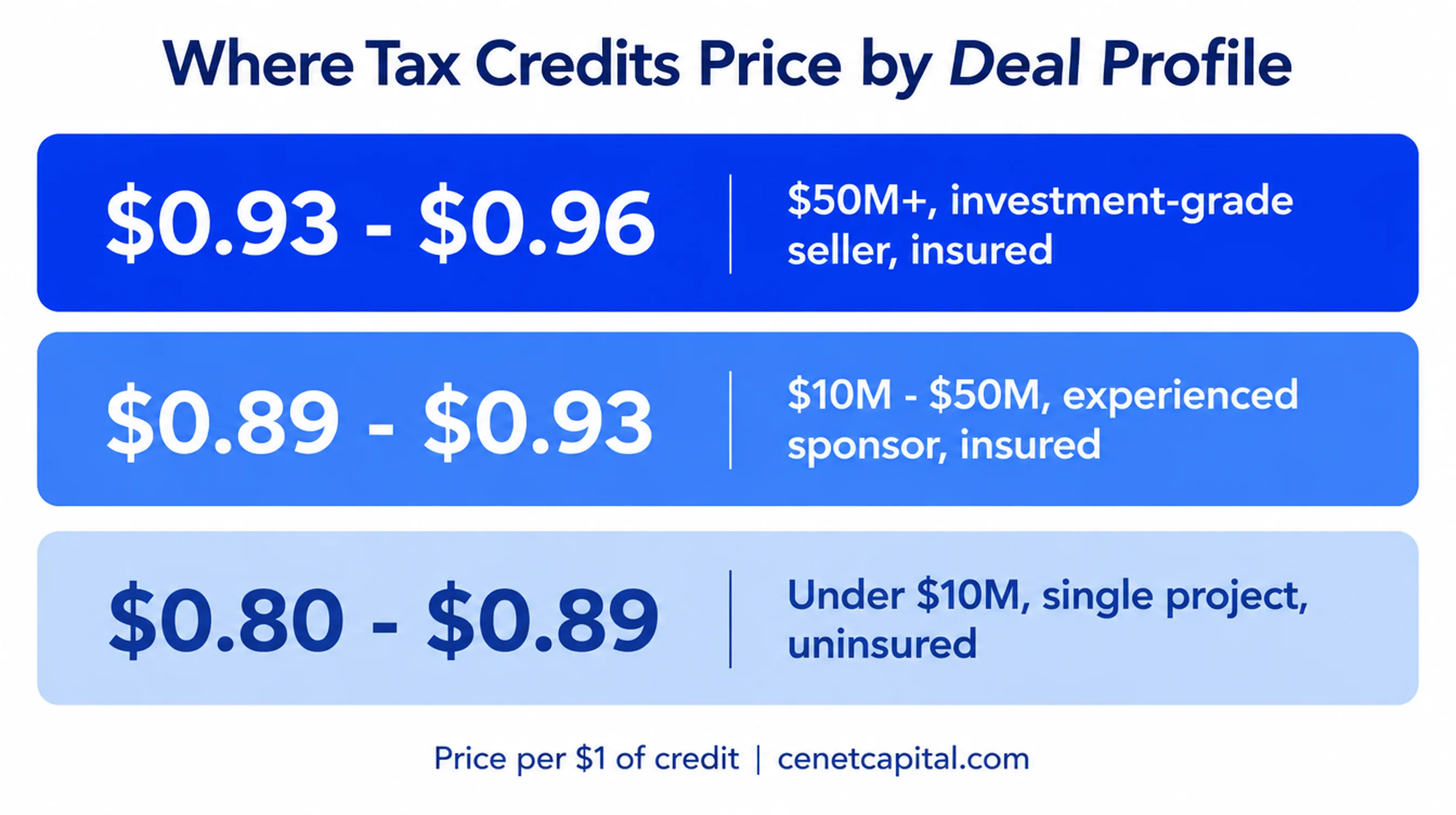
Together they explain most of the 15-cent spread in the market. A $100 million credit from an investment-grade sponsor can clear 6 to 10 cents above a $2 million credit from a first-time developer. Buyers spend roughly the same legal and diligence budget on a small deal as a large one, and their main protection if the IRS reduces the credit is the seller’s indemnity, which is only as good as the seller’s balance sheet. In Crux’s survey, 73% of buyers named seller credit quality as the most important factor in their bid.
Deal profile | Where it tends to price |
|---|---|
$50M+, investment-grade seller, insured or strong guaranty | $0.93 to $0.96 |
$10M to $50M, experienced sponsor, insured | $0.89 to $0.93 |
Under $10M, single project, uninsured | $0.80 to $0.89 |
What costs come out of the sale price?
Headline prices are what the buyer pays. The seller usually pays its own insurance, legal and any intermediary fees out of that, so net cash typically runs 1 to 6 cents below the headline price.
Tax credit insurance: premiums typically run 2% to 5% of the insured limit, with coverage set at roughly 100% to 140% of the credit. Minimum premiums make insurance expensive for credits under about $10 million. See tax credit insurance.
Legal and diligence: seller’s counsel, cost segregation and PWA reviews, often $40,000 or more per deal.
Intermediary fees: brokers and marketplaces commonly charge 1% to 3% of the credit. Selling directly to a principal buyer such as Cenet Capital avoids this layer.
On small deals these costs bite hardest. A $1 million credit that sells for 88 cents but carries $40,000 of legal costs nets 84 cents.
When do you get paid?
The buyer’s cash has to be paid within a set window: from the first day of the seller’s tax year in which the credit arises until the due date (with extensions) of the seller’s return for that year, when the transfer election is made. That rule, from the IRS’s transferability regulations, shapes three common structures:
Spot sale: the credit already exists (for an ITC, the project is placed in service). Cash typically arrives at closing, often within 4 to 8 weeks of a signed term sheet.
Forward commitment: the buyer signs before placed-in-service and pays once the credit is determined. Prices run lower, but the commitment can support construction financing. A bridge loan can advance cash against it.
PTC strips: a multi-year agreement for a project’s future production credits, usually paid quarterly or annually as power is generated.
How does foreign-entity exposure affect price?
In the first half of 2026, prohibited foreign entity (PFE) exposure became the strongest predictor of deal price, ahead of deal size and seller rating, according to Crux’s 2026 Mid-Year Report. For projects beginning construction after 2025, buyers want a documented material assistance cost ratio and supplier certifications before they bid. A credit with no FEOC analysis can lose several cents or find no buyer at all. Our FEOC rules guide explains what to document.
Worked example: a $5 million solar ITC
A developer with a single 15 MW solar project and a $5 million 48E credit, no credit rating, insurance in place, a current-year credit and clean documentation:
Line | Amount |
|---|---|
Estimated price (89.5 cents) | $4,475,000 |
Insurance premium (~2.75% of credit) | −$150,000 (minimum premium) |
Legal and diligence | −$50,000 |
Net cash to seller | $4,275,000 (85.5 cents) |
Selling through a 2% broker would cut another $100,000. Raising documentation quality or bundling several projects into one larger sale are the two most reliable ways to move up the range.
How can you get a higher price for your credit?
Document everything early: cost segregation, PWA payroll, bonus adder support and FEOC certifications.
Register early: complete IRS pre-filing registration so the registration number is ready at signing.
Aggregate: bundle smaller projects into one portfolio sale to reach a better size tier.
Sell current-year credits when possible, and go to market before the year-end rush.
Cut out layers: a direct principal buyer avoids intermediary fees.
How accurate is a calculator estimate?
Close enough to plan around, usually within 2 to 3 cents of a real bid, but not a substitute for a quote. Three things a calculator can’t see often decide where a deal lands inside its range:
Buyer demand at that moment: prices drift through the year, and Crux has tracked swings of about 2.5% as buyers firm up their tax positions in the second half.
Specific diligence findings: an aggressive cost basis, a weak bonus adder claim or a single PWA gap can each move a bid.
Deal terms: indemnity caps, holdbacks and who pays for insurance all trade off against the headline price.
For a firm number, send the project’s size, credit type, placed-in-service date and documentation status to a buyer. Cenet Capital prices credits from $250,000 to more than $250 million and can usually indicate a range within a few business days.
Sources
Crux, 2026 Mid-Year Market Intelligence Report (summary)
Crux, 45X tax credit: a 2026 guide (45X pricing)
Frequently Asked Questions
How much is a $1 million tax credit worth in cash?
Typically $800,000 to $960,000 before the seller's own costs in 2026, depending on credit type, deal size, seller strength, insurance and documentation. Net of legal and insurance costs, small sellers often keep 82 to 88 cents per dollar.
Why do production tax credits sell for more than investment tax credits?
When does the buyer pay for a transferred tax credit?
Does tax credit insurance increase the price?
Can Cenet Capital buy my tax credit?
Calculator estimate in hand? Get a firm bid.
Cenet Capital is a direct principal buyer, so there's no broker fee between you and your price. Send us your credit details and we'll come back with a firm range within days.

More Insights