Commercial solar costs about $1.77/W installed in 2026. See prices by size, net cost after the 30% ITC and depreciation, payback by power rate, and a sizing estimator.
Author -
Paulestini Francois
Published -
READ TIME
Commercial solar prices rose in 2026 for the first time in years, and the tax credit that pays for a big share of every system now has a firm end date. If you're weighing solar for a warehouse, office, farm or factory, the questions are simple: what will it cost, what will it cost after incentives, and how fast will it pay back? Here are 2026 prices by system size, how the investment tax credit and depreciation cut the net cost roughly in half, payback by electricity rate, and an estimator to size and price a system from your own usage.
QUICK ANSWER
Commercial solar costs about $1.77 per watt installed in 2026 (Wood Mackenzie/SEIA, Q2 2026), or roughly $885,000 for a 500 kW system. The 30% investment tax credit and federal depreciation together cut that to about $460,000, and most systems pay back in 4 to 8 years.
KEY FACTS
Price by size: About $177,000 for 100 kW, $885,000 for 500 kW and $1.77 million for 1 MW at the Q2 2026 benchmark, before incentives.
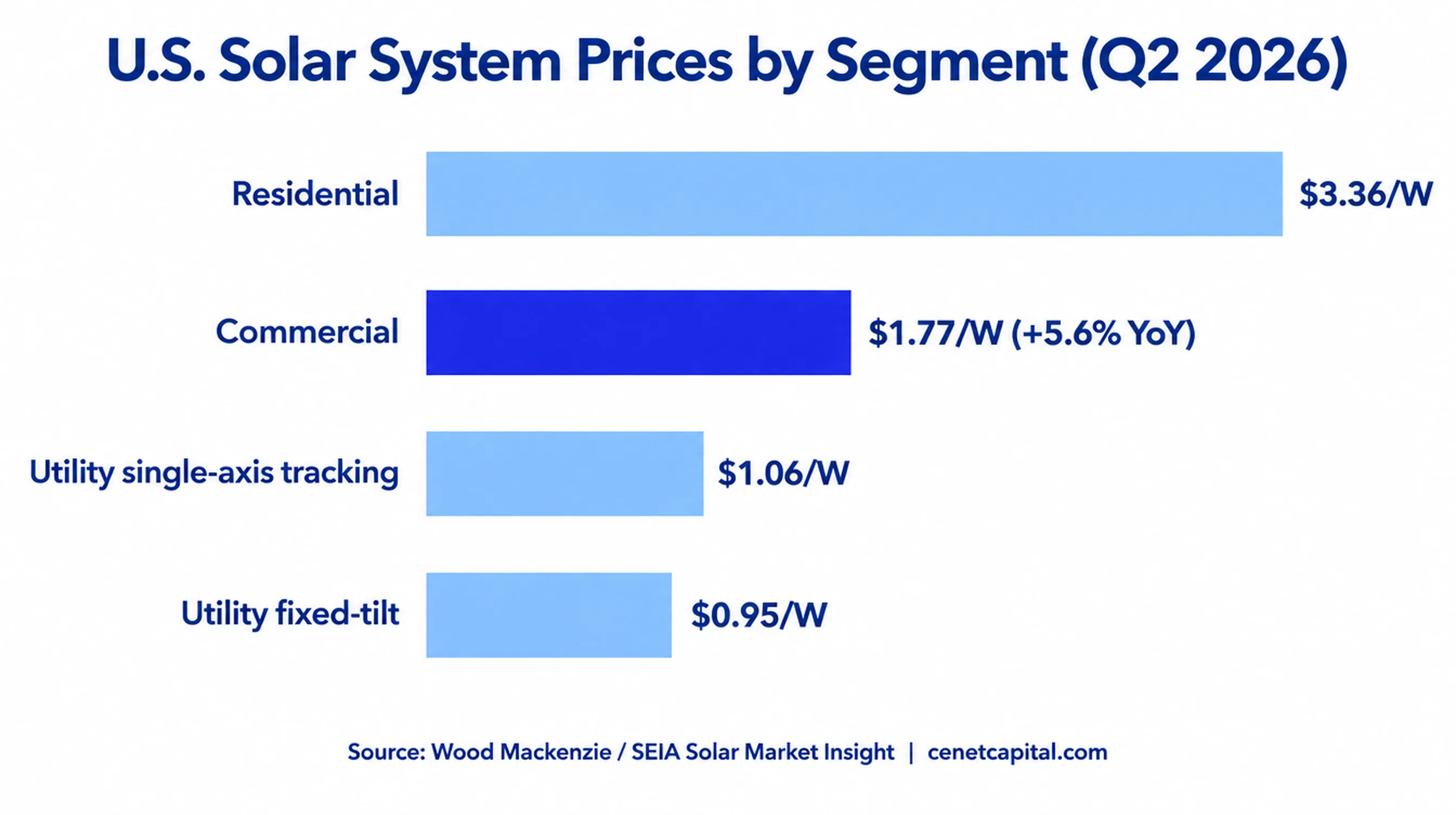
Compared with other segments: About half the per-watt price of residential solar ($3.36/W) and roughly 70% more than utility-scale ($0.95–$1.06/W).
Why prices rose: Module prices fell, but labor, freight, steel, electrical equipment and tariffs pushed installed costs up 5.6% year over year.
Net cost after incentives: The 30% ITC plus depreciation recover about 48% of cost; energy community or domestic content bonuses push the credit to 40–50%.
Deadline: Under the One Big Beautiful Bill Act, solar must begin construction by July 4, 2026 or be placed in service by the end of 2027 to claim the credit.
How much does commercial solar cost in 2026?
Commercial solar cost about $1.77 per watt (DC) installed in the second quarter of 2026, according to Wood Mackenzie and SEIA. That puts a 100 kW system at about $177,000, a 500 kW system at about $885,000 and a 1 MW system at about $1.77 million, before any tax credit or incentive. Commercial prices rose 5.6% year over year, the steepest increase of any segment, even as solar modules got cheaper. After the federal investment tax credit and depreciation, a business typically pays roughly half the sticker price.
This guide breaks down what drives the price, what a system really costs after incentives, how long it takes to pay back, and how to keep costs down. The numbers come from the Q2 2026 Solar Market Insight data reported by pv magazine. For the tax credit itself, see our commercial solar tax credit guide.
How does commercial solar pricing compare with other segments?
Commercial solar costs about half as much per watt as residential and roughly 70% more than utility-scale. Bigger systems spread fixed costs (design, permitting, interconnection, mobilization) over more watts, so cost per watt falls as size rises.
Segment | Q2 2026 price | Change vs. Q2 2025 |
|---|---|---|
Residential | $3.36/W | −1.4% |
Commercial | $1.77/W | +5.6% |
Utility, single-axis tracking | $1.06/W | +2.0% |
Utility, fixed-tilt | $0.95/W | +0.9% |
Modules (distributed generation) | $0.37/W | −16% |
The national benchmark hides wide variation. Small rooftop systems under 100 kW often price above $2.00 per watt; large ground-mount or carport projects over 1 MW can come in well under the benchmark, though carports carry a structural premium of their own. Labor costs, permitting timelines and utility interconnection requirements vary sharply by state.
Why did commercial solar get more expensive in 2026?
Because everything except the panels got more expensive. Distributed-generation module prices fell about 16% year over year to $0.37 per watt, but Wood Mackenzie and SEIA attributed the overall increase to a roughly 15% average rise in logistics and freight costs and to Section 232 tariffs on aluminum, steel and copper that raise the cost of racking, wiring and other balance-of-system equipment. Modules are now less than a quarter of a commercial system’s installed price; racking, inverters, electrical work, labor, engineering, permitting, interconnection and overhead make up the rest.
Hardware: modules, inverters, racking or carport structures, wiring, monitoring.
Labor and installation: crews, equipment, electrical work, roof work.
Soft costs: engineering, permitting, interconnection studies and upgrades, insurance, financing and developer margin.
What does commercial solar cost after the tax credit?
On a 500 kW system at $1.77 per watt, the 30% investment tax credit and federal depreciation together cut an $885,000 sticker price to roughly $460,000, about 52% of cost. Bonus credits for energy communities or domestic content cut it further.
500 kW system | 30% ITC | 40% ITC (with one bonus) |
|---|---|---|
Installed cost | $885,000 | $885,000 |
Investment tax credit | −$265,500 | −$354,000 |
Federal depreciation benefit (est.) | −$157,973 | −$148,680 |
Approximate net cost | $461,527 | $382,320 |
Net cost per watt | $0.92 | $0.76 |
The depreciation estimate assumes a 21% federal rate on a basis reduced by half the credit, undiscounted; your tax advisor will refine it. The tax credit only helps if you can use it or sell it. A business without enough federal tax liability can sell the credit for cash, usually at 80 to 92 cents per dollar for deals this size. Timing also matters: solar starting construction after July 4, 2026 must be placed in service by December 31, 2027. The energy community map guide shows how to check for the 10-point bonus, and our domestic content guide covers the other one.
How long does commercial solar take to pay back?
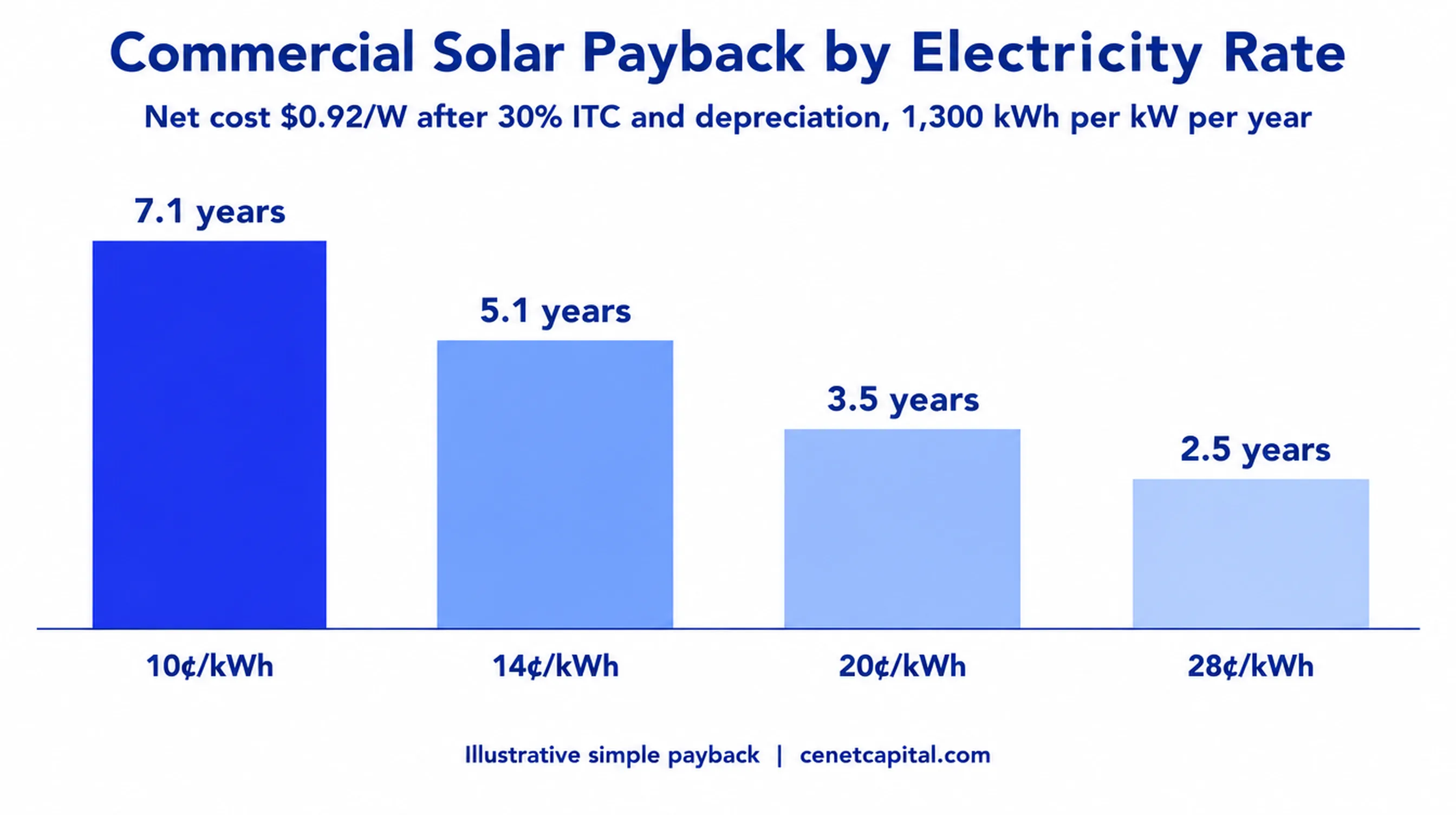
Typically about 4 to 8 years after incentives, depending mainly on your electricity rate and how much sun you get. A system that produces about 1,300 kWh per kW per year and offsets power at 14 cents per kWh saves about $182 per kW a year; at a net cost of about $0.92 per watt, that’s a simple payback of around five years.
Electricity rate offset | Annual savings per kW | Simple payback (net $0.92/W) |
|---|---|---|
10¢/kWh | $130 | ~7.1 years |
14¢/kWh | $182 | ~5.1 years |
20¢/kWh | $260 | ~3.5 years |
28¢/kWh | $364 | ~2.5 years |
These assume 1,300 kWh per kW per year and full offset of retail energy charges. Demand charges, net metering rules and time-of-use rates can change the math considerably, so ask your installer for a bill analysis based on your actual interval data. Use the estimator below to size a system from your own electricity use.
How big a system do you need, and what will it cost?
Illustrative only. Default cost is the Q2 2026 U.S. commercial benchmark ($1.77/W, Wood Mackenzie/SEIA). Roof area assumes ~12.5 W per square foot. Depreciation is a rough undiscounted federal estimate; 25-year savings assume 0.5%/yr degradation and 2.5%/yr rate growth. Excludes demand charges, state incentives and O&M.
Price my solar credit →How big a solar system does a business need?
Divide your annual electricity use by your site’s production per kW. A business using 650,000 kWh a year in a location that produces 1,300 kWh per kW needs about 500 kW to offset 100% of its use. Most systems are sized below 100% offset for three reasons: roof or land space, utility net metering limits, and the fact that the last few percent of offset tends to be the least valuable. As a rough guide, a commercial rooftop fits about 10 to 15 watts per square foot of usable roof, so 500 kW needs roughly 35,000 to 50,000 square feet.
What does commercial solar cost to operate?
Ongoing costs are modest: typically monitoring, periodic cleaning and inspection, insurance, and one inverter replacement over the system’s life. Commercial modules usually carry 25- to 30-year performance warranties and lose roughly half a percent of output a year. String or central inverters often need replacement once, somewhere around years 10 to 15, which is worth budgeting for. Many owners sign an operations and maintenance contract that bundles monitoring, cleaning and repairs for a predictable annual fee. Over a 25-year life, a well-sited system typically produces electricity well below the price of grid power, which is why the long-term value usually exceeds the simple payback figure.
Should a business buy, lease or sign a PPA?
Buy (cash or loan) | Lease or PPA | |
|---|---|---|
Upfront cost | Full system cost (or loan down payment) | Little or none |
Who claims the tax credit | You (or you sell it) | The developer |
Depreciation | You | The developer |
Long-term savings | Highest | Lower, but immediate |
Best for | Businesses with tax capacity or a plan to sell the credit | Nonprofits (unless using elective pay) and businesses preserving cash |
How can businesses lower commercial solar costs?
Get at least three bids with itemized pricing, and compare cost per watt and production estimates, not just total price.
Size to your load and interconnection limits to avoid costly utility upgrades.
Claim every bonus you qualify for: energy community, domestic content and, for small projects in eligible areas, low-income communities.
Stack state incentives such as rebates, renewable energy credits and performance payments.
Sell the credit if you can’t use it, rather than letting it sit. Pooling several sites into one sale can improve pricing.
Consider third-party ownership (a lease or PPA) if you’d rather not own the system; the developer claims the credit and prices it into your rate.
Is commercial solar still worth it in 2026?
For most businesses with suitable roof or land space and meaningful daytime electricity use, yes, provided the system can be placed in service by the end of 2027. Higher equipment and freight costs have pushed prices up, but the 30% or higher credit, depreciation and rising utility rates still deliver paybacks most businesses accept. The bigger risk is timing: design, permitting and especially interconnection can take a year or more. A project that can’t realistically be in service by December 31, 2027 should be modeled without the federal credit. See the One Big Beautiful Bill guide for every deadline.
Sources
Wood Mackenzie / SEIA Q2 2026 pricing, via pv magazine USA
Cenet Capital calculations; payback figures are illustrative.
Frequently Asked Questions
How much does a 100 kW commercial solar system cost?
About $177,000 installed at the Q2 2026 commercial benchmark of $1.77 per watt, or roughly $92,000 after the 30% investment tax credit and federal depreciation. Actual bids vary with roof type, interconnection and local labor costs.
Is commercial solar cheaper per watt than residential?
How long does commercial solar take to pay back?
Can a business without much tax liability use the solar tax credit?
Can Cenet Capital buy my commercial solar tax credit?
Turn your solar tax credit into cash at closing.
Cenet Capital buys commercial solar tax credits directly, so you can use the credit to fund construction instead of waiting for tax season. Send us your project and we'll price the credit.

More Insights