Section 45Y explained: who qualifies, the 2026 rate of 3.1 cents per kWh, bonuses, 45Y vs. Section 45 and 48E, OBBBA deadlines, and selling 45Y credits for cash.
Author -
Paulestini Francois
Published -
READ TIME
Section 45Y is the production tax credit for every new zero-emission power plant placed in service since 2025, whether it runs on wind, sun, water, heat from the earth or nuclear fission. It pays a fixed amount for each kilowatt-hour sold for 10 years, it can be sold for cash, and after the One Big Beautiful Bill Act it has very different deadlines depending on the technology. Here's how 45Y works, what it's worth in 2026, how it compares with the old Section 45 credit and the 48E investment credit, and a calculator to see which credit pays more for your project.
QUICK ANSWER
Section 45Y, the clean electricity production credit, pays 3.1 cents per kWh in 2026 for electricity a zero-emission facility produces and sells, for 10 years after it's placed in service (0.6 cents without prevailing wage and apprenticeship). It replaced Section 45 for facilities placed in service after 2024 and can be sold for cash.
KEY FACTS
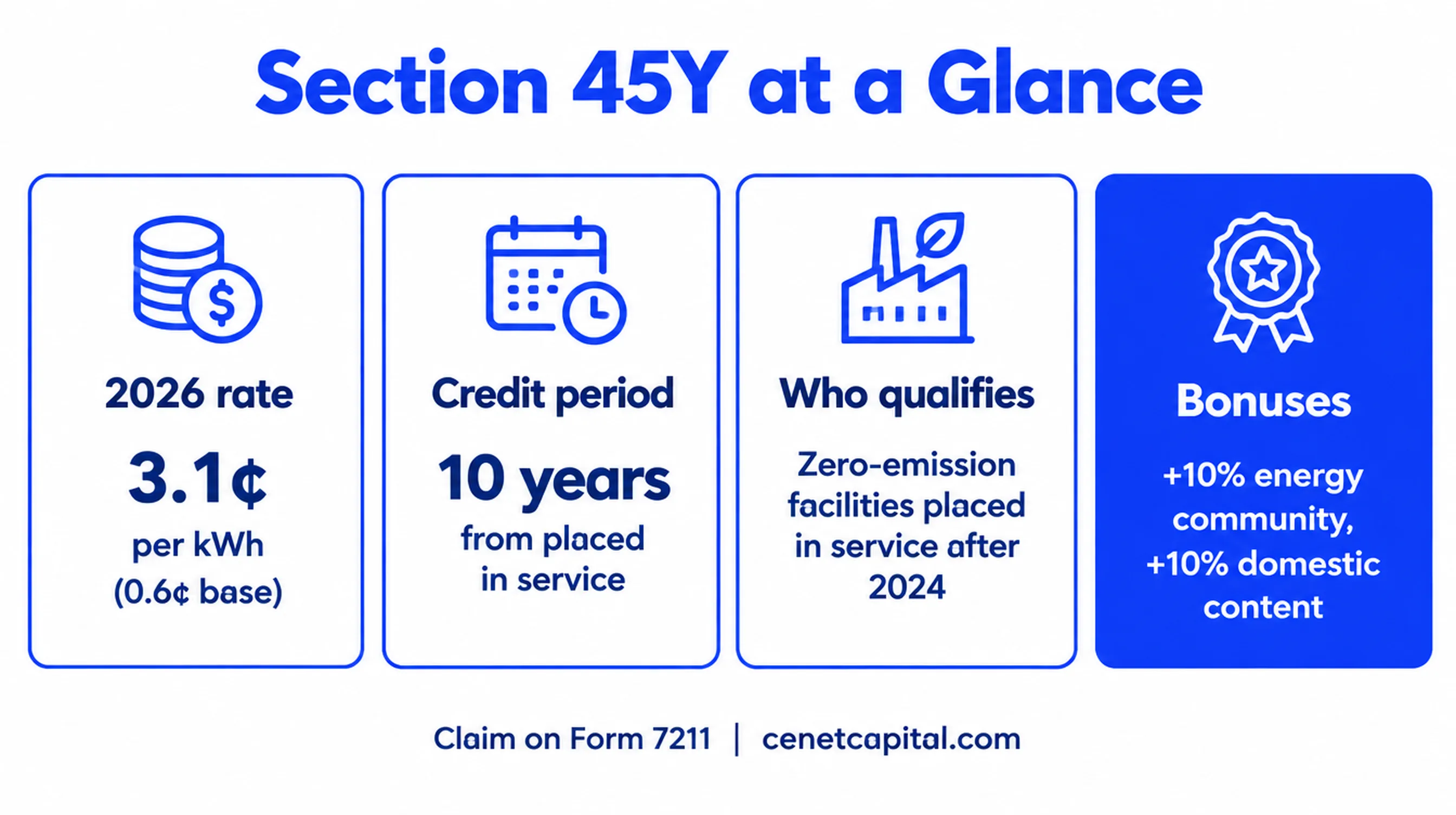
Who qualifies: Any generating facility placed in service after 2024 with a greenhouse gas emissions rate of zero or less, including wind, solar, hydro, geothermal and nuclear.
2026 rate: 3.1 cents per kWh at the full rate and 0.6 cents at the base rate; energy community and domestic content bonuses each add 10%.
45 vs. 45Y: Section 45 covers named renewables that began construction before 2025; 45Y is technology-neutral and pays the same rate.
45Y vs. 48E: The production credit usually wins for large, low-cost, high-output projects; the 48E investment credit wins for smaller or costlier ones.
OBBBA deadlines: Wind and solar must begin construction by July 4, 2026 or be in service by the end of 2027; hydro, geothermal, nuclear and storage keep the full credit through 2033.
What is the Section 45Y tax credit?
Section 45Y, the clean electricity production credit, is a federal tax credit paid for each kilowatt-hour of electricity a zero-emission facility produces and sells, for 10 years after the facility is placed in service. For 2026 it’s worth 3.1 cents per kWh for projects that meet prevailing wage and apprenticeship requirements and 0.6 cents per kWh for those that don’t. It’s the technology-neutral successor to the legacy Section 45 production tax credit and applies to facilities placed in service after 2024. Any technology qualifies if its greenhouse gas emissions rate is zero or less.
45Y was created by the Inflation Reduction Act, implemented in final regulations published January 15, 2025, and amended by the One Big Beautiful Bill Act in July 2025. The IRS set the 2026 rates using an inflation adjustment factor of 2.0570, published in the Federal Register on September 4, 2026. For a broader introduction to production credits, see our production tax credit guide.
Which facilities qualify for 45Y?
Any facility that generates electricity, is placed in service after 2024, and has a greenhouse gas emissions rate of zero or less. Wind, solar, hydropower, marine and hydrokinetic, geothermal and nuclear (fission and fusion) are treated as zero-emission automatically under the final regulations. Treasury publishes an annual table of qualifying technology categories, the first in Revenue Procedure 2025-14.
Non-combustion technologies on the list qualify without a lifecycle analysis.
Combustion and gasification facilities, such as those burning biomass or renewable natural gas, must show through a lifecycle analysis that net emissions are zero or below. That’s a high bar, and few such facilities qualify.
Expansions and new units at existing facilities qualify to the extent of the incremental capacity.
Sale requirement: the electricity must be sold to an unrelated person (or, in limited cases, metered and consumed), and measured accurately.
A facility can’t claim 45Y if it, or a prior owner, has claimed the investment tax credit (48 or 48E), legacy 45, 45J, 45Q or 45U for it. Energy storage doesn’t generate electricity and so can only use the 48E investment credit.
How much is the 45Y credit in 2026?
3.1 cents per kWh at the full rate and 0.6 cents per kWh at the base rate, with the energy community and domestic content bonuses each adding 10% to the credit.
2026 45Y rate | Per kWh | Per MWh |
|---|---|---|
Base rate | 0.6¢ | $6.00 |
Full rate (PWA met, under 1 MW AC, or construction began before January 29, 2023) | 3.1¢ | $31.00 |
Full rate + one bonus | 3.41¢ | $34.10 |
Full rate + both bonuses | 3.72¢ | $37.20 |
The amounts are re-indexed every year, and each year’s output earns that year’s rate, so a facility’s credit per kWh generally rises over its 10-year credit period. The credit is claimed on Form 7211 and carried to Form 3800.
What’s the difference between Section 45 and Section 45Y?
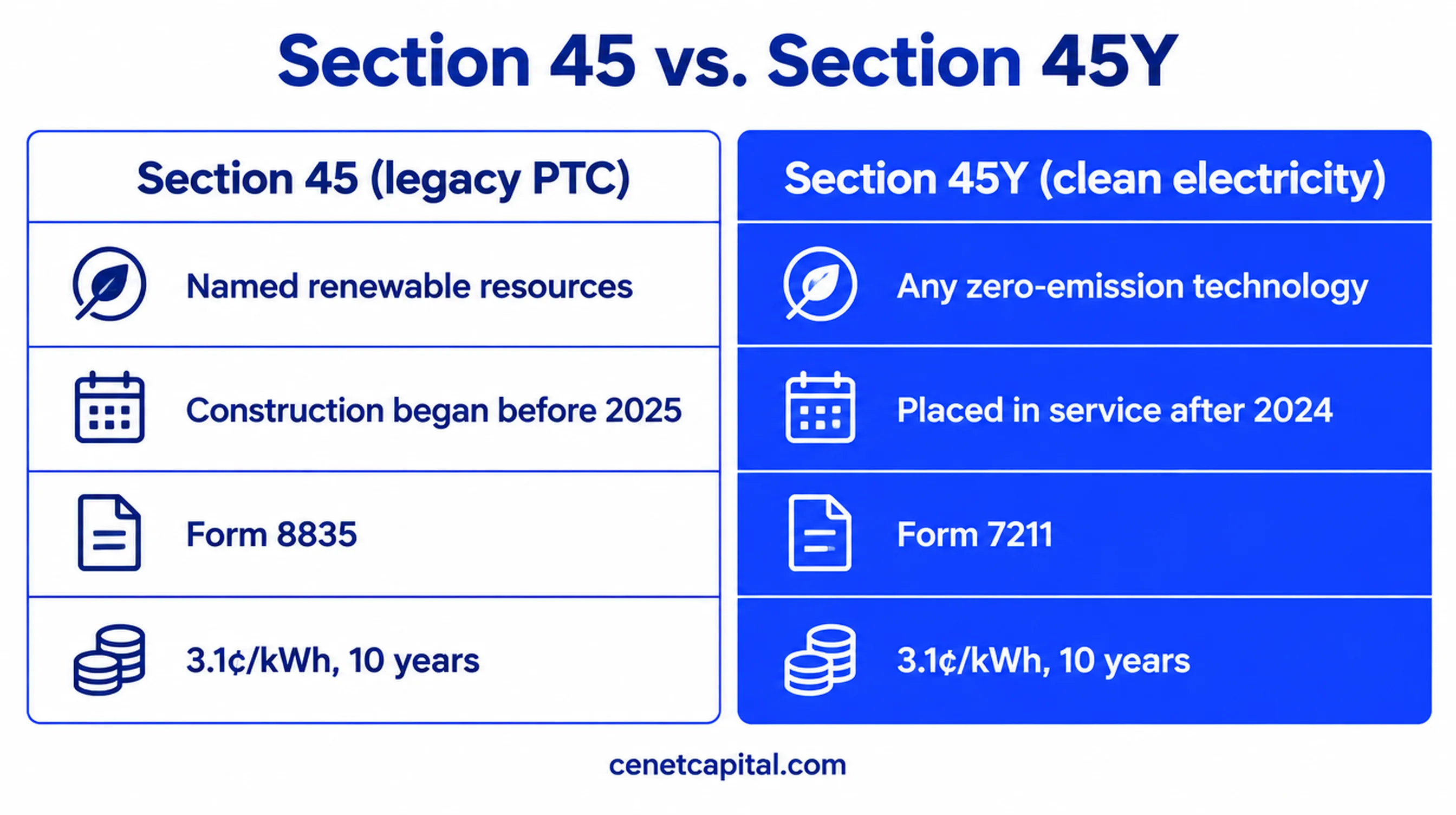
Section 45 lists specific renewable resources and covers facilities that began construction before 2025; Section 45Y is technology-neutral and covers zero-emission facilities placed in service after 2024. The rates are the same.
Section 45 (legacy PTC) | Section 45Y (clean electricity PTC) | |
|---|---|---|
Eligibility | Named resources (wind, solar, geothermal, biomass, hydro and others) | Any technology with zero or negative emissions |
Timing | Construction began before 2025 | Placed in service after 2024 |
2026 full rate | 3.1¢/kWh (most resources) | 3.1¢/kWh |
Credit period | 10 years | 10 years |
Form | Form 8835 | Form 7211 |
Foreign-entity rules | Taxpayer rules | Taxpayer rules plus material assistance for construction after 2025 |
Should a project claim 45Y or the 48E investment credit?
It comes down to output versus cost. The 45Y production credit tends to win for large, low-cost, high-output projects; the 48E investment credit tends to win for smaller, higher-cost or lower-output projects. A facility claims one or the other, never both, so owners compare the present value of 10 years of 45Y credits with the up-front 48E credit.
Example: a 100 MW solar farm in Texas at a 27% capacity factor produces about 236,500 MWh a year, roughly $7.3 million of 45Y credits at $31 per MWh, or $73 million over 10 years undiscounted. If the project costs $110 million, a 30% ITC is $33 million up front. Discounted at 8%, the 45Y stream is worth about $49 million, so 45Y wins comfortably. If the same project cost $160 million and ran at a 20% capacity factor, the comparison flips. Use the breakeven calculator below to test your own project.
45Y or 48E: which credit is worth more for your project?
Illustrative only. Assumes prevailing wage and apprenticeship are met, credits are used or sold at the same price, and full output is sold. Ignores ITC basis reduction, recapture and production risk. Storage can only use 48E.
Price my credits →How does 45Y work for nuclear, geothermal and hydro?
These technologies are where 45Y has the longest runway: they keep the full credit for construction beginning through 2033, and their high capacity factors make the production credit especially valuable. A geothermal plant running at 90% of capacity produces more than three times the electricity per megawatt of a solar farm, so 10 years of 45Y credits can easily exceed what an investment credit would pay. New nuclear capacity, including uprates and new units at existing sites, can qualify for 45Y on the incremental output. Existing nuclear plants that don’t add capacity use a separate credit, Section 45U, through 2032.
50 MW facility | Capacity factor | Annual output | Annual 45Y at 3.1¢ |
|---|---|---|---|
Solar | 25% | 109,500 MWh | $3.4M |
Wind | 35% | 153,300 MWh | $4.8M |
Hydropower | 45% | 197,100 MWh | $6.1M |
Geothermal | 90% | 394,200 MWh | $12.2M |
Can tax-exempt organizations use 45Y?
Yes. Public power utilities, rural electric cooperatives, municipalities, tribes and nonprofits can take 45Y as an elective (direct) payment from the IRS each year of the credit period. For facilities of 1 MW or more, the payment is reduced or eliminated if the facility doesn’t meet domestic content requirements, unless an exception applies; for construction starting after 2025, the reduction is total. That makes our domestic content guide essential reading for public power projects. Elective pay requires IRS pre-filing registration each year, just like a credit sale.
What did the One Big Beautiful Bill change for 45Y?
It added technology-specific deadlines and foreign-entity rules but kept the rates, the 10-year period and transferability.
Wind and solar: must have begun construction by July 4, 2026, or be placed in service by December 31, 2027.
Other zero-emission technologies: full credit for construction beginning through 2033, 75% in 2034, 50% in 2035, and none after.
Foreign entities: prohibited foreign entities can’t claim 45Y, and facilities starting construction after 2025 must meet the material assistance threshold (40% non-prohibited content in 2026, rising to 60% by 2030). See our FEOC rules guide.
Transfers: 45Y credits can’t be sold to a specified foreign entity.
Every deadline across all credits is in our One Big Beautiful Bill guide.
Can you sell 45Y credits?
Yes, one year at a time or as multi-year “strips.” Production credits generally sell for more than investment credits because there’s no recapture risk, though Crux has reported that the newer tech-neutral 45Y and 48E credits trade at a measurable discount to legacy 45 and 48 credits while the market gets comfortable with them. Early-2026 production credit pricing averaged about 91.7 cents per dollar across the market, according to Crux. Buyers focus on production history or forecasts, metering, offtake contracts, beginning-of-construction support and, for 2026 starts, the foreign-entity analysis. A credit must be registered with the IRS each year it’s sold. See our market report for current pricing.
45Y compliance checklist
Confirm the technology is on Treasury’s zero-emission table, or complete a lifecycle analysis.
Document the beginning-of-construction date and, for wind and solar, the July 4, 2026 analysis.
Track prevailing wages and apprentices during construction and for any alteration or repair during the 10-year period.
Install revenue-grade metering and keep sale records to unrelated buyers.
Run the material assistance calculation for construction starting after 2025.
Register each year you plan to sell or take elective pay, and file Form 7211.
Sources
IRS, 2026 inflation adjustment factor and applicable amounts for 45Y
Treasury, final 45Y/48E regulations (January 15, 2025)
Congressional Research Service, Technology-neutral clean electricity tax credits under the IRA and OBBBA
Crux, Q1 2026 market update
Frequently Asked Questions
How much is the 45Y tax credit worth in 2026?
3.1 cents per kilowatt-hour for facilities that meet prevailing wage and apprenticeship requirements (or are under 1 MW), and 0.6 cents otherwise. Energy community and domestic content bonuses each add 10%, so the top 2026 rate is about 3.7 cents.
What form is used to claim the 45Y credit?
Can solar projects claim 45Y instead of the investment credit?
Can 45Y credits be transferred?
Can Cenet Capital buy or insure 45Y credits?
Sell ten years of 45Y credits in one deal.
Cenet Capital buys 45Y production credits year by year or as multi-year strips, so you can lock in pricing before the first kilowatt-hour. Tell us about your project.

More Insights