

ITC vs. PTC: how the credits compare, the breakeven capacity factor rule of thumb, worked examples for solar, wind and geothermal, and a calculator for your project.
Author -
Paulestini Francois
Published -
READ TIME
Every new clean electricity project has to make the same irreversible choice: take the investment tax credit up front or the production tax credit over 10 years. The wrong pick can leave tens of millions of dollars on the table for a utility-scale project. Here's how the ITC and PTC compare, the breakeven capacity factor that decides most cases, worked examples for solar, wind and geothermal, the non-math factors that tip close calls, and a calculator to find the answer for your own project.
QUICK ANSWER
Claim the PTC if your project produces a lot of power relative to its cost, and the ITC if it's expensive, small or lower-output. With a 30% ITC and the 2026 PTC of 3.1 cents per kWh, the PTC wins when capacity factor (%) exceeds about 15 times installed cost in $/W, assuming an 8% discount rate.
KEY FACTS
Core difference: The ITC pays 30% of eligible cost once; the PTC pays 3.1 cents per kWh in 2026 for 10 years, adjusted for inflation.
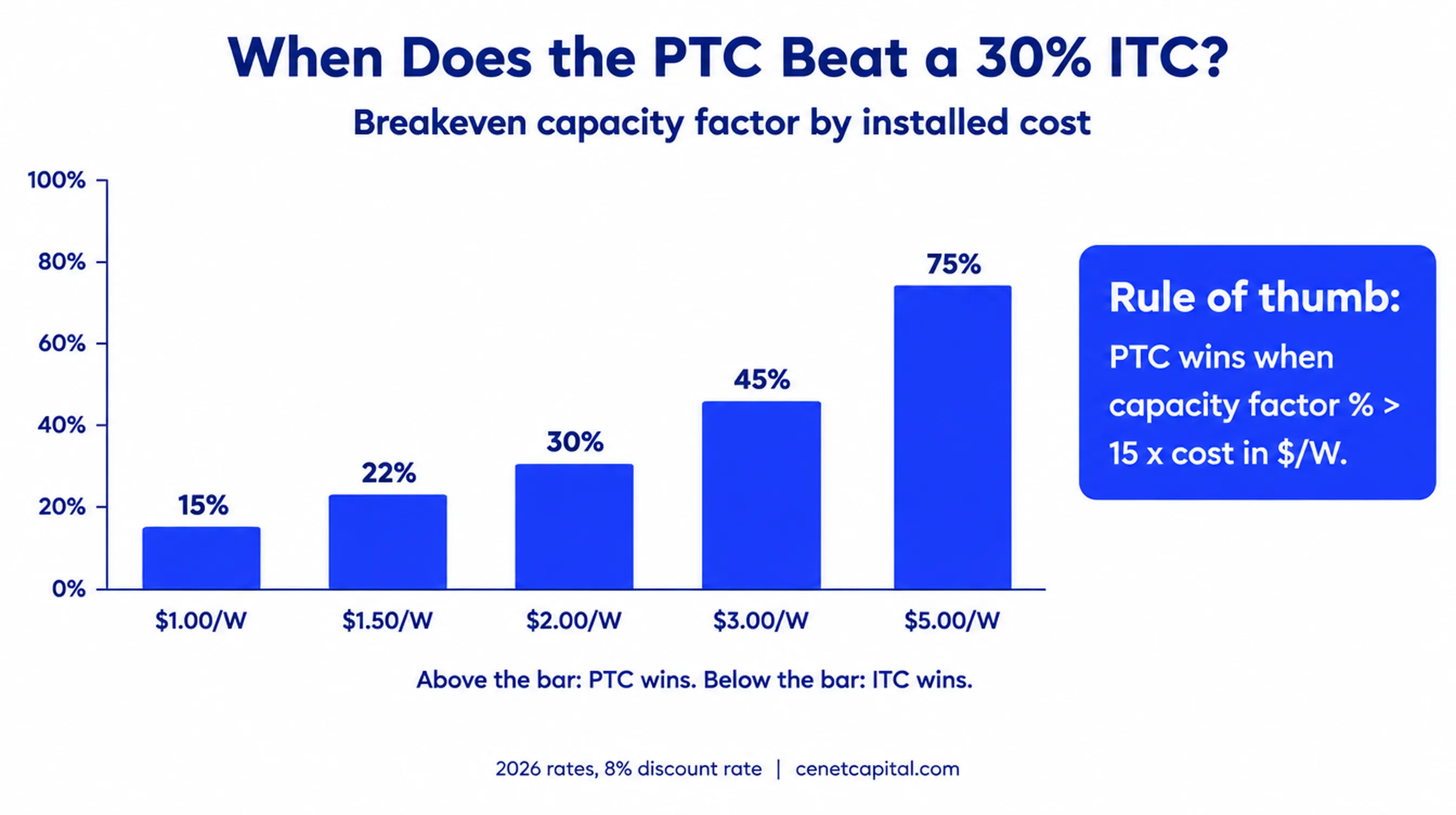
Breakeven: About 15% capacity factor at $1.00/W, 30% at $2.00/W and 75% at $5.00/W with no bonus adders.
Bonuses favor the ITC: Each adder lifts a 30% ITC by a third but the PTC by only a tenth, raising the breakeven to about 21× cost with two adders.
Typical winners: PTC for utility solar with trackers, onshore wind and geothermal; ITC for storage, commercial solar and high-cost projects.
Pricing and risk: PTCs sold for about $0.917 per dollar in early 2026 vs. $0.895 for ITCs, reflecting the ITC's 5-year recapture risk.
Should a project claim the ITC or the PTC?
Claim the production tax credit (PTC) if the project produces a lot of electricity relative to what it costs to build; claim the investment tax credit (ITC) if it’s expensive, small or produces less. A useful rule of thumb: with a 30% ITC and the 2026 PTC rate of 3.1 cents per kWh, the PTC wins when the project’s capacity factor (in percent) is above about 15 times its installed cost in dollars per watt. A $1.10/W solar project breaks even at about a 16% capacity factor, so a tracking system at 27% is better off with the PTC. A $5/W geothermal plant needs about 75%, which most geothermal plants exceed.
The two credits are alternatives: a facility claims one or the other, never both. Since 2025 the choice is between Section 48E (the technology-neutral ITC) and Section 45Y (the technology-neutral PTC) for most new projects, though projects that began construction before 2025 can still use legacy Sections 48 and 45. The math works the same way under both sets of rules.
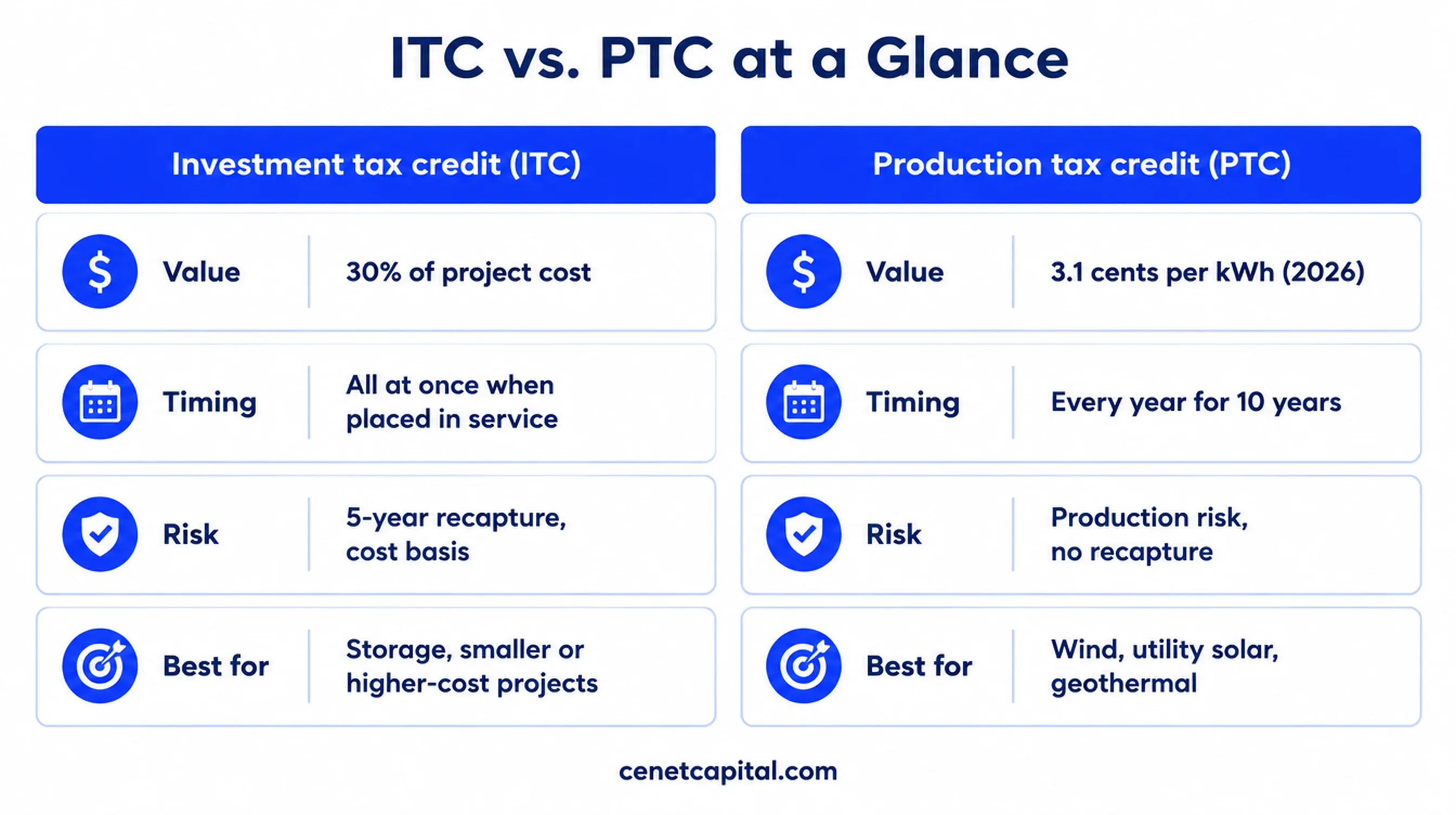
How do the ITC and PTC compare?
The ITC pays a percentage of what you spend, once; the PTC pays for what you produce, every year for 10 years. That difference drives everything else.
Investment tax credit (48 / 48E) | Production tax credit (45 / 45Y) | |
|---|---|---|
Full rate | 30% of eligible cost | 3.1¢ per kWh in 2026, adjusted for inflation each year |
When it’s earned | The year the project is placed in service | Each year for 10 years, as power is sold |
Bonus adders | +10 points each (energy community, domestic content); low-income bonus of 10 or 20 points | +10% each (energy community, domestic content) |
Main risk | 5-year recapture; cost basis challenges | Production shortfalls (less sun, wind or uptime) |
Depreciation | Depreciable basis reduced by half the credit | No basis reduction |
Transfer price (2026 avg.) | ~$0.895 per $1 | ~$0.917 per $1 |
Energy storage | Eligible | Not eligible |
For the details of each credit, see our investment tax credit guide, Section 48E guide, production tax credit guide and Section 45Y guide.
What is the breakeven capacity factor?
It’s the capacity factor at which 10 years of production credits, discounted to today, are worth exactly the same as the up-front investment credit. Above it, the PTC wins; below it, the ITC wins. Capacity factor is the share of the year’s maximum possible output a project actually produces: utility-scale tracking solar typically runs about 25% to 30% (AC), commercial rooftop solar 15% to 18%, onshore wind 35% to 45%, and geothermal 80% to 90%.
Installed cost | Breakeven capacity factor (no bonuses) | With two bonus adders |
|---|---|---|
$1.00 per watt | 15% | 21% |
$1.50 per watt | 22% | 31% |
$2.00 per watt | 30% | 41% |
$3.00 per watt | 45% | 62% |
$5.00 per watt | 75% | 104% (ITC always wins) |
Assumptions: 2026 full rates (30% ITC, 3.1¢ PTC), an 8% discount rate and 2.5% annual inflation adjustments to the PTC rate. Notice that bonus adders raise the bar for the PTC. Each bonus adds a third to a 30% ITC (30% to 40%) but only a tenth to the PTC, so projects in energy communities or with domestic content tilt toward the ITC. Use the calculator below to find the breakeven for your own cost, output and bonuses.
Find your breakeven capacity factor
Illustrative only. 2026 full rates (30% ITC, 3.1¢/kWh PTC) with prevailing wage met, 10-year PTC with 2.5%/yr inflation adjustments. Ignores depreciation basis reduction, degradation and transfer price differences. Storage can only claim the ITC.
Price my credits →How does the choice work out for real projects?
Utility-scale wind, tracking solar and geothermal usually come out ahead with the PTC; storage, commercial solar and higher-cost projects usually come out ahead with the ITC. Illustrative 2026 examples, using the same assumptions as the table above:
Project | ITC (30%) | PTC, present value | Better choice |
|---|---|---|---|
100 MW tracking solar, $1.10/W, 27% CF | $33.0M | $54.3M | PTC |
100 MW onshore wind, $1.60/W, 38% CF | $48.0M | $76.4M | PTC |
50 MW geothermal, $5.00/W, 85% CF | $75.0M | $85.4M | PTC |
2 MW commercial solar, $1.77/W, 17% CF | $1.06M | $0.68M | ITC |
Battery storage | 30% of cost | Not eligible | ITC |
The nominal PTC numbers are larger still: the 100 MW solar project would earn about $82 million in credits over 10 years. But a dollar of credit in year 10 is worth less than a dollar today, which is why the comparison uses present value.
What else should affect the decision?
The capacity-factor math is the starting point; five other factors can tip a close call.
Depreciation: an ITC reduces the project’s depreciable basis by half the credit, about 15% of cost at a 30% ITC. At a 21% tax rate that’s roughly 3 cents of lost tax savings per dollar of cost, a point in the PTC’s favor.
Production risk: a PTC is only as good as the project’s output. New technologies, uncertain resource data or curtailment-prone grids favor the ITC’s certainty.
Recapture risk: an ITC can be partly clawed back if the project is sold or stops operating within five years. Buyers price this in, which is why ITCs trade about 2 cents lower than PTCs.
Cash timing: an ITC turns into cash in one transaction, which can repay construction debt. PTCs arrive over a decade, though they can be sold in advance as multi-year strips.
Financing structure: some tax equity investors and lenders prefer one credit over the other. See tax equity vs. transferability for how the credit choice interacts with financing.
When do you have to choose, and can you change it?
The choice is made on the tax return for the year the facility is placed in service, and it’s generally irrevocable for that facility. Because the decision can’t be undone, most developers run the comparison during financing, when cost and production estimates are firm, and confirm it before placed-in-service. A project can mix credits across separate facilities, for example, claiming the PTC on a solar array and the ITC on a co-located battery, which is common in solar-plus-storage projects.
Did the One Big Beautiful Bill change the ITC vs. PTC choice?
Not directly. The rates, the 10-year PTC period, the bonus adders and transferability are unchanged, and the new deadlines apply equally to both credits. Wind and solar projects must begin construction by July 4, 2026, or be placed in service by the end of 2027, whichever credit they claim. Storage, geothermal, hydro and nuclear keep both options through 2033. Foreign-entity rules also apply to both. Our OBBBA guide covers the deadlines in full.
Can you sell either credit?
Yes. Both the ITC and the PTC can be sold for cash under Section 6418. ITCs are sold once, after the project is placed in service or through a forward commitment. PTCs can be sold one year at a time or as a multi-year strip. PTCs averaged about $0.917 per dollar in early 2026 versus about $0.895 for ITCs, according to our tax credit transfer market report. That 2-cent gap is small next to the gaps in the table above, so the transfer price rarely decides the choice on its own, but it can settle a close call.
Sources
Cenet Capital analysis: present-value comparison at an 8% discount rate and 2.5% annual PTC inflation adjustment
Frequently Asked Questions
Is the ITC or PTC better for solar?
For utility-scale solar with single-axis trackers, usually the PTC: a 100 MW project at $1.10/W and a 27% capacity factor earns about $54 million in present-value PTCs vs. $33 million from a 30% ITC. Small commercial solar at lower capacity factors usually does better with the ITC.
Can a project claim both the ITC and the PTC?
Can energy storage claim the PTC?
When do you choose between the ITC and the PTC?
Can Cenet Capital buy both ITCs and PTCs?
Whichever credit you choose, we'll buy it.
Cenet Capital buys both investment and production tax credits, including multi-year PTC strips. Send us your project's cost and output estimates and we'll price both options.

More Insights