The commercial solar tax credit is 30% or more of system cost in 2026. Real net cost at $1.77/W, who qualifies, the 2026–2027 deadlines, and how to claim or sell it.
Author -
Paulestini Francois
Published -
READ TIME
For a business installing solar, the federal tax credit is the single biggest factor in the economics: 30% of the system's cost, or more with bonuses, often cutting the real price roughly in half once depreciation is included. But the window is closing for new projects. Here's how the commercial solar tax credit works in 2026, what a system really costs after incentives, who can claim it, the deadlines, and how to claim or sell the credit.
How much is the commercial solar tax credit?
The commercial solar tax credit is a federal investment tax credit of 30% of a system’s eligible cost for projects that meet prevailing wage and apprenticeship rules or are under 1 MW AC, with bonus adders that can raise it to 40%, 50% or more. On a typical 500 kW rooftop system costing about $885,000, the base credit is about $265,000. For systems placed in service after 2024, the credit is claimed under Section 48E, the clean electricity investment credit. Businesses that can’t use the credit can sell it for cash.
The big change for 2026 is timing. Under the One Big Beautiful Bill Act, solar projects that didn’t begin construction by July 4, 2026 must be placed in service by December 31, 2027 to qualify. This guide covers the rate, the real 2026 math, who qualifies, the deadlines, and how to claim or sell the credit. For eligibility details, see our earlier guide, does your commercial solar project qualify?
What does commercial solar cost after the tax credit in 2026?
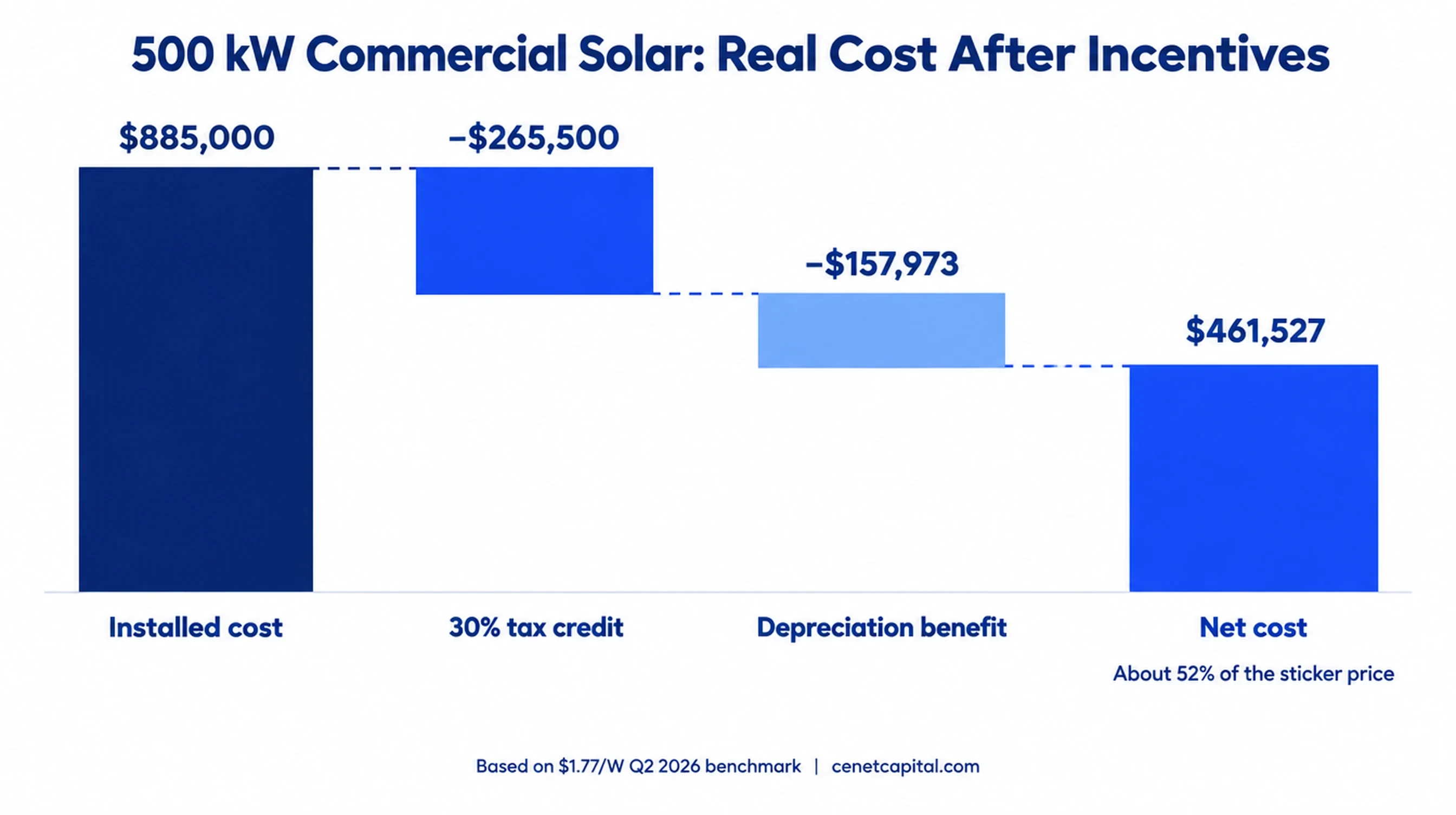
The national benchmark for commercial solar in the second quarter of 2026 was about $1.77 per watt (DC), up 5.6% from a year earlier, according to SEIA and Wood Mackenzie data reported by pv magazine. After a 30% credit and depreciation, a business’s net cost is often roughly half the sticker price.
500 kW commercial rooftop system | Amount |
|---|---|
Installed cost at $1.77/W | $885,000 |
30% investment tax credit | −$265,500 |
Federal depreciation benefit (21% × basis reduced by half the credit, undiscounted) | −$157,973 |
Approximate net cost | $461,527 (about 52% of cost) |
With energy community bonus (40% ITC) | Credit rises to $354,000 |
State incentives, utility rebates and the value of the electricity the system produces come on top. Module prices actually fell in 2026, but balance-of-system costs rose with tariffs on structural materials and higher transportation costs. Use the calculator below to estimate your project’s net cost and payback.
What will commercial solar really cost you?
Illustrative only. Default cost is the Q2 2026 U.S. commercial benchmark ($1.77/W, SEIA/Wood Mackenzie). Depreciation is a rough undiscounted federal estimate. Excludes state incentives and financing. Solar starting construction after July 4, 2026 must be placed in service by December 31, 2027.
Price your solar credit →Who can claim the commercial solar tax credit?
Whoever owns the system: a business, a landlord, a solar developer that leases or sells power to the business (third-party ownership), or a tax-exempt organization using elective pay.
Businesses that buy the system claim the credit directly, or sell it if they don’t have enough tax liability.
Third-party owners under a lease or power purchase agreement claim the credit and usually pass savings through in a lower price.
Nonprofits, schools, cities and churches can take the credit as a direct cash payment from the IRS. Systems of 1 MW or more face a domestic content requirement for full direct pay.
Partnerships and S corporations claim at the entity level and pass credits to owners, or sell them.
The system has to be new (original use begins with the owner), used in the U.S., and not used for lodging. Rooftop systems qualify; the roof itself does not, except for structural components that are integral to the solar property.
What are the commercial solar tax credit deadlines?
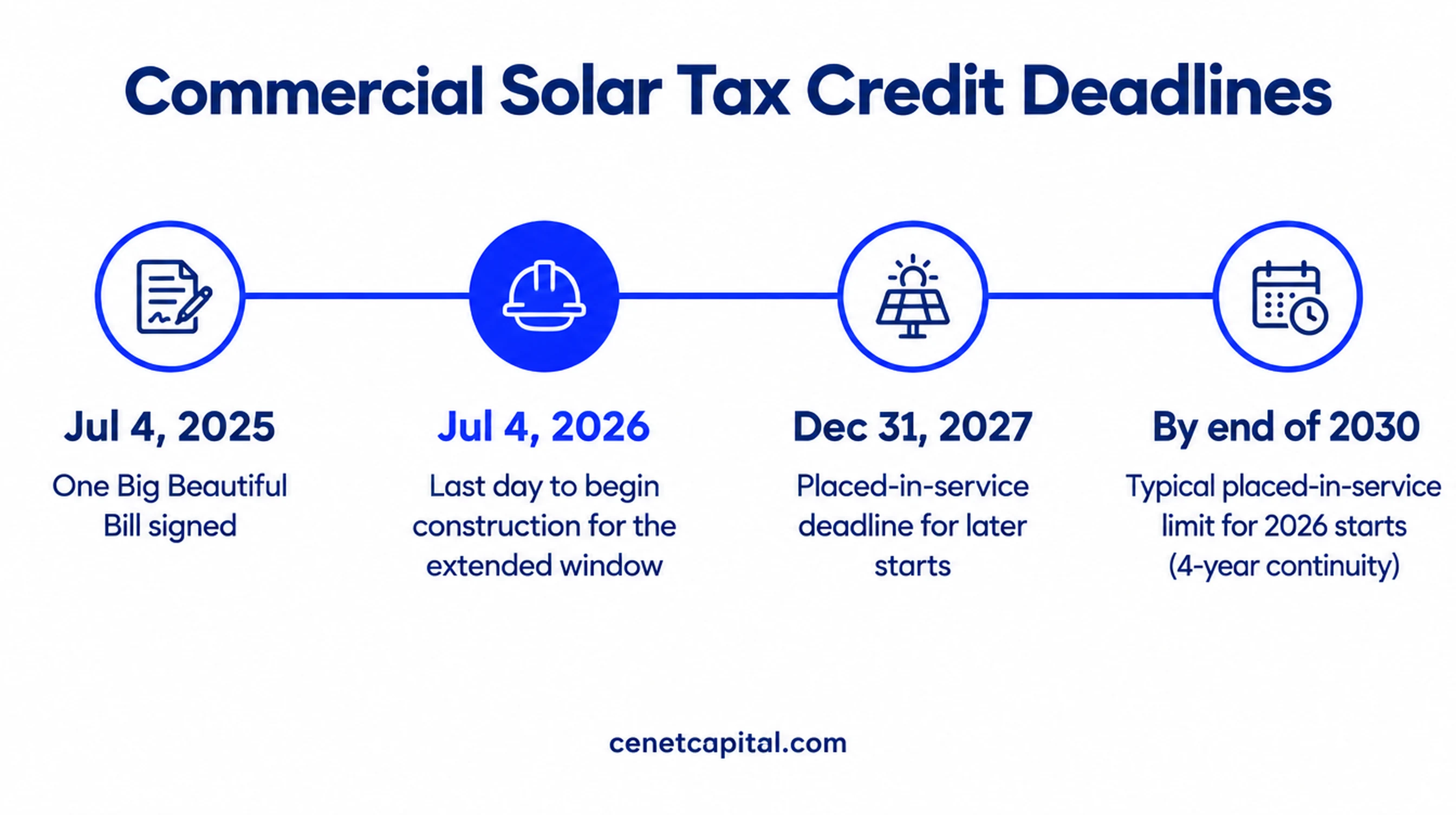
Solar projects that began construction on or before July 4, 2026 can still earn the full credit if placed in service within the four-year continuity window. Projects starting later must be placed in service by December 31, 2027.
Construction began | Must be placed in service | Credit |
|---|---|---|
On or before July 4, 2026 | Generally within 4 calendar years (e.g., by end of 2030 for a 2026 start) | Full 48E credit |
After July 4, 2026 | By December 31, 2027 | Full 48E credit |
After July 4, 2026 | After December 31, 2027 | No credit |
Smaller commercial systems had an advantage in proving the start of construction: even under IRS Notice 2025-42, which eliminated the 5% cost safe harbor for most solar, systems under 1.5 MW AC could still use it. A federal court vacated that notice on June 6, 2026, and an appeal is expected. For anything starting now, the practical deadline is placed in service by the end of 2027. Our One Big Beautiful Bill guide covers every deadline.
Which bonus adders can commercial solar get?
Energy community (+10 points): brownfields, coal closure areas and qualifying statistical areas. Check with our energy community map guide.
Domestic content (+10 points): U.S. steel and iron plus 50% U.S. manufactured products for 2026 construction starts.
Low-income communities (+10 or +20 points): systems under 5 MW AC in low-income areas, on tribal land, or serving affordable housing, with a Treasury allocation.
Systems under 1 MW AC get the 30% rate without having to meet prevailing wage and apprenticeship rules, which covers most rooftop and carport projects.
Is commercial solar still worth it in 2026?
For most businesses with good roof space or parking lots and meaningful daytime electricity use, yes, as long as the system can be placed in service by the end of 2027. A system costing $1.77 per watt that produces about 1,300 kWh per kW per year, offsetting electricity at 14 cents per kWh, saves about $182 per kW a year. After the credit and depreciation, net cost is roughly $0.92 per watt, which implies a simple payback of around five years before state incentives. In higher-rate states, payback can be shorter.
The deadline changes the calculus. A business that starts planning now has about 14 months to finish design, permitting, interconnection and installation. Interconnection queues are often the longest step. If a project can’t realistically reach placed-in-service by December 31, 2027, it should be modeled without the federal credit.
Can commercial solar use the production tax credit instead?
It can, but it rarely makes sense. The PTC pays 3.1 cents per kWh for 10 years. For a 500 kW system producing 650,000 kWh a year, that’s about $20,000 a year, or roughly $200,000 over a decade, less than the $265,000 a 30% ITC pays up front. The PTC wins only for large, very low-cost systems with high output, like utility-scale farms. Our PTC guide shows the comparison.
How do you claim the commercial solar tax credit?
File Form 3468, Part V (Section 48E), for the year the system is placed in service, carry the credit to Form 3800, and attach the required statements. Projects claiming bonus adders attach the domestic content certification or energy community support. Projects over 1 MW claiming 30% via PWA attach Form 7220. If you’ll sell the credit or take direct pay, register with the IRS first. See our step-by-step Form 3468 instructions.
Can you sell a commercial solar tax credit?
Yes, and it’s a common choice for businesses without enough federal tax liability. Commercial solar credits generally sell for 80 to 92 cents per dollar, with smaller deals at the lower end. A $265,000 credit sold at 87 cents brings in about $230,000 in cash, typically paid once the system is placed in service and the transfer closes. Small deals price lower because buyers spend similar diligence costs regardless of size; pooling several systems into one sale can improve pricing. Our guide to selling commercial solar tax credits covers the process, and tax credit pricing explains what moves the price.
Commercial solar tax credit checklist
Confirm the construction start date and the deadline that applies.
Get an itemized invoice separating eligible solar equipment from roofing and other ineligible costs.
Document size (AC) for the under-1 MW rule, or track PWA.
Check energy community and domestic content eligibility.
Decide early whether you’ll use, sell or take direct pay, and register if needed.
Keep the system in service for five years to avoid recapture.
Installing commercial solar and want cash for the credit? Cenet Capital buys, insures and finances commercial solar tax credits, including small projects and portfolios. Run the calculator above and send us your numbers.
Installing commercial solar? Turn the credit into cash.
Cenet Capital buys, insures and finances commercial solar tax credits, including small projects and portfolios. Send us your system details for pricing.

More Insights