

Prevailing wage and apprenticeship rules explained: the 5x multiplier, exemptions, 15% apprentice hours, good faith exception, cure penalties and a cost calculator.
Author -
Paulestini Francois
Published -
READ TIME
Four-fifths of most clean energy tax credits depend on two labor rules: paying prevailing wages and using registered apprentices. Miss them and a 30% investment credit drops to 6%. Meet them, and document that you met them, and the full credit is yours to claim or sell. Here's what the prevailing wage and apprenticeship (PWA) requirements demand under the IRS's final regulations, who is exempt, how to cure a failure, what records buyers will ask for, and a calculator to compare cure costs with the credit at stake.
QUICK ANSWER
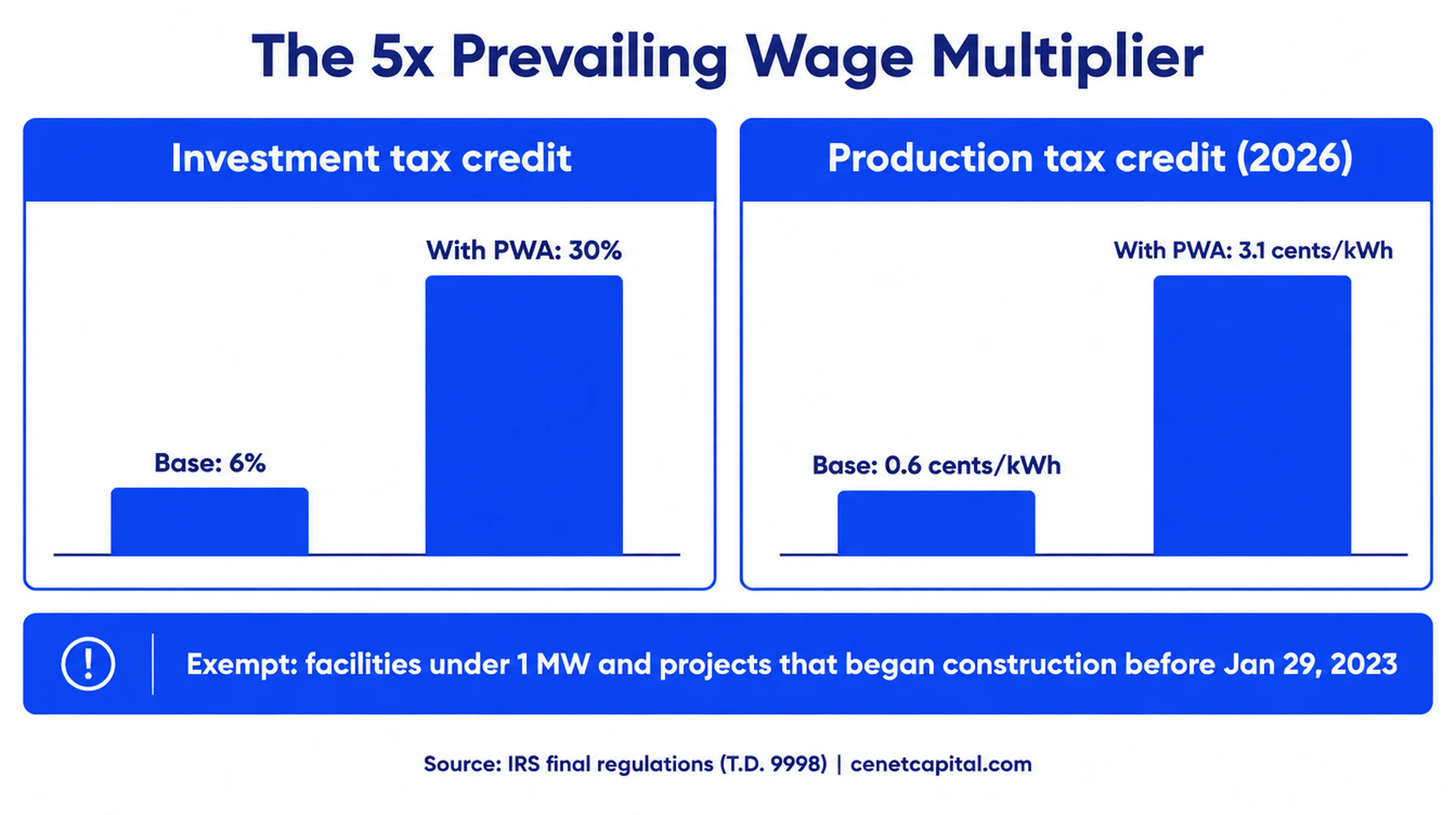
The prevailing wage and apprenticeship (PWA) requirements multiply most clean energy credits by five: a 6% ITC becomes 30%, and the 2026 PTC rises from 0.6 to 3.1 cents per kWh. Workers must be paid Davis-Bacon prevailing wages, and registered apprentices must perform 15% of construction labor hours for projects starting in 2024 or later.
KEY FACTS
Exemptions: Facilities under 1 MW (AC) and projects that began construction before January 29, 2023 get the full credit without meeting PWA.
Prevailing wage: Applies to all laborers and mechanics of the taxpayer, contractors and subcontractors during construction, plus alteration and repair for 5 years (ITC) or 10 years (PTC).
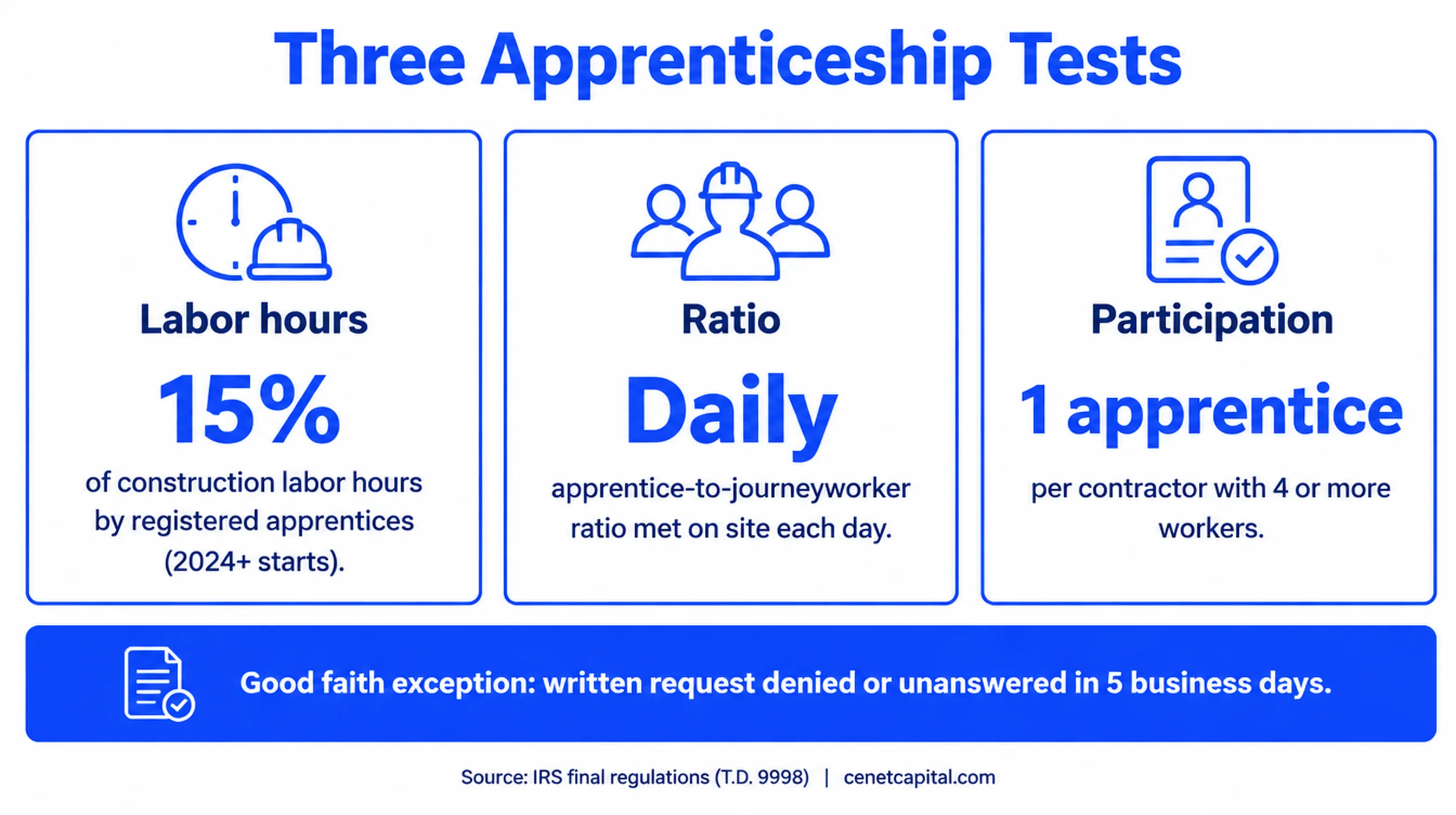
Apprenticeship: 15% of labor hours, daily apprentice-to-journeyworker ratios, and at least one apprentice per contractor with 4 or more workers.
Good faith exception: A written request to a registered program that is denied or unanswered within 5 business days satisfies the rule for 365 days.
Cure costs: Back pay plus interest and $5,000 per underpaid worker; $50 per short apprentice hour. Intentional disregard raises these to 3x, $10,000 and $500.
What are the prevailing wage and apprenticeship requirements?
The prevailing wage and apprenticeship (PWA) requirements are the labor rules a clean energy project must meet to earn the full value of most federal clean energy tax credits. Meeting them multiplies the base credit by five: a 6% investment tax credit becomes 30%, and a 0.6-cent production tax credit becomes 3.1 cents per kWh in 2026. There are two parts. Every laborer and mechanic working on construction, alteration or repair must be paid at least the local prevailing wage set by the Department of Labor. And a minimum share of construction labor hours, 15% for projects beginning construction in 2024 or later, must be performed by registered apprentices.
The rules come from the Inflation Reduction Act and the IRS’s final regulations (T.D. 9998), published June 25, 2024. The One Big Beautiful Bill Act of 2025 changed credit deadlines and added foreign-entity rules but left the PWA rules in place.
Which credits have prevailing wage requirements?
Nearly every major clean energy credit except the 45X manufacturing credit. The multiplier works the same way across them: the base amount is one-fifth of the full amount.
Credit | Base amount | With PWA |
|---|---|---|
Investment tax credit (48 / 48E) | 6% | 30% |
Production tax credit (45 / 45Y), 2026 | 0.6¢ per kWh | 3.1¢ per kWh |
Clean hydrogen (45V) | Up to $0.60 per kg | Up to $3.00 per kg |
Carbon capture (45Q) | $17 per ton (geologic storage) | $85 per ton |
Advanced energy project (48C) | 6% | 30% |
EV charging (30C), business property | 6% | 30% |
The bonus adders scale too. Without PWA, the domestic content and energy community bonuses add 2 percentage points to an investment credit instead of 10. See our investment tax credit guide and production tax credit guide for how the full rates stack.
Which projects are exempt?
Two groups get the full credit without meeting PWA: facilities with a maximum net output under 1 megawatt (AC), and projects that began construction before January 29, 2023. The 1 MW exemption is why most rooftop and small commercial solar projects never deal with these rules. It’s measured per facility, so splitting one project into several sub-1 MW pieces to dodge the requirements is a known audit target; the IRS can treat related units that operate together as a single facility.
How does the prevailing wage requirement work?
Every laborer and mechanic employed by the taxpayer, its contractors or its subcontractors must be paid at least the prevailing wage for their job classification in the project’s county, as published in a Davis-Bacon wage determination on SAM.gov. The wage includes fringe benefits, so a contractor can pay part of it as health or retirement contributions.
Which determination applies: the general wage determination in effect when the construction contract is signed, generally locked for that contract.
Missing classifications: if a needed trade isn’t listed, the taxpayer asks the Department of Labor for a supplemental determination.
How long it lasts: construction, plus any alteration or repair work during the 5-year recapture period for an investment credit or the 10-year credit period for a production credit. Routine maintenance isn’t covered.
Who it covers: on-site laborers and mechanics. Office staff, engineers and supervisors whose duties are mainly managerial aren’t covered.
What are the apprenticeship requirements?
There are three tests, and all three apply to construction, alteration and repair work.
Test | Requirement |
|---|---|
Labor hours | Qualified apprentices must perform 15% of total construction labor hours for projects beginning construction in 2024 or later (12.5% for 2023, 10% before 2023) |
Ratio | The apprentice-to-journeyworker ratio set by the registered apprenticeship program must be met each day on site |
Participation | Each contractor or subcontractor employing 4 or more people on the project must employ at least one qualified apprentice |
Apprentices must be enrolled in a registered apprenticeship program under the National Apprenticeship Act. Hours worked by a contractor’s regular employees who aren’t in a registered program don’t count, even if they’re early-career workers.
What if apprentices aren’t available?
The good faith effort exception treats the apprenticeship requirement as met if a taxpayer asks a registered program for apprentices in writing and the request is denied (for reasons other than the taxpayer’s own noncompliance) or goes unanswered for 5 business days. Under the final rules, one documented request covers 365 days from the date it’s made. The exception only covers the hours the program couldn’t supply, so a taxpayer that gets some apprentices must still use them. Keep copies of every request and response; they’re among the first documents a credit buyer’s diligence team will ask for.
What happens if you don’t comply?
You can usually still claim the full credit by curing the failure: pay workers what they were owed, with interest, and pay a penalty to the IRS. Cures are only available if the taxpayer fixes the problem; they can’t be waived by a buyer or insurer.
Failure | Cure | If intentional disregard |
|---|---|---|
Underpaid wages | Back pay plus interest at the federal short-term rate + 6 points, plus a $5,000 penalty per worker | 3x back pay plus interest, and $10,000 per worker |
Apprentice hours short | $50 per labor hour of shortfall | $500 per labor hour |
Penalties can be waived when underpayments are corrected quickly under the conditions in the regulations, or when the work was done under a qualifying project labor agreement. Consider a hypothetical 50 MW solar project with $55 million of eligible cost. The full ITC is $16.5 million and the base credit is $3.3 million, so $13.2 million rides on PWA. Suppose 12 electricians were underpaid $3,000 each, and apprentices worked 13.5% of 300,000 labor hours instead of 15%, a 4,500-hour shortfall. The cure is about $36,000 of back pay, $3,600 of interest, $60,000 in wage penalties and $225,000 in apprenticeship penalties: roughly $325,000 to protect $13.2 million. Use the calculator below to compare cure costs with the credit at stake for your project.
What does a PWA failure cost to fix, and what's at stake?
Illustrative only. Uses 15% apprentice hours (2024+ construction starts), 2026 PTC rates (3.1¢ full, 0.6¢ base) and ~10% interest for one year. Facilities under 1 MW and projects that began construction before January 29, 2023 are exempt. Penalty waivers may apply.
Review my PWA file →What records do you need to keep?
Certified payroll for every laborer and mechanic: name, classification, hours, wage rate and fringe benefits, for every contractor and subcontractor.
Wage determinations used for each contract, plus any supplemental determination requests.
Apprenticeship records: apprentice hours, daily ratios, program registration, and every request to a registered program.
Contract flow-down clauses requiring contractors to comply and deliver payroll.
Cure documentation, if any: correction payments, interest calculations and penalty payments.
The IRS expects these records to be kept for as long as the credit can be examined, and PWA compliance is reported on each credit’s form, such as Form 3468 for investment credits and Form 7211 for 45Y. Our Form 3468 instructions show where the PWA election sits for investment credits.
How does PWA affect selling your credit?
PWA is the largest single diligence item in most credit sales, because four-fifths of the credit’s value depends on it. Buyers review payroll samples, apprentice hour reports and good faith requests before closing, and they price in any gaps. Clean PWA files help a seller reach the top of the price range; missing records can cost several cents per dollar or stop a deal entirely. Tax credit insurance can cover PWA risk, but insurers underwrite the same records and often exclude known failures.
If you’re preparing to sell, see how to sell commercial solar tax credits for the full seller checklist and transferable tax credit pricing for how documentation moves price.
PWA compliance checklist
Confirm whether you’re exempt (under 1 MW AC, or construction began before January 29, 2023).
Pull the wage determination for the project county before signing construction contracts.
Flow PWA clauses down to every contractor and subcontractor, with payroll delivery deadlines.
Request apprentices in writing from registered programs before work starts, and renew within 365 days.
Track apprentice hours and daily ratios weekly, not at project end.
Audit payroll monthly and correct underpayments immediately to qualify for penalty relief.
Keep monitoring alteration and repair work for 5 or 10 years after placed in service.
Sources
Frequently Asked Questions
What happens if prevailing wage requirements are not met?
The credit drops to its base amount, one-fifth of the full value, unless the taxpayer cures the failure by paying workers the difference with interest at the federal short-term rate plus 6 points and paying the IRS a $5,000 penalty per affected worker.
Do projects under 1 MW have to meet prevailing wage requirements?
What percentage of labor hours must be performed by apprentices?
Where do prevailing wage rates come from?
Can Cenet Capital buy credits with PWA risk?
Clean PWA records are worth cents per dollar.
Cenet Capital reviews prevailing wage and apprenticeship files before closing, flags fixable gaps early and buys credits with PWA risk insured. Send us your project details.

More Insights