

Credit Guides
What energy attribute certificates must show for 45V, the 36-month rule, the 13 grid regions, hourly EACs from 2030, RECs vs EACs, and a qualification checker.
Author -
Paulestini Francois
Published -
READ TIME
For a green hydrogen producer, the 45V credit rides on paperwork as much as on electrolyzers. Energy attribute certificates are how you prove the power was clean, and the final rules spell out exactly which ones count. Here's what an EAC is, what each certificate must show, how the 36-month and same-region rules work, when you need hourly EACs, why most RECs don't qualify, and a checker to test your supply plan.
QUICK ANSWER
Energy attribute certificates (EACs) are tradeable certificates that each represent one MWh of electricity from a specific generator. For 45V, a hydrogen producer must retire qualifying EACs for its power, and each must pass three tests: a generator no more than 36 months older than the hydrogen facility, the same grid region, and matching by year until 2030 and by hour after.
KEY FACTS
What is an EAC? A tradeable certificate for one MWh of electricity, issued through a qualified EAC registry.
What makes a qualifying EAC? It passes incrementality, deliverability and temporal matching, and a qualified verifier confirms it.
What must an EAC registry do? Assign unique IDs, prevent double counting, retire each EAC once, identify owners and publish registered generators.
What is 45V deliverability? The generator must be in the same grid region as the hydrogen facility, or delivery must be shown hour by hour with transmission rights.
When are hourly EACs required? For electricity generated on or after January 1, 2030.
RECs vs EACs: do ordinary RECs count? Rarely. Most unbundled RECs come from older generators or other regions and carry only a vintage year.
What is an energy attribute certificate?
An energy attribute certificate (EAC) is a tradeable certificate that represents the environmental attributes of one megawatt-hour of electricity from a specific generator. For the 45V hydrogen credit, EACs are how a producer proves its electrolyzer ran on clean power instead of average grid electricity.
The 45V regulations define an EAC as “a tradeable contractual instrument, issued through a qualified EAC registry or accounting system,” in 26 CFR 1.45V-4(d)(2)(ii). Renewable energy certificates (RECs) are the best-known type. One MWh of electricity used to make hydrogen must be matched with one MWh of qualifying EACs.
Why do EACs matter for the 45V credit?
Without qualifying EACs, an electrolyzer’s power is counted at the regional grid’s average emissions, which on most U.S. grids puts hydrogen far above the 4 kg CO2e per kg limit. With them, the power is treated as coming from a specific clean generator, which can qualify for the top 45V rate of $3.28 per kg in 2026.
The rule lets a producer treat electricity as coming from a specific generator only if it “acquires and retires qualifying EACs” for each unit it claims, under section 1.45V-4(d)(1). Our article on green hydrogen and grid power shows why grid-average electricity fails: about 14.4 kg of CO2 per kg of hydrogen even at perfect efficiency.
What makes an EAC qualify for 45V?
A qualifying EAC is an eligible EAC that passes all three pillars: incrementality, deliverability and temporal matching. A qualified verifier must also confirm that it meets the rules. An eligible EAC comes from a generator registered on only one qualified registry and carries a minimum set of information.
Incrementality: the generator’s commercial operations date is “no more than 36 months before the hydrogen production facility” was placed in service.
Deliverability: the generator is in the same region as the hydrogen facility, or the power is shown to be delivered across regions.
Temporal matching: the same calendar year before 2030, and the same hour from January 1, 2030.
What information must each EAC contain?
Each eligible EAC must show the facility’s technology and feedstock, the amount of electricity, the generator’s commercial operations date, and when the power was generated: the calendar year before 2030, or the date and hour after 2029. It must also carry any data 45VH2-GREET needs, any carbon capture in-service date, and a project ID.
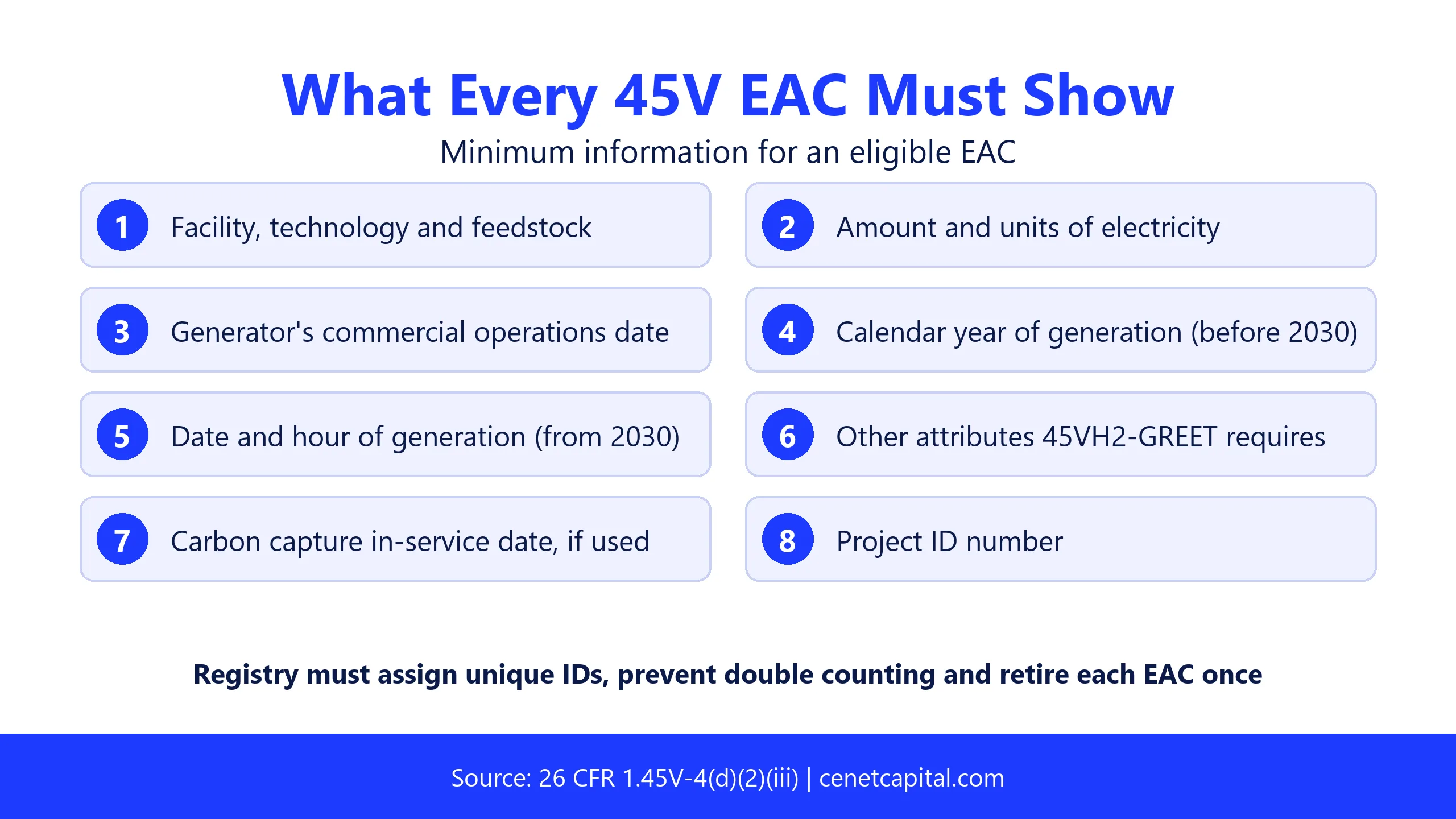
The registry has duties too. Under section 1.45V-4(d)(2)(viii), a qualified EAC registry or accounting system must assign each EAC a unique ID, make sure only one EAC exists for each unit of electricity, verify “that each EAC is claimed and retired only once,” identify each EAC’s owner, and give the public a view of all registered generators.
How does the 36-month incrementality rule work?
The generator must have started commercial operations no more than 36 months before the hydrogen facility is placed in service. A hydrogen plant placed in service in January 2028 can count EACs from generators that began operating in January 2025 or later. Older generators qualify only through an exception.
Qualifying states: both the generator and the hydrogen facility are in a state with a qualifying clean electricity standard and greenhouse gas cap. Treasury has said California and Washington qualify.
Nuclear: up to 200 MWh of electricity per operating hour per qualifying reactor can count, with a physical connection or a binding contract of at least 10 years.
Uprates and carbon capture: only the added capacity counts, or carbon capture placed in service within the same 36-month window.
What counts as the same region for 45V?
Regions are set by balancing authority, not by map location. The rules use 13 regions in the lower 48 states, from California and Texas (ERCOT) to New England and the Southeast, and treat Alaska, Hawaii and each U.S. territory as separate regions. Power from another region counts only with proof of delivery.
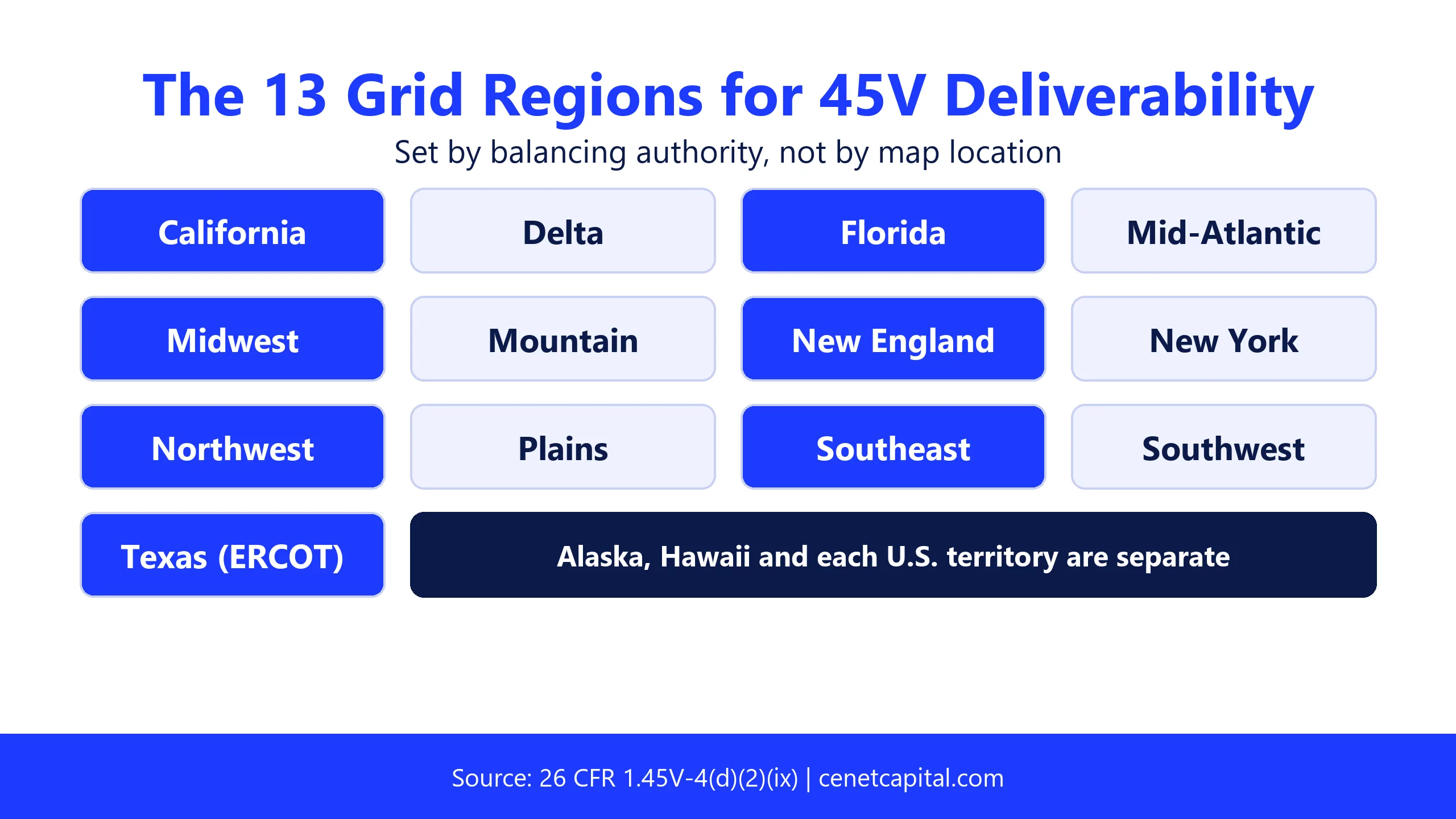
Interregional power needs transmission rights from the generator to the hydrogen facility’s region. It must also be “scheduled and dispatched or settled in” that region, shown “on at least an hour-to-hour basis,” and verified with NERC E-tags or the equivalent, under section 1.45V-4(d)(3)(iii)(B). For example, PJM is in the Mid-Atlantic region and SPP is in the Plains region.
When do you need hourly EACs?
For electricity generated on or after January 1, 2030. Until then, an EAC only has to match the calendar year the hydrogen was made. After that, each EAC must show the date and hour of generation and match the hour the electrolyzer used power, which makes hourly EACs a must for any project running past 2029.
Treasury’s final rules extended annual matching two years beyond the proposal, with “hourly matching required starting in 2030 for all facilities,” according to the Treasury announcement. Because 45V runs for 10 years, nearly every project will spend most of its credit period under hourly matching. Storage can shift power across hours if it’s in the same region and its losses are counted.
What’s the difference between RECs and EACs for 45V?
A REC is one kind of EAC, but most RECs traded today won’t qualify for 45V on their own. Typical unbundled RECs come from older wind and solar farms, carry only a vintage year, and often come from another region. 45V needs certificates from new generators in the same region, with hourly time stamps after 2029.
That makes the RECs vs EACs choice mostly about sourcing. Many producers sign power purchase agreements with new projects and take the EACs with the power, instead of buying unbundled RECs on the open market. Use the checker below to see whether a supply plan passes all three pillars.
Will your EACs count for the 45V credit?
Illustrative only, based on 26 CFR 1.45V-4(d). EACs must also come from a qualified registry, be retired by or for the owner, and be checked by a qualified verifier.
Review my 45V power plan →How do EACs affect selling a 45V credit?
Buyers of 45V credits check EAC records closely, because a certificate that fails any pillar can push the emissions rate into a lower tier or above 4 kg, cutting or erasing the credit. Expect a buyer to ask for retirement records, registry statements, generator in-service dates and the verifier’s report before closing.
Weak EAC documentation usually shows up as a lower price or a demand for tax credit insurance. Our guides to monetizing a 45V credit and tax credit insurance explain how buyers price that risk, and our 45V rules guide covers the rest of the credit’s requirements.
Sources
Legal Information Institute, 26 CFR 1.45V-4, Lifecycle greenhouse gas emissions rate
U.S. Department of the Treasury, Final rules for the clean hydrogen production tax credit (January 2025)
Legal Information Institute, 26 U.S. Code 45V, Credit for production of clean hydrogen
Frequently Asked Questions
What is an energy attribute certificate for 45V?
A tradeable contractual instrument, issued through a qualified EAC registry or accounting system, that represents the attributes of one MWh of electricity from a specific generator. 45V producers retire EACs to show their electrolyzer used clean power instead of average grid electricity.
What makes an EAC qualify for the 45V credit?
What is the 36-month rule for 45V EACs?
When do 45V EACs have to be hourly?
Does Cenet Capital buy 45V credits backed by EACs?
Sure your EACs pass all three pillars?
A failed certificate can cut a 45V credit to zero. Cenet Capital reviews EAC sourcing, retirement records and verifier reports before buying or insuring 45V credits. Send us your power plan for a review.

More Insights