
Credit Guides
Why green hydrogen on grid power fails 45V, how the three pillars and EACs work, what the credit pays in 2026, the 2030 hourly rule, and an emissions calculator.
Author -
Paulestini Francois
Published -
READ TIME
Green hydrogen sounds clean by definition, but under the federal 45V tax credit, an electrolyzer is only as clean as the electricity feeding it. Plug one into the average U.S. grid and the hydrogen fails the test by a wide margin. Here's why, how producers prove clean power with the three pillars and certificates, what the green hydrogen tax credit is worth in 2026, what changes in 2030, and a calculator to check your own power mix.
QUICK ANSWER
Green hydrogen doesn't automatically qualify for the 45V credit. An electrolyzer on average U.S. grid power produces about 14.4 kg of CO2 per kg of hydrogen even at perfect efficiency, far above the 4 kg limit. It qualifies only when clean power is proven with energy attribute certificates that meet the three pillars.
KEY FACTS
Is green hydrogen automatically eligible for the green hydrogen tax credit? No. Grid-average power puts hydrogen far above the 45V limit of 4 kg CO2e per kg.
Why does a grid-connected electrolyzer fail? At 0.366 kg of CO2 per kWh (EIA, 2023) and at least 39.4 kWh per kg, grid hydrogen is about 14.4 kg CO2 per kg.
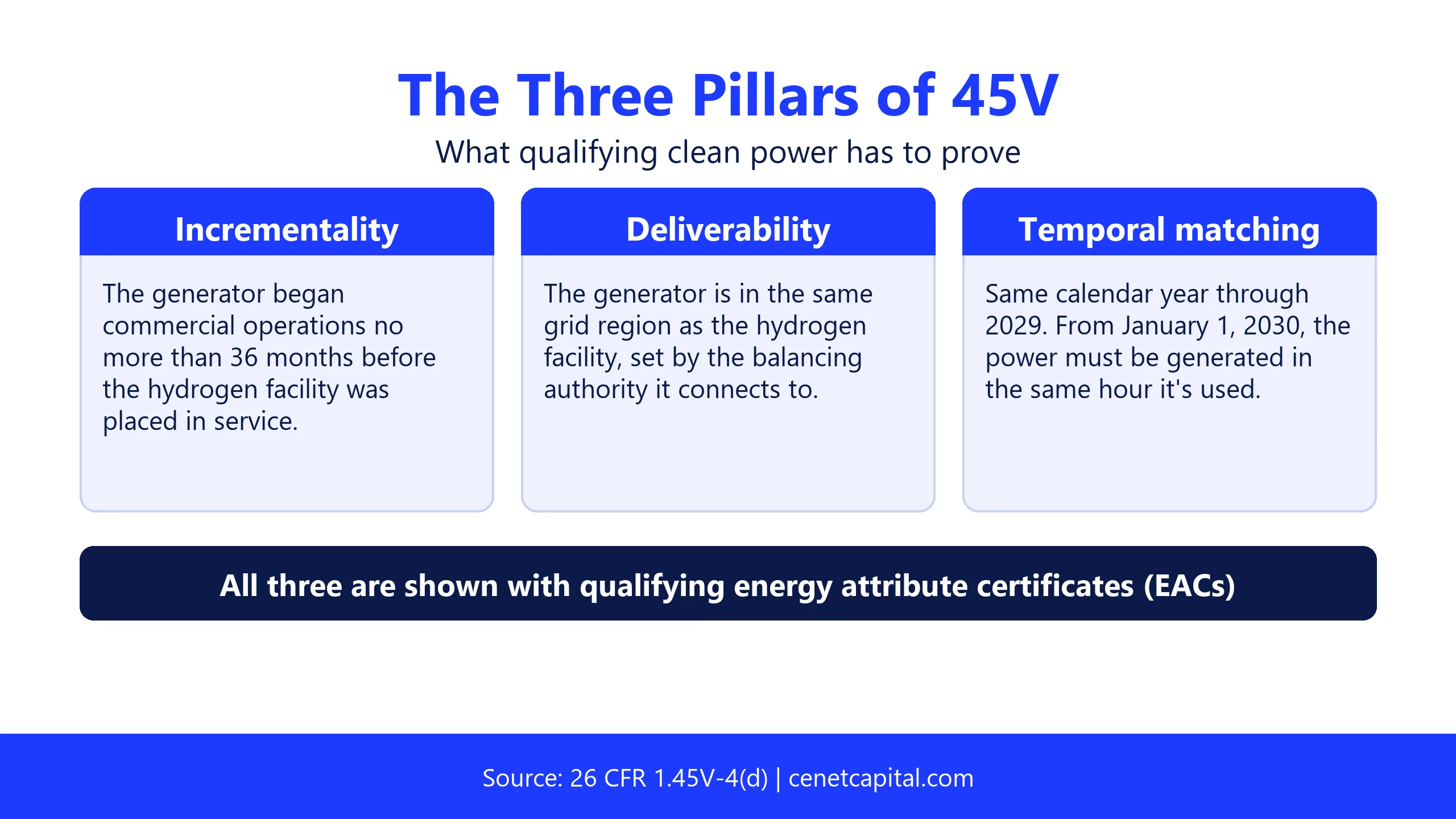
What are the 45V three pillars? Incrementality (36 months), deliverability (same grid region) and temporal matching (annual through 2029, hourly from 2030).
What is the green hydrogen production tax credit worth? Up to $3.28 per kg in 2026 for the cleanest tier with prevailing wage, for 10 years.
What's the deadline? Construction must begin before January 1, 2028.
What is green hydrogen?
Green hydrogen is hydrogen made by splitting water in an electrolyzer powered by renewable or other clean electricity, so making this electrolytic hydrogen emits no carbon dioxide on site. “Green” is a marketing label, though. For the 45V tax credit, what counts is the lifecycle emissions rate, and that depends almost entirely on where the electricity comes from.
Green hydrogen is still a tiny slice of the market. Global hydrogen demand passed 100 million tonnes in 2025, and low-emissions production grew 20% that year to reach almost 1 million tonnes, according to the IEA’s Global Hydrogen Review 2026. Most of the rest is gray hydrogen made from natural gas, and our guide to blue hydrogen and 45V covers the version with carbon capture.
Does green hydrogen automatically qualify for the 45V tax credit?
No. An electrolyzer running on ordinary grid power fails the 45V test badly. At the U.S. average grid emissions rate, even a perfectly efficient electrolyzer would produce about 14.4 kg of CO2 per kg of hydrogen from electricity alone, more than three times the 4 kg limit. Green hydrogen only qualifies when the clean power is proven.
The math is simple. Making 1 kg of hydrogen takes at least 39.4 kWh of electricity, hydrogen’s energy content, and real electrolyzers use more. U.S. power plants emitted about 0.81 pounds (0.366 kg) of CO2 per kWh in 2023, according to the U.S. Energy Information Administration. Multiply the two and grid-powered hydrogen lands near 14.4 kg before counting upstream emissions, which DOE’s 45VH2-GREET model adds on top.
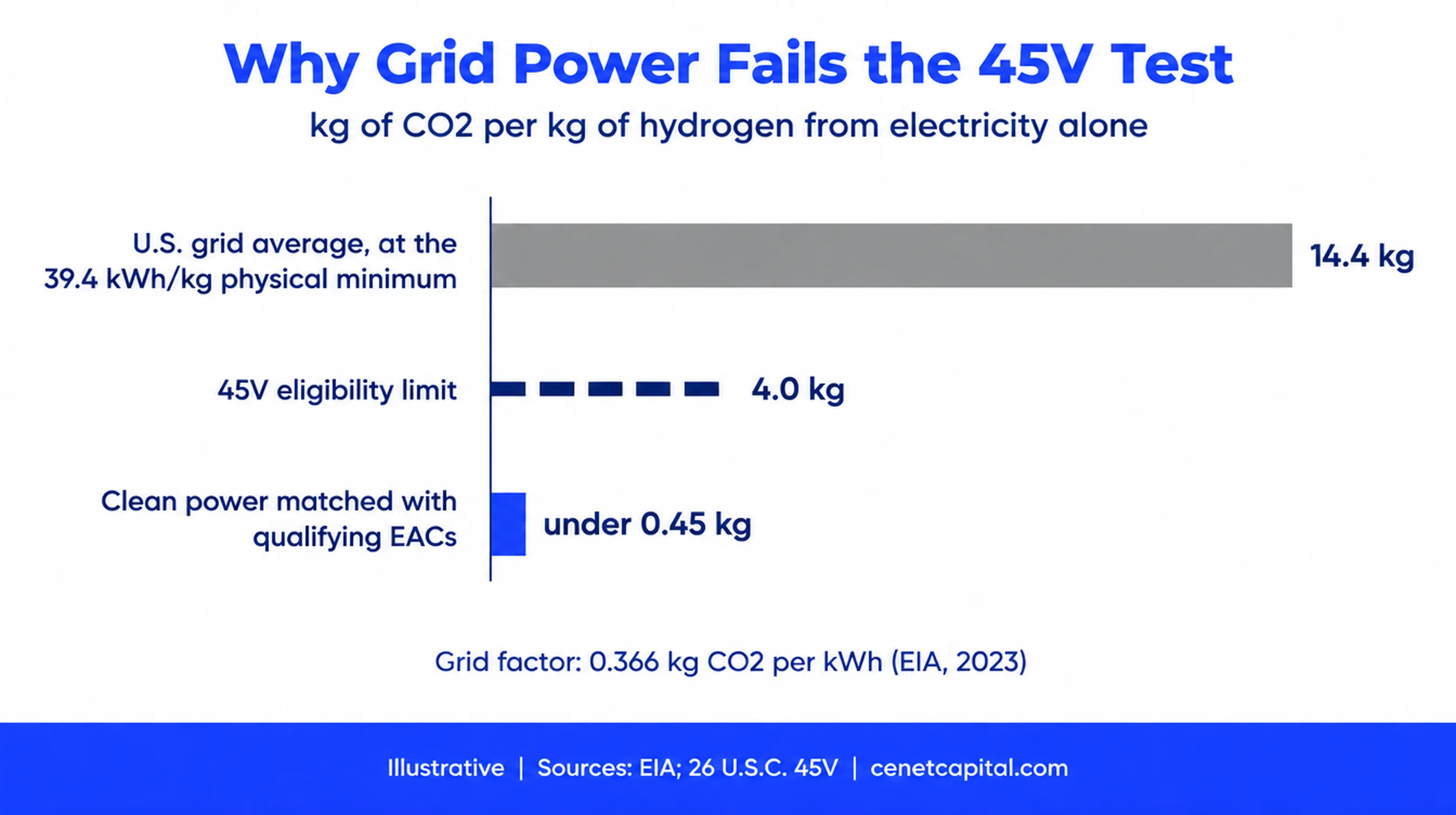
That’s the “dirty secret” of green hydrogen: the electrolyzer is clean, but the grid usually isn’t. Under the final rules, grid electricity without matching certificates is counted at “the annual average lifecycle GHG emissions of the regional electricity grid,” per 26 CFR 1.45V-4.
How do green hydrogen producers prove they use clean power?
By buying and retiring qualifying energy attribute certificates (EACs) for each MWh the electrolyzer uses. Each certificate must pass three tests, often called the three pillars: incrementality, deliverability and temporal matching. A qualified verifier then has to confirm the certificates meet the rules.
Incrementality: the generator began commercial operations no more than 36 months before the hydrogen facility was placed in service.
Deliverability: the generator is in the same grid region, defined by balancing authority, with 13 regions in the lower 48 states.
Temporal matching: the same calendar year for power generated before 2030, and the same hour starting January 1, 2030.
Our guide to energy attribute certificates for hydrogen covers what each certificate must contain and which ones count.
What is the green hydrogen tax credit worth in 2026?
Up to $3.28 per kg in 2026 for hydrogen under 0.45 kg of CO2e per kg, if the project meets prevailing wage and apprenticeship rules. That’s the top 45V tier, and green hydrogen matched with qualifying clean power is the main way to reach it. The credit runs for 10 years.
Lifecycle emissions (kg CO2e per kg H2) | 2026 credit per kg with prevailing wage | 10,000 tonnes a year |
|---|---|---|
Under 0.45 | $3.28 | $32.8 million |
0.45 to under 1.5 | $1.095 | $10.95 million |
1.5 to under 2.5 | $0.82 | $8.2 million |
2.5 to 4.0 | $0.655 | $6.55 million |
Amounts reflect the IRS inflation adjustment in Notice 2026-41. Without prevailing wage and apprenticeship, divide by five. See our 45V tax credit calculator for a full 10-year estimate.
What changes for green hydrogen in 2030?
From January 1, 2030, every MWh an electrolyzer uses must be matched with clean power generated in the same hour, not just the same year. Solar and wind don’t produce around the clock, so a plant either runs less, adds storage, or buys hourly certificates from several sources. That can cut output and raise costs.
The rule is direct: electricity must be “generated in the same hour that the taxpayer’s hydrogen production facility uses electricity to produce hydrogen,” under section 1.45V-4(d)(3)(ii). Storage can help, but the battery must be in the same region and its efficiency losses count. Producers can also calculate emissions hour by hour, as long as the annual average stays at or below 4 kg.
Are there exceptions to the three pillars?
Yes, mostly for incrementality. Power from a qualifying state with a clean electricity standard and greenhouse gas cap counts, and Treasury has said California and Washington qualify. Existing nuclear reactors at risk of retirement can supply up to 200 MWh per operating hour, and uprates or newly added carbon capture also count.
Qualifying states: both the generator and the hydrogen facility must be in the state. Treasury named Washington and California in its January 2025 announcement.
Nuclear: only 200 MWh per operating hour per qualifying reactor, and only with a physical connection or a binding contract of at least 10 years.
Uprates and carbon capture: only the added capacity counts, or carbon capture placed in service within the 36-month window.
Does your electrolyzer's power mix qualify for 45V?
Illustrative only. Counts electricity emissions only; 45VH2-GREET uses lifecycle regional grid factors and adds other process emissions, so official rates run higher. Default grid factor is the EIA 2023 U.S. average (0.81 lb CO2 per kWh).
Price my green hydrogen credits →What did the One Big Beautiful Bill change for green hydrogen?
Two things. Hydrogen facilities must now begin construction before January 1, 2028, to claim 45V. And new wind and solar lost their tax credits unless construction began by July 4, 2026, or they’re placed in service by the end of 2027, which shrinks the supply of new clean power that 45V’s 36-month rule depends on.
The second change gets less attention but may matter more. Green hydrogen needs a steady pipeline of newly built generators, and the One Big Beautiful Bill Act ended the 45Y and 48E credits for most wind and solar after 2027. Our explainers on 45V and the One Big Beautiful Bill and the 45Y clean electricity credit cover both deadlines.
How much does green hydrogen cost compared with gray hydrogen?
Green hydrogen still costs more than hydrogen made from natural gas in most of the world, including the United States, according to the IEA. Electrolyzers outside China cost $2,000 to $2,600 per kW in 2024, and the U.S. has some of the cheapest natural gas, so the 45V credit is what closes much of the gap.
The IEA’s Global Hydrogen Review 2025 put Chinese electrolyzers at $600 to $1,200 per kW. Its 2026 review found the pipeline of announced low-emissions projects shrank to 27 million tonnes by 2030, with just over 6 million tonnes committed or likely. Our hydrogen hubs update shows how that pullback played out in the U.S.
Sources
Legal Information Institute, 26 CFR 1.45V-4, Lifecycle greenhouse gas emissions rate
Legal Information Institute, 26 U.S. Code 45V, Credit for production of clean hydrogen
U.S. Department of the Treasury, Final rules for the clean hydrogen production tax credit (January 2025)
U.S. Energy Information Administration, How much carbon dioxide is produced per kilowatthour of U.S. electricity generation?
International Energy Agency, Global Hydrogen Review 2026, executive summary
International Energy Agency, Global Hydrogen Review 2025, executive summary
Frequently Asked Questions
Does green hydrogen qualify for the 45V tax credit?
Only if its lifecycle emissions are 4 kg of CO2e per kg of hydrogen or less. That requires proving clean power with qualifying energy attribute certificates; an electrolyzer on average U.S. grid electricity produces about 14.4 kg of CO2 per kg, far above the limit.
Why does grid power disqualify green hydrogen?
What are the three pillars of the 45V credit?
How much is the green hydrogen tax credit worth in 2026?
Does Cenet Capital buy green hydrogen 45V credits?
Clean power locked in? Turn your 45V into cash.
Cenet Capital buys and insures 45V credits from green hydrogen producers and reviews your EAC and verification records up front, so you know your price before you file. Send us your annual production.

More Insights