
Credit Guides
Can blue hydrogen qualify for 45V? Tiers, methane leakage, the 45V vs 45Q choice, OBBBA changes, cancelled projects and a calculator to compare both credits.
Author -
Paulestini Francois
Published -
READ TIME
Blue hydrogen, made from natural gas with carbon capture, was supposed to be the fast lane for U.S. clean hydrogen. Then the final 45V rules, the One Big Beautiful Bill and a string of stalled projects changed the math. Here's whether blue hydrogen still qualifies for 45V, which tier it lands in, why 45Q often pays as much, what happened to the big projects, and a calculator to compare both credits for your plant.
QUICK ANSWER
Blue hydrogen can qualify for 45V if its lifecycle emissions, measured well to gate in 45VH2-GREET, are 4 kg of CO2e per kg of hydrogen or less. Most blue projects land in the lowest tiers, worth $0.655 to $0.82 per kg in 2026, and many earn about as much from 45Q, but one plant can't claim both.
KEY FACTS
What is blue hydrogen? Hydrogen made from natural gas by steam methane or autothermal reforming, with SMR carbon capture storing most of the CO2.
Is there a separate blue hydrogen tax credit? No. There is no dedicated blue hydrogen tax credit; blue projects claim either 45V or 45Q.
Does blue hydrogen qualify for 45V? Only if 45VH2-GREET puts its lifecycle emissions at 4 kg of CO2e per kg or less, well to gate.
What is the 45V blue hydrogen credit worth? Usually $0.655 per kg (2.5 to 4 kg tier) or $0.82 per kg (1.5 to 2.5 kg tier) in 2026, with prevailing wage met.
45Q vs 45V: can you claim both? No. Section 45V(d)(2) bars 45V at a facility whose carbon capture equipment has claimed 45Q.
What are the deadlines? Construction must begin before January 1, 2028, for 45V and before January 1, 2033, for 45Q.
What is blue hydrogen?
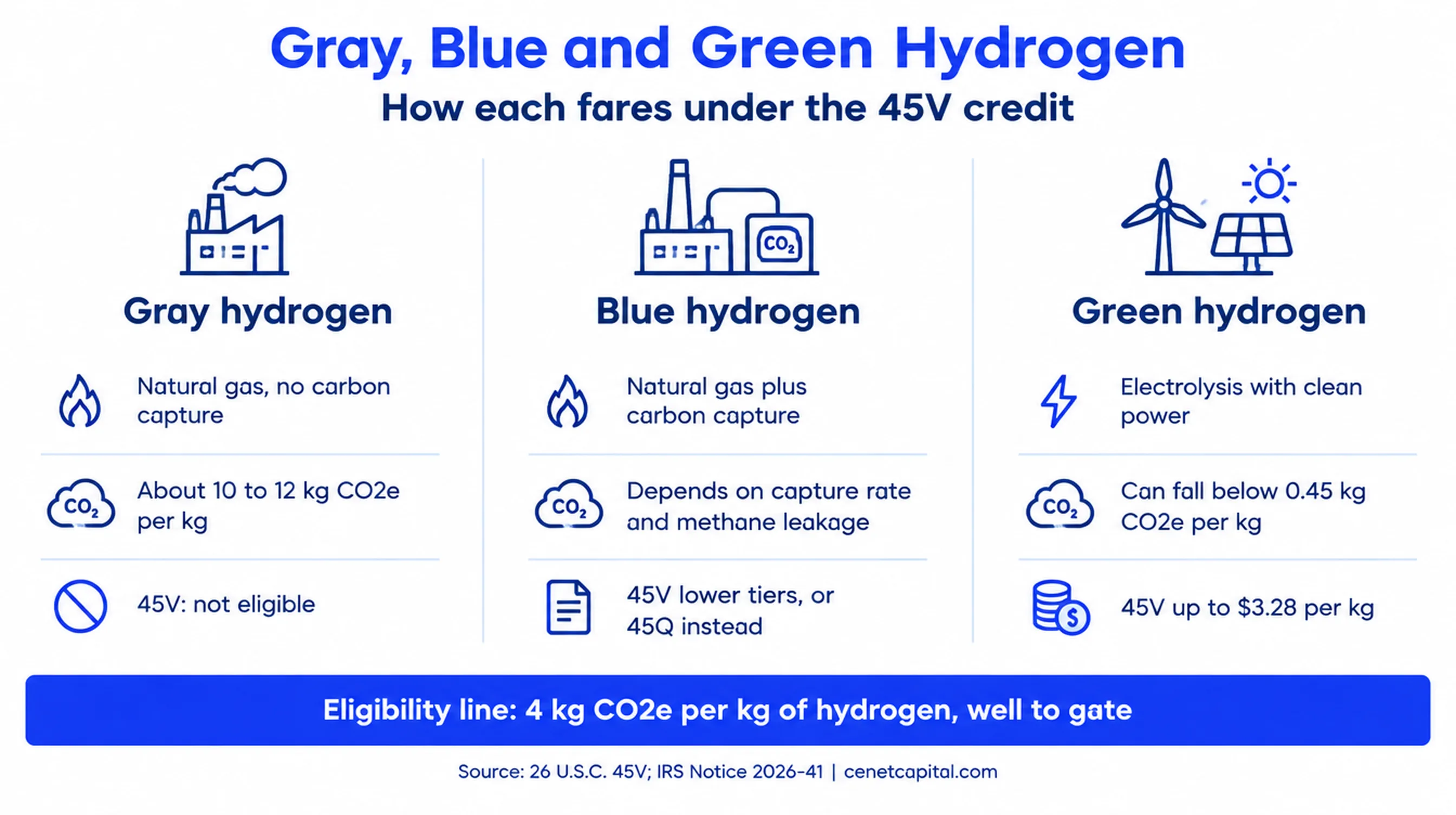
Blue hydrogen is hydrogen made from natural gas, usually by steam methane reforming or autothermal reforming, with the carbon dioxide captured and stored underground instead of vented. Without capture, the same process makes gray hydrogen, which is how most U.S. hydrogen is produced today. The only difference between the two is the carbon capture equipment and where the CO2 ends up.
Reforming splits methane into hydrogen and CO2. A conventional plant without capture emits about 11.9 kg of CO2e per kg of hydrogen over its life cycle, according to a National Renewable Energy Laboratory life-cycle assessment, nearly three times the 4 kg ceiling for the federal clean hydrogen credit. Capture brings that number down, but never to zero, because upstream methane leakage and uncaptured flue gas still count.
Can blue hydrogen qualify for the 45V tax credit?
Yes, if its lifecycle emissions, measured well to gate with DOE’s 45VH2-GREET model, come in at or below 4 kg of CO2e per kg of hydrogen. Treasury’s January 2025 final rules expressly cover methane reforming with carbon capture, but most blue projects land in the two lowest 45V tiers, not the top one.
The final rules “provide rules for determining eligibility of hydrogen produced using methane reforming technologies, including with carbon capture and sequestration,” according to the Treasury announcement. The credit itself is set by 26 U.S.C. 45V, and the 2026 amounts below include the IRS inflation adjustment in Notice 2026-41.
Lifecycle emissions (kg CO2e per kg H2) | Share of full credit | 2026 base credit per kg | With prevailing wage and apprenticeship |
|---|---|---|---|
2.5 to 4.0 | 20% | $0.131 | $0.655 |
1.5 to under 2.5 | 25% | $0.164 | $0.82 |
0.45 to under 1.5 | 33.4% | $0.219 | $1.095 |
Under 0.45 | 100% | $0.656 | $3.28 |
For the full tier, verification and three-pillar rules, see our 45V tax credit rules guide.
What decides which 45V tier blue hydrogen lands in?
Three things decide it: the share of CO2 the plant captures, the upstream methane leakage rate assumed in 45VH2-GREET, and the emissions from the power and heat used to run the capture equipment. High capture can push a plant toward 2.5 kg, but each point of methane leakage adds roughly 0.7 to 1 kg.
Capture rate: capturing only the concentrated process stream leaves the reformer furnace’s flue gas behind. Autothermal reformers make it easier to capture nearly all of the CO2.
Methane leakage: Treasury says upstream leakage “will be based on default national values” in 45VH2-GREET, with project-specific rates allowed in future versions if verified EPA reporting data supports them.
Model version: a producer can use the 45VH2-GREET version that was current when construction began for the whole credit period. The latest is the December 2025 release on DOE’s GREET page.
A Cenet estimate shows why leakage matters so much: a reformer uses roughly 3 to 3.5 kg of natural gas per kg of hydrogen. Losing 1% of that upstream adds about 0.03 kg of methane, which at a 100-year warming potential near 30 is about 1 kg of CO2e per kg of hydrogen, enough to drop a project a full tier. NREL found the same sensitivity: raising natural gas losses from 1.4% to 4% increased total emissions by 16%.
Can you claim 45V and 45Q on the same blue hydrogen plant?
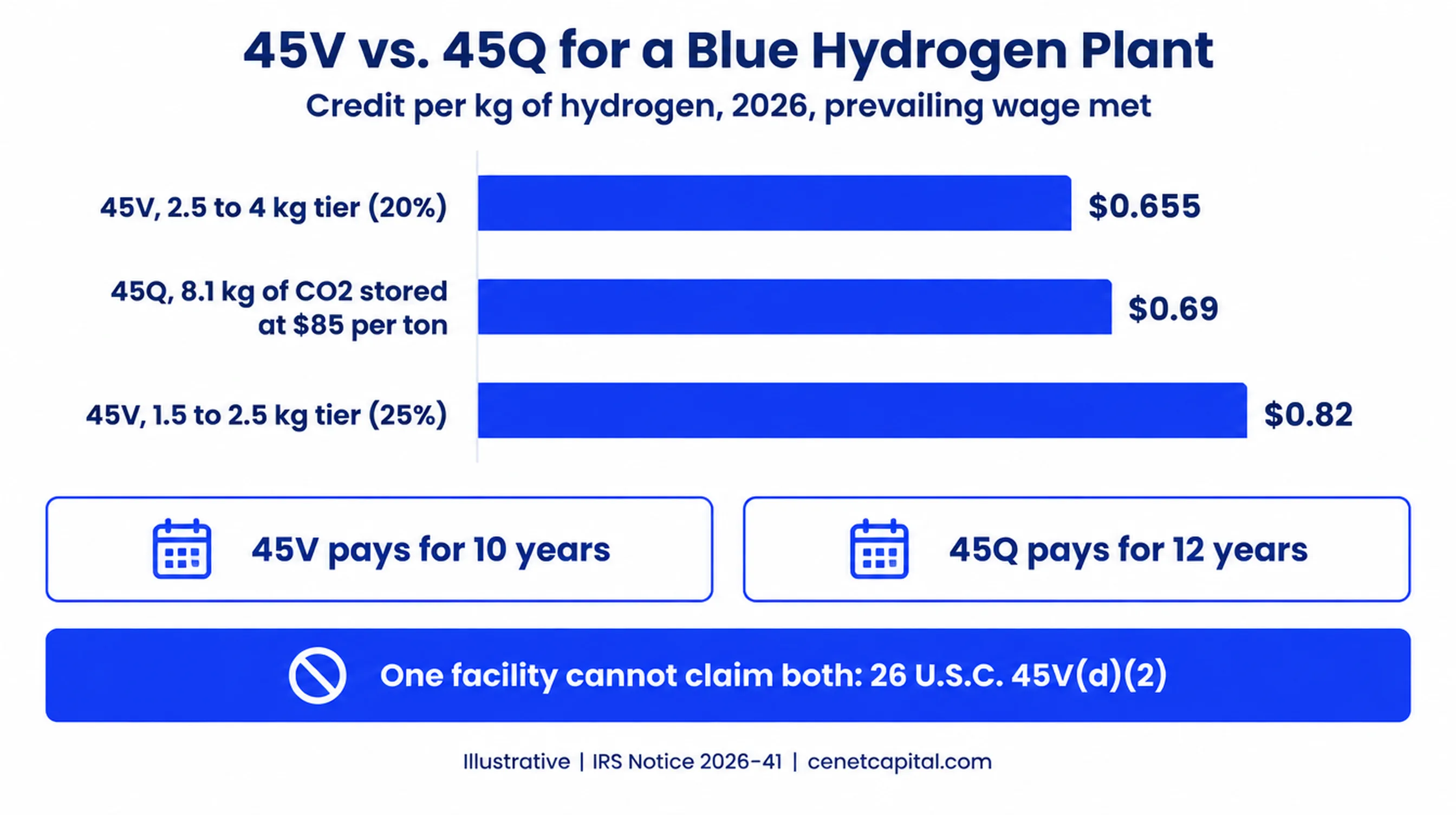
No. Section 45V(d)(2) bars the 45V credit for hydrogen made at a facility that includes carbon capture equipment for which a 45Q credit is allowed “for the taxable year or any prior taxable year.” A blue hydrogen owner has to choose, and once 45Q is claimed, 45V is gone for that facility.
Order matters. Claiming 45Q in an early year to bridge cash flow permanently closes the door on 45V for that plant. The two credits also run on different clocks: 45V pays for 10 years from when the hydrogen facility is placed in service, while 45Q pays for 12 years from when the capture equipment is placed in service.
Does 45V or 45Q pay more for blue hydrogen?
For most blue hydrogen plants, the two credits pay about the same per kilogram, and 45Q often wins over the full term. A plant storing 8.1 kg of CO2 per kg of hydrogen earns about $0.69 per kg under 45Q for 12 years, versus $0.655 in 45V’s lowest tier for 10 years. 45V wins once emissions drop below 2.5 kg.
45Q: NREL attributes 74.8% of conventional SMR emissions, roughly 9 kg of CO2 per kg of hydrogen, come from the plant itself. Capturing 90% stores 8.1 kg, or 0.0081 metric tons, which at $85 per ton is $0.69 per kg of hydrogen.
45V: $0.655 per kg at 2.5 to 4 kg of CO2e, or $0.82 per kg at 1.5 to 2.5 kg, with prevailing wage met.
Term: 12 years of 45Q versus 10 years of 45V, and 45Q amounts start adjusting for inflation in 2027.
45Q has another practical edge: its value doesn’t depend on a GREET methane assumption that a buyer or the IRS might question. Run your own numbers in the calculator below.
Which credit pays more for your blue hydrogen plant?
Illustrative only. 2026 45V amounts from IRS Notice 2026-41; 45Q at 2026 rates before inflation adjustments start in 2027. Totals are undiscounted. Your 45V tier comes from 45VH2-GREET, including upstream methane leakage, not from this slider.
Price my hydrogen credits →What did the One Big Beautiful Bill change for blue hydrogen?
The One Big Beautiful Bill Act of July 2025 moved the 45V construction deadline up to January 1, 2028, from 2033. It left 45Q’s 2033 deadline in place and gave utilization and enhanced oil recovery the same 45Q rate as storage. For blue hydrogen, both changes tilted the economics further toward 45Q.
The 45V deadline is now in section 45V(c)(3)(C), which reads “before January 1, 2028.” For 45Q, the rate parity applies to capture equipment placed in service after July 4, 2025. Our explainer on 45V and the One Big Beautiful Bill covers how developers lock in the 2028 date.
What happened to the big U.S. blue hydrogen projects?
Several flagship projects have stalled. Air Products abandoned its Louisiana blue hydrogen and ammonia complex on June 30, 2026, and ExxonMobil paused its planned Baytown, Texas plant, citing weak demand. The Gulf Coast HyVelocity hub, which includes blue hydrogen, is still on DOE’s 2026 retained list.
Air Products, Louisiana: cancelled after the company said expected returns no longer met its criteria, along with the CO2 storage wells planned under Lake Maurepas, according to gasworld and C&EN.
ExxonMobil, Baytown: paused until the company sees a path to a market-driven business, according to Energynews.pro.
HyVelocity hub: retained in DOE’s April 2026 review. Our hydrogen hubs update tracks every hub.
The pattern is consistent: credits alone haven’t closed the cost gap without long-term buyers. The projects still moving tend to have a committed user next door, such as an ammonia plant or refinery.
How do blue hydrogen producers turn the credit into cash?
Both 45V and 45Q can be sold to an unrelated buyer for cash under section 6418, or taken as a direct payment from the IRS for the first five years. Production credits typically sell for about 90 cents per dollar or more in 2026, and buyers will check the GREET inputs or storage monitoring before closing.
The steps are the same as any credit sale: IRS pre-filing registration, a transfer agreement and a transfer election with the return. Our guides to monetizing 45V and elective pay walk through each one.
Sources
Legal Information Institute, 26 U.S. Code 45V, Credit for production of clean hydrogen
Legal Information Institute, 26 U.S. Code 45Q, Credit for carbon oxide sequestration
U.S. Department of the Treasury, Final rules for the clean hydrogen production tax credit (January 2025)
U.S. Department of Energy, GREET and 45VH2-GREET models
National Renewable Energy Laboratory, Life Cycle Assessment of Hydrogen Production via Natural Gas Steam Reforming
gasworld, Air Products axes huge blue hydrogen project in Louisiana
C&EN, Air Products cancels blue hydrogen project in Louisiana
Energynews.pro, ExxonMobil freezes Baytown, major blow to US blue hydrogen sector
Frequently Asked Questions
Is blue hydrogen eligible for the 45V tax credit?
Yes, if its lifecycle emissions, measured well to gate with DOE's 45VH2-GREET model, are 4 kg of CO2e per kg of hydrogen or less. Treasury's January 2025 final rules cover methane reforming with carbon capture, but most blue projects qualify only for the lower tiers.
What is the difference between gray, blue and green hydrogen?
Is 45Q or 45V better for blue hydrogen?
How does methane leakage affect blue hydrogen's 45V credit?
Does Cenet Capital buy blue hydrogen credits?
Blue hydrogen or 45Q? Get paid either way.
Cenet Capital buys transferable 45V and 45Q credits from hydrogen and carbon capture owners, and reviews GREET inputs and storage monitoring up front so you know your price before you file. Send us your annual volumes.

More Insights