
Credit Guides
Form 8835 vs Form 7210 (and 7211): which credit each claims, 2025 rates, line-by-line Form 7210 tips, the hydrogen self-use rule, and a form finder tool.
Author -
Paulestini Francois
Published -
READ TIME
Production credits for clean power and clean hydrogen look alike, but they're claimed on different IRS forms, and picking the wrong one is an easy way to slow down a return or a credit sale. Here's what Form 8835, Form 7210 and Form 7211 each claim, the 2025 rates, how to fill out Form 7210, when a hydrogen project with its own wind or solar can claim both credits, and a tool to find the right form.
QUICK ANSWER
Form 8835 claims the section 45 renewable electricity production credit, paid per kWh sold, for facilities whose construction began before 2025. Form 7210 claims the section 45V clean hydrogen production credit, paid per kg of qualified clean hydrogen. Newer zero-emission power plants claim the section 45Y credit on Form 7211.
KEY FACTS
What is Form 8835? The form for the section 45 renewable electricity production credit, paid per kWh sold to an unrelated person.
What is Form 7210? The form for the section 45V clean hydrogen production credit, paid per kg of qualified clean hydrogen.
When do you use Form 7211? For the section 45Y clean electricity production credit, mainly projects whose construction began in 2025 or later.
What do the Form 7210 instructions require you to attach? The verification report, any DOE provisional emissions rate documents, and Form 7220 for the 5x amount.
Can a hydrogen project claim both credits? Yes. Section 45(e)(13) treats verified self-use at a 45V facility as a sale for section 45.
What is the difference between Form 8835 and Form 7210?
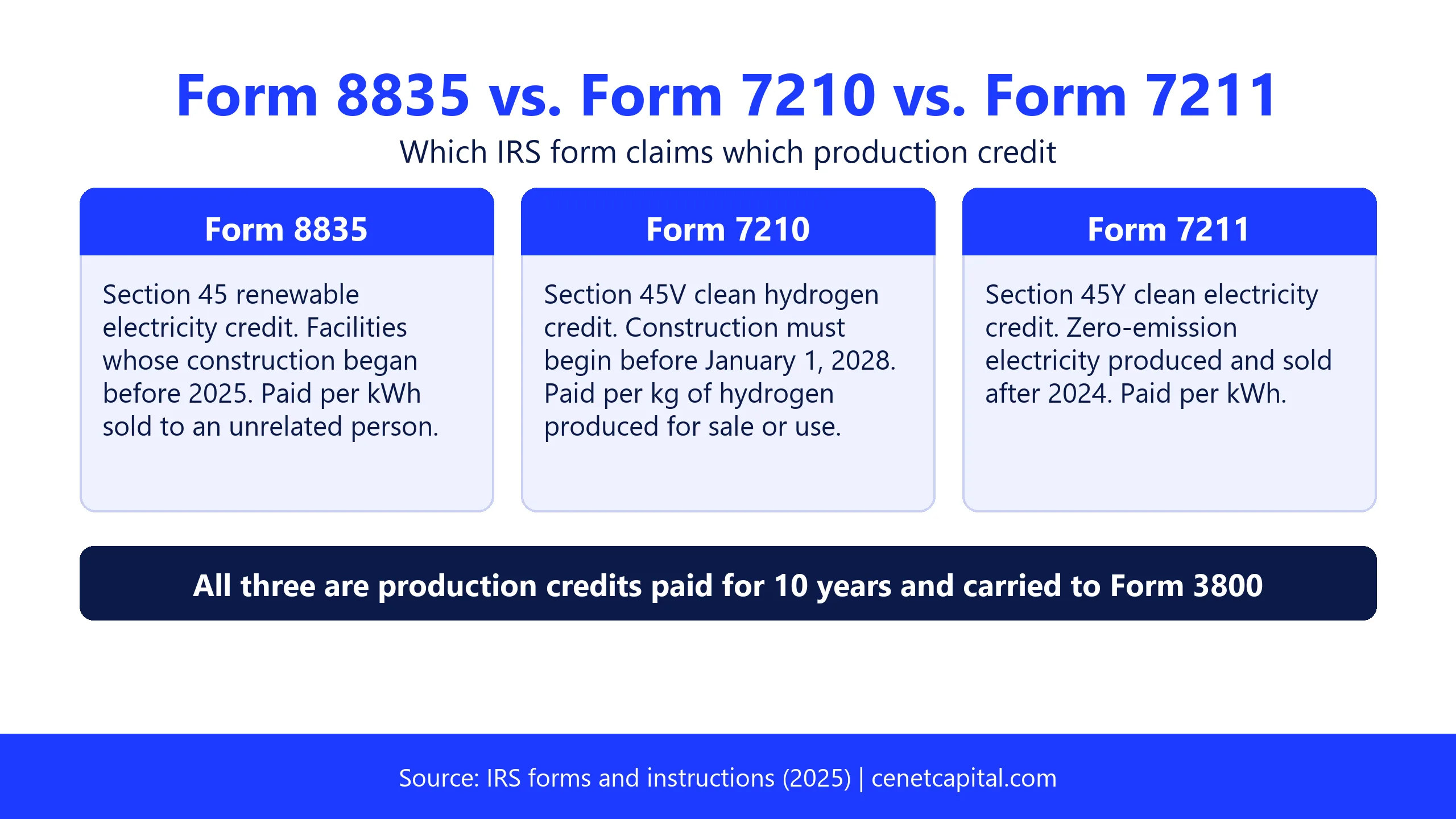
Form 8835 claims the section 45 renewable electricity production credit, paid per kWh of electricity sold, for facilities whose construction began before 2025. Form 7210 claims the section 45V clean hydrogen production credit, paid per kg of qualified clean hydrogen. Newer zero-emission power plants use a third form, Form 7211, for section 45Y.
Form | Credit | Paid on | Who it’s for |
|---|---|---|---|
Form 8835 | Section 45 renewable electricity production credit | kWh sold to an unrelated person | Wind, solar, geothermal and other facilities whose construction began before 2025 |
Form 7210 | Section 45V clean hydrogen production credit | kg of qualified clean hydrogen | Hydrogen facilities whose construction begins before January 1, 2028 |
Form 7211 | Section 45Y clean electricity production credit | kWh of clean electricity | Zero-emission facilities, electricity sold after 2024 |
All three are production credits that run for 10 years from when the facility is placed in service, and all three flow to Form 3800, the general business credit form.
What is Form 8835 used for?
Form 8835 is used to claim the section 45 renewable electricity production credit. The IRS says the credit “is allowed only for the sale of electricity produced in the United States or U.S. territories from qualified energy resources at a qualified facility.” For 2025, the base rate is 0.6 cents per kWh for wind and solar placed in service after 2021, or 3.0 cents with prevailing wage.
Section 45 now applies mainly to older projects. The Form 8835 instructions describe qualified facilities by construction start, for example a wind facility “the construction of which begins before 2025.” Projects that start later use section 45Y instead. The 2025 rates are:
Wind, closed-loop biomass, geothermal and solar placed in service after 2021: 0.6 cents per kWh, multiplied by 5 with prevailing wage and apprenticeship
Open-loop biomass, landfill gas, trash, hydropower and marine energy placed in service after 2021: 0.3 cents per kWh, also multiplied by 5
Facilities placed in service before 2022: 3.0 or 1.5 cents per kWh
Who files Form 8835?
The owner of a qualified facility files Form 8835. Taxpayers, applicable entities, partnerships and S corporations must file a separate form for each qualified facility. Partners and shareholders who receive a section 45 credit through a pass-through entity generally report it directly on Form 3800 instead.
Tax-exempt and government entities taking elective pay file Form 8835 with Form 3800 and their return, such as Form 990-T. Sellers using a section 6418 transfer can sell all or part of the credit for cash, and both groups need an IRS registration number each year. Our production tax credit guide covers the credit itself.
What is Form 7210 used for?
Form 7210 claims the 45V credit for qualified clean hydrogen produced after 2022 at a qualified clean hydrogen production facility, for 10 years after the facility is placed in service. The credit is the kilograms of hydrogen produced times an applicable amount based on lifecycle emissions, up to 4 kg of CO2e per kg.
Emissions rate (kg CO2e per kg H2) | Share | 2025 applicable amount per kg |
|---|---|---|
Under 0.45 | 100% | $0.637 |
0.45 to under 1.5 | 33.4% | $0.213 |
1.5 to under 2.5 | 25% | $0.159 |
2.5 to 4.0 | 20% | $0.127 |
These are the amounts in the Form 7210 instructions for 2025, multiplied by 5 when prevailing wage and apprenticeship rules are met. The hydrogen must be made “for its sale or use, in the ordinary course of a trade or business,” and the production and sale or use must be verified by an unrelated party. Our 45V rules guide covers the emissions tiers.
How do you fill out Form 7210?
Start with Line A, the facility’s lifecycle emissions rate in kg of CO2e per kg, plus any DOE control number. Part I identifies the facility and its dates, Part II multiplies kilograms by the applicable amount, Part III reduces the credit for tax-exempt bond financing, and Part IV applies the 5x multiplier and adds pass-through credits.
Part I: registration number (line 1), owner (line 2), facility address and coordinates (lines 2a and 2b), construction start date (line 3), placed-in-service date (line 4), and the increased-amount box (line 5).
Part II: kilograms times the applicable amount on lines 6a to 6d, using only one emissions rate, totaled on line 7.
Part III: tax-exempt bond reduction on line 8.
Part IV: multiply by 5 on line 10 if line 5 is checked, add K-1 credits on line 11, and total on line 12.
The IRS requires you to “attach (a) the required verification report and (b) if you are either petitioning for or using a provisional emissions rate, a copy of the documentation obtained from the Department of Energy.” Attach Form 7220 when claiming the increased amount.
When do you file Form 7211 instead of Form 8835?
Use Form 7211 for the section 45Y clean electricity production credit, which the IRS describes as the credit “for clean electricity produced at a qualified facility and sold after 2024.” Wind and solar projects whose construction began in 2025 or later generally claim 45Y on Form 7211, not section 45 on Form 8835.
The two credits pay about the same per kWh, but 45Y is technology-neutral, so any zero-emission generator can use it. Our Section 45Y guide covers rates and deadlines, including the One Big Beautiful Bill’s cutoff for new wind and solar.
Which IRS form claims your credit?
Based on the 2025 IRS forms and instructions. Transfers and elective payments also need an IRS registration number for each facility, every year.
Sell this credit for cash →Does a hydrogen project with its own wind or solar file both forms?
It can. Section 45(e)(13) treats electricity a producer uses at its own qualified clean hydrogen facility as sold to an unrelated person, as long as an unrelated third party verifies the use and production. So a section 45 wind farm feeding an electrolyzer can claim the electricity credit on Form 8835 and the hydrogen credit on Form 7210.
Normally section 45 pays only for power “sold by the taxpayer to an unrelated person,” per 26 U.S.C. 45. Section 45Y has its own route: power that’s “sold, consumed, or stored by the taxpayer” counts if the facility has a meter “owned and operated by an unrelated person,” under 26 U.S.C. 45Y. The hydrogen side still needs qualifying EACs to show the power is clean, as our EAC guide explains.
Where do Form 8835 and Form 7210 go on Form 3800?
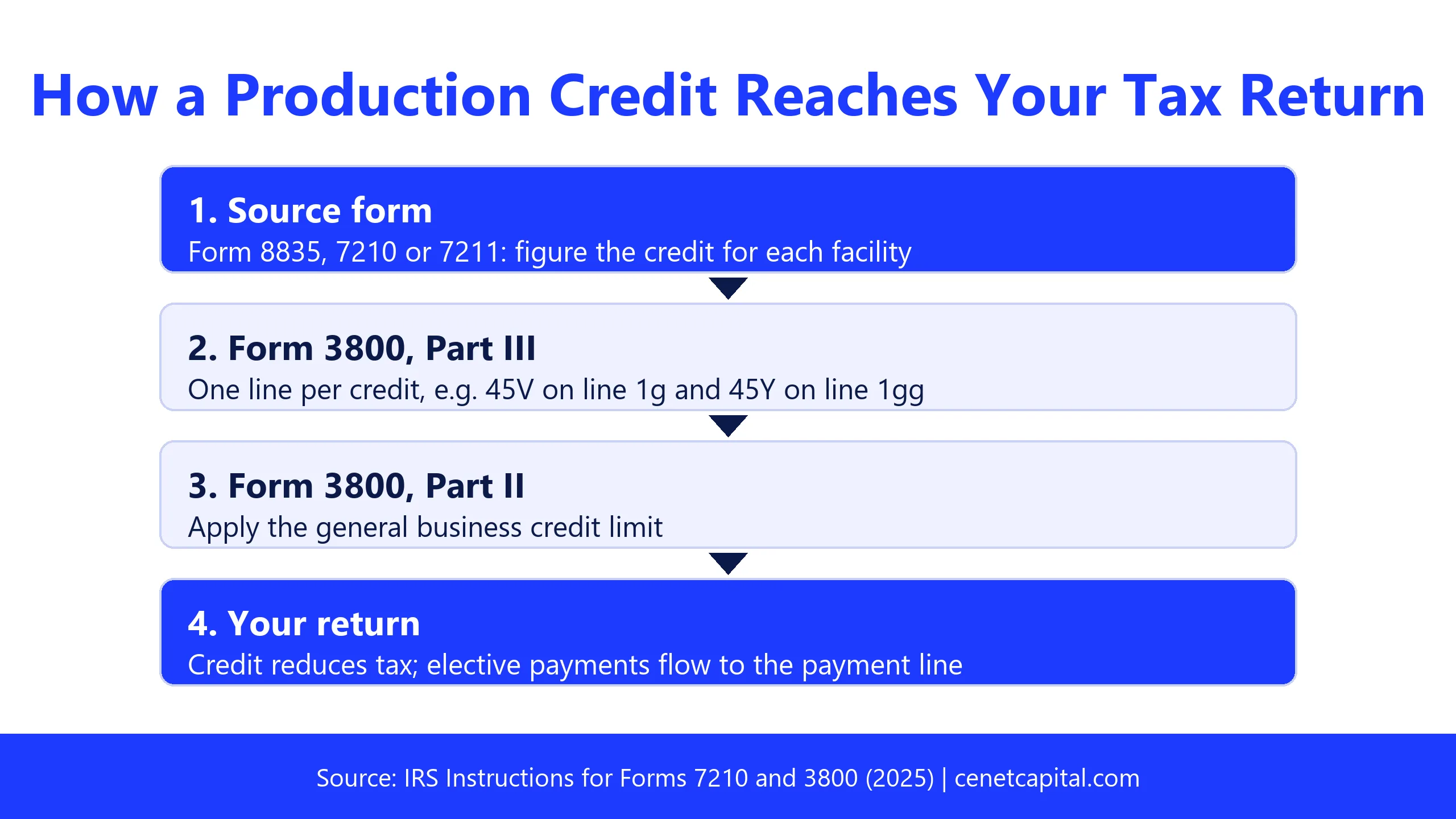
Both credits go in Form 3800, Part III. The Form 7210 credit goes on line 1g, the 45Y credit from Form 7211 on line 1gg, and the section 45 credit from Form 8835 on its own Part III line. Part II then applies the general business credit limit before the credit reduces tax.
A buyer that purchases a transferred credit reports it on its own Form 3800, and sellers show the transfer in Part III, column (f). Partnerships and S corporations that own a hydrogen facility must attach a separate Form 7210 for each facility, even when they transfer the credit.
What are the most common Form 8835 and Form 7210 mistakes?
The most common mistakes are claiming section 45 on Form 8835 for a facility that should use 45Y on Form 7211, claiming electricity that wasn’t sold or verified, leaving off the verification report, entering more than one emissions rate on Form 7210, and missing the annual registration number for a transfer or elective payment.
Using Form 8835 for a project whose construction began in 2025 or later.
Claiming self-used power without the section 45(e)(13) verification or a qualifying third-party meter.
Skipping Form 7220 when claiming the 5x prevailing wage amount.
Using one registration number for every facility or every year.
Sources
IRS, About Form 8835, Renewable Electricity Production Credit
Legal Information Institute, 26 U.S. Code 45 and 26 U.S. Code 45Y
Frequently Asked Questions
What is the difference between Form 8835 and Form 7210?
Form 8835 claims the section 45 renewable electricity production credit, paid per kWh of electricity sold, mainly for facilities whose construction began before 2025. Form 7210 claims the section 45V clean hydrogen production credit, paid per kg of qualified clean hydrogen.
What is the renewable electricity production credit rate for 2025?
Who needs to file Form 7210?
Can a hydrogen producer claim an electricity credit for its own wind or solar?
Can Cenet Capital buy credits claimed on Form 8835 or Form 7210?
Filing Form 8835 or 7210? Sell the credit instead.
If you can't use the full credit, Cenet Capital buys transferable section 45, 45Y and 45V credits directly, closing before your return is due. Send us your credit type and amount for a price.

More Insights