

Credit Guides
Refundable, nonrefundable, transferable and direct-pay tax credits explained: how each pays, who qualifies, what each is worth, and a calculator to compare.
Author -
Paulestini Francois
Published -
READ TIME
Not every tax credit is worth a dollar to every taxpayer. Whether a credit pays out depends on whether it's refundable, nonrefundable, transferable or eligible for direct pay, and each works differently. This guide explains all four in plain English, shows which credits fall into each group, compares what each is worth and when the cash arrives, and includes a calculator to compare your options.
QUICK ANSWER
A refundable tax credit pays you whatever exceeds your tax as a refund. A nonrefundable credit only reduces tax to zero. A transferable credit can be sold to another taxpayer for cash, typically 88 to 96 cents per dollar. A direct-pay (elective pay) credit is treated as a tax payment and refunded, but mainly for tax-exempt and government entities.
KEY FACTS
Refundable: Paid as a refund beyond your tax, like the Earned Income Tax Credit and up to $1,700 per child of the Child Tax Credit for 2025.
Nonrefundable: Reduces tax to zero; business credits are also capped at about 75% of tax above $25,000.
Transferable: 11 clean energy credits can be sold for cash under Section 6418, tax-free to the seller.
Direct pay: Tax-exempt and government entities for 12 credits; any taxpayer for 45Q, 45V and 45X for five years.
Carryovers: Unused clean energy credits carry back 3 years and forward 22.
What is the difference between refundable, transferable and direct-pay tax credits?
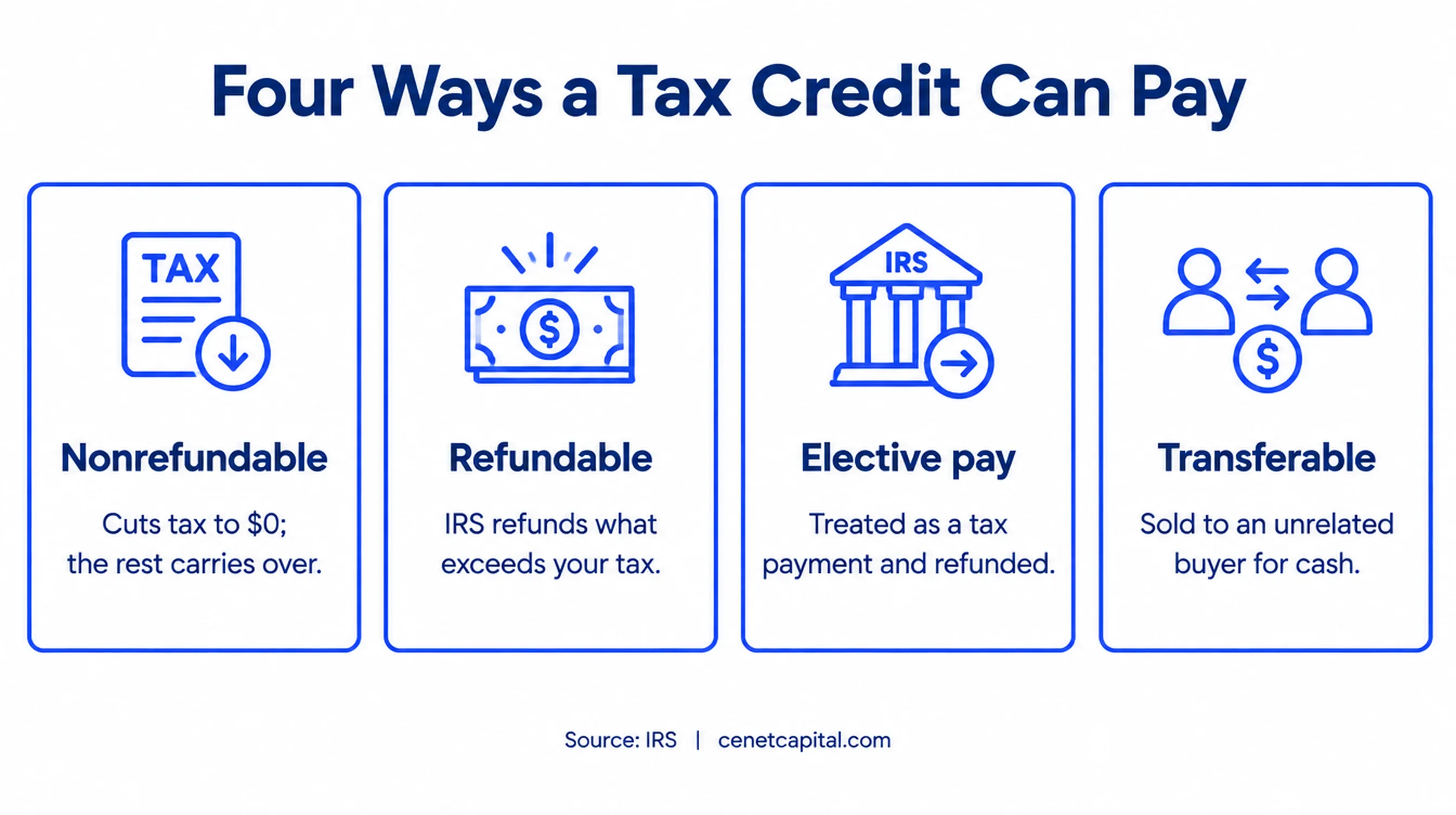
A refundable credit pays you the amount that exceeds your tax as a refund. A transferable credit can be sold to another taxpayer for cash. A direct-pay credit, officially called elective pay, is treated as a tax payment, so the IRS refunds whatever exceeds your tax. A nonrefundable credit only reduces your tax to zero. Most business credits are nonrefundable, which is why transferability and direct pay matter so much for clean energy projects.
The difference is about who can turn a credit into cash, and how fast. A profitable company can use almost any credit against its own tax. A developer with little taxable income, a city or a hospital can’t. The Inflation Reduction Act created elective pay and transferability to close that gap for clean energy credits.
What is a refundable tax credit?
A refundable tax credit is one you can receive as a refund even if you owe no tax. If a $3,000 refundable credit exceeds your $1,000 tax bill, the IRS pays you the other $2,000. The IRS describes most credits as reducing tax only to $0, while refundable credits go beyond that.
Almost all fully or partly refundable credits are for individuals:
Earned Income Tax Credit: fully refundable for low- and moderate-income workers.
Additional Child Tax Credit: the Child Tax Credit is up to $2,200 per child for 2025, and up to $1,700 of it can be refunded through the Additional Child Tax Credit.
American Opportunity Tax Credit: 40% refundable, up to $1,000 of the $2,500 maximum.
Premium Tax Credit: refundable help with health insurance bought through the Marketplace.
Businesses have few refundable credits. The fuel tax credit is one. Another is the payroll tax election for research credits: a startup with gross receipts under $5 million can apply up to $500,000 of its research credit against payroll taxes, according to the Form 6765 instructions.
What is a nonrefundable credit, and what happens to the unused part?
A nonrefundable credit reduces your tax to zero and no further. For business credits, a further limit applies: general business credits can offset all of the first $25,000 of tax but only 75% of tax above that, and any excess carries to other years.
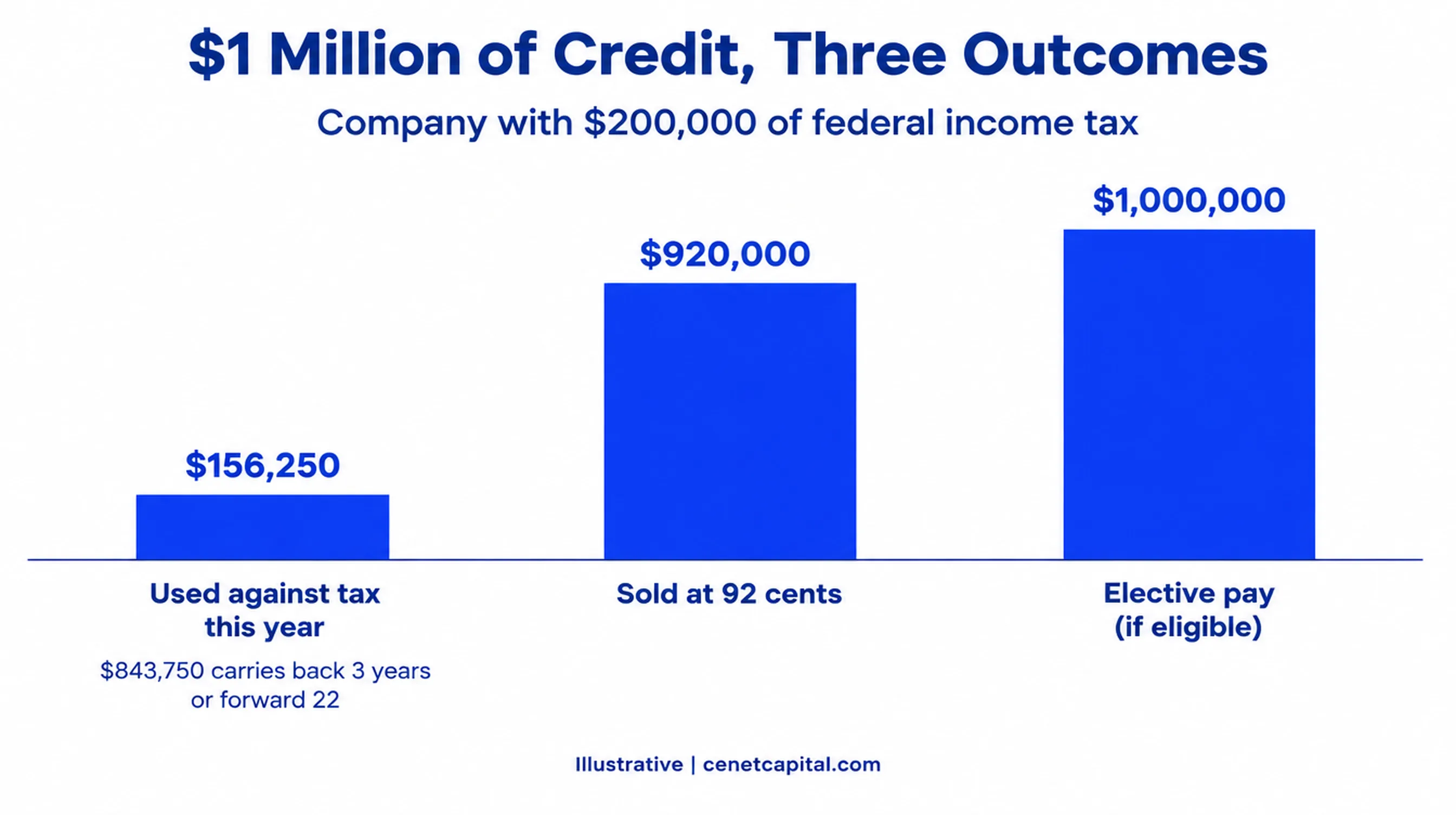
Unused general business credits normally carry back one year and forward 20. For the clean energy credits eligible for elective pay, Section 39 extends that to a three-year carryback and a 22-year carryforward. A carryforward is worth less than cash today, and it’s worth nothing if the company never earns enough taxable income to use it. That’s why developers sell credits rather than wait.
What is a transferable tax credit?
A transferable tax credit is one the owner can sell to an unrelated taxpayer for cash under Section 6418. The buyer pays less than face value, typically 88 to 96 cents per dollar in 2026, and uses the full credit against its own federal tax. Eleven clean energy credits are transferable, including the ITC, PTC, 45X, 45Q, 45V, 45Z, 30C and 48C.
Cash only: the buyer must pay in cash.
Tax-neutral price: the seller doesn’t pay income tax on the proceeds, and the buyer can’t deduct the price, under Section 6418(b).
No resale: the buyer can’t transfer the credit again, though a seller can split a credit among several buyers.
Penalty risk: if the credit turns out to be overstated, the buyer repays the excess plus 20% unless it had reasonable cause, which is why buyers insist on diligence and insurance.
For the full process, see our buyer’s guide or the transfer market report for current prices.
What is a direct-pay (elective pay) credit?
Elective pay, often called direct pay, treats a clean energy credit as a payment of federal income tax. The IRS applies it against any tax owed and refunds the rest, which makes the credit effectively refundable for the organizations that qualify. It covers 12 clean energy credits plus the semiconductor manufacturing credit.

Only some taxpayers qualify. Tax-exempt organizations, state and local governments, tribal governments, U.S. territories, Alaska Native Corporations, rural electric cooperatives and TVA can elect it for any of the 12 credits. Any other taxpayer can elect it only for the 45Q carbon capture, 45V clean hydrogen and 45X manufacturing credits, and only for five consecutive years, according to the IRS elective pay FAQs. The payment isn’t available until the return’s due date, even if you file early. Our elective pay guide covers registration and deadlines.
Which option is worth the most?
Elective pay returns 100 cents on the dollar but is limited to tax-exempt and government owners, plus 45Q, 45V and 45X for five years. Selling returns about 88 to 96 cents now. Using the credit yourself is worth face value only if you have enough tax to absorb it.
Feature | Refundable | Transferable | Elective (direct) pay |
|---|---|---|---|
Who pays you | IRS | A corporate buyer | IRS |
Value per $1 | $1.00 | About $0.88 to $0.96 | $1.00, less any haircuts |
When you get cash | After filing | At closing, often before filing | After the return’s due date |
Who can use it | Mostly individuals | Any non-exempt owner | Exempt and government entities; anyone for 45Q, 45V, 45X (5 years) |
Pre-filing registration | No | Yes | Yes |
Timing can outweigh the discount. A buyer can close a purchase months before the seller’s return is due, while elective pay arrives only after filing. Run your own numbers in the calculator below.
What is your credit worth in cash today?
Illustrative only. "Use it" values the carryforward at today's dollars with an 8% discount rate and ignores the 3-year carryback and other credits you already claim. Elective pay can be reduced by domestic content and tax-exempt bond haircuts.
Compare my options →Can a credit be both transferable and direct-pay?
Not the same dollars. A credit bought from someone else can’t be claimed with elective pay, and an owner must choose one route for each credit amount. Owners of 45Q, 45V and 45X credits can elect direct pay for five years and then sell credits in the years that follow.
Both routes require IRS pre-filing registration for each facility, and the registration number must appear on the return. Register early: the IRS recommends at least 120 days before filing.
Sources
Legal Information Institute, 26 U.S. Code 6418, Transfer of certain credits
Legal Information Institute, 26 U.S. Code 39, Carryback and carryforward of unused credits
IRS, Instructions for Form 6765, Credit for Increasing Research Activities
Frequently Asked Questions
What is the difference between a refundable and nonrefundable tax credit?
A refundable credit pays you the amount that exceeds your tax as a refund. A nonrefundable credit can only reduce your tax to zero, and for business credits any unused amount carries to other years.
What does it mean that a tax credit is transferable?
Is direct pay the same as a refundable credit?
Which is worth more, selling a tax credit or carrying it forward?
Can Cenet Capital buy my tax credits?
Can't use your credit? Sell it instead.
Cenet Capital buys transferable clean energy credits directly, closing before your return is due. Tell us your credit type and amount and we'll compare a sale with carrying it forward or direct pay.

More Insights