
Credit Guides
The 45Q carbon capture credit explained: $85 and $180 per ton rates, OBBBA parity for EOR, capture thresholds, reporting, transferability and a calculator.
Author -
Paulestini Francois
Published -
READ TIME
The 45Q tax credit pays carbon capture projects for every metric ton of CO2 they keep out of the atmosphere, and it came through the One Big Beautiful Bill Act stronger than before. Here's how much it's worth per ton in 2026, which facilities qualify, what changed for enhanced oil recovery, what you have to prove, how to sell the credit or take it as cash, and a calculator to estimate what your facility earns.
QUICK ANSWER
The 45Q tax credit pays $85 per metric ton of CO2 captured at an industrial or power source and $180 per ton for direct air capture in 2026, if prevailing wage rules are met, for 12 years. Since the 2025 tax law, storage, enhanced oil recovery and utilization earn the same rate. Construction must begin before 2033.
KEY FACTS
Rate: $85 per metric ton (point source) or $180 (direct air capture) with prevailing wage and apprenticeship; $17 or $36 without. Inflation adjustments start in 2027.
Duration: 12 years from the date the capture equipment is placed in service.
Minimum capture: 1,000 metric tons a year for direct air capture, 12,500 for industrial facilities and 18,750 for power plants.
Deadline: Construction must begin before January 1, 2033.
Monetizing: Transferable for cash, and any taxpayer can elect direct pay for the first five years.
How does 45Q transferability work? 45Q transferability lets the taxpayer that owns the capture equipment sell the credit for cash under Section 6418 after registering the facility with the IRS. Any taxpayer can instead elect direct pay for the first five years of 45Q credits.
What is the 45Q tax credit?
Section 45Q is a federal tax credit paid for each metric ton of carbon oxide that a facility captures and then stores underground, uses for enhanced oil recovery or turns into a product. For 2026 it’s worth up to $85 per ton for capture at an industrial or power source and $180 per ton for direct air capture, for 12 years. The credit goes to the owner of the carbon capture equipment, and it can be sold for cash or, for five years, taken as a direct payment from the IRS.
45Q has been in the tax code since 2008, but the Inflation Reduction Act raised its value and the One Big Beautiful Bill Act of 2025 kept it largely intact while most other clean energy credits were cut back. The statute is at 26 U.S.C. 45Q. For the wider picture of what survived the 2025 law, see our One Big Beautiful Bill clean energy guide.
How much is the 45Q credit per ton in 2026?
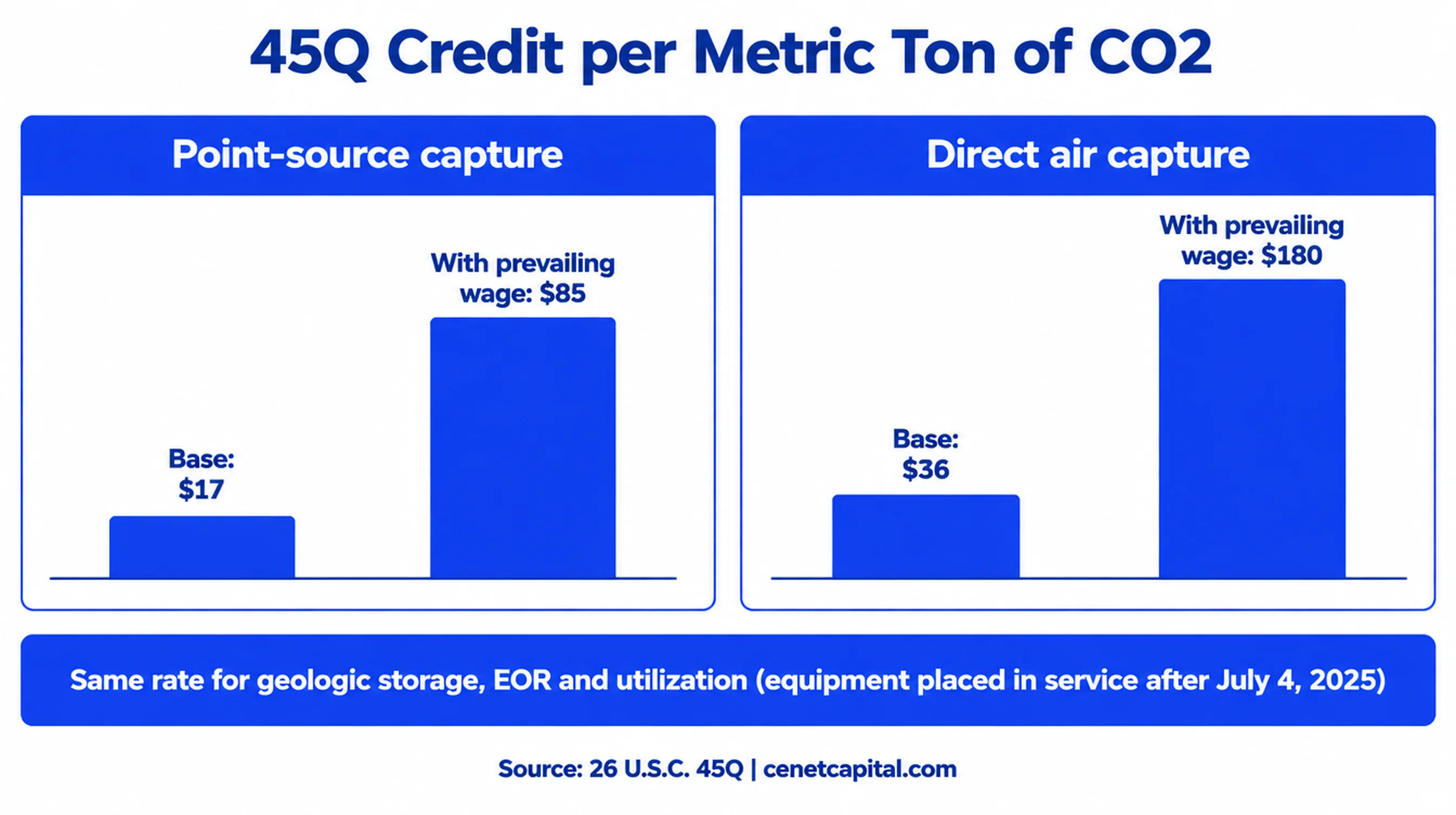
The base credit is $17 per metric ton, or $36 for direct air capture, and it rises five times to $85 and $180 when the project meets the prevailing wage and apprenticeship requirements. For taxable years beginning after 2026, both amounts are adjusted for inflation using 2025 as the base year, so they’ll start creeping up in 2027.
Capture type | Base credit | With prevailing wage and apprenticeship |
|---|---|---|
Industrial or power plant (point source) | $17 per metric ton | $85 per metric ton |
Direct air capture | $36 per metric ton | $180 per metric ton |
Equipment placed in service before February 9, 2018 | $20 per ton stored, $10 per ton used, under the older rules | |
The multiplier is the same 5x structure used across the clean energy credits. Our guide to the prevailing wage and apprenticeship requirements covers the wage, apprentice-hour and recordkeeping rules that unlock it.
What did the One Big Beautiful Bill change for 45Q?
It gave enhanced oil recovery and utilization the same credit as permanent storage, added foreign-entity restrictions, and left the $85 and $180 rates, the 2033 construction deadline and transferability unchanged. Before the law, CO2 used for oil recovery or turned into products earned $60 per ton ($130 for direct air capture), well below the storage rate.
Parity: carbon oxide injected for enhanced oil or natural gas recovery or used in a product now earns the same credit as carbon stored in a saline formation. Parity applies to equipment placed in service after July 4, 2025, according to the Government Accountability Office.
Foreign entities: no credit is allowed for taxable years beginning after July 4, 2025 if the taxpayer is a specified foreign entity or a foreign-influenced entity. See our guide to FEOC rules.
What stayed: the per-ton amounts, the 2027 inflation adjustment, the 12-year credit period and the ability to transfer the credit, as the Global CCS Institute summarized.
Which facilities qualify for 45Q?
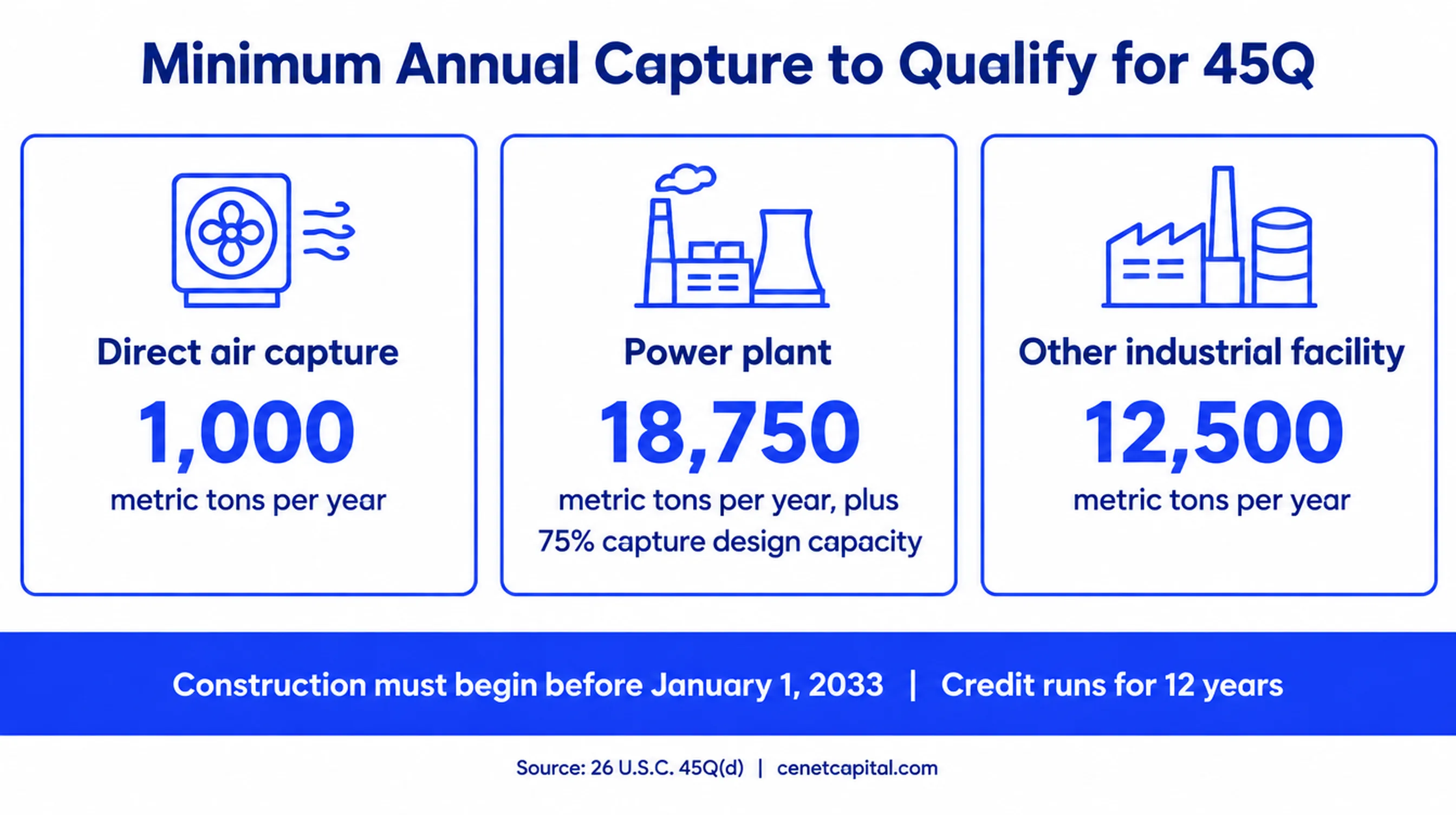
A facility qualifies if construction began before January 1, 2033 and it captures at least a minimum amount of carbon oxide each year: 1,000 metric tons for direct air capture, 12,500 metric tons for most industrial facilities, and 18,750 metric tons for power plants. Power plants must also have a capture design capacity of at least 75% of the unit’s baseline carbon oxide output.
Those thresholds make 45Q a credit for large, steady emitters. The most common projects capture high-purity CO2 from ethanol fermentation, natural gas processing, hydrogen and ammonia plants, where capture is cheapest per ton. Cement, steel and power plants have dilute flue gas and higher costs, and direct air capture is still early. As of March 2026, the GAO counted 33 carbon capture facilities in the U.S., about half of them sending CO2 to enhanced oil recovery and four using direct air capture.
How do you calculate the 45Q credit?
Multiply the metric tons of qualified carbon oxide captured and stored, used or injected during the year by the per-ton amount, then repeat every year for 12 years from the date the capture equipment was placed in service. There’s no cap on the number of tons and no basis calculation.
An ethanol plant capturing 300,000 metric tons a year, with prevailing wage met, earns about $25.5 million a year (300,000 × $85), or roughly $306 million over 12 years before inflation adjustments. A direct air capture plant pulling 50,000 tons a year earns $9 million a year at $180 per ton. Utilization is different: only the tons that the lifecycle analysis shows are kept out of the atmosphere count, and the IRS has to approve that analysis first. Run your own facility in the calculator below.
How much 45Q credit will your facility earn?
Illustrative only. Assumes capture equipment placed in service after July 4, 2025, so storage, enhanced oil recovery and utilization earn the same rate. Utilization counts only the tons an approved lifecycle analysis supports. Power plants also need 75% capture design capacity.
Price my 45Q credits →What do you need to prove to claim 45Q?
You need to prove where every ton went: storage under an EPA-approved monitoring plan, injection under an ISO 27916 quantification for oil recovery, or an IRS-approved lifecycle analysis for utilization. The credit is claimed on Form 8933, and the 2021 final regulations set the reporting rules.
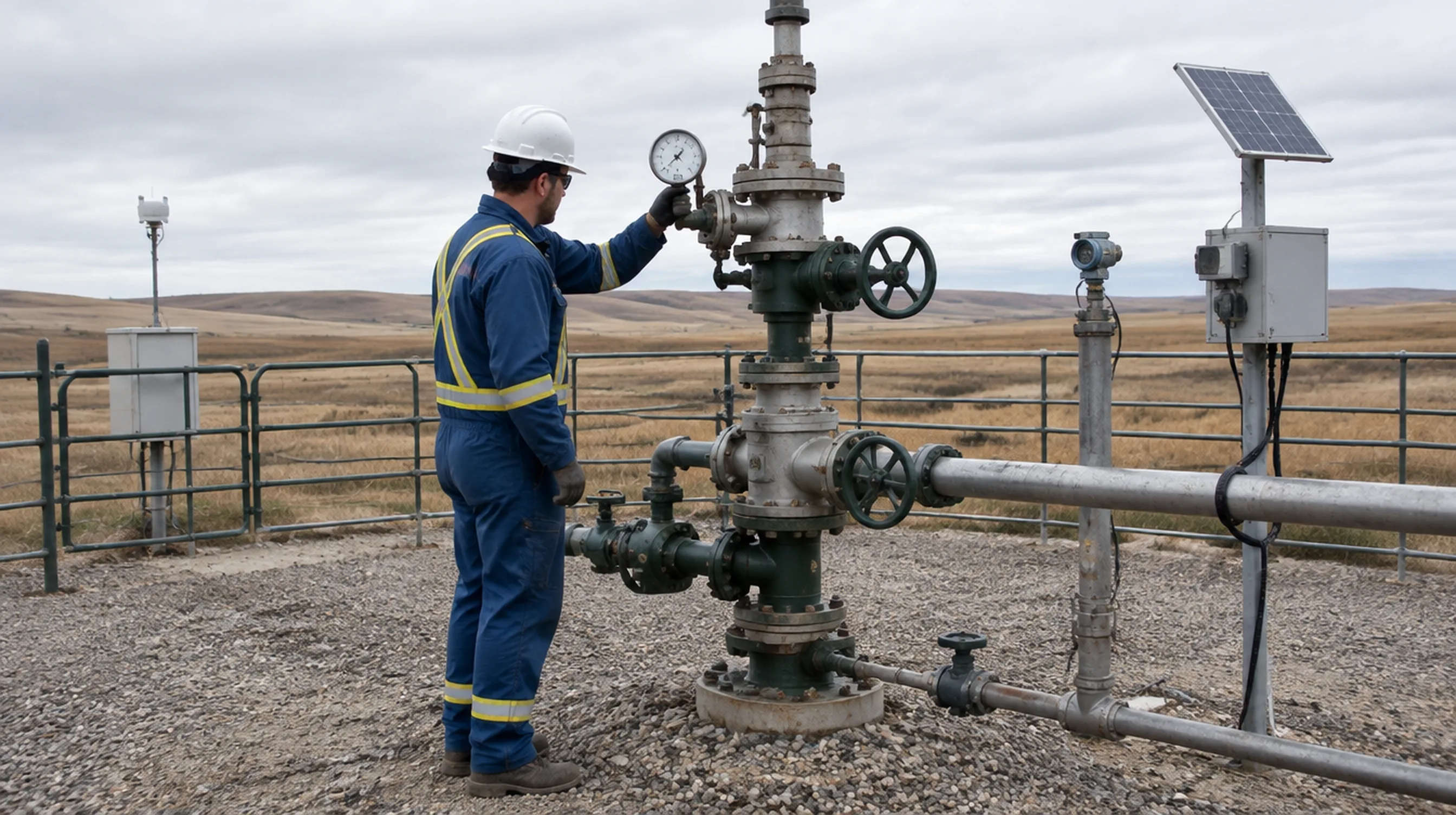
Geologic storage: report under EPA’s Greenhouse Gas Reporting Program Subpart RR with an approved monitoring, reporting and verification plan.
Enhanced oil recovery: report under Subpart RR or certify volumes under the CSA/ANSI ISO 27916 standard.
Utilization: get a lifecycle greenhouse gas analysis approved by the IRS and DOE before claiming. GAO found these approvals can take a long time and slow claims.
Recapture: if stored carbon oxide leaks during the three-year recapture period, the credit for those tons must be paid back.
Who claims the credit matters too. It belongs to the owner of the capture equipment, which can elect to allow the company that stores or uses the CO2 to claim it instead, a common structure when a pipeline or storage operator takes the gas.
Can you sell 45Q credits or get them paid as cash?
Yes, both. Any 45Q taxpayer can sell the credit to an unrelated buyer for cash under Section 6418, or elect direct payment from the IRS for the first five years of the 12-year period under Section 6417. Tax-exempt and government owners can take direct payment for all 12 years.
Direct pay is attractive early on, but the money arrives only after the tax return is filed, so many owners sell the remaining credits, or all of them, to corporate buyers. 45Q credits usually sell for less than solar or wind credits because buyers price the leakage, measurement and recapture risk. Clean monitoring plans, a strong storage operator and tax credit insurance help close that gap. See our guides to elective pay and transferable credit pricing.
Can 45Q be combined with other credits?
Generally no. A facility can’t claim both 45Q and the 45V clean hydrogen credit, and a fuel producer claiming 45Q at a facility can’t also claim the 45Z clean fuel credit there for that year. Owners model both before choosing.
The choice often comes down to which credit pays more per unit of output. A hydrogen plant compares 45Q on captured CO2 with the 45V credit, and an ethanol plant compares 45Q against the lower carbon score, and higher 45Z credit, that capture can earn its fuel.
Sources
Legal Information Institute, 26 U.S. Code 45Q, Credit for carbon oxide sequestration
U.S. Government Accountability Office, Carbon Capture Tax Credit: Actions Needed to Improve Federal Administration (GAO-26-107711)
Global CCS Institute, U.S. preserves and increases 45Q credit in One Big Beautiful Bill Act
Federal Register, Credit for Carbon Oxide Sequestration, final regulations (2021)
Frequently Asked Questions
How much is the 45Q tax credit per ton?
In 2026, $85 per metric ton for carbon oxide captured at an industrial or power plant and $180 per ton for direct air capture, if the project meets prevailing wage and apprenticeship requirements. Without them the credit is $17 and $36 per ton.
Does enhanced oil recovery qualify for the full 45Q credit?
How long can you claim 45Q?
Can you sell 45Q tax credits?
Does Cenet Capital buy 45Q credits?
Capturing carbon? Turn every ton into cash.
Cenet Capital buys 45Q credits from capture and storage owners and reviews monitoring plans, volumes and recapture risk up front, so you know your price before you file. Send us your annual tons.

More Insights