

The 30C EV charger credit: 30% up to $100,000 per charger, eligible census tracts, the June 30, 2026 cutoff, how to claim on Form 8911, and how to sell it.
Author -
Paulestini Francois
Published -
READ TIME
The 30C credit paid businesses up to $100,000 per EV charger, and although it ended for chargers placed in service after June 30, 2026, many owners still haven't claimed or sold the credits they earned. Here's what the 30C credit is worth, how to confirm that an installed charger sits in an eligible census tract, how to claim it on Form 8911, and how businesses without enough tax liability can turn it into cash.
QUICK ANSWER
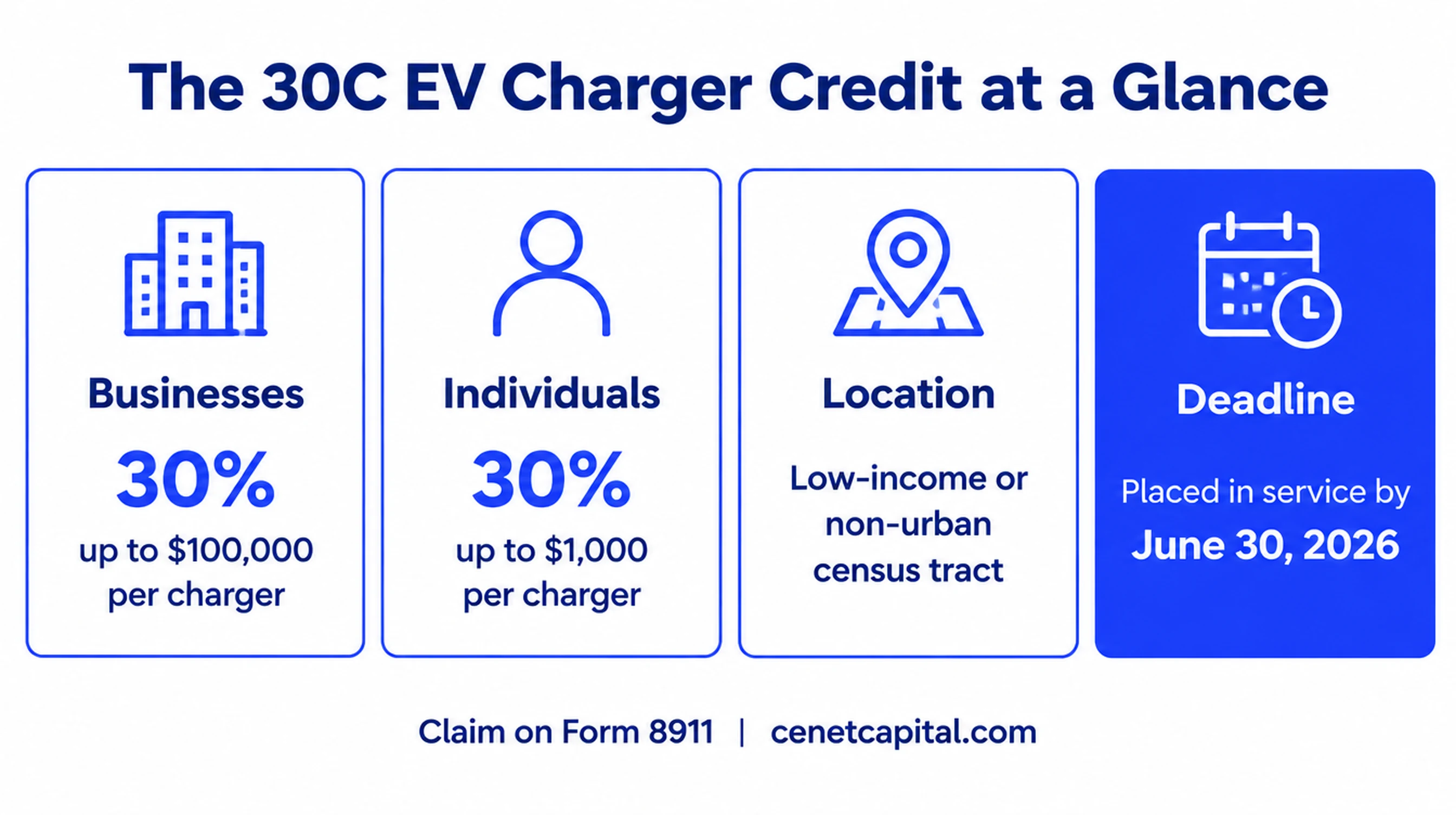
The 30C tax credit is a federal tax credit for installing qualified alternative fuel vehicle refueling property, mainly EV chargers, in eligible low-income or non-urban census tracts. Businesses could claim up to 30% of each charger’s cost, capped at $100,000 per item; individuals up to $1,000 per item.
KEY FACTS
What it is: Section 30C, the alternative fuel vehicle refueling property credit, a federal tax credit for EV chargers and other clean-fuel refueling equipment.
Business amount: 30% of cost with prevailing wage and apprenticeship (6% without), up to $100,000 per item of property.
Individual amount: 30% of cost, up to $1,000 per item, for home chargers.
Location rule: the charger must be in an eligible census tract, either a low-income community or a non-urban tract.
Deadline: ended for property placed in service after June 30, 2026, under the One Big Beautiful Bill Act.
Still claimable: chargers placed in service by June 30, 2026 are claimed on Form 8911 for that tax year, and business credits can be sold for cash.
What is the 30C tax credit?
The 30C tax credit is a federal tax credit for installing qualified alternative fuel vehicle refueling property, mainly EV chargers, in eligible low-income or non-urban census tracts. Businesses could claim up to 30% of each charger’s cost, capped at $100,000 per item; individuals up to $1,000 per item. The Inflation Reduction Act extended and expanded it through 2032, but the One Big Beautiful Bill Act ended it for property placed in service after June 30, 2026.
That doesn’t make it irrelevant. Thousands of chargers placed in service in 2025 and the first half of 2026 still have credits to claim on 2025 and 2026 returns, and businesses that can’t use the credit can still sell it. This guide covers how much it’s worth, how to confirm eligibility for a charger already installed, and how to claim or sell the credit. The official program summary is on the Department of Energy’s Alternative Fuels Data Center.
How much is the 30C credit?
For businesses, 30% of the cost of each item of qualified refueling property, up to $100,000 per item, if prevailing wage and apprenticeship requirements are met; otherwise 6%. For individuals, 30% up to $1,000 per item.
Example | Cost per charger | Credit per charger | Total |
|---|---|---|---|
10 DC fast chargers, PWA met | $150,000 | $45,000 | $450,000 |
4 high-power chargers, PWA met | $400,000 | $100,000 (capped) | $400,000 |
20 Level 2 workplace chargers, no PWA | $8,000 | $480 | $9,600 |
Home Level 2 charger (individual) | $2,500 | $750 | $750 |
The cap applies per “single item of property,” which IRS guidance generally treats as each charging unit and its related equipment, not the whole site. That’s why multi-charger sites can earn well over $100,000 in total. Costs include equipment, installation and related electrical work that is part of the property. The depreciable basis is reduced by the credit amount. Use the calculator below to estimate a site.
Can you still claim 30C on your chargers?
Illustrative only. Business credit capped at $100,000 per item of property; individual credit capped at $1,000 per item. Claimed on Form 8911 for the year placed in service. Confirm eligibility with your tax advisor.
Sell my charger credit →How do you check if a location is eligible for 30C?
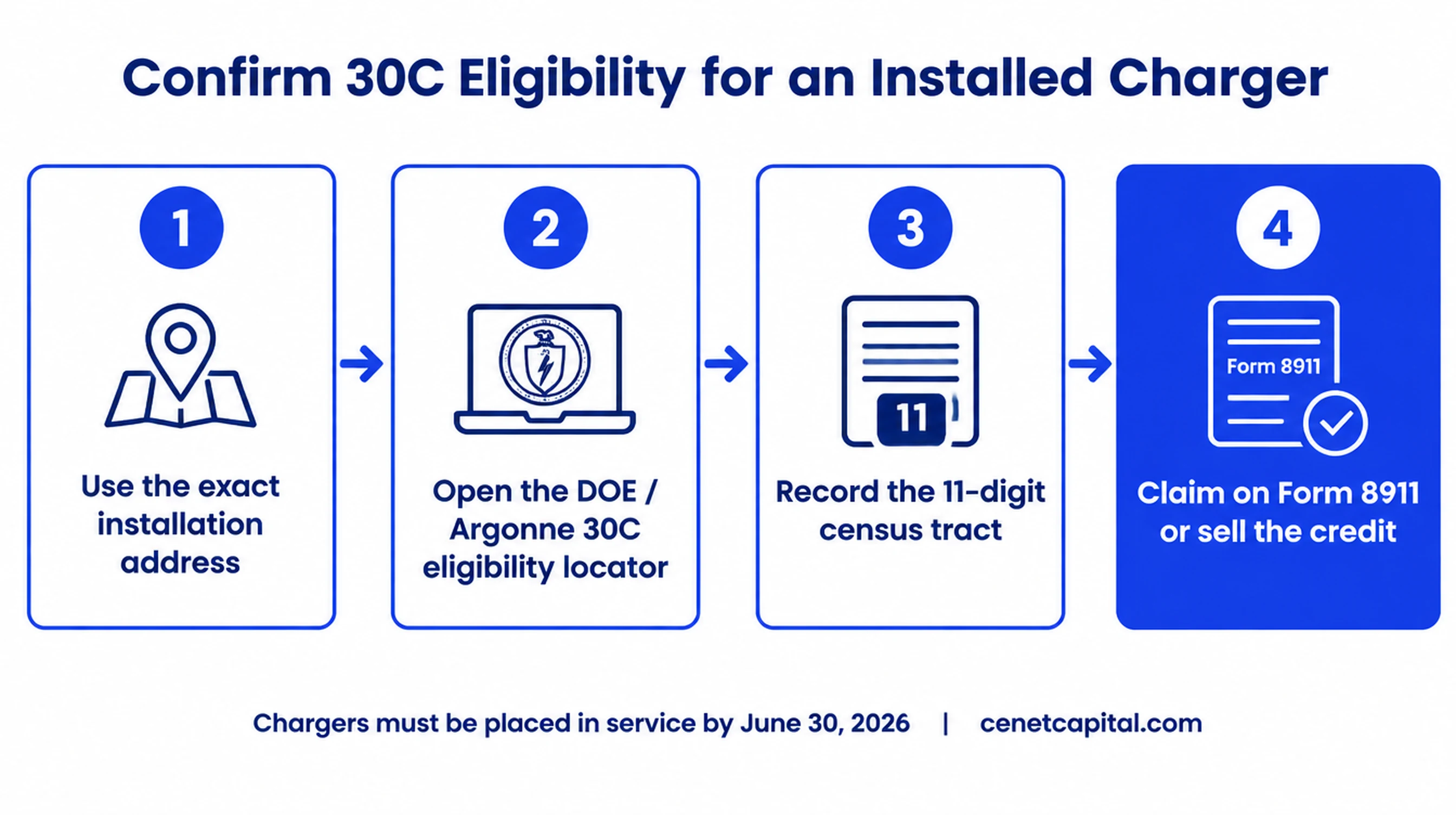
Look up the charger’s address in Argonne National Laboratory’s 30C Tax Credit Eligibility Locator (linked from the AFDC page), which maps every eligible census tract. A tract qualifies if it’s a low-income community (as defined for the New Markets Tax Credit) or isn’t an urban area. Steps:
Use the exact installation address or coordinates.
Open the locator and check the layer that applies to the date the charger was placed in service.
Note the 11-digit census tract number, which you’ll report on Form 8911.
Save a screenshot for your records and for any credit buyer.
Roughly two-thirds of Americans live in an eligible tract, according to the Treasury Department, so many suburban retail, rural highway and lower-income urban locations qualify. Chargers in eligible tracts installed after June 30, 2026 still don’t qualify, because the credit itself ended.
What property qualifies for the 30C credit?
EV chargers (Level 2 and DC fast), including bidirectional chargers.
Dispensing equipment for hydrogen, natural gas, propane and high-ethanol or biodiesel blends.
Requirements: new property, placed in service in an eligible tract, used in the U.S., and depreciable (for businesses) or installed at the taxpayer’s main home (for individuals).
Buildings, parking structures and general site improvements don’t qualify.
How do you claim the 30C credit?
File Form 8911, Alternative Fuel Vehicle Refueling Property Credit, with a Schedule A for each item of property, listing the census tract, cost and placed-in-service date. Businesses carry the credit to Form 3800. Businesses claiming the 30% rate on the basis of prevailing wage and apprenticeship attach Form 7220. Tax-exempt organizations and governments can claim it through elective pay, which requires IRS pre-filing registration. The deadline to claim is the return for the year the charger was placed in service, including extensions.
Can you sell a 30C tax credit?
Yes. 30C is one of the 11 transferable credits under Section 6418, so a business that installed eligible chargers by June 30, 2026 but has little federal tax liability can sell the credit for cash. Because 30C deals are usually small, they typically price toward the lower end of the market. Pooling credits from several sites, or combining them with other credits from the same owner, can improve pricing. The seller must register the property with the IRS before filing. See our guide to selling credits and tax credit pricing for how deals are valued.
What replaced 30C after June 2026?
No federal tax credit replaced it. Businesses installing chargers after June 30, 2026 rely on state rebates, utility make-ready programs and any remaining federal grant funding. Solar and storage paired with charging can still qualify for the 48E investment credit on the generation and storage portions, subject to their own deadlines. See energy tax credits in 2026 for what’s still available.
Sources
U.S. Department of Energy, Alternative Fuel Infrastructure Tax Credit
P.L. 119-21, as summarized by RSM
Our earlier walkthrough of Form 8911 for chargers installed before the deadline
Frequently Asked Questions
Is the 30C EV charger credit still available?
Only for property placed in service on or before June 30, 2026. Chargers placed in service after that date don't qualify.
Is the 30C cap $100,000 per site or per charger?
Does a charger have to be in a low-income area?
What form is used to claim 30C?
Can Cenet Capital buy or insure 30C EV charger credits?
Chargers in service by June 30, 2026? Claim the cash.
If your chargers were placed in service by June 30, 2026, your 30C credit can still be sold for cash. We'll confirm eligibility and price it, even for smaller sites.

More Insights