Credit Guides
What the 45VH2-GREET model is, how it sets your 45V tier, what it counts, its 9 pathways and electricity factors, which version to use, and an estimator.
Author -
Paulestini Francois
Published -
READ TIME
Every 45V claim runs through one government spreadsheet. The 45VH2-GREET model turns a hydrogen plant's inputs into an emissions rate, and that number decides whether you get the full credit, a fraction of it, or nothing. Here's what the GREET model is, how it sets your tier, what it counts and leaves out, the pathways and electricity factors it uses, which version you must use, and an estimator to test your power source.
QUICK ANSWER
45VH2-GREET is the Department of Energy's model for calculating well-to-gate greenhouse gas emissions from hydrogen production for the 45V credit. Producers enter a year of actual inputs, and the model returns kg of CO2e per kg of hydrogen. That emissions rate sets the 45V tier, from the full $3.28 per kg down to nothing above 4 kg.
KEY FACTS
What is 45VH2-GREET? DOE's version of Argonne's GREET model, adopted by Treasury to calculate 45V emissions rates.
Which 45V GREET version is current? 45VH2-GREET Rev. December 2025; DOE expects to update it at least annually.
What does the 45V emissions model count? Well-to-gate emissions: feedstock, energy, upstream methane, purification and compression to 300 psia.
What does the GREET model leave out? Construction emissions and everything after production, like transport and end use.
Which greet model 45v version applies to my claim? The latest version available on the first day of the tax year, unless you elect the version from when construction began.
How does the model treat grid power? At regional grid-average emissions unless qualifying EACs prove a cleaner source.
What is the 45VH2-GREET model?
45VH2-GREET is the Department of Energy’s spreadsheet model for calculating the well-to-gate greenhouse gas emissions of hydrogen production for the 45V tax credit. Developed by Argonne National Laboratory, it turns your facility’s inputs (feedstock, energy use and electricity sources) into kilograms of CO2e per kilogram of hydrogen, which sets your 45V tier.
It’s a version of Argonne’s broader GREET (Greenhouse gases, Regulated Emissions, and Energy use in Technologies) model, trimmed to the system boundary the Treasury chose for 45V. Treasury adopted it in the final regulations, and DOE publishes it with a user manual on its GREET page. The current release is 45VH2-GREET Rev. December 2025, and DOE says it expects to update the model at least annually.
How does the 45V GREET model decide how much credit you get?
The model’s output, kg of CO2e per kg of hydrogen, is the emissions rate that places your hydrogen in one of four 45V tiers. Under 0.45 kg earns the full credit, up to $3.28 per kg in 2026 with prevailing wage. Above 4 kg earns nothing. A small change in an input can move you across a tier line.
45VH2-GREET result (kg CO2e per kg H2) | Share of full credit | 2026 rate with prevailing wage |
|---|---|---|
Under 0.45 | 100% | $3.28 per kg |
0.45 to under 1.5 | 33.4% | $1.095 per kg |
1.5 to under 2.5 | 25% | $0.82 per kg |
2.5 to 4.0 | 20% | $0.655 per kg |
Above 4.0 | 0% | Not eligible |
The jump from the second tier to the first triples the credit, which is why producers fight over tenths of a kilogram. Our 45V tax credit calculator converts any emissions rate into a 10-year credit value.
What does 45VH2-GREET count, and what does it leave out?
It counts emissions “well to gate”: from extracting and delivering feedstock and energy through the point of hydrogen production, including purification and compression to a standard 300 psia. It leaves out construction (embodied) emissions and everything after production, such as transport and end use. It measures methane and nitrous oxide on a 100-year warming basis.
Greenhouse gases: CO2, methane and nitrous oxide, converted with IPCC AR5 100-year warming factors (methane 28, nitrous oxide 265). Fossil methane gets 2 added to account for its later oxidation into CO2.
Upstream methane: by default, about 0.7% of the methane a reformer consumes is assumed lost upstream. The model also lets producers enter supplier-specific leakage values if they come from EPA-verified Greenhouse Gas Reporting Program data.
Pressure: if you produce below 300 psia, the model adds the electricity needed to compress to that level, and it does the same above 300 psia.
Purification: under 26 CFR 1.45V-1, emissions from any purification needed before the hydrogen can be productively used count toward the rate.
Which hydrogen pathways can 45VH2-GREET model?
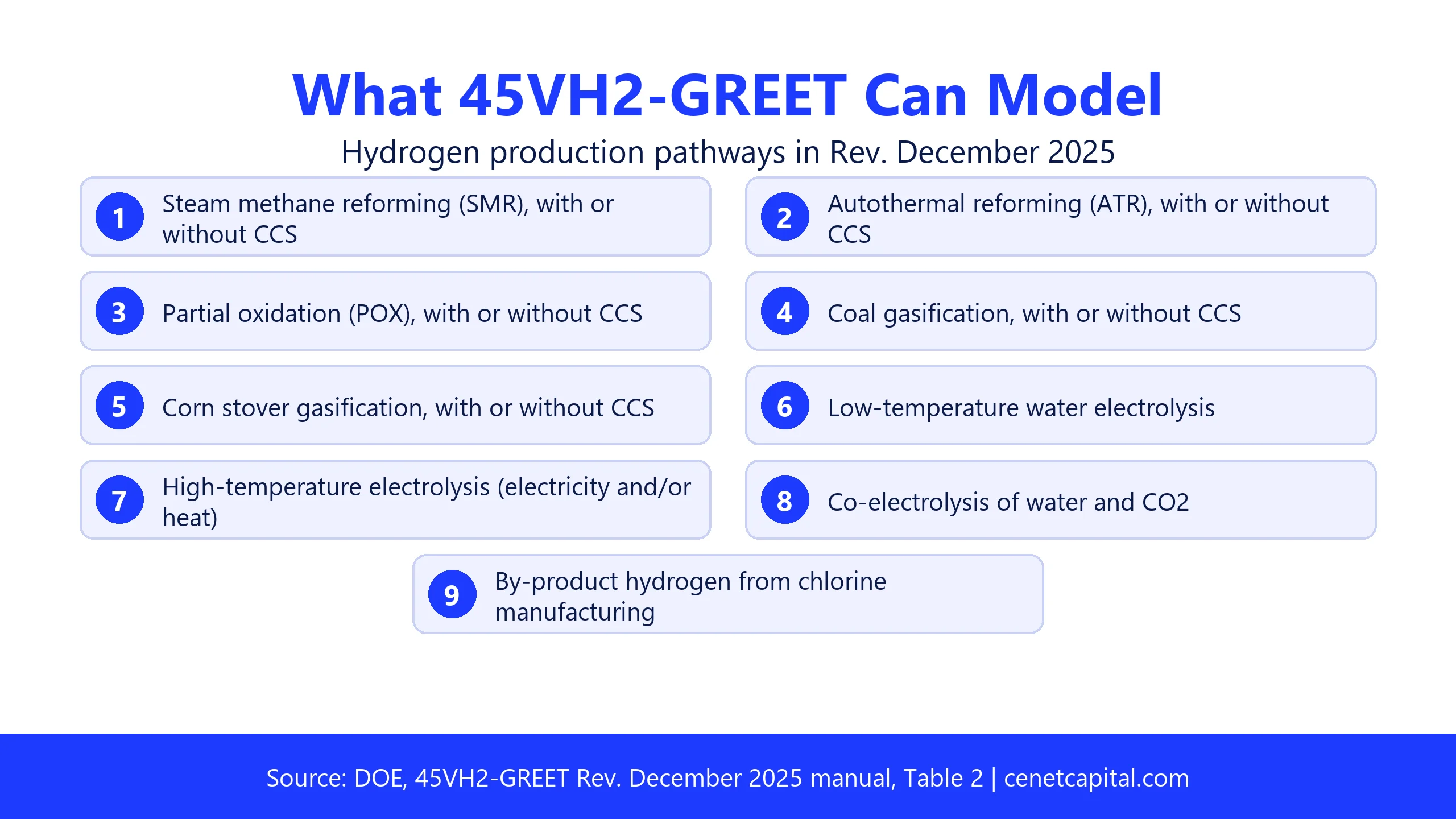
The December 2025 release covers nine processes: steam methane reforming, autothermal reforming and partial oxidation (each with optional carbon capture), coal and corn stover gasification, low- and high-temperature electrolysis, co-electrolysis of water and CO2, and by-product hydrogen from chlorine production. Pathways outside the model need a provisional emissions rate from DOE.
The reforming pathways accept fossil natural gas or renewable natural gas from landfills, animal manure or wastewater plants, plus coal mine methane. High-temperature electrolysis can use heat only from a light water nuclear reactor, from electricity, or from a non-combustion reaction such as ammonia synthesis. If your process isn’t listed, section 45V(c)(2)(C) lets you petition for a provisional emissions rate, which DOE reviews.
How does 45VH2-GREET treat electricity?
Electricity from the grid is counted at your regional grid’s average emissions unless you retire qualifying energy attribute certificates that meet the three pillars. With qualifying EACs, the model uses the generator’s own factor: zero for wind, solar and hydro, 0.00253 kg CO2e per kWh for nuclear and 0.488 for natural gas.
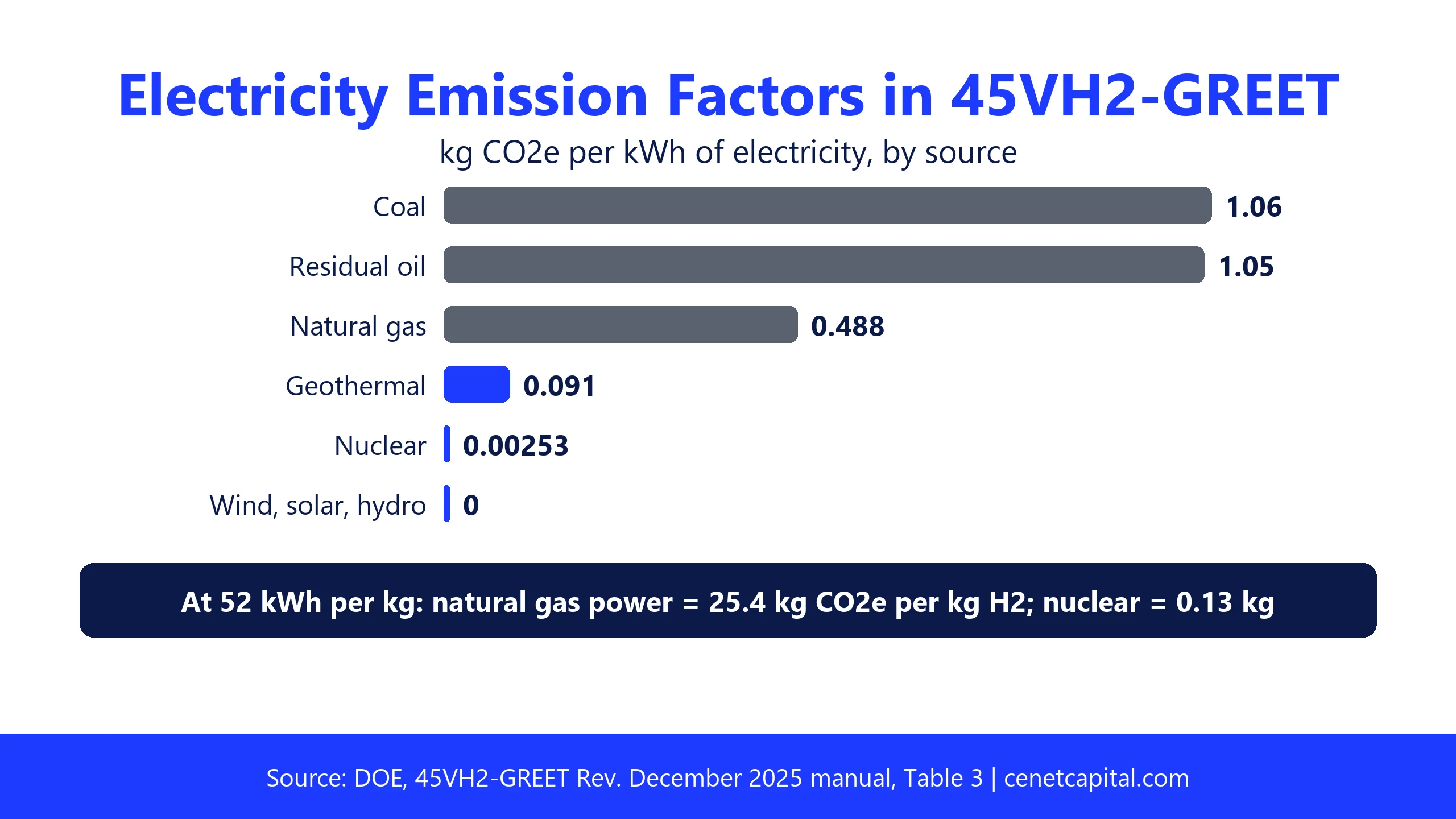
That’s why the electricity source matters more than the electrolyzer. At 52 kWh per kg, power from natural gas plants puts hydrogen at about 25 kg of CO2e per kg, six times the limit, while nuclear lands near 0.13 kg from electricity alone. The rules for proving clean power are in our guide to energy attribute certificates for 45V. Hourly accounting is allowed only from 2030; until then, the model works on annual totals.
Which 45V tier does your power source land in?
Illustrative only. Counts electricity emissions with the 45VH2-GREET Rev. December 2025 factors. The full model also adds compression, purification and other process inputs, so your official rate will be somewhat higher.
Check my 45V emissions →Which version of 45VH2-GREET do you have to use?
Generally, the latest version that was publicly available on the first day of the taxable year in which the hydrogen was produced. You may use a version released later in that same year. Or you can make an irrevocable election to lock in the version that was available when construction of the facility began, for the rest of the 10-year credit period.
Both rules come from the final regulations, 26 CFR 1.45V-1 and 1.45V-4. The beginning-of-construction election is a hedge: if DOE later changes a background assumption against your pathway, such as upstream methane, you keep the older numbers. If future versions are likely to help your pathway, you’d skip the election. Construction has to begin before January 1, 2028, so that window is closing; see our explainer on 45V and the One Big Beautiful Bill.
How do you run 45VH2-GREET for a 45V claim?
Download the model and manual from DOE, pick a single primary feedstock for each process, and enter a full taxable year of actual inputs: feedstock and fuel quantities, electricity by source with EACs, co-products, hydrogen output and production pressure. The result goes on Form 7210, and an unrelated verifier has to sign off on it.
Choose the production technology and one primary feedstock per process; facilities with two feedstocks model each process separately.
Enter the year simulated, grid region, and electricity use split by source, backed by retired EACs.
Enter natural gas or other feedstock use, purchased steam or heat, and any carbon captured and stored.
Enter hydrogen output, purity and pressure, then record the emissions rate the model reports.
Hand the inputs, model file and supporting records to your qualified verifier and attach the report to Form 7210.
What GREET mistakes cost producers the most?
Using the wrong model version, counting grid power that isn’t backed by qualifying EACs, and leaving out purification or compression energy. Each one can push the emissions rate into a lower tier, or above the 4 kg cutoff, and the IRS can disallow credits claimed on a rate the records don’t support.
Buyers of transferred credits review the same model file, so errors also cut the price a seller can get. Our guide to monetizing 45V credits covers what diligence teams ask for.
Sources
U.S. Department of Energy, Guidelines to Determine Well-to-Gate GHG Emissions of Hydrogen Production Pathways using 45VH2-GREET Rev. December 2025
U.S. Department of Energy, GREET
Legal Information Institute, 26 CFR 1.45V-1, Definitions
Legal Information Institute, 26 CFR 1.45V-4, Lifecycle greenhouse gas emissions rate
Legal Information Institute, 26 U.S. Code 45V, Credit for production of clean hydrogen
Frequently Asked Questions
What is the 45VH2-GREET model?
45VH2-GREET is the Department of Energy's spreadsheet model, developed by Argonne National Laboratory, that calculates well-to-gate greenhouse gas emissions of hydrogen production. Treasury adopted it for the 45V credit, and its result in kg of CO2e per kg of hydrogen sets the credit tier.
Which version of 45VH2-GREET should I use?
What emissions does 45VH2-GREET include?
What if my hydrogen pathway isn't in 45VH2-GREET?
Does Cenet Capital review 45VH2-GREET results before buying 45V credits?
Not sure your GREET result will hold up?
Cenet Capital reviews 45VH2-GREET inputs, verifier reports and EAC records before buying or insuring 45V credits, so you know your tier and price before you file. Send us your model results for a review.

More Insights