
Credit Guides
Can existing nuclear plants make 45V hydrogen? The qualifying reactor tests, the 200 MWh-per-hour cap, uprates and restarts, emissions, projects and a calculator.
Author -
Paulestini Francois
Published -
READ TIME
Nuclear reactors look like the perfect partner for hydrogen: steady, carbon-free power around the clock. But the 45V rules treat most existing reactors as old power that doesn't count. Here's how nuclear hydrogen can still qualify, the three tests for an at-risk reactor, how the 200 MWh-per-hour cap works, the rules for uprates and restarts, the emissions rate you can expect, and a calculator to size your credit.
QUICK ANSWER
Yes, but only through narrow exceptions. Existing nuclear reactors normally fail 45V's 36-month incrementality rule. A qualifying at-risk reactor can supply up to 200 MWh per operating hour that counts as incremental, and uprates and restarts have their own routes. Nuclear power adds only about 0.13 kg of CO2e per kg of hydrogen.
KEY FACTS
What is pink hydrogen? A common name for nuclear hydrogen, made by electrolysis using electricity or heat from a nuclear reactor.
What is the 45V nuclear cap? 200 MWh per operating hour per qualifying reactor can count as incremental.
What makes an at-risk nuclear 45V reactor qualify? Merchant or single-unit, gross receipts under 4.375 cents/kWh in 2 of 2017 to 2021, and behind-the-meter or a 10-year contract.
Do nuclear uprates count? Yes, if completed within 36 months of the hydrogen facility's in-service date, for the uprated share only.
What emissions rate does nuclear hydrogen get? About 0.13 kg CO2e per kg from electricity at 52 kWh per kg, using GREET's 0.00253 kg per kWh factor.
What's the deadline? Construction of the hydrogen facility must begin before January 1, 2028.
What is nuclear hydrogen?
Nuclear hydrogen is hydrogen made by electrolysis using electricity, and sometimes heat, from a nuclear reactor. It’s often called pink hydrogen. Because nuclear power emits almost no CO2 when it runs, the hydrogen can fall well under 0.45 kg of CO2e per kg, the threshold for the full 45V clean hydrogen credit.
Reactors suit nuclear hydrogen production because they run around the clock at steady output, which keeps expensive electrolyzers busy. DOE estimates that a single 1,000-megawatt nuclear plant could produce up to 150,000 tons of hydrogen a year, according to its Office of Nuclear Energy. High-temperature electrolyzers can also use the reactor’s heat to cut the electricity they need.
Can existing nuclear plants produce 45V-qualifying hydrogen?
Yes, but only through a narrow exception. Existing reactors usually fail the 36-month incrementality rule, because they began operating decades ago. The final 45V rules let a “qualifying nuclear reactor” count anyway, capped at 200 MWh of electricity per operating hour per reactor. Uprates and restarts of retired plants have their own routes.
Without the exception, power from an old reactor is treated like any other existing generator: it can’t be shown as incremental, so the hydrogen gets credited at the regional grid’s average emissions and usually fails the 4 kg limit. Treasury carved out the at-risk reactor path in the January 2025 final rules, 26 CFR 1.45V-4, on the theory that hydrogen revenue could keep a financially struggling plant from retiring.
What makes a reactor a “qualifying nuclear reactor” for 45V?
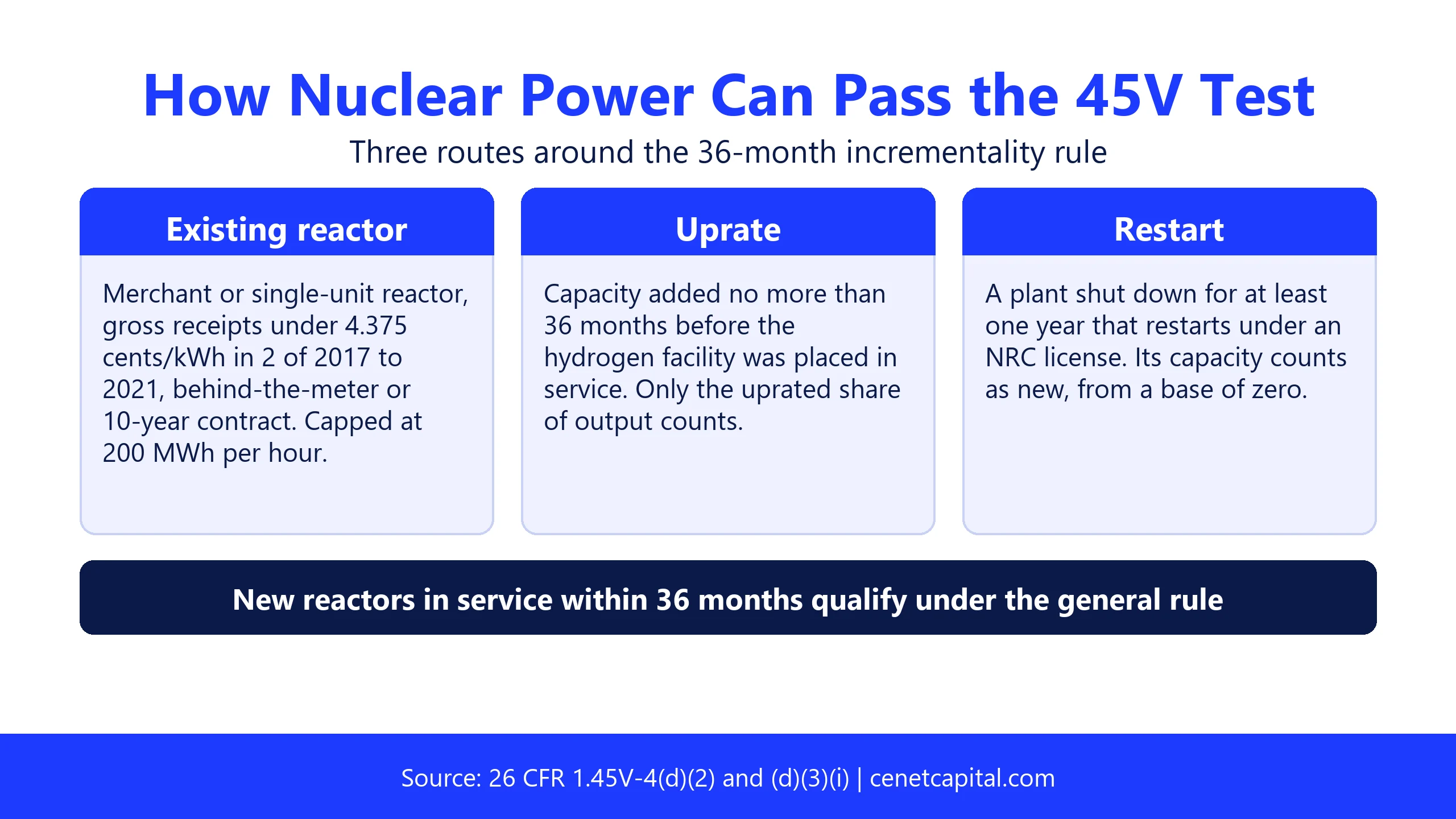
Three tests. The reactor must be a merchant plant or not co-located with another operating reactor. Its average annual gross receipts must have been under 4.375 cents per kWh in any two calendar years from 2017 through 2021. And it must either connect to the hydrogen facility behind the meter or sign a binding offtake contract of at least 10 years.
Merchant or single-unit: a merchant reactor sells into a competitive market, with more than 50% of the reactor and its output not recovering costs through rate regulation or public ownership.
Financial stress: gross receipts below 4.375 cents per kWh in at least two years from 2017 to 2021, tested against any one owner.
Behind the meter: a physical electrical connection on the reactor’s side of the utility meter, before either side connects to the grid.
Or a 10-year contract: a written binding contract under which the hydrogen producer buys and retires the reactor’s EACs and takes on part of its revenue risk. Under that route, only the MWh actually bought under the contract count.
Those definitions sit in 26 CFR 1.45V-4(d)(2). A contract with a damages cap below 5% of the total contract price doesn’t count as binding.
How does the 200 MWh-per-hour cap work?
Only 200 MWh of a qualifying reactor’s electricity per operating hour can count as incremental. At 52 kWh per kg, that supports about 3,846 kg of hydrogen an hour, or roughly 33,700 tonnes a year running every hour. Sites with several integrated reactors get 200 MWh per hour times the number still operating.
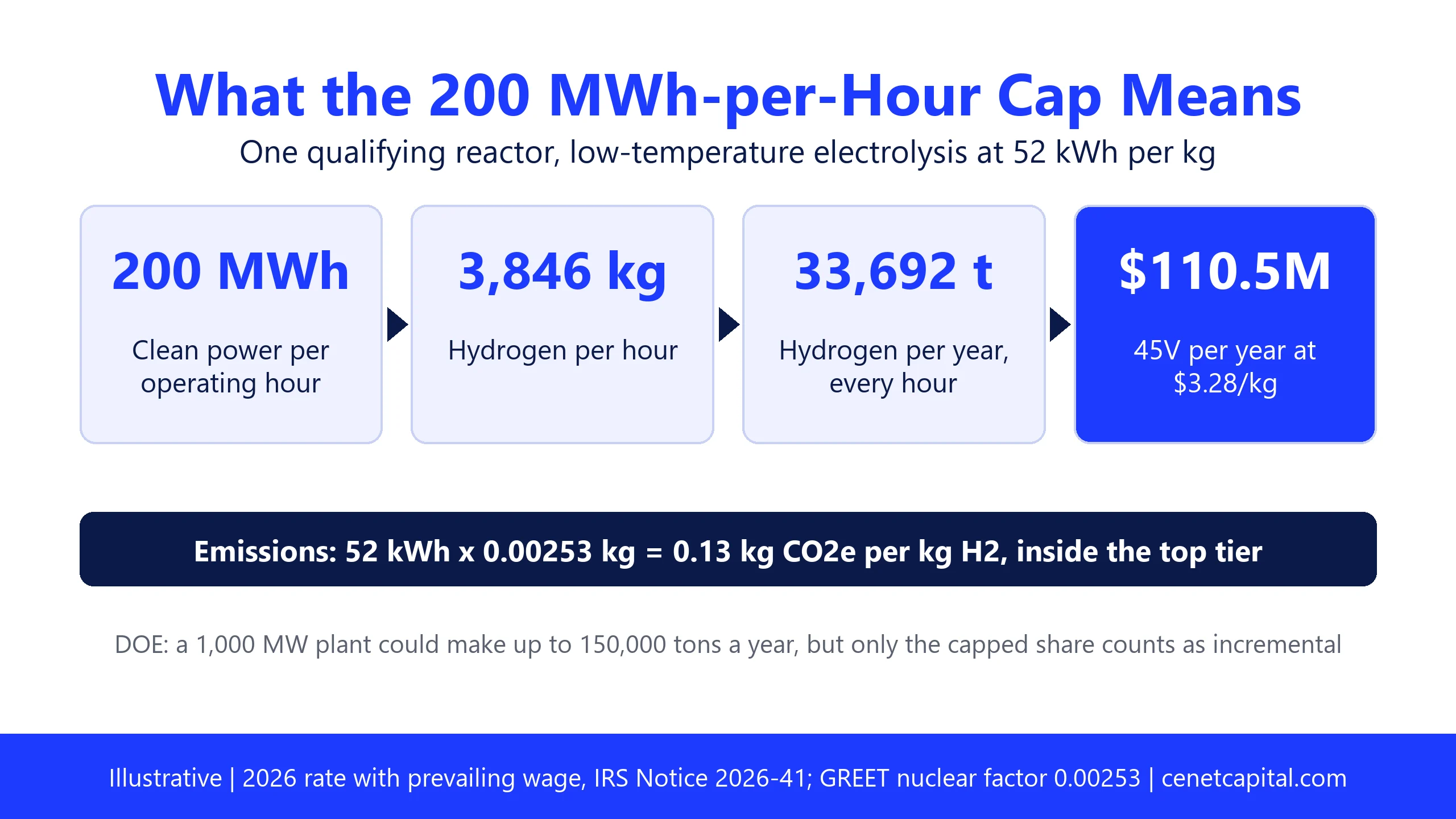
At the top 2026 rate of $3.28 per kg, a fully used cap is worth about $110 million a year for 10 years. Related companies count as one taxpayer when deciding whether reactors are integrated, so splitting ownership doesn’t add capacity. Power above the cap can still run the electrolyzer, but that hydrogen is scored at grid-average emissions unless other qualifying EACs cover it.
Do nuclear uprates and restarts qualify for 45V?
Yes. An uprate completed no more than 36 months before the hydrogen facility was placed in service counts as incremental, but only for the uprated share of output. A retired or decommissioning plant that restarts can treat its capacity as new from a base of zero, if it was shut down for at least a year and restarts under an NRC license.
For an uprate, the incremental share is the added capacity divided by post-uprate capacity, applied hour by hour or year by year to total output. A 1,000 MW reactor uprated to 1,100 MW would supply about 9.1% of its output as incremental. The restart rule also bars plants that shut down specifically to qualify. Brand-new reactors placed in service within 36 months of the hydrogen facility qualify under the general rule, as explained in our guide to energy attribute certificates for 45V.
What 45V nuclear emissions rate can a reactor achieve?
Very low. 45VH2-GREET assigns nuclear power 0.00253 kg of CO2e per kWh, so an electrolyzer using 52 kWh per kg adds only about 0.13 kg of CO2e per kg of hydrogen from electricity. That’s well inside the top 45V tier, as long as the power is covered by qualifying EACs.
Deliverability and temporal matching still apply: the reactor must be in the same grid region, and from 2030, generation has to match electrolyzer use hour by hour. Steady nuclear output makes hourly matching far easier than with wind or solar. The model, its electricity factors and version rules are covered in our 45VH2-GREET guide, and the green hydrogen tax credit article compares other power sources.
How much of your electrolyzer does the 200 MWh cap cover?
Illustrative only. Assumes the reactor meets the qualifying nuclear reactor tests and all power is matched with qualifying EACs in the same grid region. Uses the 45VH2-GREET nuclear factor (0.00253 kg CO2e per kWh) and 2026 rates; the full model adds other process emissions.
Price my nuclear H2 credits →Which U.S. nuclear plants are making hydrogen?
Three DOE-backed demonstrations lead the way. Constellation’s Nine Mile Point in New York started producing hydrogen in February 2023, the first nuclear-powered clean hydrogen facility in the U.S. Energy Harbor’s Davis-Besse in Ohio is testing low-temperature electrolysis, and Xcel Energy and Bloom Energy are demonstrating high-temperature electrolysis at Prairie Island in Minnesota.
DOE expected Prairie Island to start producing hydrogen in 2026. All three are small demonstrations sized to test the technology and economics, not commercial plants. Commercial-scale nuclear hydrogen still faces the same constraint as every other 45V project: construction must begin before January 1, 2028, under the One Big Beautiful Bill Act. Our explainer on 45V and the One Big Beautiful Bill covers that deadline.
How do nuclear hydrogen producers turn 45V into cash?
By transferring the credit to an unrelated corporate buyer under section 6418. A producer without enough federal tax liability sells the 45V credit for cash, usually at a discount to face value. Buyers price nuclear-backed credits on the reactor’s qualifying status, EAC contracts, verifier reports and the hourly matching records that apply from 2030.
Because the at-risk reactor test looks back to 2017 to 2021 gross receipts, buyers will ask for that analysis early. Our guide to monetizing the 45V credit walks through a transfer step by step, and tax credit insurance can cover the qualification risk.
Sources
Legal Information Institute, 26 CFR 1.45V-4, Lifecycle greenhouse gas emissions rate
Legal Information Institute, 26 U.S. Code 45V, Credit for production of clean hydrogen
U.S. Department of Energy, Office of Nuclear Energy, 3 Nuclear Power Plants Gearing Up for Clean Hydrogen Production
U.S. Department of Energy, 45VH2-GREET Rev. December 2025 user manual
Frequently Asked Questions
Can existing nuclear plants produce 45V-qualifying hydrogen?
Yes, through a narrow exception. A qualifying nuclear reactor can supply up to 200 MWh per operating hour that counts as incremental even though it began operating long ago. Uprates within 36 months and restarts of retired plants have their own routes.
What is a qualifying nuclear reactor for 45V?
How does the 200 MWh-per-hour cap work?
What 45V tier can nuclear hydrogen reach?
Does Cenet Capital buy 45V credits from nuclear hydrogen producers?
Producing hydrogen from nuclear power? Get paid now.
Cenet Capital buys and insures 45V credits from nuclear-powered hydrogen producers and reviews reactor qualification, EAC contracts and verifier reports up front. Send us your capacity and output for a price.

More Insights