Credit Guides
Can clean ammonia plants claim 45V? What green ammonia earns per tonne, when blue ammonia should take 45Q instead, 2026 projects, deadlines and a calculator.
Author -
Paulestini Francois
Published -
READ TIME
Clean ammonia is where a lot of U.S. hydrogen ends up, but the tax code doesn't pay for ammonia. It pays for the hydrogen inside it, or for the CO2 a plant captures. Here's whether your ammonia plant can claim the 45V credit, what green ammonia earns per tonne, when blue ammonia is better off with 45Q, which projects are moving in 2026, the deadlines, and a calculator to price your plant.
QUICK ANSWER
Clean ammonia producers can claim the 45V credit only on hydrogen they produce themselves, not on the ammonia. Each tonne of ammonia holds 177.6 kg of hydrogen, worth about $582 at the top 2026 tier. Blue ammonia plants usually claim 45Q for stored CO2 instead, and can't claim both.
KEY FACTS
Is there an ammonia tax credit? Not directly. Producers claim 45V on the hydrogen they make, or 45Q on CO2 captured and stored.
What is green ammonia worth under 45V? About $582 per tonne at the top tier in 2026, since each tonne contains 177.6 kg of hydrogen.
What is blue ammonia? Ammonia made from natural gas hydrogen with the CO2 captured and stored; it usually claims 45Q at up to $85 per ton.
Can a plant claim green ammonia 45V and 45Q together? No. 45V is barred at a facility with carbon capture equipment for which 45Q was allowed.
Is low-carbon ammonia the same as clean ammonia? Both are industry labels covering green and blue ammonia; the tax code looks only at the hydrogen or the CO2.
What are the deadlines? Construction must begin before January 1, 2028 for 45V and before January 1, 2033 for 45Q.
Can clean ammonia producers claim the 45V credit?
Yes, but only on the hydrogen. The 45V credit pays per kilogram of qualified clean hydrogen that the taxpayer produces, not per tonne of ammonia. An ammonia plant that makes its own low-emission hydrogen can claim 45V on that hydrogen. A plant that buys hydrogen can’t, because the credit belongs to whoever produced it.
Under 26 U.S.C. 45V, the hydrogen must be produced at a qualified facility in the ordinary course of business and sold or used. Turning it into ammonia counts. The final rules define a productive use as consumption that “generates positive economic value,” judged without regard to the credit itself (26 CFR 1.45V-1).
Emissions are counted “well to gate,” through the point where the hydrogen is produced. So the emissions rate that sets your 45V tier reflects how the hydrogen was made, plus any purification it needs before use, rather than the ammonia synthesis loop downstream. Our guide to 45V tax credit rules covers the full eligibility test.
How much is the ammonia tax credit worth per tonne?
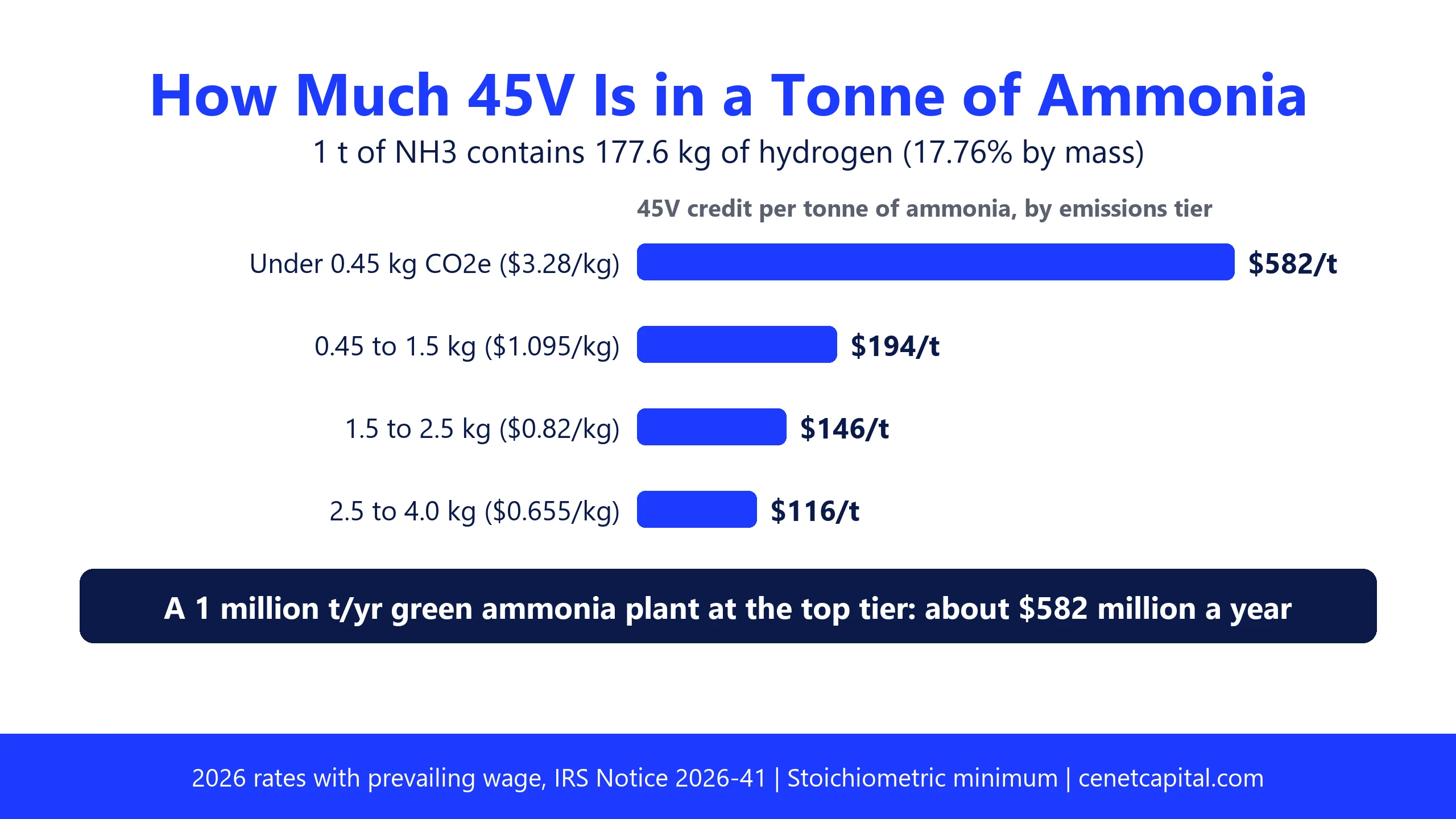
About $582 per tonne of ammonia at the top 45V tier in 2026. Every tonne of ammonia (NH3) contains 177.6 kg of hydrogen, and hydrogen under 0.45 kg of CO2e per kg earns $3.28 per kg with prevailing wage and apprenticeship. Lower tiers pay roughly $116 to $194 per tonne of ammonia.
The 177.6 kg figure is chemistry: hydrogen makes up 17.76% of ammonia’s mass (three hydrogen atoms at 1.008 each, out of a molecular weight of 17.03). Real plants use a little more because of purge gas and losses. 45V counts all qualified hydrogen produced, so the credit per tonne can run slightly higher than the table shows.
Hydrogen emissions (kg CO2e per kg) | 2026 rate per kg H2 | Credit per tonne of ammonia | 500,000 t/yr plant |
|---|---|---|---|
Under 0.45 | $3.28 | $582 | $291.2 million |
0.45 to under 1.5 | $1.095 | $194 | $97.2 million |
1.5 to under 2.5 | $0.82 | $146 | $72.8 million |
2.5 to 4.0 | $0.655 | $116 | $58.2 million |
Rates reflect the 2026 inflation adjustment and assume prevailing wage and apprenticeship rules are met; without them, divide by five. The credit runs for 10 years from the date the hydrogen facility is placed in service. Our 45V tax credit calculator projects the full 10 years.
What is the difference between green ammonia and blue ammonia?
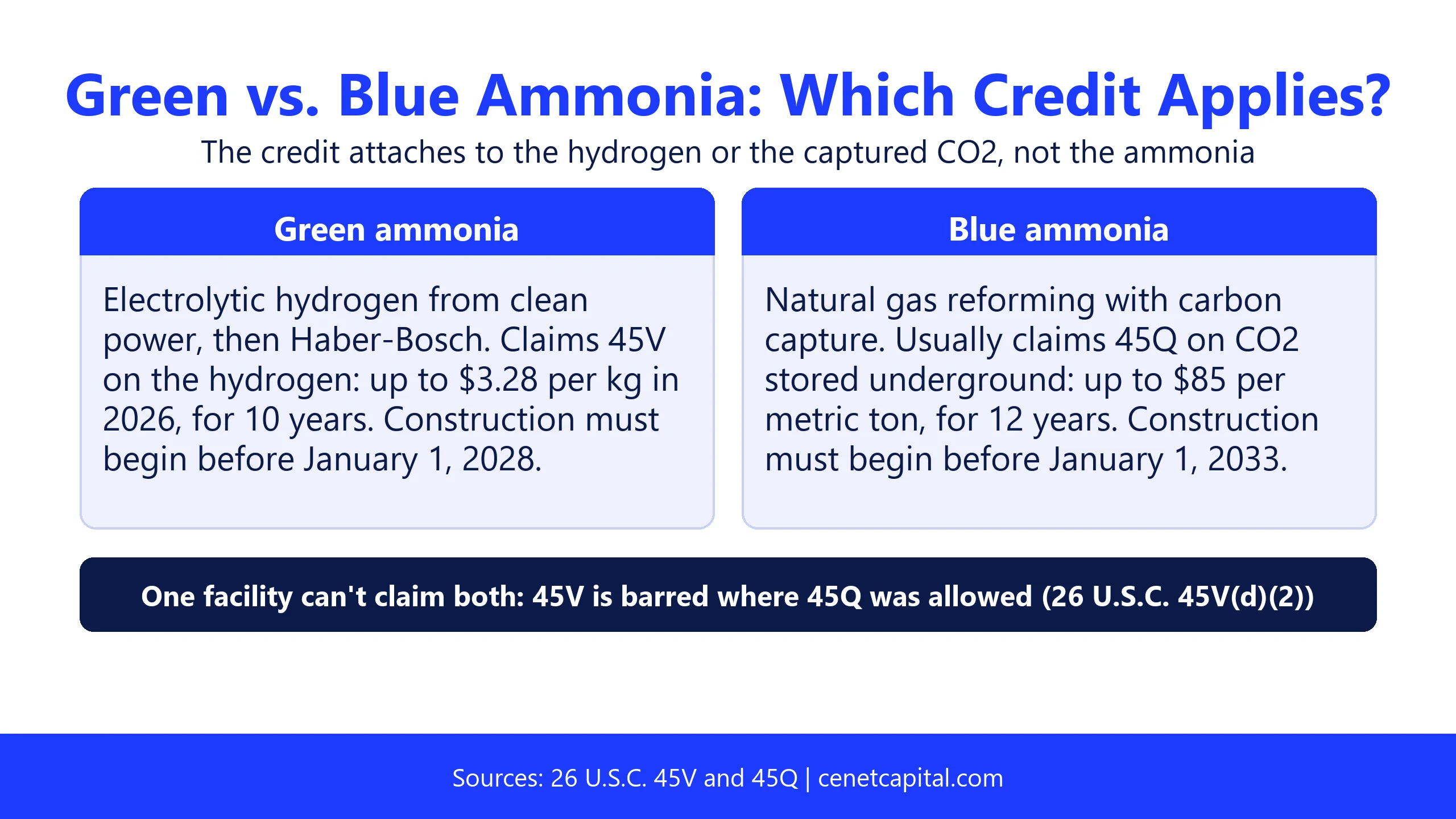
Green ammonia uses hydrogen from electrolysis powered by clean electricity. Blue ammonia uses hydrogen made from natural gas, with the CO2 captured and stored. Both feed the same Haber-Bosch synthesis. “Clean ammonia” and “low-carbon ammonia” are industry labels that usually cover both, but the tax code treats them very differently.
Green ammonia lives or dies on 45V. Its electrolyzers have to prove clean power with qualifying energy attribute certificates, or grid power will push the hydrogen far above the 4 kg limit, as our guide to the green hydrogen tax credit shows. Blue ammonia has a second option: the 45Q credit for carbon capture. Ammonia plants already strip CO2 out of the hydrogen stream before synthesis, so capture equipment can build on existing process steps.
Should a blue ammonia plant claim 45V or 45Q?
Most blue ammonia projects choose 45Q, which pays up to $85 per metric ton of CO2 stored underground for 12 years. 45V is barred at any facility with carbon capture equipment for which 45Q was allowed in that year or any earlier year, so the first claim effectively locks in the choice. Run both numbers before filing.
The reason 45Q usually wins: blue hydrogen tends to land in the lower 45V tiers once upstream methane leakage is counted, while 45Q pays per ton of CO2 regardless of the hydrogen’s emissions rate. Our breakdowns of blue hydrogen and 45V and the 45Q tax credit walk through that math.
CF Industries shows how it works in practice. Its Donaldsonville, Louisiana, ammonia complex started its carbon capture system in July 2025, with ExxonMobil transporting and storing up to 2 million metric tons of CO2 a year. CF reported about $43 million of 45Q credits for the first half of 2026 in its second-quarter 10-Q.
Which U.S. clean ammonia projects are moving forward in 2026?
The projects moving forward are mostly blue. CF Industries’ Blue Point broke ground in August 2026, and Woodside’s Beaumont New Ammonia made its first ammonia in December 2025. Others have stalled: five Gulf Coast blue ammonia projects totaling 5.4 million tonnes a year were canceled or put on hold after the 2025 tax law passed.
Blue Point (Louisiana): about 1.4 million tonnes a year, capturing more than 95% of its CO2, owned 40% by CF Industries, 35% by JERA and 25% by Mitsui. Production is expected in 2029, according to CF Industries.
Beaumont New Ammonia (Texas): Woodside took operational control in March 2026 and is targeting lower-carbon ammonia in 2027, which depends on carbon-abated hydrogen supply and ExxonMobil’s CCS network, per Woodside.
Canceled: Yara and BASF scrapped a planned 1.2 to 1.4 million tonne blue ammonia plant on the Gulf Coast in 2025, as reported by Hydrogen Insight. The Ohio River Valley Institute tallied the 5.4 million tonnes of paused or canceled capacity.
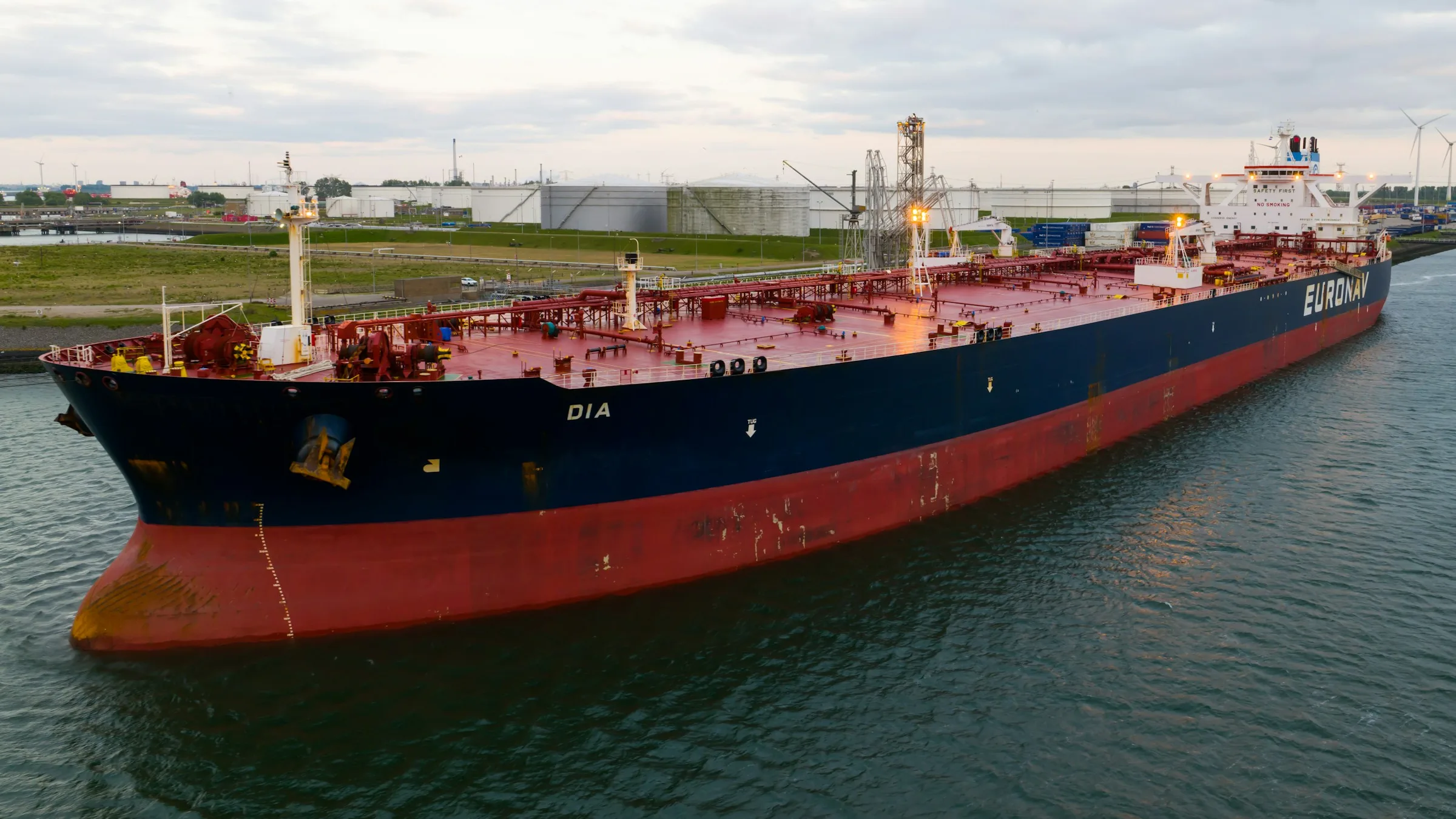
Much of this capacity is aimed at export. Japan’s power and shipping sectors want low-carbon ammonia as a fuel, which is why JERA and Mitsui are equity partners in Blue Point rather than just buyers.
What deadlines apply to green ammonia 45V and blue ammonia 45Q?
For 45V, construction of the hydrogen facility must begin before January 1, 2028, under the One Big Beautiful Bill Act. For 45Q, construction of the carbon capture equipment must begin before January 1, 2033. A green ammonia project that misses the 2028 date loses 45V entirely, so safe-harboring construction matters more than anything else in 2026 and 2027.
The 2025 law left 45Q in place and gave CO2 used in products the same $85 rate as CO2 stored, while it cut years off the 45V runway. Our explainer on 45V and the One Big Beautiful Bill covers what counts as beginning construction. Prevailing wage still drives the 5x multiplier on both credits; see our prevailing wage and apprenticeship guide.
What is your ammonia plant's credit worth?
Illustrative only. Uses 177.6 kg of hydrogen per tonne of ammonia (stoichiometric minimum) and 2026 45V rates. A facility can't claim 45V where 45Q was allowed, so the paths don't stack. Enter your own plant's CO2 capture figure.
Price my ammonia credits →How do you sell 45V or 45Q credits from an ammonia plant?
Both credits are transferable under section 6418, so an ammonia producer without enough federal tax liability can sell them to an unrelated corporate buyer for cash. Buyers price 45V on the emissions rate, verification report and EAC records, and 45Q on monitoring and storage documentation. Clean files close faster and at better prices.
Credits are typically sold at a discount to face value, with the spread driven by size, credit type, risk and whether insurance is in place. Our guide to monetizing the 45V credit explains the transfer process step by step, and the transferable tax credits guide covers the rules for buyers and sellers.
Sources
Legal Information Institute, 26 U.S. Code 45V, Credit for production of clean hydrogen
Legal Information Institute, 26 U.S. Code 45Q, Credit for carbon oxide sequestration
Legal Information Institute, 26 CFR 1.45V-1, Definitions
CF Industries, Form 10-Q for the quarter ended June 30, 2026
CF Industries, Blue Point
Woodside Energy, Beaumont New Ammonia
Hydrogen Insight, BASF and Yara scrap plans for blue hydrogen-based ammonia project in the US
Ohio River Valley Institute, A big beautiful blow to the ammonia industry
Frequently Asked Questions
Can clean ammonia producers claim the 45V tax credit?
Yes, but only on hydrogen they produce. 45V pays per kilogram of qualified clean hydrogen made by the taxpayer, so an ammonia plant with its own electrolyzers or low-emission reformers can claim it. A plant that buys hydrogen can't, because the producer owns the credit.
How much is the 45V credit worth per tonne of ammonia?
Should blue ammonia claim 45V or 45Q?
What is the difference between green ammonia and blue ammonia?
Does Cenet Capital buy ammonia-related tax credits?
Making clean ammonia? Turn the credits into cash.
Cenet Capital buys and insures 45V and 45Q credits from ammonia producers as a direct principal buyer, with diligence on emissions, verification and storage records up front. Send us your annual output for a price.

More Insights