Policy & Compliance
Which DOE hydrogen hubs survived in 2026, which were cancelled, how much was spent, and whether hub projects can still claim the 45V credit before 2028.
Author -
Paulestini Francois
Published -
READ TIME
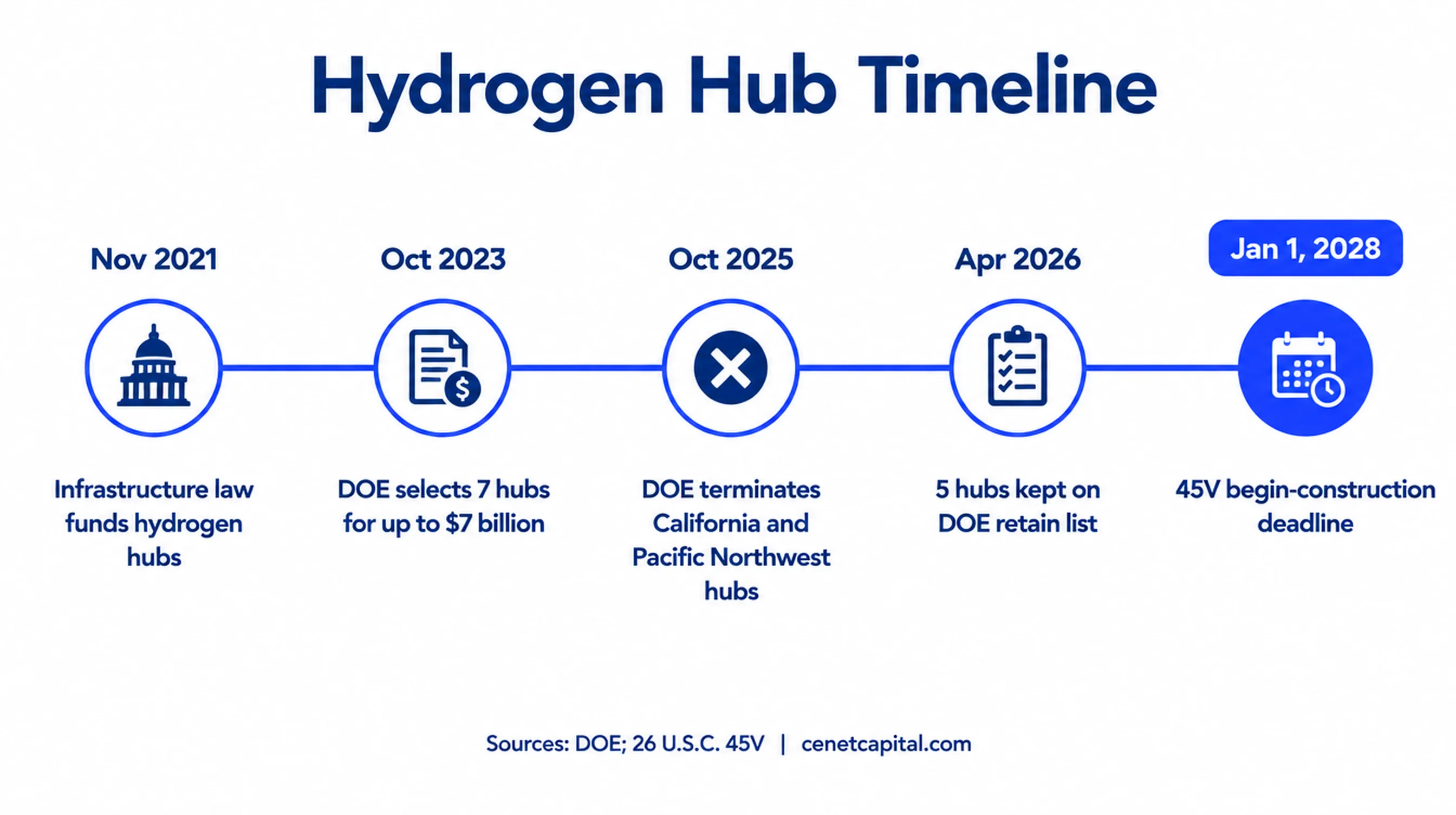
In 2023, the Department of Energy picked seven regional clean hydrogen hubs, the H2Hubs, to share up to $7 billion. By 2026, two had been cancelled and the rest were moving slowly. Here's which hydrogen hubs survived, how much money has actually been spent, whether hub projects can still claim the 45V credit, what the 2028 deadline means, and a calculator to estimate a project's credit.
QUICK ANSWER
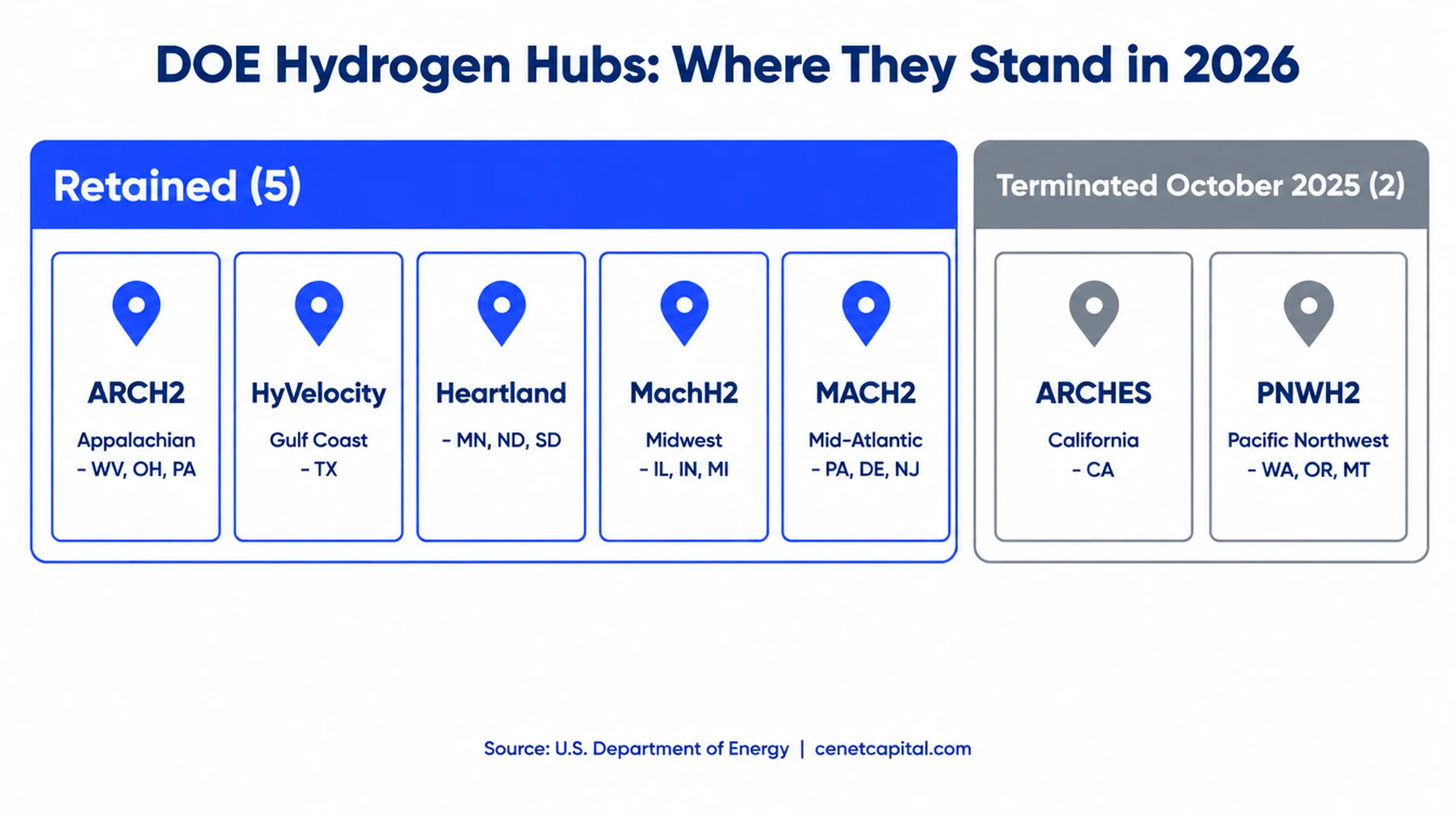
Five of DOE's seven regional clean hydrogen hubs survived: ARCH2, HyVelocity, Heartland, MachH2 and MACH2 stayed on DOE's April 2026 retain list, while the California and Pacific Northwest hubs were terminated in October 2025. Hub projects can still claim the 45V credit if they begin construction before January 1, 2028.
KEY FACTS
How many DOE hydrogen hubs are left? Five of the original seven regional clean hydrogen hubs.
Which hubs were cancelled? ARCHES (California) and PNWH2 (Pacific Northwest), terminated in October 2025.
Is the ARCH2 hydrogen hub still funded? Yes. Spectrum News reported DOE's April 2026 list keeps $925 million for ARCH2, though its anchor projects have stalled.
Has the hub money been spent? Mostly not. Payments were about 26% of Phase 1 obligations as of August 2026.
Can hub projects still get 45V? Yes, if construction begins before January 1, 2028, and emissions stay at or under 4 kg CO2e per kg.
What are the DOE regional clean hydrogen hubs?
The Regional Clean Hydrogen Hubs are seven regional networks of hydrogen producers, pipelines and users that the Department of Energy selected in October 2023 to share up to $7 billion from the 2021 Infrastructure Investment and Jobs Act. Each hub paired clean hydrogen production with nearby industrial and transportation demand.
The October 13, 2023 White House announcement said the hubs aimed to produce more than three million metric tons of clean hydrogen a year and attract more than $40 billion in private investment. Funding was to arrive in phases, starting with planning and design, so most of the money was never paid out before the program changed course in 2025.
Which hydrogen hubs were cancelled?
Two: the California hub (ARCHES) and the Pacific Northwest hub (PNWH2). DOE terminated both awards in October 2025, together worth up to $2.2 billion, as part of a broader cancellation of clean energy grants. Both hubs moved to contest the decision, and neither appears on DOE’s 2026 retained list.
The cuts were reported at the time by the Washington State Standard and E&E News. Both were the hubs most focused on renewable-powered electrolysis, so the cancellations removed most of the program’s planned green hydrogen capacity.
Which hydrogen hubs survived in 2026?
Five hubs remain: ARCH2 in Appalachia, HyVelocity on the Gulf Coast, Heartland in the Upper Midwest, MachH2 in the Midwest and MACH2 in the Mid-Atlantic. All five appear on the retain-or-modify list DOE released in April 2026 after reviewing its grant portfolio, though their awards can still be cut or restructured.
Hub | States | Hydrogen focus | Original DOE award (up to) | Status, October 2026 |
|---|---|---|---|---|
ARCH2 (Appalachian) | WV, OH, PA | Natural gas with carbon capture | $925 million | Retained |
HyVelocity (Gulf Coast) | TX | Natural gas with carbon capture, plus renewables | $1.2 billion | Retained |
Heartland | MN, ND, SD | Diverse sources for fertilizer and power | $925 million | Retained |
MachH2 (Midwest) | IL, IN, MI | Diverse sources, including nuclear | $1 billion | Retained |
MACH2 (Mid-Atlantic) | PA, DE, NJ | Electrolysis with renewable and nuclear power | $750 million | Retained |
ARCHES (California) | CA | Renewable electrolysis and biomass | $1.2 billion | Terminated, October 2025 |
PNWH2 (Pacific Northwest) | WA, OR, MT | Renewable electrolysis | $1 billion | Terminated, October 2025 |
DOE’s April 2026 list, published by Latitude Media, groups every hub under “retain/modify,” so being retained means staying in the program, not keeping the full award. Spectrum News reported that the list keeps $925 million for ARCH2.
How much hydrogen hub money has actually been spent?
Very little. A former DOE program official tracking federal spending data reported in August 2026 that payments to the hubs totaled about 26% of their Phase 1 obligations, and that a July 2026 federal spending plan showed no further hub outlays this year. Phase 1 covers planning and design, not construction.
The analysis, published by the DOE Alumni Network, found no hub had finished Phase 1 by DOE’s expected August 2026 date. The retained hubs have their own problems too. Spectrum News reported that ARCH2 had spent $5.3 million of the $30 million released, and that the three natural gas companies behind most of its planned capacity had exited, paused permitting or were still evaluating.
Do hydrogen hub projects still qualify for the 45V tax credit?
Yes. The 45V credit is claimed per kilogram of clean hydrogen produced, so it doesn’t depend on a project’s hub grant. A project in a cancelled hub can still claim 45V if it begins construction before January 1, 2028, stays under the 4 kg emissions limit and passes annual third-party verification.
In 2026 the credit is worth up to $3.28 per kg for the cleanest tier with prevailing wage met, under IRS Notice 2026-41, for 10 years after the facility is placed in service. The credit can be sold for cash, which matters more now that grant money is uncertain. See our 45V rules guide and our guide to monetizing 45V. For the natural gas hubs, ARCH2 and HyVelocity, the bigger question is often whether to claim 45V or 45Q, which our blue hydrogen guide compares.
What is your clean hydrogen worth under 45V?
Illustrative only. Uses 2026 amounts from IRS Notice 2026-41 held flat; the IRS adjusts them for inflation each year. Emissions must be determined with the 45VH2-GREET model (or a provisional emissions rate) and verified annually. Facilities must begin construction before January 1, 2028.
Price your 45V credits →What does the 2028 deadline mean for hub projects?
It’s now the deadline that matters most. Under the One Big Beautiful Bill Act, a hydrogen facility must begin construction before January 1, 2028, to claim 45V at all. Hub projects still in Phase 1 planning in late 2026 have about 14 months to start physical work or meet the 5% cost safe harbor.
The deadline is written into section 45V(c)(3)(C), which replaced the original 2033 date. With hub payments moving slowly, many sponsors are now weighing credit-only projects that can start construction on their own timeline. Our explainer on 45V and the One Big Beautiful Bill covers what counts as beginning construction.
What does the hub shakeup mean for 45V credit buyers and sellers?
Fewer grant dollars make the 45V credit a bigger share of every hydrogen project’s capital stack, so sellers lean harder on selling credits for cash. Buyers, in turn, focus diligence on the risks grants used to absorb: offtake, begin-construction evidence before 2028, emissions modeling and verification.
For sellers, a hub project that loses grant money can still finance part of its costs by selling future 45V credits, priced at a discount for production risk. For buyers, the key checks are the 45VH2-GREET emissions rate, the energy attribute certificates behind electrolytic hydrogen, and proof that construction began before the deadline. Insurance can cover some of that risk; our guide to tax credit insurance explains what policies cover, and our transfer market report tracks current pricing.
What happens next for the hydrogen hubs?
Expect consolidation. The two cancelled hubs are pursuing appeals and state-backed alternatives, the five retained hubs face award changes and slow payments, and private sponsors are deciding project by project whether 45V alone justifies building before the 2028 deadline.
Award modifications: DOE has said it will modify retained awards as needed, which could shrink or reshape hub scopes.
Litigation: challenges to DOE’s 2025 grant terminations are still working through the courts.
Offtake: projects with signed hydrogen buyers are the ones most likely to break ground.
Construction starts: watch for begin-construction announcements before January 1, 2028.
Sources
The White House (archived), Regional clean hydrogen hubs announcement (October 13, 2023)
U.S. Department of Energy via Latitude Media, Retain/modify project list (April 2026)
Spectrum News, Appalachian Hydrogen Hub to stay fully funded, despite stalled progress
DOE Alumni Network, Four months ago, five hydrogen hubs were retained: here’s what we know
Washington State Standard, Trump administration yanks funding for Northwest green hydrogen project
Legal Information Institute, 26 U.S. Code 45V, Credit for production of clean hydrogen
Frequently Asked Questions
What happened to the DOE hydrogen hubs?
DOE terminated two of the seven hubs, ARCHES in California and PNWH2 in the Pacific Northwest, in October 2025. The other five, ARCH2, HyVelocity, Heartland, MachH2 and MACH2, stayed on DOE's April 2026 retain-or-modify list, though payments remain slow and awards may be modified.
Was hydrogen hub funding cancelled?
Is the HyVelocity hydrogen hub still active?
Can projects in a cancelled hydrogen hub still claim 45V?
Does Cenet Capital buy 45V credits from hub projects?
Hub grant uncertain? Your 45V credit isn't.
Grant money can be cut, but 45V credits from projects that begin construction before 2028 can still be sold for cash. Cenet Capital buys and insures clean hydrogen credits directly. Send us your project details.

More Insights