
Market Data & Tools
Natural hydrogen, also called geologic or white hydrogen, forms underground. How much exists, who's drilling, what it could cost, and whether it gets the 45V credit.
Author -
Paulestini Francois
Published -
READ TIME
For years, the only way to get hydrogen was to make it. Now geologists think the Earth may be making vast amounts on its own, and investors are drilling to find it. Here's what natural hydrogen is, how much there might be, who is exploring for it in the U.S., what it could cost, and why it doesn't fit neatly into today's hydrogen tax credits.
QUICK ANSWER
Natural hydrogen, also called geologic or white hydrogen, is hydrogen gas that forms underground, mainly when water reacts with iron-rich rock, and collects in rock traps. A 2024 USGS model estimates about 5.6 trillion tonnes in place worldwide. It's being explored in Kansas and Nebraska, but whether it qualifies for the 45V tax credit is untested.
KEY FACTS
What is white hydrogen? Another name for natural hydrogen: hydrogen gas found in the ground rather than manufactured.
Is geologic hydrogen the same as natural hydrogen? Mostly. Geologic hydrogen covers natural deposits plus stimulated geologic hydrogen made by injecting water into iron-rich rock.
What is gold hydrogen? A label some use for hydrogen produced by microbes in depleted oil fields. Others use it loosely for natural hydrogen.
Where are natural hydrogen deposits in the U.S.? The USGS's 2025 map highlights a midcontinent belt across Kansas, Iowa, Minnesota and Michigan, plus the Four Corners states.
Which geologic hydrogen companies are drilling? Koloma, backed by Breakthrough Energy Ventures, and Natural Hydrogen Energy are among the companies exploring in the Midcontinent.
Does natural hydrogen get the 45V tax credit? Not clearly. The 45V PTC pays for hydrogen produced through a process, and the final rules have no pathway for extracted hydrogen.
What is natural hydrogen?
Natural hydrogen is hydrogen gas that forms underground through natural chemical reactions and can collect in rock formations, much like natural gas. It’s also called geologic hydrogen, white hydrogen or gold hydrogen. Instead of being manufactured from natural gas or water, it’s found and drilled, so it can come with almost no emissions.
For decades, geologists assumed free hydrogen couldn’t build up underground in useful amounts because the molecule is so small, reactive and quick to escape. A village in Mali changed that view. In Bourakebougou, a water well drilled in 1987 hit gas that turned out to be 98% hydrogen. Hydroma has since drilled 24 more boreholes there, and the field has supplied the village with electricity since 2012.
The names overlap. “White hydrogen” and “natural hydrogen” usually mean the same thing in the colors of hydrogen scheme. “Geologic hydrogen” is the term the U.S. government uses, and it covers both naturally occurring deposits and hydrogen that’s deliberately stimulated underground.
How does geologic hydrogen form?
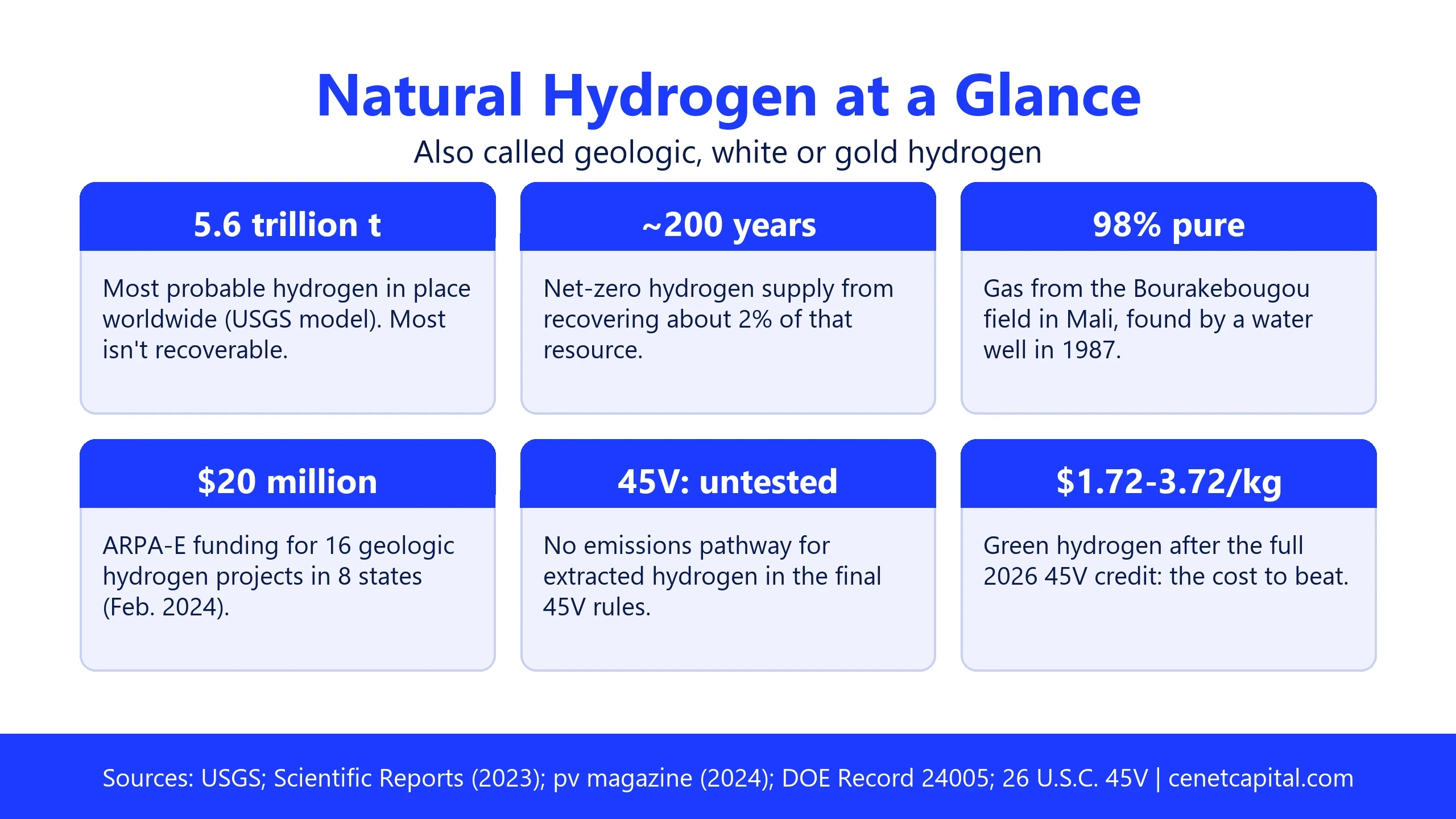
Most geologic hydrogen forms when water reacts with iron-rich rocks, a process called serpentinization, which strips oxygen from water and releases hydrogen. Radiation from uranium and thorium splitting water molecules adds more. The gas then migrates and can be trapped under seals of salt, clay or dense rock, just like oil and gas.
That chemistry is why explorers focus on old, iron-rich rock. In the U.S., the Midcontinent Rift, a 1,200-mile ancient crack in the continent running south of Lake Superior through Wisconsin to Kansas, is a top target. Because the reaction continues today, some researchers describe natural hydrogen as partly renewable, though how fast it recharges a given reservoir isn’t known.
Stimulated geologic hydrogen takes the process a step further. Companies inject water, sometimes with catalysts, into iron-rich formations to speed up the reaction, then recover the hydrogen. In February 2024, the Department of Energy’s ARPA-E program awarded $20 million to 16 projects in eight states to develop stimulated production and reservoir engineering.
How much natural hydrogen is there?
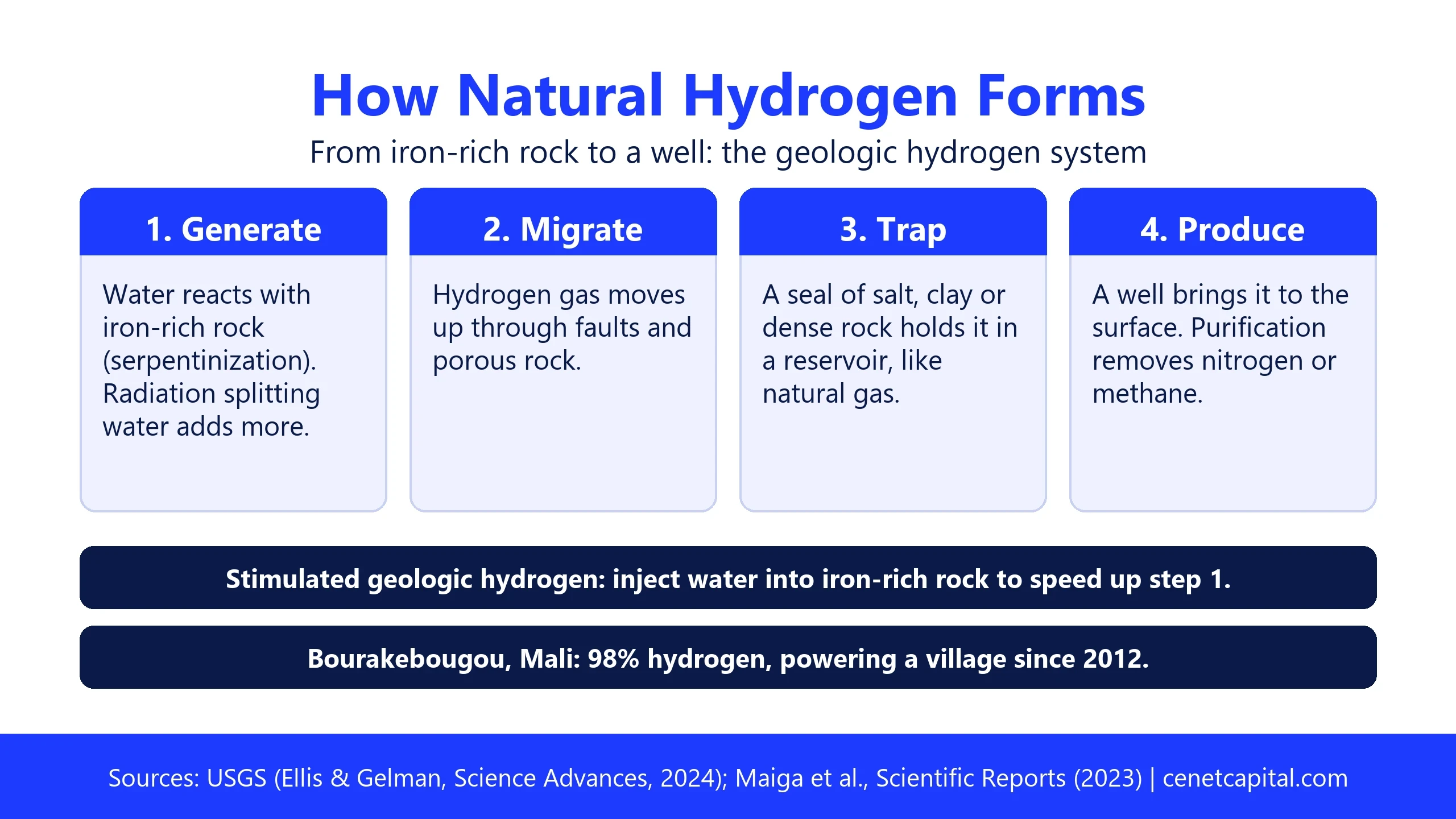
A 2024 U.S. Geological Survey model put the most probable amount of geologic hydrogen in place worldwide at about 5.6 trillion tonnes. Most of it is likely too deep, too scattered or too far offshore to recover. Even so, recovering about 2% would supply the hydrogen needed for net-zero emissions for roughly 200 years.
The study, by USGS geologists Geoffrey Ellis and Sarah Gelman, was published in Science Advances. Its range is enormous, from 1,000 to 10 billion million tonnes, which shows how early the science is. The authors note that 100,000 million tonnes would hold more energy than all proven natural gas reserves on Earth.
In January 2025, the USGS followed with its first map of potential geologic hydrogen in the lower 48 states. It highlights a midcontinent belt covering Kansas, Iowa, Minnesota and Michigan, plus the Four Corners states, the California coast and parts of the Eastern Seaboard.
Who is drilling for natural hydrogen in the U.S.?
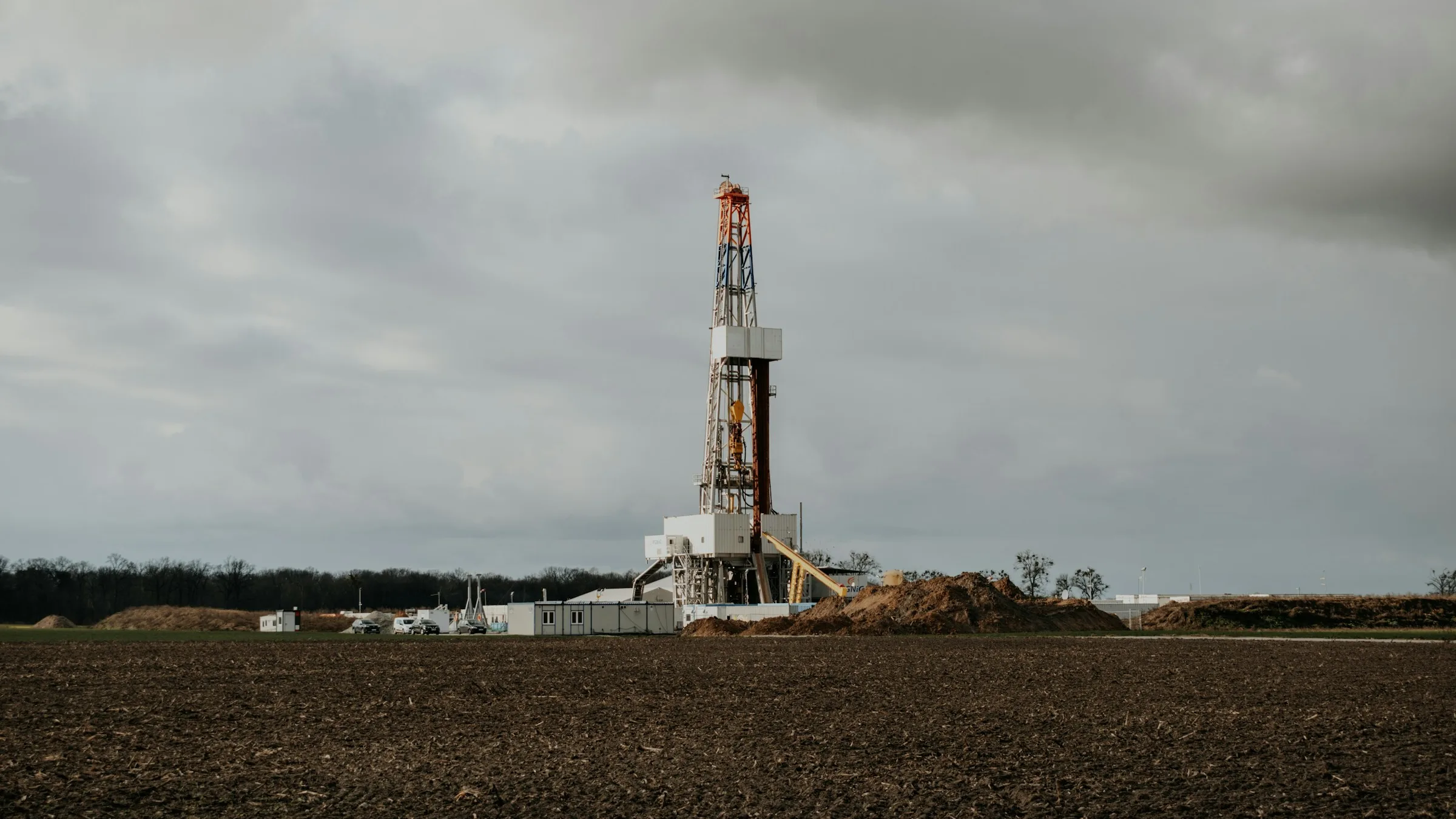
Startups backed by large investors are drilling in the Midcontinent, especially Kansas and Nebraska. Koloma, the best funded, counts Bill Gates’s Breakthrough Energy Ventures among its backers. Natural Hydrogen Energy has drilled in Nebraska, and universities and national labs are working on stimulated production.
Yale Environment 360 reported that Breakthrough Energy Ventures joined a $91 million investment in Koloma, which is exploring along the Midcontinent Rift, and that successful drilling in Nebraska and Kansas has encouraged others. Results remain thinly reported. No U.S. well has yet shown that it can produce hydrogen at commercial scale for years, the way Bourakebougou has on a village scale.
States are starting to prepare. In January 2026, Michigan’s governor signed Executive Directive 2026-1, ordering a report by April 1, 2026 on the state’s authority to permit geologic hydrogen exploration, production and storage. Who owns hydrogen underground, the surface owner or the mineral owner, still isn’t settled in most states.
Does natural hydrogen qualify for the 45V tax credit?
Not clearly. The 45V clean hydrogen production tax credit (PTC) pays for hydrogen “produced through a process” at a qualified facility, and Treasury’s final rules provide no emissions pathway for hydrogen drilled from natural deposits. Stimulated geologic hydrogen has a stronger argument, but no guidance confirms either one.
The statute’s definition of qualified clean hydrogen centers on a production process with lifecycle emissions of 4 kg CO2e per kg or less. Lifecycle emissions are calculated with the 45VH2-GREET model, which covers manufactured routes such as reforming and electrolysis. A producer outside those pathways would need a provisional emissions rate from the IRS, and no natural hydrogen producer has publicly received one.
Timing is also a problem. To qualify, a 45V facility must begin construction before January 1, 2028. Few natural hydrogen projects will be ready to build by then, so most will need to compete on cost without a federal production credit. Our 45V tax credit guide covers the full requirements.
Could natural hydrogen be cheaper than green hydrogen?
Potentially, yes. A DOE analysis puts PEM electrolysis at $5 to $7 per kg. Even after the full 2026 45V credit of $3.28 per kg, green hydrogen costs about $1.72 to $3.72. A productive natural hydrogen well that lifts and cleans gas for less than that could undercut it without any tax credit.
The DOE figure comes from Program Record 24005 on clean hydrogen from PEM electrolyzers. Natural hydrogen economics are still unproven. They depend on flow rates, purity, drilling cost and how long a reservoir keeps producing. Gas that’s mixed with nitrogen or methane needs purification, which adds cost. Use the calculator below to test your own assumptions.
For comparison, our hydrogen price per kg and levelized cost of hydrogen guides show what manufactured hydrogen costs today.
What could a natural hydrogen well earn?
Your own assumptions for output, price and cost. The comparison uses DOE's $5-7/kg cost for PEM electrolysis, less the full 2026 45V credit.At $1.00 per kg, your well would undercut electrolytic hydrogen even after that producer collects the full 45V credit, without needing a tax credit of its own.
Illustrative only. No commercial natural hydrogen field in the U.S. has published costs yet, and 45V eligibility for extracted hydrogen is untested.
Talk through my project →What does natural hydrogen mean for hydrogen tax credit investors?
For now, it’s an exploration play, not a tax credit play. 45V credits from electrolytic, blue and other manufactured hydrogen remain the main source of hydrogen tax credits to buy and sell into the late 2030s. If natural hydrogen scales, it could pressure hydrogen prices and the economics of projects that rely on 45V.
Projects that began construction before 2028 can earn 45V for 10 years, which means credits will keep coming to market well into the 2030s. Buyers and sellers should still track geologic hydrogen. A cheap, low-emissions supply would change the offtake prices that 45V projects use to raise financing. Producers planning to sell 45V credits should lock in strong offtake contracts early.
Sources
Ellis, G. and Gelman, S., Model predictions of global geologic hydrogen resources, Science Advances (2024)
U.S. Geological Survey, USGS releases first-ever map of potential for geologic hydrogen in U.S.
Maiga, O. et al., Characterization of the spontaneously recharging natural hydrogen reservoirs of Bourakebougou in Mali, Scientific Reports (2023)
pv magazine, US funding 16 geologic hydrogen exploration projects (February 9, 2024)
Yale Environment 360, Natural Hydrogen: A Potential Clean Energy Source Beneath Our Feet
Office of the Governor of Michigan, Executive Directive 2026-1
U.S. Department of Energy, Program Record 24005: Clean hydrogen production cost, PEM electrolyzer
Legal Information Institute, 26 U.S. Code 45V
Frequently Asked Questions
What is natural hydrogen?
Natural hydrogen is hydrogen gas formed by geological processes, mainly the reaction of water with iron-rich rocks and the splitting of water by natural radiation. It can migrate and collect in underground traps. It's also called geologic hydrogen or white hydrogen, and it can be produced with wells like natural gas.
Where has natural hydrogen been found?
How much natural hydrogen is there?
Is natural hydrogen cheaper than green hydrogen?
Can Cenet Capital help with hydrogen tax credits?
Building a hydrogen project? Know your credits
Cenet Capital helps hydrogen developers value and sell 45V credits, and weigh which projects qualify. Tell us your production route, location and expected start date.

More Insights