
Credit Guides
Hydrogen storage methods compared: compressed tanks, liquid, materials and salt caverns. Energy and cost trade-offs, and how storage earns the 48E ITC in 2026.
Author -
Paulestini Francois
Published -
READ TIME
Making clean hydrogen is only half the job. You also have to hold it until someone needs it, and that's harder than it sounds for the lightest element in the universe. Here's how hydrogen storage works, how the main methods compare on energy and cost, and how storage projects can earn a federal tax credit worth up to half their cost.
QUICK ANSWER
Hydrogen storage holds hydrogen as compressed gas at 350 to 700 bar, as a liquid at about -253°C, in materials or chemical carriers, or underground in salt caverns. Compression uses about 1.7 to 6.4 kWh per kg and liquefaction 10 to 13 kWh per kg. Hydrogen storage can earn the 48E investment tax credit of 6% to 50%.
KEY FACTS
What are the main hydrogen storage methods? Compressed gas tanks, liquid hydrogen storage, materials-based storage and underground salt caverns.
How much does a hydrogen storage tank cost? DOE estimated a 700-bar vehicle tank at about $15 per kWh, or $500 per kg of hydrogen, at high production volume.
What is underground hydrogen storage? Storing compressed hydrogen in solution-mined salt caverns, used in Texas since 1983 and now in Utah for power.
How much energy does liquid hydrogen storage take? 10 to 13 kWh per kg to liquefy, or 30% to 39% of the energy in the hydrogen, per DOE.
What is hydrogen energy storage property? Under Treasury rules, tanks, underground storage and compressors that store at least 0.127 kg (5 kWh) of hydrogen.
What is the 48E ITC rate for energy storage? 6% of eligible cost, or 30% with prevailing wage and apprenticeship, plus up to 10 points each for bonus adders.
Is salt cavern hydrogen storage eligible for the energy storage ITC? Yes. Underground storage facilities are listed as hydrogen energy storage property in the final section 48 rules.
What is hydrogen storage?
Hydrogen storage is how hydrogen is held between production and use: as a compressed gas in tanks, as a super-cold liquid, inside other materials or chemicals, or underground in salt caverns. It’s hard because hydrogen has the most energy per kilogram of any fuel but very little energy per liter.
The Department of Energy sums up the hydrogen storage challenge this way: hydrogen has the highest energy per mass of any fuel, but its low density at normal temperature and pressure gives it very low energy per unit volume. A kilogram of hydrogen holds 33.3 kWh of energy on a lower heating value basis, yet at atmospheric pressure it fills about 11 cubic meters.
Storage matters to every hydrogen project. Electrolyzers running on wind and solar make hydrogen when the power is available, while refineries, ammonia plants and power plants need a steady supply. Storage bridges that gap, and its cost and energy losses feed directly into the levelized cost of hydrogen.
What are the main hydrogen storage methods?
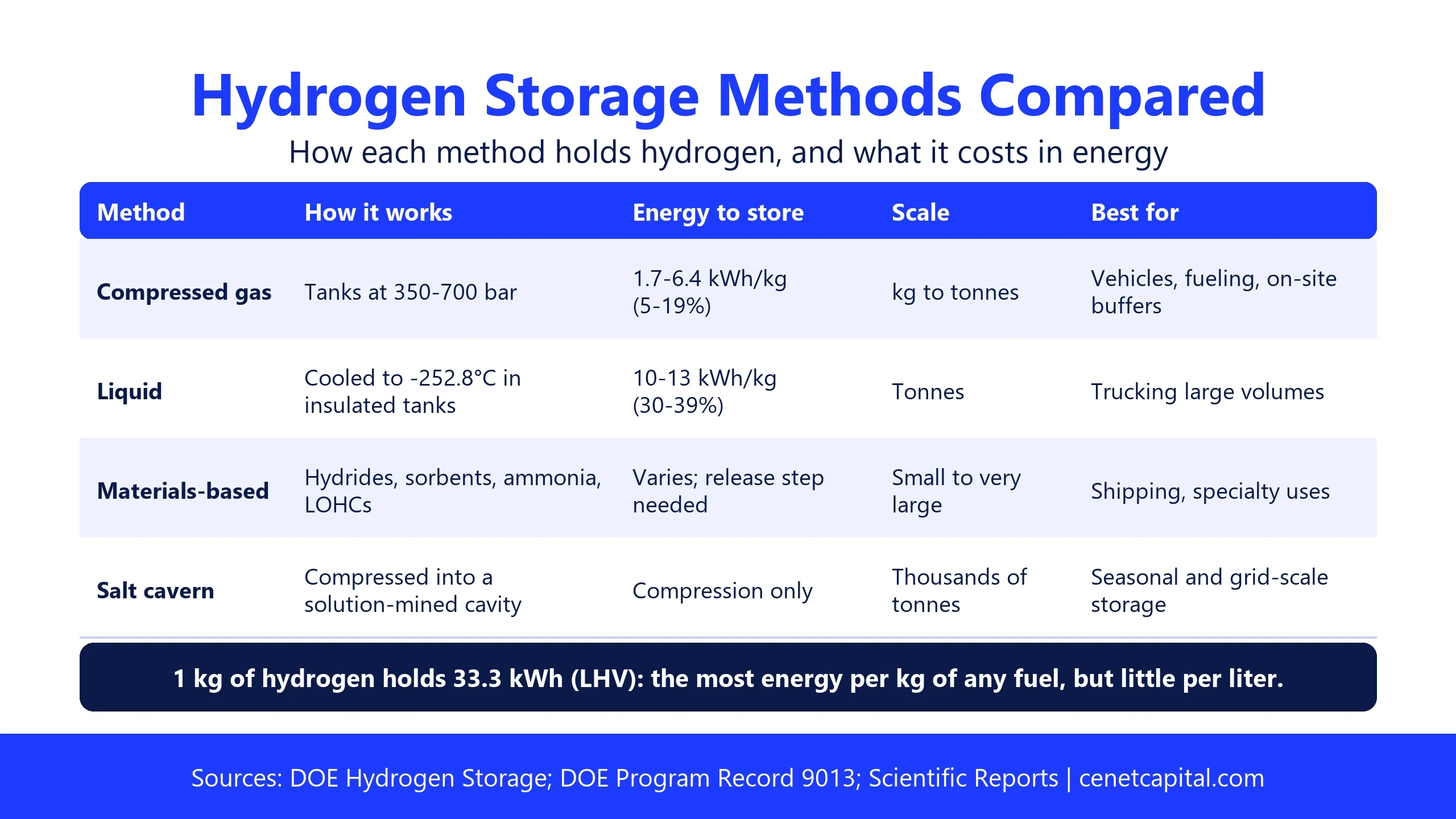
There are four main hydrogen storage methods. Compressed gas tanks hold hydrogen at 350 to 700 bar. Liquid storage cools it to about -253°C. Materials-based storage binds it in solids or chemical carriers such as ammonia. Underground storage packs large volumes into salt caverns.
Compressed gas: the most mature option, according to the DOE’s page on physical hydrogen storage. Vehicle tanks run at 350 or 700 bar (5,000 or 10,000 psi), and industrial sites use tube trailers and stationary vessels.
Liquid hydrogen storage: hydrogen boils at -252.8°C, so liquid storage needs cryogenic, insulated tanks. It’s the standard way to move large volumes by truck, and it holds far more per tank than gas.
Materials-based: metal hydrides and sorbents absorb or adsorb hydrogen reversibly. Chemical carriers such as ammonia or liquid organic carriers need a separate reaction to release it.
Underground hydrogen storage: solution-mined salt caverns hold thousands of tonnes, which makes them the only proven option for seasonal, grid-scale storage.
How much energy does it take to store hydrogen?
Compressing hydrogen takes about 1.7 to 6.4 kWh per kg in DOE field data, roughly 5% to 19% of its energy. Liquefying it takes 10 to 13 kWh per kg, or 30% to 39% of the 33.3 kWh it contains. That energy penalty is the main trade-off between gas and liquid storage.
The figures come from DOE Program Record 9013. The theoretical minimum to liquefy hydrogen is only 3.9 kWh per kg, so real plants use about three times the ideal. Novel liquefiers could cut that to around 7 kWh per kg. Liquid tanks also lose some hydrogen to boil-off over time, which is why liquid storage suits fast-moving supply chains more than long holds.
For an electrolytic producer, the storage energy usually comes from the same power supply as the electrolyzer. That means it counts toward the plant’s electricity use, and it can affect the emissions result in the 45VH2-GREET model if the power isn’t clean.
What is a hydrogen storage tank, and what does it cost?
A hydrogen storage tank is a pressure vessel or cryogenic container built for hydrogen. High-pressure tanks are usually carbon fiber wrapped around a polymer liner. DOE estimated a 700-bar automotive tank at about $15 per kWh, or $500 per kg of hydrogen held, against an ultimate target of $8 per kWh.
Tank types run from all-steel Type I cylinders to Type IV composite tanks, which are the lightest and the standard for fuel cell vehicles. The DOE’s storage targets table notes that the $15 per kWh estimate assumes production of 500,000 units a year. Stationary storage at industrial sites uses larger steel or composite vessels, where cost depends heavily on pressure and size.
For most projects the bigger question isn’t the tank. It’s how many hours or days of production the site needs to hold, which sets the size of the storage system and its share of capex.
How does underground hydrogen storage in salt caverns work?
Developers dissolve a cavity in an underground salt formation with water, then inject compressed hydrogen. Salt is nearly impermeable and self-sealing, so the gas stays put. Salt caverns in Texas have stored hydrogen for refineries since 1983, and Utah’s ACES Delta project is now using them for seasonal power storage.
A study on hydrogen leakage in salt caverns notes that pure hydrogen has been stored at Clemens Dome since 1983, Moss Bluff since 2007, and Spindletop in Texas, as well as Teesside in the UK since 1972. These sites mainly supply refineries and chemical plants.
The newest example is much larger. ACES Delta in Delta, Utah, developed by Chevron New Energies and Mitsubishi Power, can produce up to 100 tons of hydrogen a day with 220 MW of electrolyzers. It stores the hydrogen in two salt caverns of 150 GWh each, and was nearing completion in February 2026. The project received a $504 million conditional DOE loan guarantee in 2022.
Does hydrogen storage qualify for a tax credit?
Yes. Hydrogen storage counts as “energy storage technology” under section 48(c)(6), so it can earn the 48E clean electricity investment tax credit (ITC). The rate is 6% of eligible cost, or 30% if prevailing wage and apprenticeship rules are met, plus up to 20 points of bonus credits.
The statute covers property that stores energy for conversion to electricity “or, in the case of hydrogen, which stores energy,” so stored hydrogen doesn’t have to be turned back into power. Treasury’s final regulation 1.48-9 defines hydrogen energy storage property as property that stores at least 5 kWh of hydrogen, equal to 0.127 kg. It includes above-ground tanks, underground storage facilities and compressors, with liquefaction equipment and gathering lines as integral parts.
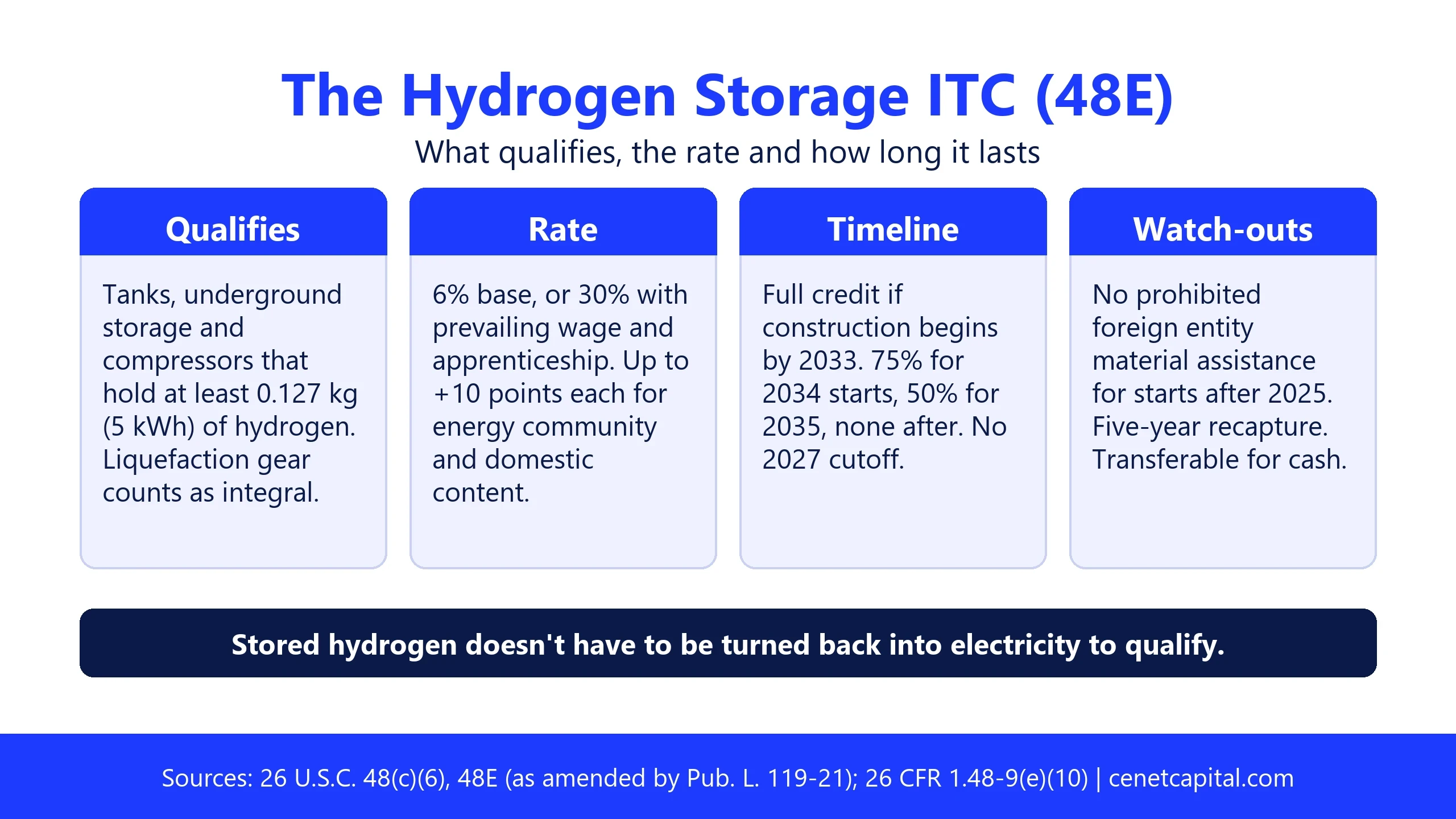
The bonus credits are the energy community and domestic content adders, worth 10 points each on a 30% credit. Use the estimator below to value your project.
What is your hydrogen storage worth in tax credits?
Hydrogen energy storage property qualifies for the 48E investment tax credit if it holds at least 0.127 kg (5 kWh) of hydrogen.Storage that begins construction after 2025 can't include material assistance from a prohibited foreign entity. The credit can be sold to a corporate buyer under section 6418.
An estimate, not tax advice. Eligible basis, domestic content rules and how storage at a 45V site is treated need review by your tax advisor.
Price my storage ITC →How long is the hydrogen storage ITC available?
Under section 48E as amended in 2025, energy storage that begins construction by the end of 2033 gets the full credit. The credit drops to 75% for construction starting in 2034, 50% in 2035, and zero after. Unlike wind and solar, storage isn’t subject to the 2027 placed-in-service cutoff.
The 2025 law did add a sourcing rule. Under section 48E(c)(3), storage that begins construction after December 31, 2025 can’t include material assistance from a prohibited foreign entity. Our FEOC rules guide explains how to test a supply chain. Like other ITCs, the credit can be recaptured if the property is sold or stops qualifying within five years.
The storage ITC is separate from the 45V credit for producing the hydrogen. Developers should confirm with their tax advisor how storage at a 45V facility is treated before counting both. Either credit can be sold for cash to a corporate buyer.
Sources
U.S. Department of Energy, Hydrogen Storage and Physical Hydrogen Storage
U.S. Department of Energy, Program Record 9013: Energy requirements for hydrogen gas compression and liquefaction
Legal Information Institute, 26 U.S. Code 48, 26 U.S. Code 48E and 26 CFR 1.48-9
Scientific Reports, Characterization and assessment of hydrogen leakage mechanisms in salt caverns
pv magazine, ACES 220 MW Utah project nears completion (February 27, 2026)
POWER Magazine, ACES Delta gets $504M conditional DOE loan guarantee
Frequently Asked Questions
What is the best way to store hydrogen?
It depends on volume and duration. Compressed gas tanks suit vehicles and small on-site buffers. Liquid hydrogen suits moving large volumes by truck. Salt caverns are the cheapest way to store thousands of tonnes for weeks or months. Chemical carriers like ammonia suit long-distance shipping.
Why is hydrogen hard to store?
Does hydrogen storage qualify for a tax credit?
When does the hydrogen storage tax credit expire?
Can Cenet Capital help sell a hydrogen storage tax credit?
Turn your hydrogen storage into tax credit cash
Cenet Capital helps hydrogen developers value the 48E storage ITC and sell it to corporate tax buyers. Tell us your storage type, capacity, cost and construction start date.

More Insights