Market Data & Tools
What an electrolyzer is, how it splits water, alkaline vs. PEM vs. solid oxide, cost per kW, efficiency in kWh per kg, and how electrolyzers earn the 45V credit.
Author -
Paulestini Francois
Published -
READ TIME
Every kilogram of green or pink hydrogen starts in an electrolyzer. The machine you choose sets how much power you'll buy, how often you'll replace stacks, and how much the project costs to build. It also decides how much 45V tax credit you can earn. Here's how a hydrogen electrolyzer works, how the main types compare, and what they cost in 2026.
QUICK ANSWER
A hydrogen electrolyzer uses electricity to split water into hydrogen and oxygen. The main types are alkaline, PEM, solid oxide and AEM. Alkaline and PEM systems use about 55 kWh per kg and cost $2,000 to $2,600 per kW installed outside China. Hydrogen made with clean power can earn the 45V credit, up to $3.28 per kg in 2026.
KEY FACTS
What is an electrolyzer? A device that uses electricity to split water into hydrogen and oxygen across an anode, a cathode and an electrolyte.
How does an electrolyzer work? Current drives water apart at one electrode. Ions cross the electrolyte, and hydrogen gas forms at the other electrode.
What is an alkaline electrolyzer? The most proven design. It uses liquid potassium or sodium hydroxide, runs at 60°C to 90°C and avoids precious metals.
What is a PEM electrolyzer? A design with a solid polymer membrane that runs at 70°C to 90°C and ramps quickly with wind and solar.
What is a solid oxide electrolyzer? A ceramic design that splits steam at 650°C to 850°C and uses about 38 kWh of electricity per kg, plus heat.
What is the electrolyzer cost per kW? The IEA put installed costs at $2,000 to $2,600 per kW outside China in 2024, and $600 to $1,200 in China.
Can an electrolyzer take a hydrogen ITC instead of the 45V PTC? Yes. Producers can elect the section 48 investment tax credit, worth up to 30% of eligible cost, instead of the per-kg 45V PTC.
What is an electrolyzer?
An electrolyzer is a machine that uses electricity to split water into hydrogen and oxygen. Inside each cell, an anode and a cathode sit on either side of an electrolyte. When current flows, hydrogen collects at one electrode and oxygen at the other. It’s the core equipment behind green, pink and other electrolytic hydrogen.
Electrolyzers range from small units that fit in a shipping container to plants of hundreds of megawatts. Capacity is measured by the electricity they can draw, in kilowatts or megawatts, so a 20 MW hydrogen electrolyzer is rated by its power input, not its hydrogen output. Commercial systems stack hundreds of cells together, and the “stack” is the part that wears out and gets replaced.
The market is still small but growing fast. The IEA’s Global Hydrogen Review 2025 reports that global installed water electrolysis capacity reached 2 GW in 2024, with more than 1 GW added through July 2025. China accounts for 65% of installed capacity and capacity that has reached a final investment decision.
How does an electrolyzer work?
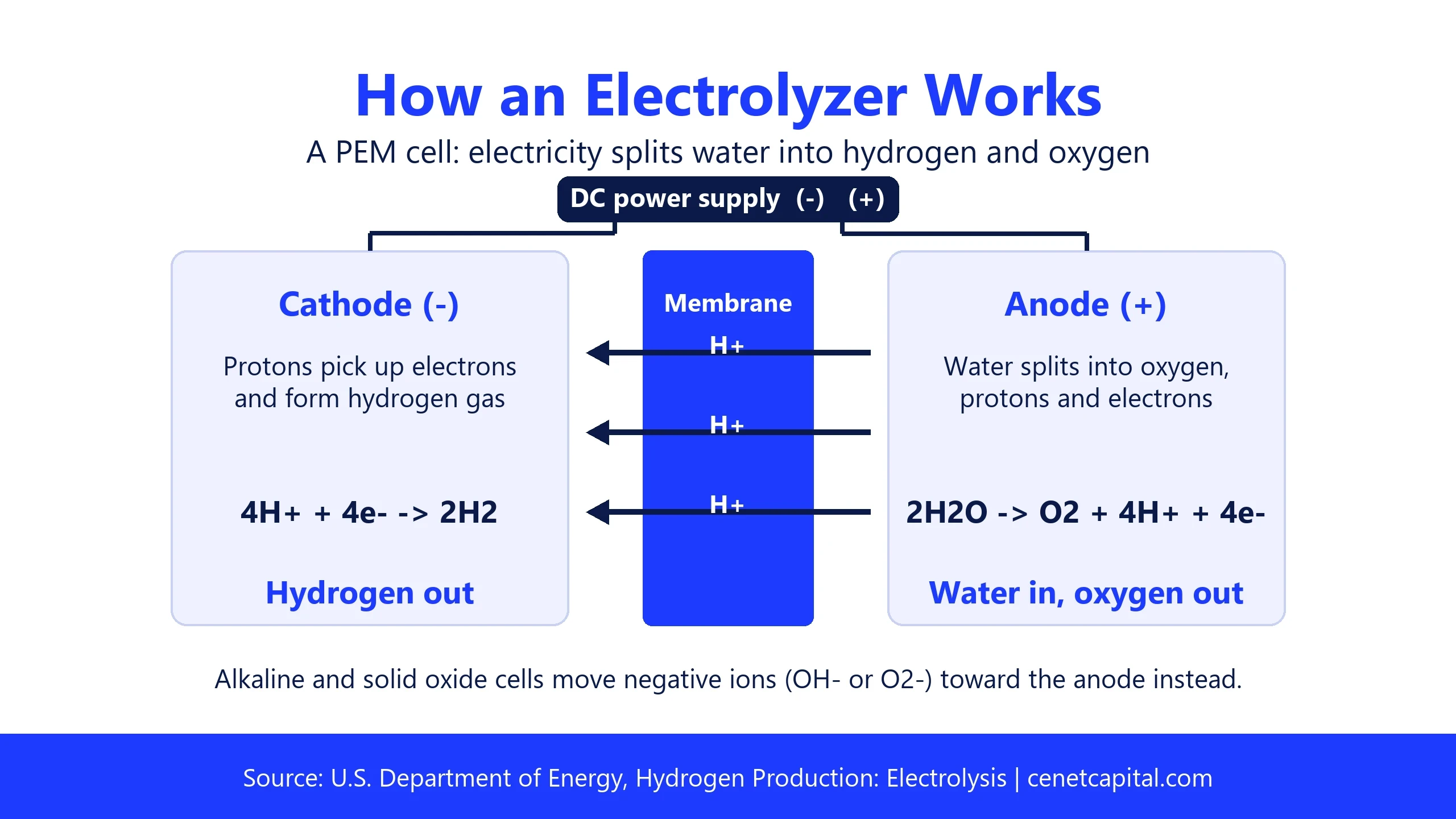
Electricity drives a reaction that pulls water apart. In a PEM electrolyzer, water splits at the anode into oxygen, protons and electrons; the protons cross a membrane and pair with electrons at the cathode to form hydrogen gas. Alkaline and solid oxide designs move negative ions the other way instead.
The Department of Energy explains that electrolyzer types differ by their electrolyte and by which ion it carries: positive hydrogen ions (H+), negative hydroxide ions (OH-) or oxide ions (O2-). The chemistry is the same overall. It takes about 39.4 kWh of energy to make 1 kg of hydrogen at perfect efficiency on a higher heating value basis, and real systems use 50 to 55 kWh.
The rest of the plant matters as much as the stack. Water has to be purified, the hydrogen dried and compressed, and the power converted from AC to DC. Engineers call this the balance of plant, and it’s a large part of what the electrolyzer costs.
What are the main types of electrolyzer?
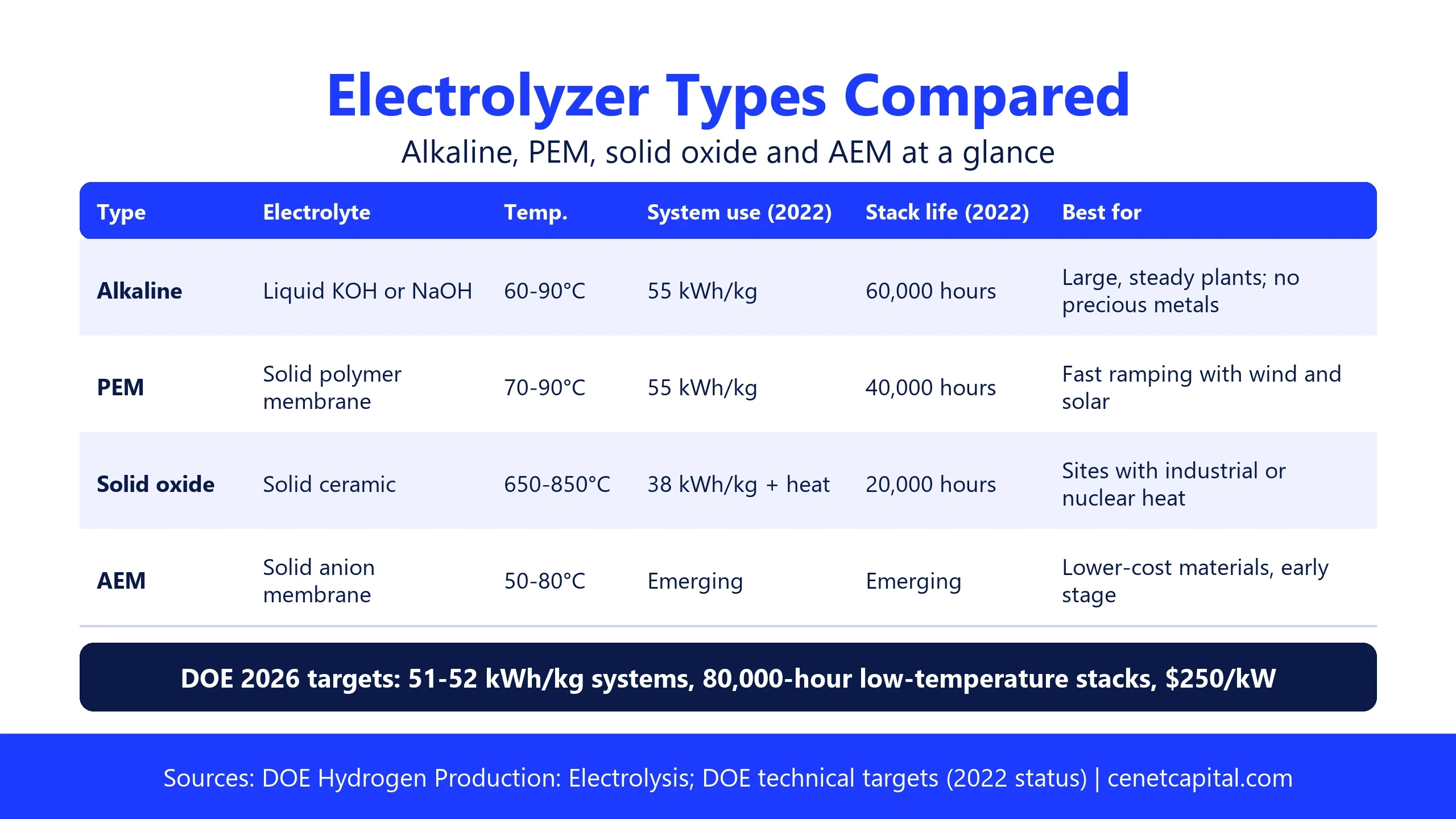
There are four main types. Alkaline electrolyzers use a liquid potassium or sodium hydroxide solution. PEM electrolyzers use a solid polymer membrane. Solid oxide electrolyzers (SOEC) use a ceramic at 650°C to 850°C. Anion exchange membrane (AEM) designs pair a solid membrane with alkaline chemistry.
Alkaline electrolyzer: the oldest, most proven technology. It runs at about 60°C to 90°C and avoids precious metals, which keeps cost down, but it responds more slowly to changing power.
PEM electrolyzer: runs at about 70°C to 90°C, ramps quickly and produces high-purity hydrogen at pressure, which suits variable wind and solar. It uses platinum and iridium catalysts.
Solid oxide electrolyzer: splits steam at high temperature and needs far less electricity per kg, especially when paired with industrial or nuclear heat. Stacks are less mature and wear out faster.
AEM electrolyzer: an emerging design that runs at about 50°C to 80°C and aims to combine PEM’s flexibility with alkaline’s cheaper materials.
How efficient is a hydrogen electrolyzer?
DOE’s 2022 status figures put alkaline and PEM systems at about 55 kWh per kg of hydrogen, roughly 61% efficient on a lower heating value basis. Solid oxide systems use about 38 kWh of electricity per kg, plus heat. DOE’s 2026 targets are 51 to 52 kWh per kg for PEM and alkaline systems.
The DOE’s technical target tables for PEM, liquid alkaline and high-temperature electrolysis also track stack life. In 2022, PEM stacks lasted about 40,000 operating hours, alkaline about 60,000 and solid oxide about 20,000. The 2026 target for low-temperature stacks is 80,000 hours.
Efficiency drives the power bill, and power is usually the biggest cost. At $40 per MWh, a system using 55 kWh per kg spends $2.20 per kg on electricity alone. Our levelized cost of hydrogen guide shows how that combines with capex and utilization.
How much does an electrolyzer cost?
Installed electrolyzer costs outside China ran $2,000 to $2,600 per kW in 2024, according to the IEA. A Chinese electrolyzer built and installed in China cost $600 to $1,200 per kW. Shipped and installed elsewhere, Chinese equipment ran $1,500 to $2,400 per kW after transport and tariffs.
At those prices, a 20 MW plant in the United States costs about $40 million to $52 million to install. The DOE’s own figures show the gap with its goals: uninstalled PEM systems cost about $1,000 per kW in 2022, against a 2026 target of $250 and an ultimate target of $150. Those targets underpin DOE’s goal of producing hydrogen for $2 per kg by 2026 and $1 per kg by 2031.
Sourcing can also have tax consequences. Several clean energy credits, including the 48E ITC and 45Y PTC, now limit Chinese content under foreign entity of concern (FEOC) rules. If your hydrogen project also builds its own solar or wind, check our FEOC rules guide before signing supply contracts. Size your own project with the calculator below.
What will your electrolyzer produce and earn?
Efficiency and stack life from DOE's 2022 status figures. Equipment cost from the IEA. 45V at 2026 rates with prevailing wage and apprenticeship met.Planning estimates, not engineering or tax advice. Real output depends on degradation, balance of plant and the clean power you can match hour by hour.
Value my 45V credit →How do electrolyzers qualify for the 45V tax credit?
An electrolyzer’s hydrogen qualifies for the 45V clean hydrogen production tax credit (PTC) if its lifecycle emissions are 4 kg CO2e per kg or less. For electrolysis, that comes down to the power. Producers must back their electricity with qualifying clean energy certificates, and facilities must begin construction before January 1, 2028.
On average grid power, an electrolyzer’s hydrogen comes in around 20 kg CO2e per kg, five times the limit. To earn the top tier, worth up to $3.28 per kg in 2026, producers buy energy attribute certificates from new clean generation in the same region, matched to production by the hour from 2030. Our green hydrogen tax credit guide explains those three pillars, and our colors of hydrogen guide shows why the power source, not the label, sets the credit.
The statute defines qualified clean hydrogen by its emissions rate, which producers calculate with the 45VH2-GREET model. An electrolyzer’s efficiency feeds straight into that result: the fewer kWh per kg, the fewer emissions per kg from any non-clean power.
Should an electrolyzer project take the 45V PTC or the ITC?
Most high-utilization projects take the 45V production tax credit, which pays per kg for 10 years. A project can instead elect the section 48 investment tax credit (ITC), worth up to 30% of eligible cost at the top tier. The ITC can win when utilization is low or capex is high.
Take a 20 MW PEM plant running 70% of the year. It makes about 2,230 tonnes of hydrogen, worth about $7.3 million a year at $3.28 per kg, or $73 million over 10 years. A 30% ITC on $46 million of equipment is about $13.8 million up front. The ITC election also comes with annual emissions verification for five years, and missing a tier triggers ITC recapture.
Either credit can be sold for cash. Hydrogen producers typically sell their 45V credits to corporate tax buyers, and our ITC vs. PTC guide compares the two in more depth.
Sources
U.S. Department of Energy, Hydrogen Production: Electrolysis
U.S. Department of Energy, Technical Targets for Proton Exchange Membrane Electrolysis, Liquid Alkaline Electrolysis and High-Temperature Electrolysis
International Energy Agency, Global Hydrogen Review 2025, Executive summary
Legal Information Institute, 26 U.S. Code 45V, Credit for production of clean hydrogen
Frequently Asked Questions
What does an electrolyzer do?
An electrolyzer splits water into hydrogen and oxygen using electricity. It's the core equipment for making hydrogen without fossil fuels. When it runs on clean power, the hydrogen can qualify for the 45V clean hydrogen production tax credit.
Which electrolyzer type is best?
How much electricity does an electrolyzer use per kg of hydrogen?
How much does a 20 MW electrolyzer cost?
Can Cenet Capital help monetize the tax credit from my electrolyzer project?
Put a number on your electrolyzer's 45V credit
Cenet Capital helps electrolytic hydrogen producers sell 45V credits, or weigh the ITC election, with corporate tax buyers. Tell us your electrolyzer size, power source and expected start date.

More Insights