
Project Finance
The levelized cost of hydrogen (LCOH) formula, a worked DOE example at $4.86/kg, what moves it most, and how the 45V credit changes LCOH.
Author -
Paulestini Francois
Published -
READ TIME
The levelized cost of hydrogen is the number a lender checks before anything else. If your LCOH is above what buyers will pay for each kilogram, the project doesn't get funded. Here's the LCOH formula, a worked calculation using DOE's own inputs, the four inputs that move it most, and how to count the 45V credit without overstating it.
QUICK ANSWER
Levelized cost of hydrogen (LCOH) is the average cost per kilogram over a plant's life, including the return on capital. For DOE's wind and solar case, a simplified LCOH calculation gives $4.86 per kg: $1.88 electricity, $1.87 capital, $0.88 O&M and $0.23 stack replacement. The 45V credit lowers it by about $2.14.
KEY FACTS
What is the LCOH formula? (Capex x CRF + fixed O&M + stack replacement) / annual kg + electricity price x kWh per kg - levelized credits.
What is the capital recovery factor? CRF = r(1+r)^n / ((1+r)^n - 1). At a 10% WACC over 30 years, it's 0.1061.
How much electricity does an electrolyzer use? About 57 kWh per kg for today's PEM systems, so 1 cent per kWh adds about $0.57 to LCOH.
What does DOE estimate for green hydrogen LCOH? About $5 to $7 per kg unsubsidized, with $5.20 for a wind and solar hybrid.
How does a hydrogen LCOH calculation treat the 45V credit? Levelize it: $3.28 per kg for 10 of 30 years is worth about $2.14 per kg.
Where can I find an LCOH calculator? Use the calculator in this article, or the European Hydrogen Observatory's public LCOH calculator for European projects.
What is the levelized cost of hydrogen (LCOH)?
The levelized cost of hydrogen is the average cost to produce one kilogram over a plant’s whole life, including the return investors need on their capital. It spreads the upfront cost of the plant, operating costs, part replacements and electricity across every kilogram the plant will make. Lenders use it to test whether an offtake price covers the project.
LCOH works like the levelized cost of electricity (LCOE), but per kilogram instead of per megawatt-hour. DOE’s H2A model, the standard U.S. method, is a discounted cash-flow model. It finds the constant hydrogen price that pays back every cost and delivers the target return. Lenders, tax equity investors and offtakers all start from that figure.
A low LCOH doesn’t guarantee a financeable project, but a high one rules most projects out. If the plant’s LCOH is above what buyers will pay, no lender will fund the gap. That’s why LCOH is usually the first slide in a credit committee deck for a hydrogen project, and why the price of hydrogen per kg in the market matters so much to developers.
What is the LCOH formula?
LCOH equals annualized capital cost plus fixed O&M plus stack replacement, divided by annual kilograms, plus electricity price times kWh per kilogram, minus the levelized value of any credits. Capital is annualized with a capital recovery factor (CRF) based on your cost of capital and plant life.
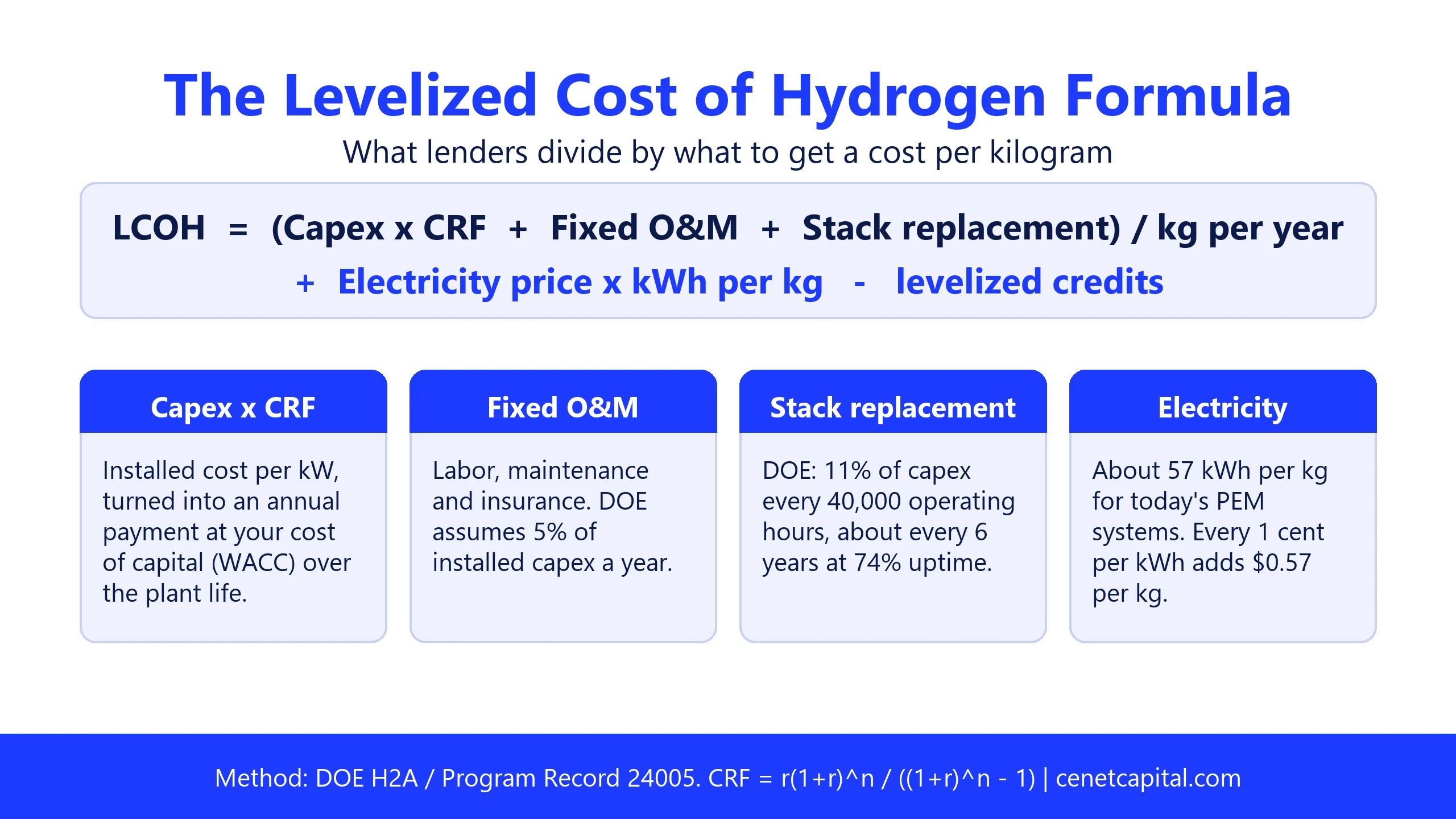
The capital recovery factor is CRF = r(1+r)^n / ((1+r)^n − 1), where r is the weighted average cost of capital and n is the plant life in years. At a 10% WACC over 30 years, CRF is 0.1061. In other words, every $1,000 of capex costs about $106 a year.
Annual output per kW of electrolyzer is 8,760 hours times the capacity factor, divided by kWh per kilogram. At 74% uptime and 57 kWh per kg, each kW makes about 113.7 kg a year. That denominator is why capacity factor matters so much: idle hours still carry the capital cost.
Full models add income tax, depreciation, water, compression and working capital. DOE Program Record 24005 used a nominal WACC of about 10%, 30-year life, fixed O&M of 5% of installed capex a year and stack replacements costing 11% of capex every 40,000 operating hours.
How do you calculate LCOH step by step?
Take DOE’s wind and solar hybrid case: $2,000 per kW, 74% capacity factor, 3.3 cents per kWh and 57 kWh per kg. Capital adds $1.87 per kg, electricity $1.88, fixed O&M $0.88 and stack replacement $0.23. The simplified LCOH is $4.86 per kg, against $5.20 in DOE’s full H2A model.
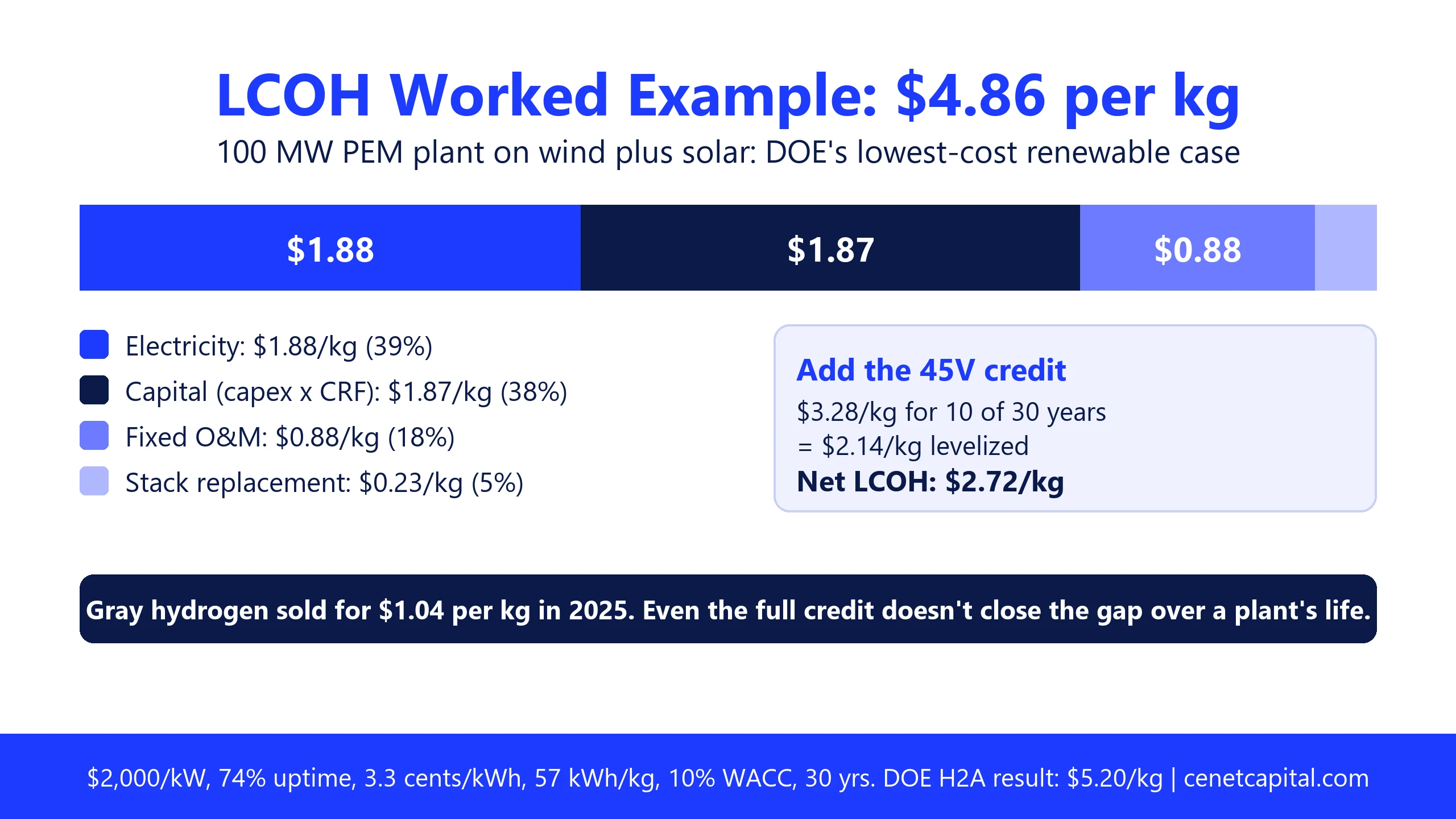
Output: 8,760 × 0.74 ÷ 57 = 113.7 kg per kW per year. A 100 MW plant makes about 11,370 tonnes.
Capital: $2,000 × 0.1061 ÷ 113.7 = $1.87 per kg.
Fixed O&M: 5% × $2,000 ÷ 113.7 = $0.88 per kg.
Stack replacement: 11% of capex roughly every 6.2 years, discounted and annualized = $0.23 per kg.
Electricity: 57 kWh × $0.033 = $1.88 per kg.
The $0.34 gap to DOE’s $5.20 comes mostly from income taxes and depreciation, which the full model includes. DOE’s grid-average case, at 97% uptime and 8.3 cents per kWh, comes out at $7.50. Our simplified version gives $7.08. Try the inputs for your own project below.
Calculate your levelized cost of hydrogen
Starts from DOE's wind-plus-solar PEM case. Move any input to see what drives your cost per kilogram.A simplified model, not investment or tax advice. It leaves out income taxes, depreciation, water and compression, so it runs slightly below DOE's H2A results. Fixed O&M is 5% of capex a year; stacks cost 11% of capex every 40,000 hours.
Value my 45V stream →Which inputs move LCOH the most?
Electricity price, capacity factor and capex, in that order for most projects. Each 1 cent per kWh adds about $0.57 per kg. Dropping from 74% to 50% uptime raises LCOH from $4.86 to $6.15. Cutting capex from $2,000 to $1,000 per kW lowers it to $3.37.
Power price: at 2 cents per kWh, LCOH is $4.12. At 5 cents, it’s $5.83.
Capacity factor: at 30% uptime, typical of solar alone, LCOH climbs to $8.77. At 97%, it falls to $4.23, but round-the-clock clean power is hard to find.
Capex: the IEA’s Global Hydrogen Review 2025 put installed cost outside China at $2,000 to $2,600 per kW in 2024, and $600 to $1,200 in China. At $800 per kW, LCOH drops to $3.07.
Cost of capital: a 7% WACC gives $4.42. At 12%, it’s $5.17. Contracted offtake and credit monetization lower WACC more than most engineering changes do.
These inputs pull against each other. Cheap solar power usually means low uptime, and high uptime usually means grid power that fails the emissions test. Under the 45V rules, clean power has to be matched with energy attribute certificates to reach the top tier, which adds cost.
How does the 45V credit change LCOH?
At the top tier, 45V pays $3.28 per kg in 2026, but only for the first 10 years. Spread across a 30-year life at a 10% discount rate, it’s worth about $2.14 per kg, or 65% of the headline rate. That takes DOE’s $4.86 example down to a net LCOH of about $2.72.
The rate comes from IRS Notice 2026-41, which set the inflation-adjusted base at $0.656 per kg. The emissions tier sets the share, and meeting prevailing wage and apprenticeship rules multiplies it by five. The 10-year window comes from 26 U.S.C. 45V, which also requires construction to begin before January 1, 2028.
Levelizing the credit is the step most quick estimates skip. Subtracting $3.28 from $4.86 makes a project look as if it produces hydrogen for $1.58 for its whole life. It doesn’t. After year 10, the plant has to earn its full cost from the market.
How you monetize the credit matters too. Sold at 90 cents per dollar, the $2.14 becomes about $1.93. Our 45V tax credit calculator estimates the annual credit, and our guide to monetizing 45V covers transfer and direct pay.
What LCOH do lenders and tax equity investors want to see?
They want an LCOH comfortably below a contracted offtake price, tested on conservative uptime and power cost assumptions. They also want proof the credit is real: a qualifying emissions rate, prevailing wage records and a plan to sell or claim the credit. A model that works only at its P50 case rarely closes.
Debt sizing usually runs off downside cases, such as lower capacity factor, higher power prices or slower stack performance. Investors in the credit also test the 45V tier itself. A project that slips from the top tier to the 0.45 to 1.5 kg tier loses about two-thirds of its credit. Our 45VH2-GREET guide covers how that rate is set.
Credit monetization is often the bridge between LCOH and offtake price. Developers use tax equity or transfer sales, and sometimes a bridge loan against expected credits, to fund construction. Our comparison of tax equity and transferability explains which fits which sponsor.
How is LCOH different from LCOE?
LCOE measures the cost of a megawatt-hour of electricity, and LCOH measures the cost of a kilogram of hydrogen. For an electrolyzer, LCOE is an input to LCOH: the power plant’s cost per MWh, times about 0.057 MWh per kg, becomes the largest line in the hydrogen cost.
That’s why the cheapest hydrogen projects sit on the cheapest clean power. The European Hydrogen Observatory publishes a public LCOH calculator for alkaline and PEM electrolysis in Europe. For U.S. projects, include the 45V credit, delivery costs and how the credit is monetized in any LCOH you show a lender.
Sources
U.S. Department of Energy, Hydrogen Program Record 24005: Clean Hydrogen Production Cost Scenarios with PEM Electrolyzer Technology
Internal Revenue Service, Internal Revenue Bulletin 2026-29, Notice 2026-41
Legal Information Institute, 26 U.S. Code 45V, Credit for production of clean hydrogen
International Energy Agency, Global Hydrogen Review 2025: Executive summary
European Hydrogen Observatory, Levelised Cost of Hydrogen Calculator
Center for Sustainable Systems, University of Michigan, Hydrogen Factsheet, Pub. No. CSS23-07 (August 2026)
Frequently Asked Questions
What is the levelized cost of hydrogen?
It's the average cost to produce one kilogram of hydrogen over a plant's whole life, including the return investors need on their capital. It spreads capital, operating, replacement and electricity costs across every kilogram the plant will make, so it can be compared directly with an offtake price.
How do you calculate LCOH?
What is a good LCOH for green hydrogen?
Does the 45V credit lower LCOH by $3 per kg?
Can Cenet Capital help finance a hydrogen project's 45V credits?
Turn your 45V credit into a lower LCOH
Cenet Capital prices and sells 45V clean hydrogen credits for producers, and helps sponsors show lenders a credit value they can underwrite. Tell us your plant size, emissions tier and start date.

More Insights