
Market Data & Tools
Hydrogen price per kg in 2026: gray at $1.04, green at $5 to $7 before credits, $35 at the pump, and how much the $3.28/kg 45V credit really cuts.
Author -
Paulestini Francois
Published -
READ TIME
The hydrogen price per kg ranges from about $1 to more than $35, depending on how the hydrogen is made and where you buy it. For anyone planning a clean hydrogen project, the useful number is what green hydrogen costs after the 45V tax credit, and how long that credit lasts. Here are the 2026 numbers from DOE, the IRS and the IEA, with a calculator for your own plant.
QUICK ANSWER
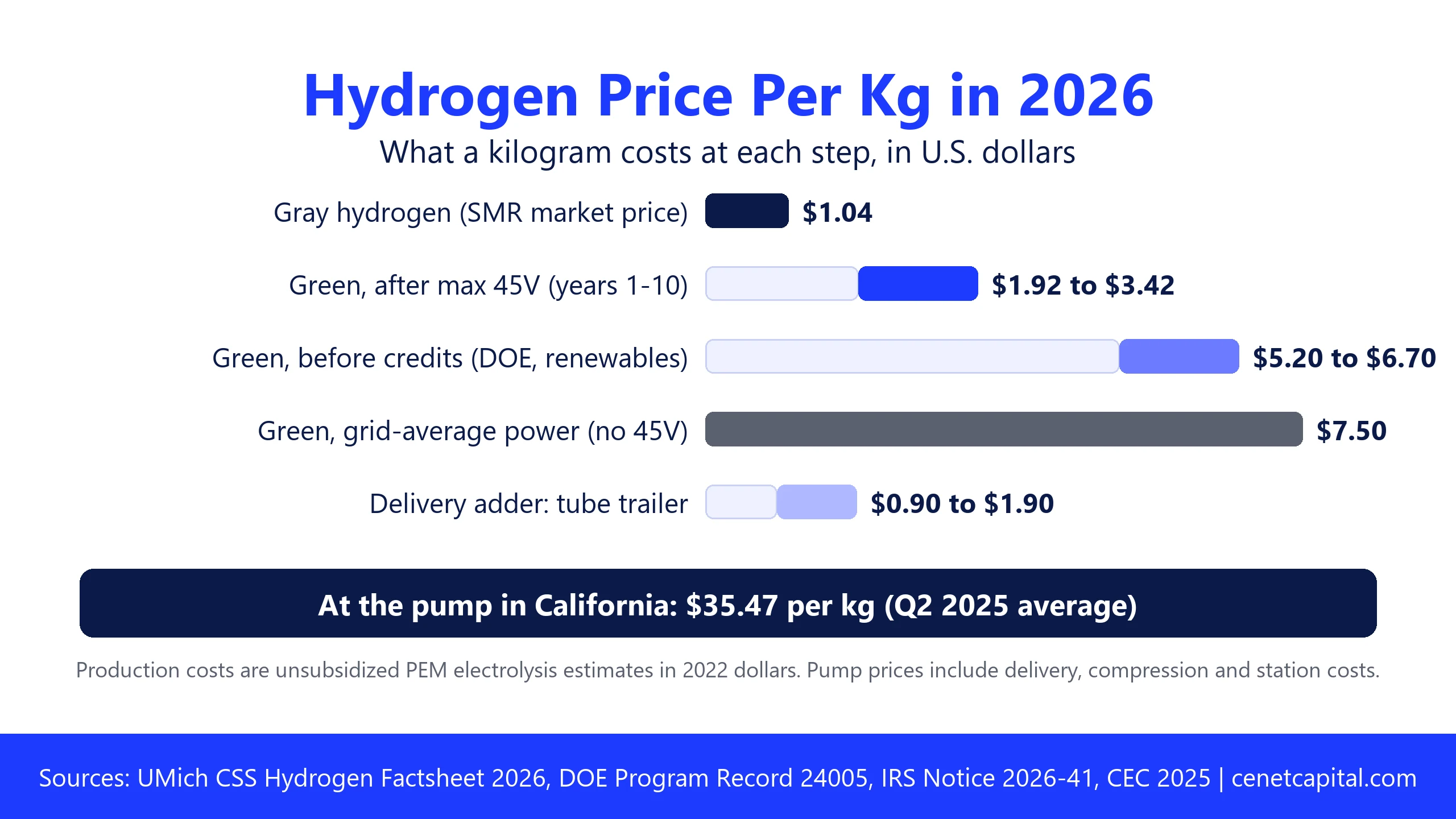
Gray hydrogen sold for about $1.04 per kg in the U.S. in 2025. Green hydrogen costs about $5 to $7 per kg to produce before credits, and California drivers paid $35.47 per kg at the pump in mid-2025. The 45V credit can cut up to $3.28 per kg in 2026, for 10 years.
KEY FACTS
What is the hydrogen cost per kg from natural gas? About $1.04 per kg in the U.S. in 2025, the market price for steam methane reforming.
What is the green hydrogen cost before credits? About $5 to $7 per kg for PEM electrolysis on renewable power, per DOE, in 2022 dollars.
How much is the 45V credit in 2026? $0.656 per kg base, or up to $3.28 per kg with prevailing wage and apprenticeship, at the top emissions tier.
What drives the hydrogen production cost most? Electricity. A PEM system uses about 57 kWh per kg, so each 1 cent per kWh adds about $0.57 per kg.
What is the electrolyzer cost in 2024? $2,000 to $2,600 per kW installed outside China, and $600 to $1,200 in China, per the IEA.
How much does delivery add? Pipeline $0.20 to $0.50, tube trailer $0.90 to $1.90, and liquid tanker $2.70 to $3.20 per kg.
How much does hydrogen cost per kg in 2026?
It depends on how it’s made and where you buy it. Gray hydrogen from natural gas sold for about $1.04 per kg in the U.S. in 2025. Green hydrogen from new electrolyzers costs about $5 to $7 per kg to produce before credits. At a California fuel pump, drivers paid an average of $35.47 per kg in mid-2025.
Those three numbers measure different things. The first two are production costs at the plant gate. The pump price includes delivery, compression, storage, the station and its margin. When people search for the hydrogen price per kg, they usually mean one of the three without saying which.
The gray figure comes from the University of Michigan’s 2026 Hydrogen Factsheet, which puts steam methane reforming (SMR) at a market price of $1.04 per kg in 2025, with a wider cost range of $0.90 to $4.40 depending on gas prices and plant size. SMR made 70.6% of U.S. hydrogen. The same factsheet puts green hydrogen at $4.33 to $6.05 per kg in 2024.
What is the cost of green hydrogen per kg before credits?
DOE’s most recent estimate is $5 to $7 per kg for a PEM electrolyzer running on renewable power, in 2022 dollars and without subsidies. The best case, a wind and solar hybrid at 74% uptime and 3.3 cents per kWh, came out at $5.20. A plant on average grid power costs about $7.50.
Those numbers come from DOE Hydrogen Program Record 24005. It assumes an installed electrolyzer cost of about $2,000 per kW and a system that uses about 57 kWh of electricity per kilogram. That second figure is the one to remember: every 1 cent per kWh on your power price adds about $0.57 to each kilogram.
Equipment is the other big driver. The IEA’s Global Hydrogen Review 2025 found that building an electrolyzer outside China cost $2,000 to $2,600 per kW in 2024, against $600 to $1,200 per kW in China. Our guide to the levelized cost of hydrogen shows how those inputs turn into a cost per kilogram.
Grid power is cheap to run on but rarely clean enough. The factsheet puts electrolysis on today’s U.S. grid mix at 20 to 25 kg of CO2 per kg of hydrogen, five times the 45V limit. That’s why green hydrogen doesn’t automatically qualify for the credit.
How much does the 45V credit cut the cost of green hydrogen?
Up to $3.28 per kg in 2026, for 10 years. That’s the top tier, for hydrogen with lifecycle emissions under 0.45 kg of CO2e per kg, at a project that meets prevailing wage and apprenticeship rules. Lower tiers pay $0.655 to $1.095 per kg. Above 4 kg, there’s no credit at all.
The statute in 26 U.S.C. 45V sets a $0.60 base, adjusted for inflation. IRS Notice 2026-41 set the 2026 inflation factor at 1.0929, which makes the base $0.656 per kg. The emissions tier sets the share you get: 20%, 25%, 33.4% or 100%. Meeting prevailing wage and apprenticeship requirements multiplies it by five.
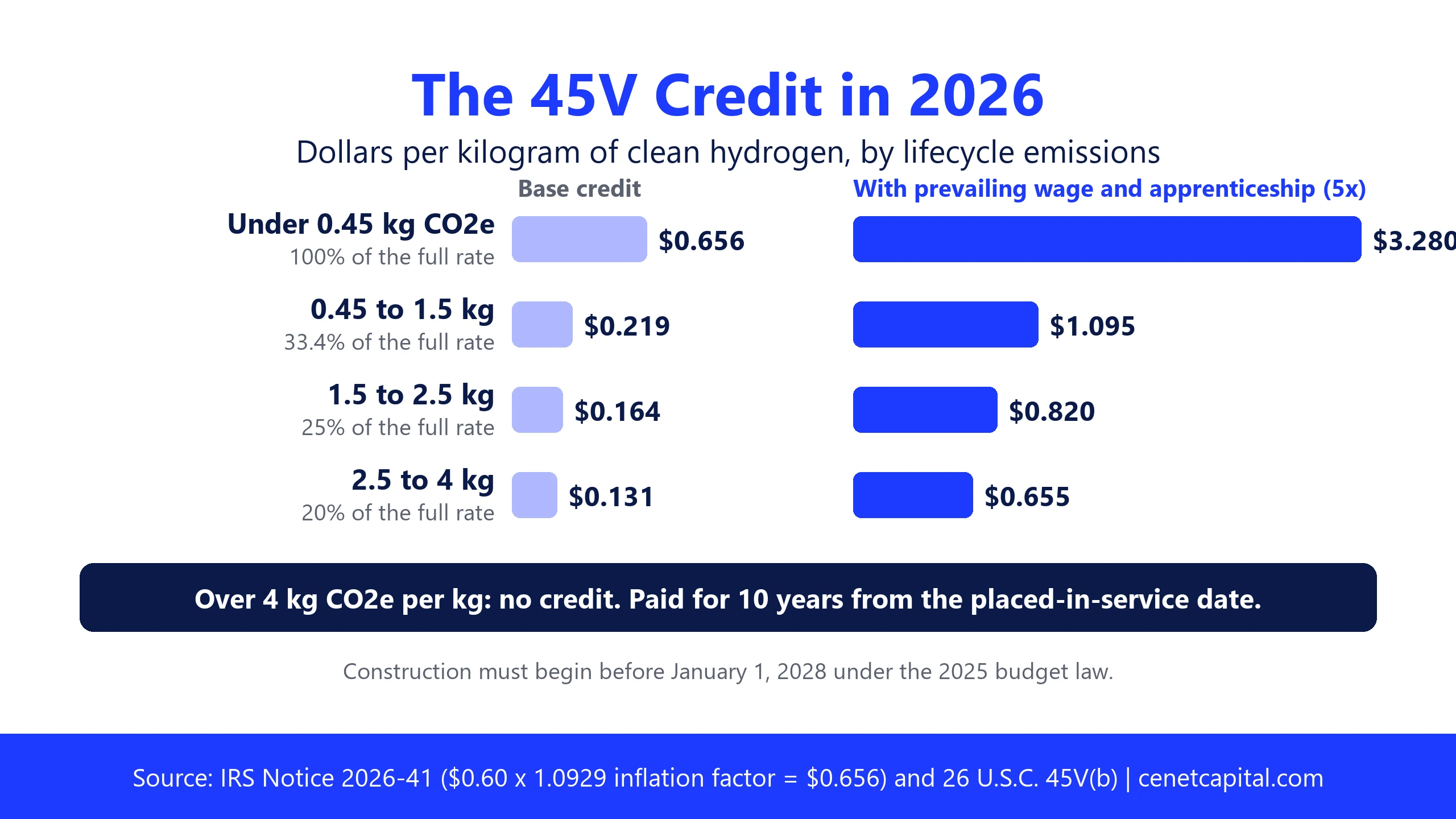
Two limits matter for cost. The credit runs for 10 years from the date the facility is placed in service, but an electrolyzer can run for 30. And under the 2025 budget law, construction must begin before January 1, 2028. Our 45V tax credit calculator estimates the annual credit for a specific plant.
Take DOE’s $5.20 hybrid case. With the full $3.28 credit, the cash cost falls to about $1.92 per kg during the credit years. Spread over a 30-year life at a 10% discount rate, the credit is worth about $2.14 per kg, so the lifetime cost lands near $3.06. Try your own numbers in the calculator below.
What does your hydrogen cost after 45V?
Pick a power source and emissions tier. Uses the 2026 credit rates and DOE's PEM electrolysis cost scenarios.At the plant gate, this hydrogen still costs $0.88/kg more than gray hydrogen while the credit lasts.
A general guide, not tax advice. Production costs are DOE's 2022-dollar estimates for PEM electrolysis. The levelized view assumes a 10% discount rate. Delivery adders are midpoints of published ranges.
Price my 45V credits →Is green hydrogen cheaper than gray hydrogen after 45V?
Only during the credit years, and only at the top tier. At $5.20 per kg before credits, a full $3.28 credit leaves green hydrogen about $0.88 per kg above gray hydrogen’s $1.04. Lower power prices close the rest. Over a full plant life, gray hydrogen still wins in the U.S., where natural gas is cheap.
The IEA reached the same conclusion. It says the cost gap with unabated fossil hydrogen is larger in regions with cheap gas, such as the U.S., where carbon capture “is likely to be more competitive for producing low-emissions hydrogen in the near term.” That’s the case for blue hydrogen and 45V. Some blue projects compare 45V against the 45Q carbon capture credit instead, since a facility can’t claim both.
For a green project, the realistic path to gray parity combines the top tier, cheap clean power, high uptime and the full credit. Hitting the top tier usually requires qualifying energy attribute certificates and a 45VH2-GREET result under 0.45 kg.
Why is hydrogen fuel $35 per kg at the pump?
Because production is a small part of the pump price. Hydrogen has to be compressed, trucked, stored and dispensed at stations that sell small volumes. California’s energy commission reported an average of $35.47 per kg in the second quarter of 2025, about the same as paying $14.40 for a gallon of gasoline.
The CEC and CARB joint assessment says prices jumped in the third quarter of 2023 and have stayed there. Station developers cited rising energy costs for natural gas and electricity, plus supply problems. Since fuel cell cars are about 2.5 times as efficient as gasoline cars, $36 per kg works out to roughly $14.40 per gallon equivalent, or up to $180 to fill an empty tank.
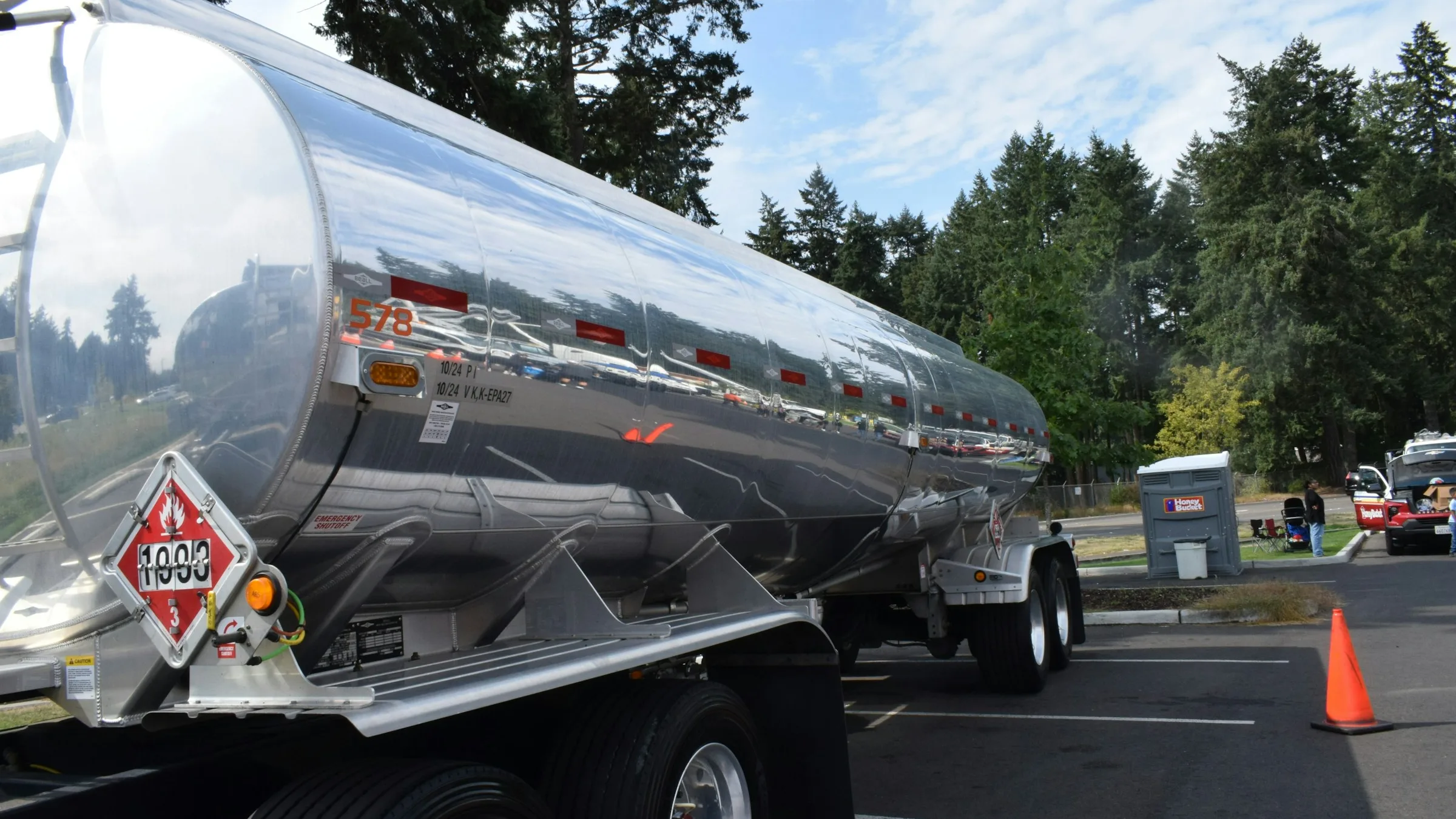
Delivery alone can double the production cost. The Michigan factsheet puts pipeline transport at $0.20 to $0.50 per kg, tube trailers at $0.90 to $1.90, and liquid tankers at $2.70 to $3.20, because liquefying hydrogen takes so much energy. That’s why most U.S. hydrogen is made at or near the plant that uses it.
What will hydrogen cost by 2030?
Less, but not as fast as forecasters once hoped. BloombergNEF put green hydrogen at $3.74 to $11.70 per kg in late 2024 and expects $1.60 to $5.09 by 2050. DOE’s Hydrogen Shot targets $2 per kg by 2026 and $1 per kg by 2031, though current costs are still well above that.
BNEF more than tripled its 2050 cost estimate, citing higher electrolyzer costs, pv magazine reported. It expects only China and India to reach gray-hydrogen parity, around 2040. The DOE targets are on its PEM electrolysis technical targets page.
Cheaper equipment is the wild card. The IEA’s October 2026 commentary on Chinese electrolysers estimates Chinese alkaline systems at $500 to $1,100 per kW in 2025, against $1,900 to $2,500 per kW elsewhere. Our FEOC rules guide covers the sourcing questions buyers now ask. For U.S. developers, the 2028 construction deadline matters more than 2030 forecasts. A project that misses it loses the credit that makes the math work. Our hydrogen hubs update shows which projects are still moving.
How do developers turn 45V into a lower hydrogen price?
By turning the credit into cash early. Most developers sell 45V credits to corporate tax buyers under the transfer rules, or take direct pay for the first five years. The cash lowers the price they can offer offtakers, and it supports project financing. Each credit has to be verified and priced before it’s sold.
Under section 6417, a taxable 45V producer can elect direct pay for five years. After that, or instead, it can sell the credit. Production tax credits averaged about 93 cents per dollar in Crux’s mid-2026 market data. Hydrogen credits carry emissions-rate risk, so buyers expect more diligence. Our guides to monetizing 45V and elective pay cover both routes.
Sources
Center for Sustainable Systems, University of Michigan, Hydrogen Factsheet, Pub. No. CSS23-07 (August 2026)
U.S. Department of Energy, Hydrogen Program Record 24005: Clean Hydrogen Production Cost Scenarios with PEM Electrolyzer Technology
Internal Revenue Service, Internal Revenue Bulletin 2026-29, Notice 2026-41
Legal Information Institute, 26 U.S. Code 45V, Credit for production of clean hydrogen and 26 U.S. Code 6417
California Energy Commission and California Air Resources Board, Joint Agency Staff Report on Assembly Bill 126, 2025 Annual Assessment
International Energy Agency, Global Hydrogen Review 2025: Executive summary and What explains the cost advantage of Chinese electrolysers?
U.S. Department of Energy, Technical Targets for Proton Exchange Membrane Electrolysis
pv magazine, The Hydrogen Stream: BNEF forecasts sharper green H2 price drop by 2050
pv magazine USA, Clean energy capital expenditures on track for $180 billion in 2026, reports Crux
Frequently Asked Questions
What is the hydrogen price per kg in 2026?
It depends on the source. Gray hydrogen from natural gas sold for about $1.04 per kg in 2025. Green hydrogen costs about $5 to $7 per kg to produce before tax credits. California drivers paid an average of $35.47 per kg at the pump in the second quarter of 2025, because delivery and station costs dominate the retail price.
What is the cost of green hydrogen after the 45V credit?
Why is hydrogen so expensive at the pump?
Will green hydrogen get cheaper than gray hydrogen?
How can Cenet Capital help lower my hydrogen cost?
Make the 45V credit lower your hydrogen price
Cenet Capital helps hydrogen producers sell 45V credits to corporate tax buyers, so the credit turns into cash that lowers the price you can offer offtakers. Tell us your expected output and emissions tier.

More Insights