
Credit Guides
The colors of hydrogen explained: green, blue, grey, pink, turquoise, yellow, brown and white. How each is made, its emissions, and which can earn the 45V PTC.
Author -
Paulestini Francois
Published -
READ TIME
Green, blue, grey, pink, turquoise: the colors of hydrogen are everywhere in energy news, and they shape how investors talk about a project. But the federal tax credit that decides whether many projects get built doesn't care about color at all. Here's what each color means, how much each one emits, and which can actually earn the 45V credit.
QUICK ANSWER
The colors of hydrogen are labels for how it's made: grey from natural gas, blue from gas with carbon capture, green from renewable electrolysis, pink from nuclear, turquoise from methane pyrolysis, yellow from grid power, brown or black from coal, and white from natural deposits. The 45V tax credit ignores color and pays on lifecycle emissions.
KEY FACTS
What are the main hydrogen colors? Grey, blue, green, pink, turquoise, yellow, brown or black, and white. Each names a feedstock and energy source, not a property of the gas.
Which types of hydrogen are most common? Grey hydrogen. Almost 100 million tonnes were used worldwide in 2024, and low-emissions hydrogen was under 1% of production.
How dirty is grey hydrogen? The IEA puts grey hydrogen from unabated natural gas at 10 to 14 kg of CO2-equivalent per kg of hydrogen.
What is turquoise hydrogen? Hydrogen from methane pyrolysis, which splits natural gas into hydrogen and solid carbon instead of releasing CO2.
What are pink hydrogen and white hydrogen? Pink hydrogen is made by electrolysis on nuclear power. White hydrogen occurs naturally underground and is drilled, not manufactured.
Can brown hydrogen earn the 45V PTC? No. Unabated coal gasification emits far more than the 4 kg CO2e per kg ceiling for the 45V tax credit.
What are the colors of hydrogen?
The colors of hydrogen are informal labels for how hydrogen is made. Grey comes from natural gas, blue from natural gas with carbon capture, green from renewable-powered electrolysis, pink from nuclear power, turquoise from methane pyrolysis, yellow from grid power, brown or black from coal, and white from natural underground deposits.
Hydrogen itself is colorless. The colors are shorthand that the industry and the press adopted to signal the feedstock and the climate impact of each production route. No law or regulator defines them, and they aren’t used consistently: “yellow” means solar-powered electrolysis in some reports and grid-powered electrolysis in others. The U.S. Energy Information Administration notes that the Department of Energy supports source-neutral production pathways and doesn’t use the color code.
Grey hydrogen still dominates. The IEA’s Global Hydrogen Review 2025 puts global demand at almost 100 million tonnes in 2024, with low-emissions hydrogen at less than 1% of production. In the United States, about 10 million metric tons are made each year, and the DOE says 95% comes from natural gas reforming.
How is each color of hydrogen made?
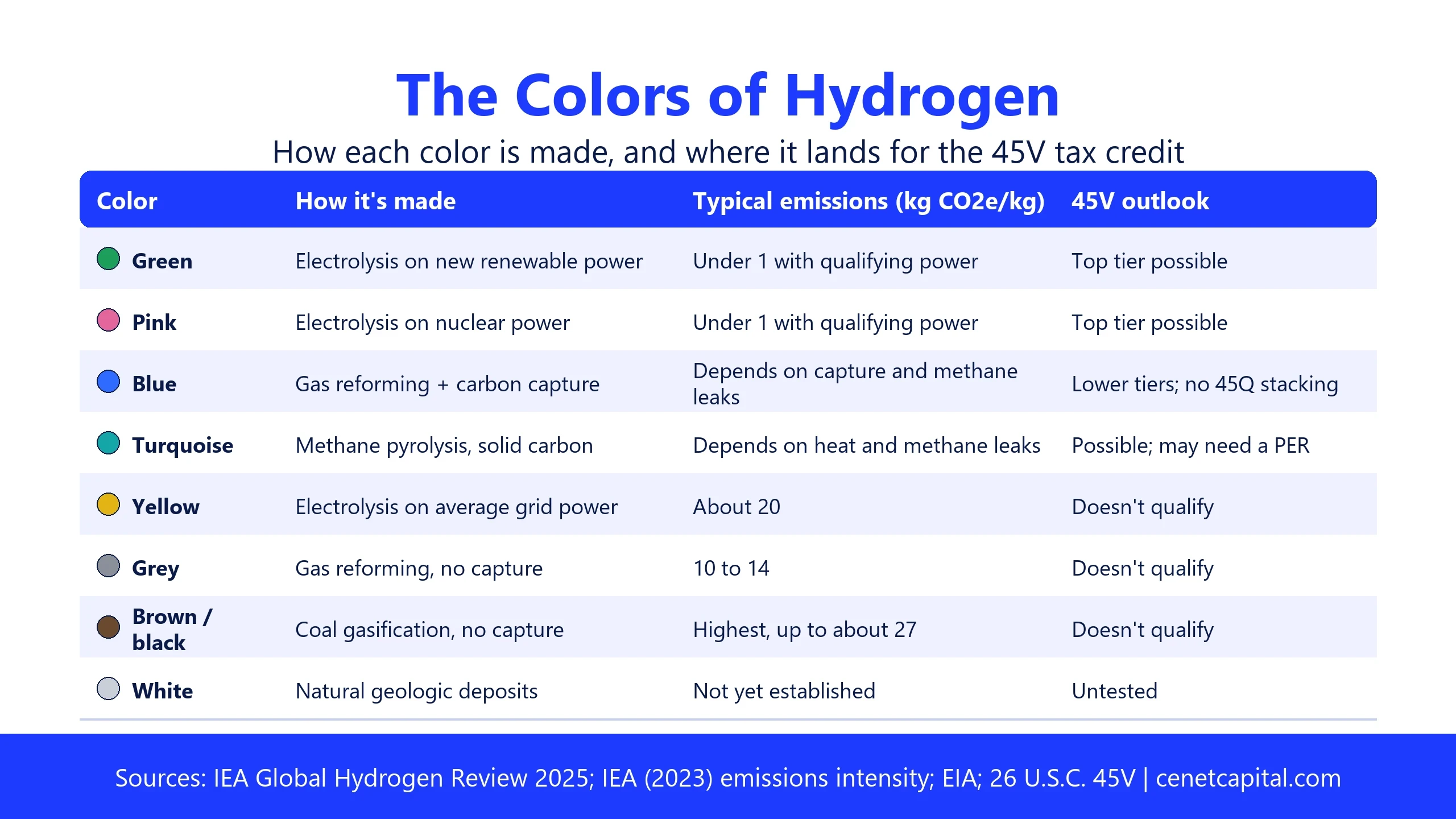
Each color maps to a feedstock and an energy source. Fossil colors split hydrogen from natural gas or coal. Electrolysis colors split water with electricity, and the power source sets the color. White hydrogen isn’t manufactured at all. It’s drilled from rock formations where it forms naturally.
Grey: steam methane reforming (SMR) of natural gas, venting the CO2. It’s the cheapest route today and the one most refineries and ammonia plants use.
Blue: the same reforming process, or autothermal reforming, with carbon capture and storage. Our blue hydrogen tax credit guide covers the capture math.
Green: electrolysis powered by wind, solar or other renewables. See our green hydrogen guide.
Pink: electrolysis powered by nuclear electricity, sometimes using reactor heat. Our nuclear hydrogen guide explains the rules.
Turquoise: methane pyrolysis, which heats natural gas until it splits into hydrogen and solid carbon instead of CO2 gas.
Yellow: electrolysis on mixed grid power (or, in some usage, solar).
Brown or black: gasification of lignite (brown) or bituminous coal (black).
White, natural or gold: naturally occurring geologic hydrogen. Some use “gold” for hydrogen that microbes release in depleted oil fields.
The electrolysis colors all rely on the same equipment. Our guide to the hydrogen electrolyzer explains how alkaline, PEM and solid oxide machines differ.
How much CO2 does each color of hydrogen emit?
Grey hydrogen from unabated natural gas emits 10 to 14 kg of CO2-equivalent per kg of hydrogen, according to the IEA, and unabated fossil routes can reach 27 kg. Electrolysis on clean power can fall below 1 kg. Blue and turquoise sit in between, depending on capture rates and methane leaks.
The IEA’s report on hydrogen definitions based on emissions intensity found that upstream and midstream emissions, mainly methane leaking from gas production, account for 1 to 5 kg of the grey hydrogen total. That’s why two blue hydrogen plants with the same capture rate can have very different footprints.
Electricity source matters just as much for the “clean” colors. An electrolyzer uses roughly 55 kWh per kg of hydrogen. At the 2023 U.S. average grid intensity of about 0.37 kg CO2 per kWh reported by the EIA, yellow hydrogen made on grid power comes out near 20 kg CO2e per kg, worse than grey.
Does the color of hydrogen matter for the 45V tax credit?
No. The 45V clean hydrogen production tax credit (PTC) never mentions colors. It pays on the lifecycle emissions rate of the process, measured well to gate. Hydrogen at or below 4 kg of CO2e per kg qualifies, and lower emissions earn a higher tier, whatever the feedstock.
Section 45V defines qualified clean hydrogen as hydrogen “produced through a process that results in a lifecycle greenhouse gas emissions rate of not greater than 4 kilograms of CO2e per kilogram of hydrogen.” Producers calculate that rate with the Treasury’s 45VH2-GREET model, and the credit is technology-neutral. This is the biggest myth about 45V: a “green” label doesn’t guarantee the credit, and a “blue” label doesn’t rule it out.
In 2026, the credit’s base rate is $0.656 per kg under Notice 2026-41. Projects that meet prevailing wage and apprenticeship rules earn five times that, up to $3.28 per kg, for 10 years. Facilities must begin construction before January 1, 2028. Our 45V tax credit guide covers every requirement.
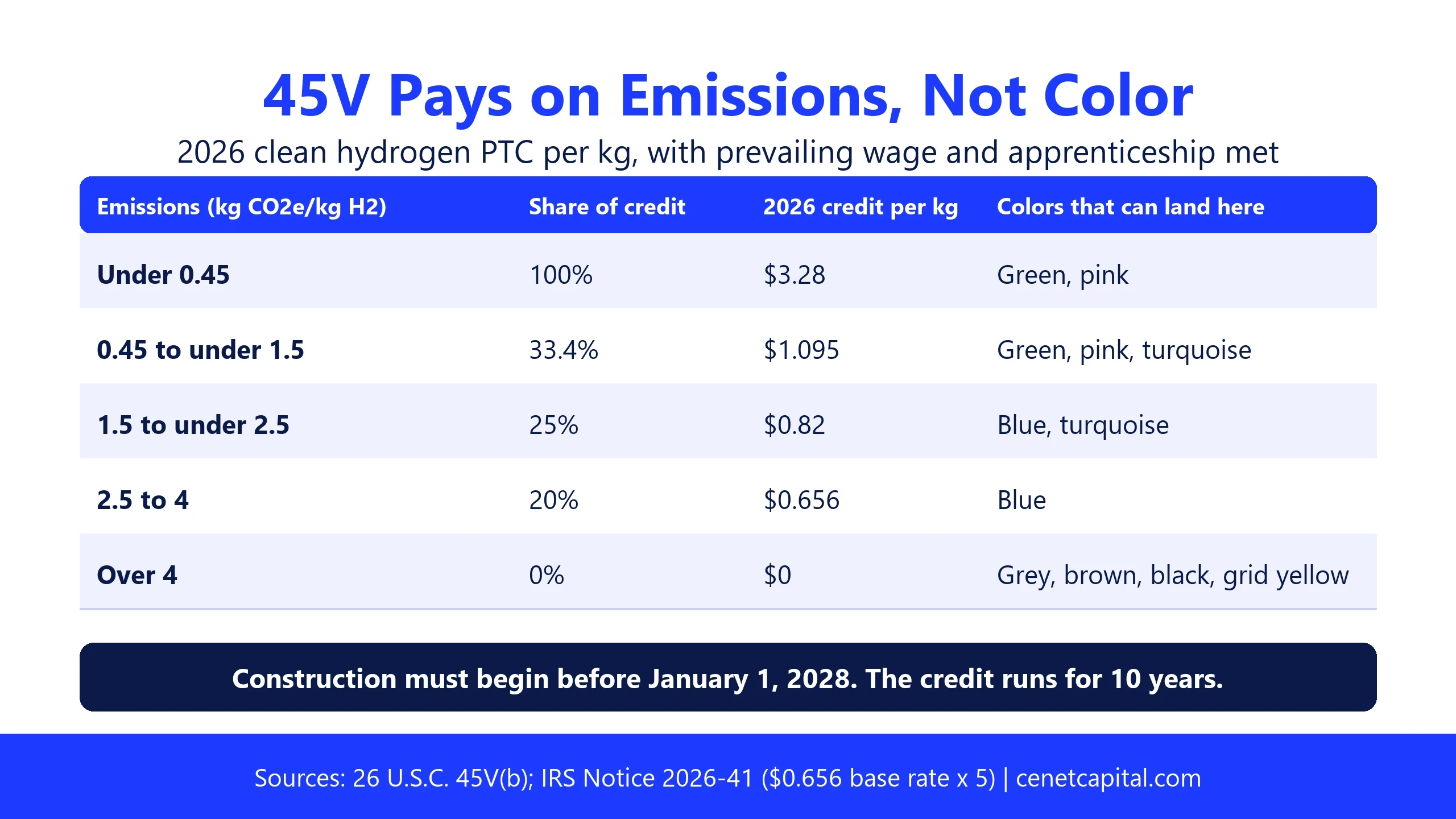
Which hydrogen colors qualify for the 45V tax credit?
Green and pink hydrogen can reach the top 45V tier if the power meets the three pillars. Blue and turquoise can earn the lower tiers with high capture and low methane leakage. Grey, brown, black and grid-powered yellow hydrogen don’t qualify. White hydrogen’s eligibility hasn’t been tested.
Electrolysis colors only get credit for clean power they can prove. That means energy attribute certificates that meet the three pillars: new clean generation, located in the same region, and matched to hydrogen production by the hour starting in 2030. A green project that slips on hourly matching can end up being taxed as grid power. Nuclear facilities face extra limits on existing reactors.
Blue hydrogen faces a stacking rule. Under section 45V(d)(2), no 45V credit is allowed at a facility whose carbon capture equipment received the 45Q credit. Producers pick one, usually by comparing the 45V tier they can reach with 45Q’s per-ton value. Turquoise producers may not find a ready-made pathway in 45VH2-GREET and would need to request a provisional emissions rate from the IRS. Try the checker below to see how a color and an emissions rate translate into a 45V tier and a dollar value.
Does your hydrogen color qualify for 45V?
Pick a color to load a typical emissions rate, then slide it to your own 45VH2-GREET result. 2026 credit values, prevailing wage and apprenticeship met.Upstream methane leakage and the capture rate decide the tier. You can't claim 45V at a facility whose capture equipment received 45Q.
Illustrative starting rates, not tax advice. 45V uses your facility's own 45VH2-GREET result, and construction must begin before January 1, 2028.
Price my 45V credit →Can white or natural hydrogen get the 45V credit?
It’s unclear. 45V pays for hydrogen “produced through a process” at a qualified facility, and the final regulations don’t provide a pathway for hydrogen extracted from underground deposits. Until Treasury or the IRS addresses natural hydrogen directly, developers shouldn’t count on 45V in their financing models.
Interest in white hydrogen is real. In January 2025, the U.S. Geological Survey published its first map of potential geologic hydrogen in the lower 48 states, flagging a midcontinent belt that includes Kansas, Iowa, Minnesota and Michigan. The USGS also cautions that much of the resource may be too deep, too far offshore or too small to recover economically.
Stimulated geologic hydrogen, made by injecting water into iron-rich rock to trigger the reaction underground, has a stronger argument that it’s “produced.” But no guidance confirms it. Natural hydrogen also needs to be measured from well to gate like any other pathway, including drilling, processing and any associated methane.
Which color of hydrogen is cheapest?
Grey hydrogen is the cheapest to make, at roughly $1 per kg from steam methane reforming in 2025. Green hydrogen from electrolysis costs several times more before tax credits. The full 45V credit of $3.28 per kg can close much of that gap for producers who qualify for the top tier.
Our hydrogen price per kg guide breaks down production and delivered prices, and the levelized cost of hydrogen guide shows how capex, power price and utilization drive the cost of each route. The economics usually turn on one question: can the project hit a 45V tier and then turn that credit into cash?
Most hydrogen producers don’t have enough federal tax liability to use a credit worth tens of millions a year. They sell the 45V credit to a corporate buyer for cash, or take elective pay for the first five years.
Sources
Legal Information Institute, 26 U.S. Code 45V, Credit for production of clean hydrogen
International Energy Agency, Global Hydrogen Review 2025, Executive summary
International Energy Agency, Towards hydrogen definitions based on their emissions intensity
U.S. Department of Energy, Hydrogen Production: Natural Gas Reforming
U.S. Energy Information Administration, Production of hydrogen and How much carbon dioxide is produced per kilowatthour of U.S. electricity generation?
U.S. Geological Survey, USGS releases first-ever map of potential for geologic hydrogen in U.S.
Internal Revenue Service, Internal Revenue Bulletin 2026-29 (Notice 2026-41)
Frequently Asked Questions
What are the different colors of hydrogen?
The common colors are grey (natural gas, no capture), blue (natural gas with carbon capture), green (electrolysis on renewable power), pink (electrolysis on nuclear power), turquoise (methane pyrolysis), yellow (electrolysis on grid or solar power), brown or black (coal gasification) and white (naturally occurring geologic hydrogen). The labels are informal and not defined in law.
Which color of hydrogen is the cleanest?
Does blue hydrogen qualify for the 45V tax credit?
Is the 45V credit based on hydrogen color?
Can Cenet Capital help sell 45V credits from my hydrogen project?
Find out what your hydrogen is really worth
Cenet Capital helps hydrogen producers of every color price and sell 45V credits to corporate tax buyers. Tell us your production pathway, emissions rate and expected output.

More Insights